Search results for embed

Laura Agustin, author of Sex at the Margins: Migration, Labour Markets, and the Rescue Industry, asks us to be critical consumers of stories about sex trafficking, the moving of girls and women across national borders in order to force them into prostitution.  Without denying that sex trafficking occurs or suggesting that it is unproblematic, Agustin wants us to avoid completely erasing the possibility of women’s autonomy and self-determination.

About one news story on sex trafficking, she writes:

…[the] ‘undercover investigation’, one with live images, fails to prove its point about sex trafficking… reporters filmed men and women in a field, sometimes running, sometimes walking, sometimes talking together.

…I’m willing to believe that we’re looking at prostitution, maybe in an informal outdoor brothel. But what we’re shown cannot be called sex trafficking unless we hear from the women themselves whether they opted into this situation on any level at all. They aren’t in chains and no guns are pointed at them, although they might be coerced, frightened, loaded with debt or wishing they were anywhere else. But we don’t hear from them. I’m not blaming the reporters or police involved for not rushing up to ask them, but the fact is that their voices are absent.

There are lots of things we might find out about the fields near San Diego… [but] we don’t see evidence for the sex-trafficking story. Feeling titillated or disgusted ourselves does not prove anything about what we are looking at or about how the people actually involved felt.

Regarding a news clip, Agustin writes:

…a reporter dressed like a tourist strolls past women lined up on Singapore streets, commenting on their many nationalities and that ‘they seem to be doing it willingly’. But since he sees pimps everywhere he asks how we know whether they are victims of trafficking or not? His investigation consists of interviewing a single woman who… articulates clearly how her debt to travel turned out to be too big to pay off without selling sex. Then an embassy official says numbers of trafficked victims have gone up, without explaining what he means by ‘trafficked’ or how the embassy keeps track…

So here again, there could be bad stories, but we are shown no evidence of them. The women themselves, with the exception of one, are left in the background and treated like objects.

To recap, what Agustin is urging us to do is to refrain from excluding the possibility of women’s agency by definition. Why might a woman choose a dangerous, stigmatized, and likely unpleasant job? Well, many women enter prostitution “voluntarily” because of social structural conditions (e.g., they need to feed their children and prostitution is the most economically-rewarding work they can get). Assuming all women are forced by mean people, however, makes the social structural forces invisible. We don’t need mean pimps to force women into prostitution, our own social institutions do a pretty good job of it.

And, of course, we must also acknowledge the possibility that some women choose prostitution because they like the work. You might say, “Okay, fine, there may be some high-end prostitutions who like the work, but who could possibly like having sex with random guys for $20 in dirty bushes?” Well, if we decide that the fact that their job is shitty means that they are “coerced” in some way, we need to also ask about those people that “choose” other potentially shitty jobs like migrant farmwork, being a cashier, filing, working behind the counter at an airline (seriously, that must suck), factory work, and being a maid or janitor. There are lots of shitty jobs in the U.S. and world economy. Agustin simply wants us to give women involved in prostitution the same subject status as women and men doing other work.

Lisa Wade, PhD is an Associate Professor at Tulane University. She is the author of American Hookup, a book about college sexual culture; a textbook about gender; and a forthcoming introductory text: Terrible Magnificent Sociology. You can follow her on Twitter and Instagram.


Aaron B. sent in this 1947 video clip (found here), titled “Are You Popular?”:

Notice the caution to women: if you go “parking with all the boys,” you might think you’re popular, but you’ll ultimately find yourself ostracized and friendless. To be really popular, you need to be well-dressed, have the respect of girls at school, and carefully guard your reputation.

Thanks, Aaron!

Gwen Sharp is an associate professor of sociology at Nevada State College. You can follow her on Twitter at @gwensharpnv.

Tessa G.S. sent in a link to the online game Miss Bimbo. Here are some images from the game:

Tessa says,

In this case, you build a “bimbo” by placing your character on diets, getting plastic surgery, shopping for clothes, attending a-list parties, dating handsome men— all with the aim of becoming the most popular bimbo in the game…[According to the website] MissBimbo is an educational tool, a social meeting place and a hot pot of bimboism. It is free to enjoy bimboland.

An educational tool? Really?

According to CNN, parents have expressed concern that pre-teen girls are playing a game that encourages them to have their characters get breast implants and facelifts, as well as go on diets.

The game also reinforces the idea that girls are always rivals, whether competing for popularity or men (or the perfect wedding, as the movie “Bride Wars” shows).

While we’re on the topic of video games (sort of), Burk M. told me about Sexy Beach 3. In the game, you get to pick a female character, what she’s wearing, which of several beach-related activities she’s involved in (playing tag, “playful floating,” limbo, etc.), the location (beach, reef, waterfall, and so on) and the time of day. And then you can take the role of a disembodied hand that rubs various parts of her body while her nipples get hard and she moans in delight and eventually appears to orgasm. Here’s an example (Not Safe for Work):

more...


MissCegenation (see her take over at Reciprocal Crap Exchange), Miguel E. (of El Forastero), Breck C. (also of Reciprocal Crap Exchange), Rachel N., Laura M.D., and Z. (of It’s the Thought that Counts) all sent in links to Burger King’s “Whopper Virgins” viral video campaign (we’ve never had so many people send in the same thing; clearly it touched a nerve):

There are several interesting things going on here. One is the exoticization of the “whopper virgins.” The taste tests were conducted in Thailand, Romania, and Greenland. We’re clearly supposed to find it charmingly cute that they’re unfamiliar with hamburgers. They don’t even know how to eat them! We get to see people taking their “first bite of a hamburger,” and wonder at their unfamiliarity with how to pick one up and eat it. This short video about the Thailand taste tests illustrates this with the dramatic voiceover about people who have “never even seen a burger. Who don’t even have a word for burger.”

There’s also a certain level of ethnocentrism here; note the comment that these are people who “really live outside of things.” That all depends on what you mean by “things,” which here seems to be defined by exposure to TV and hamburgers. The implicit understanding, of course, is that these are people who live in a backward, “traditional” culture, which is fascinating to outsiders but, ultimately, very bizarre. However, I am sure that if asked these people would feel they live “inside of” many things, just not the things considered important to this marketing team.

You might also use this to talk about the pervasiveness of advertising. As the video makes clear, they went to Thailand, Romania, and Greenland in hopes of finding people who hadn’t been exposed to Burger King or McDonald’s advertising, since it would be “impossible” to find such people in the U.S.

I also think the documentary element to the video is fascinating. I’m assuming the teams did travel to these areas, and the video claims they are all “real people,” not actors (who are, apparently, imaginary). But I have a suspicion that some elements were staged. Of course the taste-tests were staged, but I notice that almost everyone in the videos is wearing “traditional” clothing. I might be wrong, but it doesn’t strike me as the type of clothing people would wear every day–they seem like pretty fancy clothes that you’d wear for special occasions, but maybe I’m wrong. If anybody knows more about how people in these areas usually dress, let me know. Of course, it’s entirely possible that people dressed up in their fancier clothes entirely on their own because they wanted to look nice when being filmed. But I wonder if they were encouraged to dress in clothing that would make them seem more exotic, rather than showing up in a t-shirt (which is, by now, fairly universal, though I’m certain there are still groups who have not adopted t-shirts).

The second half of the video, where the Burger Team goes to villages in each country and makes them Whoppers, is also interesting in the way it portrays the team as philanthropists giving these communities a unique cultural experience. I mean, I guess they are, and I don’t want to fall into the trap of romanticizing “traditional” groups and implying that they should be shielded from “modern” innovations because it would ruin their culture. And it doesn’t seem like the marketing team is really trying to build brand loyalty, since it’s unlikely they’re going to be opening stores in any of these areas (although they do make sure to wrap the burgers in Burger King wrappers). It does, on the other hand, make the video seem more like a documentary and less obviously like a commercial, which adds to its effectiveness as a viral ad. I dunno. Maybe this is just an example of a corporation doing something nice, and I can’t get over my general distrust of marketers.

Another interesting angle you might bring up in discussion is the spread of fast-food culture and standardized, relatively cheap production processes in general, often referred to as “McDonaldization.” There’s also an entire book on the subject of McDonald’s in Asia, called Golden Arches East: McDonald’s in East Asia (edited by James L. Watson). I sometimes assign the chapter “McDonald’s in Hong Kong: Consumerism, Dietary Change, and the Rise of a Children’s Culture” in my intro classes to talk about cultural change; it’s fascinating how McDonald’s is to some degree undermining parental authority by appealing directly to children and empowering them to demand their favorite meals.

Laura sent us a link to a story about criticism of the campaign, found here.

And just an aside here: What’s the difference between a “village” and a “small town”? The word village seems to bring up certain assumptions about both quaintness and backwardness (and cultural isolation). I grew up in a town of slightly less than 300 people. Nobody ever called it a village. Is it a village if you don’t have paved roads, and a small town if you do? I’m just askin’.

Thanks to everybody who sent the video in!

Bern K. and Megan P. sent us another example of androcentrism (see herehere, here, and here), one that is nicely combined with the representation of women as annoying naggers, and the social construction of diamonds as men’s best friend.  Bern writes:

It starts off with promise, showing that it’s ridiculous for a man to buy his wife a vacuum cleaner for their anniversary. It finishes, unfortunately, by suggesting that the only way to get out of the doghouse is to buy his wife diamonds.

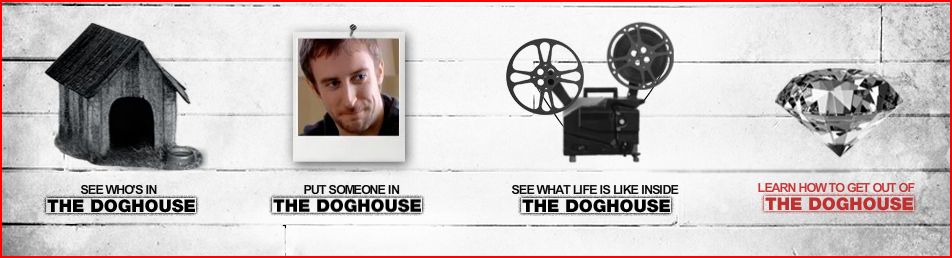
In the 5-minute commercial, men are punished by their wives for being insensitive or insulting by being sent to the “doghouse.”  In this five minute advertisement for JC Penney, men who have been sent to the doghouse are punished by being forced to do feminine tasks: fold laundry, eat quiche, and drink chai lattes.  There is some irony in that the main dude was sent to the doghouse for buying his wife a vacuum for their anniversary.  Apparently he wouldn’t want to be caught dead vacuuming… which is exactly why the gift might be considered insulting.  After all, when you give a woman a cleaning product for a gift, it means you think it’s HER JOB.

The video:

The website include the sound of a woman nagging and giving inconsistent orders (“speak less,” “talk more”).

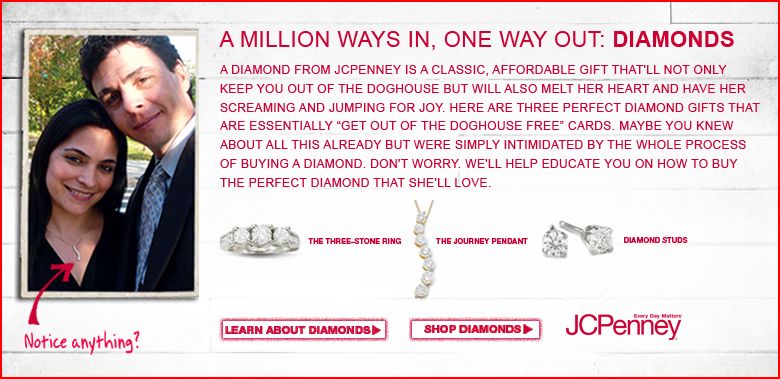
How to get out of the doghouse? Buy your wife diamonds (at JC Penney):

I like how it says that she’ll be “screaming and jumping for joy.”  Gah, women are so shallow and annoying.

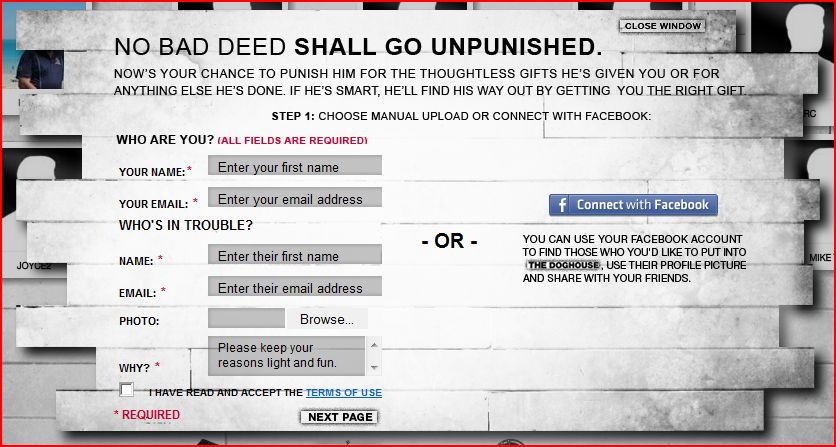
There’s more!  The website is interactive.  You can actually put people in the doghouse.  If you are on Facebook, you can upload someone’s profile picture and have it show up on the website.  A fascinating new way to merge advertising and social networking sites.

NEW (Jan. ’10)!  JC Penney apparently thought this campaign was so delightful that they updated it. Joel P. sent us the link. It’s really quite obnoxious (for all the reasons discussed above):

[youtube]https://www.youtube.com/watch?v=_U45oxUyiMc[/youtube]

Jezebel also has a nice analysis.

Lisa Wade, PhD is an Associate Professor at Tulane University. She is the author of American Hookup, a book about college sexual culture; a textbook about gender; and a forthcoming introductory text: Terrible Magnificent Sociology. You can follow her on Twitter and Instagram.

Sandra F. sent in a link to “Prop 8: The Musical,” a parody starring Jack Black, Margaret Cho, Andy Richter, John C. Reilly, Neil Patrick Harris, and other celebrities:

See more Jack Black videos at Funny or Die

The clip, though a parody, brings up a reason some groups that might not care about the reasons gays and lesbians want to get married, or about gay rights more broadly, nonetheless supported gay marriage: money. The New York Times discussed this issue here. Weddings are big business, and the more people who are eligible to be married, the more money is potentially available to wedding-related businesses. In 2004, the Congressional Budget Office estimated the impact legalizing same-sex marriage would have on the budget (end result: an estimated $1 billion a year for the 10-year estimation period). That’s just the federal budgetary effect; it doesn’t include private-sector benefits.

This anti-Prop 8 video makes an explicitly economic argument for gay marriage:

You might compare these videos to the commercials in this post; in those ads, advocates of gay marriage try to rhetorically frame the issue as being about love–that is, gay marriages are equated with straight marriages by focusing on the idea that what is important in a marriage is love, regardless of the sex of the spouses. Clearly you could use them to discuss gay marriage, but they might also be good for illustrating the idea of framing of social issues.

Thanks, Sandra!

Blanca and Stephanie brought this video, called “The Race Flag,” to my attention. In it, a referee penalizes African Americans who use “the race card” too eagerly (go here if the video doesn’t show up right):

See more funny videos at Funny or Die

It’s an interesting clip that plays on the idea of African Americans as over-sensitive, bitter whiners who see racial insult (or at least claim to) where none was intended. It might be useful for sparking a discussion about what we mean by “playing the race card.” For instance, what’s the difference between playing the race card…and pointing out actual incidents of discrimination? Obviously the difference, based on this video, is that playing the race card means the person is over-reacting and making ridiculous accusations. But “over-reacting” is a subjective term, and the idea of playing the race card assumes that there wasn’t any actual discrimination or prejudice. But most of the time we don’t have video cameras that can clearly catch everyone’s intentions and actions on tape for review. Concerns about playing the race card tend to ignore the very real fact that minorities often do face discrimination and prejudice (as well as backhanded compliments like “You’re so articulate!”) in the workplace. While I’m sure there are African American workers who make unwarranted accusations of racism (just as there are examples of almost any behavior you can think of), I’m also quite certain that there are employers and coworkers who engage in discriminatory actions but then deny any racist intent and accuse anyone who complains of playing the race card.

I’d also point out that Whites use the race card, too: I cannot tell you how many of my White students have told me that they did not get a job, into a particular college, etc., because they are White. Sometimes they say a manager/friend/etc. told them the company “had” to hire a minority “to meet quota.” Other times they’ve simply inferred, from the fact that they can see no other possible explanation for not getting said job/college acceptance letter/etc., that it must have been because they are White.

You might pair this with the chapter “‘Racing for Innocence’: Whiteness, Corporate Culture, and the Backlash against Affirmative Action,” by Jennifer L. Pierce, from White Out: The Continuing Significance of Racism (2003).

Apparently the same people who made that video made this one, which laughs at the idea of the Republican Party trying to woo African Americans (found here):

See more funny videos at Funny or Die

I’ll leave the commentary on that one to our readers, if they feel so inclined.

Thanks, Blanca and Stephanie!

Text:  “These guys these street gangs, settle their scores by singing and dancing together?  Doesn’t sound like anybody on the Westside I know.”

Text: “You want nice.  Go pick your mommy a flower.”

Text:  “Gentlemen, Check your skirts at the door.”

Text: “Today you’re using your girlfriend’s hair gel.  Tomorrow, your wife’s hairspray.  Where does it end my friend?  Where does it end?”

NEW (Mar. ’10)! Emma H. sent in this commercial, which ran during the 2010 Olympics, in which a man — shock and horror! — likes ice dancing:

More ads policing men’s behavior: sissies suck, how to do masculinity (hugging and sitting), “woman” as an insult, and boys can’t wear make-up at school.