
Coal Black and de Sebben Dwarfs (found here):
Search results for embed
In a comment to another post, Max S. pointed out this video of a question-and-answer session where, when asked about policy toward Iran, John McCain makes a joke about the Beach Boys having a song called “Bomb Iran” and sings “bomb bomb bomb” to the tune of “Barbara Ann”:
I’m probably the only person left on earth who hadn’t already sseen it, but anyway. It might be useful for a discussion of militarization and/or foreign policy, or the ways in which we obscure the reality of war such that the idea of bombing “Iran” is separated from any acknowledgement that you’re talking about bombing actual people.
Thanks, Max!
UPDATE: In a comment, thoughtcounts z said that this was probably a reference to the Capital Steps‘ parody of the Beach Boys, which it very well may be–I’m apparently horribly out of touch with…well, everything. McCain said The Beach Boys, so I just took him at his word.
Emily Martin, in her article “The Egg and the Sperm: How Science Has Constructed a Romance Based on Stereotypical Male-Female Roles,” (Signs 16(3), 1991, p. 485-501) critiques the way biological texts generally portray sperm as active, brave adventurers and eggs as passive damsels waiting for a sperm to save her lest she be flushed out as waste during menstruation.
For example, this cartoon was linked in our comments by Noumenon:
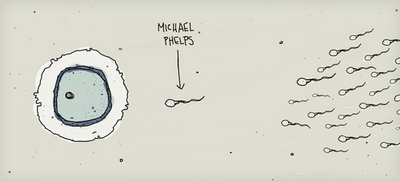
As Noumenon notes, the first sperm to arrive is not necessarily the one that “wins” the right to merge with the egg. More often than not, it is not because the necessary chemical reaction that allows fertilization needs many sperm, not just one.
Relatedly, in a comment Ranah pointed out this image (found here), which depicts how the egg plays a much more complex part in guiding some sperm in while limiting access to others than common perceptions of fertilization recognize:

Further, sperm do not swim. They are not making a break for the egg. They do not have brains, desires, or goals. Their “tails” are randomly thrashing around due to the energy provided by the fluid produced by the prostate gland. They go in every direction (not just toward the sperm) and only by random chance do some of them end up at the egg.
Here is a clip from The Family Guy showing Stewie as a sperm or, more accurately, a spermship, competing with other sperm to capture the egg:
Notice also that in both the Phelps and the Stewie examples, the sperm contains all of the future of the identity of the individual. The contribution of the egg is made invisible. This is a very old idea.
NEW! This image is drawing by Dutch physicist and microscopist Nicolas Hartsoekerfrom from 1694. In the head of the sperm, you can see a tiny, but complete figure sitting with his head down (found here):

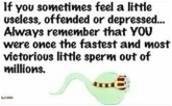
ALSO NEW! Here’s another contemporary image (found here) affirming this idea:
Text:
If you sometimes feel a little useless, offended or depressed… Always remember that YOU were once the fastest and most victorious little sperm out of millions.
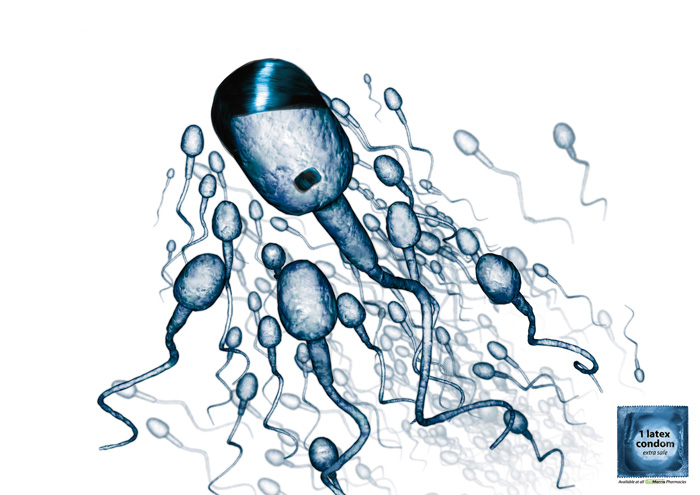
ALSO ALSO NEW! Similarly, this condom ad suggests that Hitler was once a sperm (found here):
Martin mentions that one of the few (non-scientific) cultural depictions of sperm that doesn’t draw on this imagery is in Woody Allen’s movie “Everything You Always Wanted to Know about Sex* *But Were Afraid to Ask,” where Allen plays the part of a sperm frightened of going out to face contraceptives or the possibility that it’s a false alarm (masturbation, gay sex) that won’t even get him close to an egg.
Here’s a clip from the movie showing that scene:
I’m going to show it the day we discuss Martin’s article in my women’s studies class when we address the way women’s bodies have been historically constructed, both scientifically and non-scientifically.
See also this Viagra ad that shows a sperm exploding an egg open.
Gwen Sharp is an associate professor of sociology at Nevada State College. You can follow her on Twitter at @gwensharpnv.
Amanda B.-P. sent in this Coke ad that illustrates the idea of consumption as activism (that is, you can be an activist simply by buying things). The ad tells you that every time you buy a Coke you’re supporting both the Olympics and Special Olympics.
The Coca-Cola company issued a press release titled “New Advertising Shows that Nothing Brings People Together Like the Olympic Games and Coca-Cola.Olympic-Themed Ads Invite People to ‘Connect with the World Over a Coke’.”
For other examples of consumption as activism, see here, here, here, here, here, and here.
Thanks, Amanda!
On an unrelated note, Lisa’s off doing crazy stuff again, so you’re stuck with lots of posts from me for a week or so. Sorry.
Found at the Onion thanks to Caroline H.!
It might be useful to compare and contrast this ad to more modern versions of anti-drug campaigns, such as this one.
Found here via Copyranter.
Exactly in line with Gwen’s last post on symbolizing an eco-friendly identity, Dorothee H. sent us a link to a commerical linking leftist politics to the smart car. I think Gwen’s comments say it all and Dorothee’s submission illustrates it beautifully:
See also this commercial that uses pro-communist sentiment to market a car.
In a comment to another post, Max S. pointed out this video of a question-and-answer session where, when asked about policy toward Iran, John McCain makes a joke about the Beach Boys having a song called “Bomb Iran” and sings “bomb bomb bomb” to the tune of “Barbara Ann”:
I’m probably the only person left on earth who hadn’t already sseen it, but anyway. It might be useful for a discussion of militarization and/or foreign policy, or the ways in which we obscure the reality of war such that the idea of bombing “Iran” is separated from any acknowledgement that you’re talking about bombing actual people.
Thanks, Max!
UPDATE: In a comment, thoughtcounts z said that this was probably a reference to the Capital Steps‘ parody of the Beach Boys, which it very well may be–I’m apparently horribly out of touch with…well, everything. McCain said The Beach Boys, so I just took him at his word.
Emily Martin, in her article “The Egg and the Sperm: How Science Has Constructed a Romance Based on Stereotypical Male-Female Roles,” (Signs 16(3), 1991, p. 485-501) critiques the way biological texts generally portray sperm as active, brave adventurers and eggs as passive damsels waiting for a sperm to save her lest she be flushed out as waste during menstruation.
For example, this cartoon was linked in our comments by Noumenon:
As Noumenon notes, the first sperm to arrive is not necessarily the one that “wins” the right to merge with the egg. More often than not, it is not because the necessary chemical reaction that allows fertilization needs many sperm, not just one.
Relatedly, in a comment Ranah pointed out this image (found here), which depicts how the egg plays a much more complex part in guiding some sperm in while limiting access to others than common perceptions of fertilization recognize:

Further, sperm do not swim. They are not making a break for the egg. They do not have brains, desires, or goals. Their “tails” are randomly thrashing around due to the energy provided by the fluid produced by the prostate gland. They go in every direction (not just toward the sperm) and only by random chance do some of them end up at the egg.
Here is a clip from The Family Guy showing Stewie as a sperm or, more accurately, a spermship, competing with other sperm to capture the egg:
Notice also that in both the Phelps and the Stewie examples, the sperm contains all of the future of the identity of the individual. The contribution of the egg is made invisible. This is a very old idea.
NEW! This image is drawing by Dutch physicist and microscopist Nicolas Hartsoekerfrom from 1694. In the head of the sperm, you can see a tiny, but complete figure sitting with his head down (found here):
ALSO NEW! Here’s another contemporary image (found here) affirming this idea:
Text:
If you sometimes feel a little useless, offended or depressed… Always remember that YOU were once the fastest and most victorious little sperm out of millions.
ALSO ALSO NEW! Similarly, this condom ad suggests that Hitler was once a sperm (found here):
Martin mentions that one of the few (non-scientific) cultural depictions of sperm that doesn’t draw on this imagery is in Woody Allen’s movie “Everything You Always Wanted to Know about Sex* *But Were Afraid to Ask,” where Allen plays the part of a sperm frightened of going out to face contraceptives or the possibility that it’s a false alarm (masturbation, gay sex) that won’t even get him close to an egg.
Here’s a clip from the movie showing that scene:
I’m going to show it the day we discuss Martin’s article in my women’s studies class when we address the way women’s bodies have been historically constructed, both scientifically and non-scientifically.
See also this Viagra ad that shows a sperm exploding an egg open.
Gwen Sharp is an associate professor of sociology at Nevada State College. You can follow her on Twitter at @gwensharpnv.
Amanda B.-P. sent in this Coke ad that illustrates the idea of consumption as activism (that is, you can be an activist simply by buying things). The ad tells you that every time you buy a Coke you’re supporting both the Olympics and Special Olympics.
The Coca-Cola company issued a press release titled “New Advertising Shows that Nothing Brings People Together Like the Olympic Games and Coca-Cola.Olympic-Themed Ads Invite People to ‘Connect with the World Over a Coke’.”
For other examples of consumption as activism, see here, here, here, here, here, and here.
Thanks, Amanda!
On an unrelated note, Lisa’s off doing crazy stuff again, so you’re stuck with lots of posts from me for a week or so. Sorry.
Found at the Onion thanks to Caroline H.!
It might be useful to compare and contrast this ad to more modern versions of anti-drug campaigns, such as this one.
Found here via Copyranter.
Exactly in line with Gwen’s last post on symbolizing an eco-friendly identity, Dorothee H. sent us a link to a commerical linking leftist politics to the smart car. I think Gwen’s comments say it all and Dorothee’s submission illustrates it beautifully:
See also this commercial that uses pro-communist sentiment to market a car.