Search results for embed

In the comments to another post, OTM brought my attention to this segment from Target Women, by the wonderful Sarah Haskins (go here if the video doesn’t show up):

The sexualization of the cleaning products reminds me a lot of the way food is sexualized (search under the Food tag for lots of examples).

I suggest going to the Current TV website and just browsing through every segment of Target Women they have up. They’re all fantastic.

Thanks, OTM!

UPDATE: In another example of cleaning products being portrayed as “special friends,” Swiffer created a YouTube “break-up” channel where people were encouraged to “Show us how you ‘broke up’ with your mop and bucket, broom or feather duster and ‘traded up’ to Swiffer…” by creating videos of themselves singing break-up songs to their old cleaning products. The winner got $15,000.

Swiffer also has a series of ads where women “break up” with their old cleaning products:

NEW! (Nov. ’09) This Lysol commercial (found at BrandFreak) plays on the same theme:

My race and ethnicity class is discussing American Indian team mascots today, so I thought I’d put up some images of a few. There are many, many more than what I have here (think of every high school with teams called the Redskins), but these are some of the most often discussed.

This is the logo (found here) of the University of Illinois’s sports teams, the Fighting Illini, named after the Illini tribe (really a confederation of tribes such as the Peoria) originally inhabiting the area:

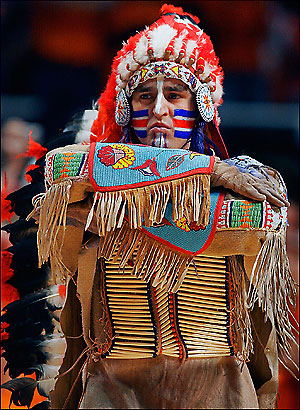
Each year a student is chosen to represent Chief Illini at sports events. The student wears what is described as “traditional” Indian clothing and until recently performed dance routines that have nothing whatsoever in common with anything I’ve ever seen at a powwow. Here is a student dressed up as Chief Illini (found here):

I found this video on youtube of Chief Illini’s “last dance,” meaning his last performance at an official NCAA-sponsored sporting event:

Last I heard the University of Illinois bowed to decades of pressure and has retired the embodiment of the mascot. They apparently no longer have a Chief Illini (a man who dresses up like an American Indian and jumps around), but they have retained the “Fighting Illini” language.

UPDATE: Not so fast.  Resist Racism has a great summary of how the University is keeping Chief Illini around even after retiring him.

The University of North Dakota’s mascot is the Fighting Sioux (found here):

Florida State’s teams are the Seminoles; here is a student representing the team at a game (found here):

Here is the Florida State NCAA logo (found here):

This is the original Chief Wahoo, the mascot for the Cleveland Indians (found at Wikipedia). According to Wikipedia, it was used from 1946 to about 1950.

Here is the updated Chief Wahoo (found here):

A quote from the Wikipedia entry on Chief Wahoo:

According to polling results published in Sports Illustrated, “Although most Native American activists and tribal leaders consider Indian team names and mascots offensive, neither Native Americans in general nor a cross section of U.S. sports fans agree.”[9] According to the article, “There is a near total disconnect between Indian activists and the Native American population on this issue.”[9]However, the results of the poll have been criticized due to Sport’s Illustrated’s refusal to provide polling information (i.e. how participants were recruited and contacted, if they were concentrated in one region, if one ethnic group is over represented and the exact wording and order of questions).[10]

Here is a link to an article by King et al. discussing both the discourse in and the methodology of the Sports Illustrated article (in the March 4, 2002 issue).

Here is a website with lots of cartoons related to the issue of American Indian mascots, and the documentary “In Whose Honor?” looks at the protests surrounding Chief Illini.

The February 2004 issue of Journal of Sport & Social Issues (vol. 28 issue 1) has several very good articles about American Indian mascots that I’ve used in both race and sport classes when we talk about the continued use of caricatures and other portrayals of American Indians and why they are viewed differently than, say, an old Mammie-type image of African Americans. We also always discuss discourses surrounding American Indian mascots, particularly the idea that they honor or respect American Indians, and the selective use of certain American Indian voices to invalidate critiques of Indian mascots. Who gets to be Indian for the purposes of speaking about whether or not Indians resent the mascots? Why do non-Indians feel a special attachment to, and often identify with, these images? Does it really matter whether or not most American Indians personally oppose the mascots–is that the issue here?

The Sports Illustrated article could also be good for a discussion of methodology and the scientific method; the fact that the magazine would not release information on their methodology violates the very spirit of scientific inquiry (the ability to replicate others’ work to check its validity, as well as open sharing of information).

For other examples of the use of images of American Indians, see here and here.

This cartoon suggests that the idea that these mascots are a way of honoring American Indians is pretty absurd.

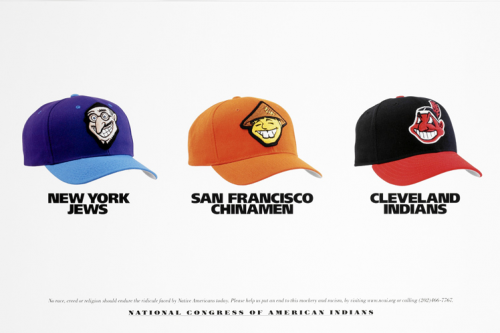
NEW! Brady P. sent in this image that questions why American Indian mascots are acceptable when most people would define the mascots that caricature other groups as patently offensive:

tumblr_koy50a7bIx1qzntqdo1_1280

Of course, there is a Dutch soccer team called The Jews.

Gwen Sharp is an associate professor of sociology at Nevada State College. You can follow her on Twitter at @gwensharpnv.

Click here if this second video doesn’t come up.

NEW! Bumpersticker for sale at CafePress:

One topic we cover in my sociology classes is the way the nature vs. nurture debate treats those two categories as though they are completely separate entities: “nature” is this fixed biological reality and “nurture” is all the social stuff we use to tinker around with nature as best we can. I point out to students that biology isn’t as fixed as we often think it is, and that seemingly “natural” processes are in fact often highly influenced by social factors.

One good example of this is the age at which girls have their first periods (menarche). In the U.S. today, the average age at menarche is a little over 12 years (see source here), and that seems normal to us. But historically, this is odd; until quite recently, girls did not begin menstruating until well into their teens. Because girls have to develop a certain amount of body fat in order to menstruate, access to food affects age at menarche. And access to food is generally an indicator of all types of social factors, including societal wealth and the distribution of wealth within groups. In general, economic development increases access to sufficient levels of food, and thus reduces average age at menarche.

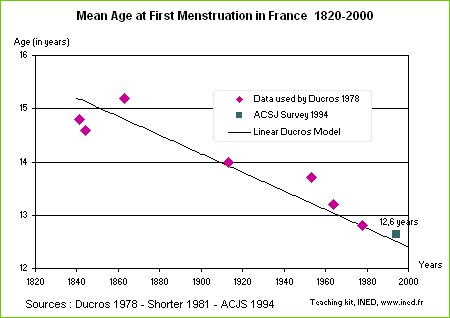
This graph of average age at menarche in France from 1840-2000 (found on the French National Institute for Demographic Studies website here) shows a clear decline, starting at over 15 years and now standing at under 13:

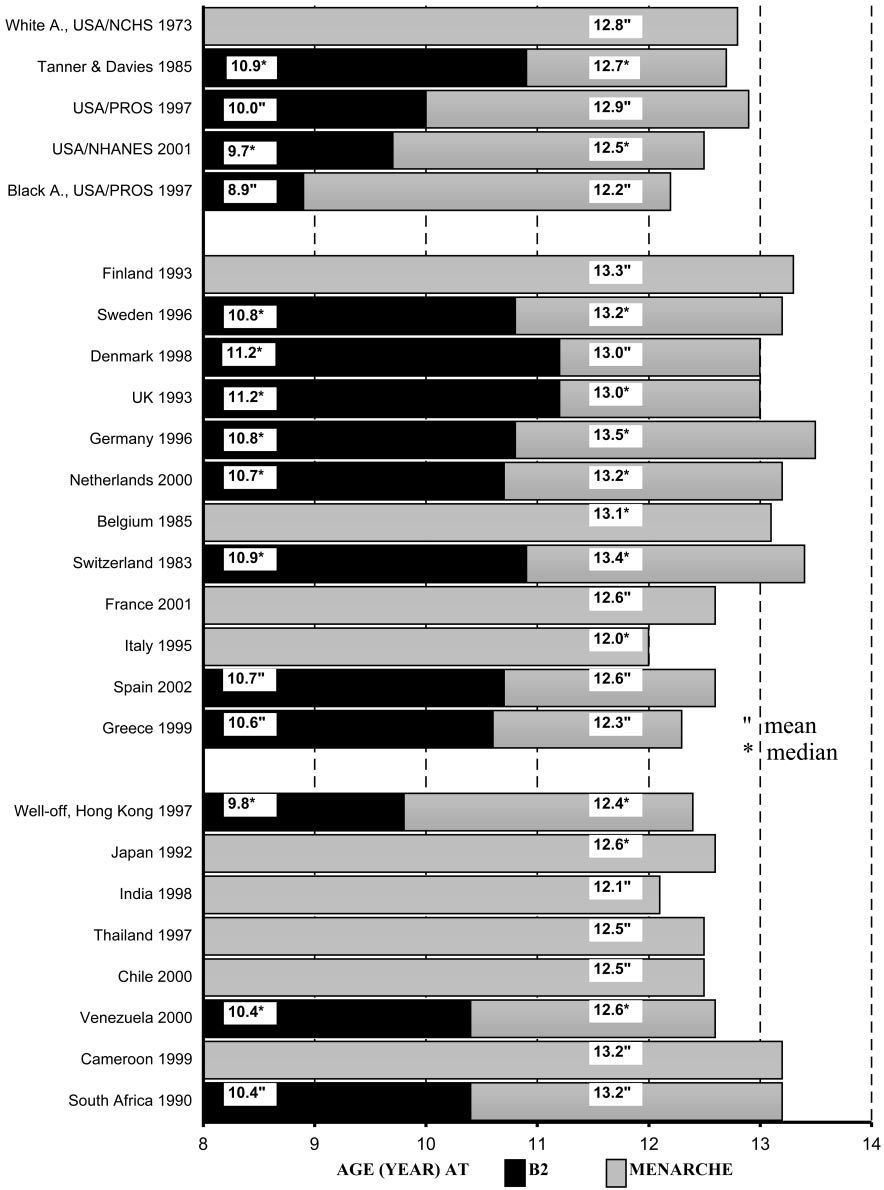
Below is a bar graph showing average age at menarche for a number of countries (found here; age at menarche is the grey bar); we see the oldest average age is 13 and a half years, in Germany. Note that the data are not all from the same year, and while most report mean age at menarche, some report median age, so though they show a general trend, they are not stricly comparable:

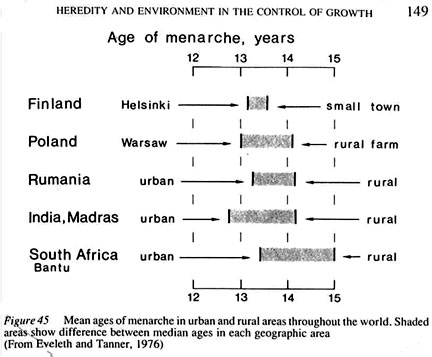
However, these average ages obscure the fact that access to resources is not equal within nations, and as we would expect, though average age at menarche has fallen for most nations over the past century, we continue to see differences in average age among groups within nations that seem to mirror differences in wealth. For instance, this graph (found at the Museum of Menstruation website here) shows differences in average age at menarche between urban and rural areas in several countries:

The example of the quite dramatic fall in average age at menarche, as well as continued differences within societies, is a very helpful example for getting across the idea that biology is not fixed. I explain to my students that though we have many biological processes (i.e., the ability to menstruate), social factors such as economic development and social inequality affect how many of those processes are expressed (i.e., how early girls being to menstruate, on average). For other examples of how social factors affect biology, see this post on average lifespan and this post on increases in height over time.

I’m currently pairing these images with the chapters “The Body’s New Timetable: How the Life Course of American Girls Has Changed” and “Sanitizing Puberty: The American Way to Menstruate” from The Body Project: An Intimate History of American Girls, by Joan Jacobs Brumberg (1997, NY: Vintage Books) in my women’s studies course. Brumberg argues that the decreasing age of menstruation has created new social pressures as there is an increasing gap between girls’ biological maturity (that is, being able to get pregnant at age 12 or so) and their mental and emotional maturity (they’re still 12 year old girls), a point activists were trying to make in these misguided PSAs about statutory rape. Brumberg argues that just as this was happening, American cultural understandings of menstruation turned it into a hygiene problem, not a maturational milestone, meaning we give girls information about tampons and sanitary pads but not much about what these changes really mean.

Just for fun, here is “The Story of Menstruation,” an animated cartoon put out by the Disney company in 1946. Millions of girls learned about menstruation from it in the ensuing decades, including that they could throwing their schedules off by getting too emotional or cold and that it’s ok to bathe as long as the water isn’t too hot or cold. It illustrates Brumberg’s point about how discusses of menstruation turned to scientific explanations of what was happening and advice about what was and wasn’t ok to do while menstruating, while mostly ignoring it’s emotional or social significance.

I also like the explanation at the beginning of why we refer to “Mother” nature–because she does all her work without anyone even noticing, just like moms. How nice.

Blanca M. sent in this picture she took here in Las Vegas of a truck advertising Air Conditioning Technical Institute. The truck says “Hot City, Cool Career,” and then had this image on the side.

When you go to the website, you see a video (which I can’t embed, sorry) of a man driving up to a house in a sports car. A blonde woman comes out and gushes over the car. The man then says “Six months ago she wouldn’t have given me a second look. I had no job, no education, I was living with my parents.”

So apparently air conditioning tech school is appropriate only for men, and guarantees that you will make enough money to get the hot women you’ve always wanted. Aside from the clear objectification of women as sexual rewards for men, it reinforces the idea of women as opportunistic gold-diggers. It’s also an interesting perspective on how men should view relationships–that they should be perfectly happy to be with women who don’t like them for who they are, and who would presumably leave them if they lost their job or got a pay cut. As long as the woman’s hot, a guy is apparently supposed to be satisfied with the relationship and not worry about little things like whether his wife actually loves him–we reserve concerns about love and emotional closeness for women only.

Thanks, Blanca!

Here are the Red State Update guys talking about Toby Keith being a Democrat:

It might be useful for starting a discussion about the way country music is so associated with conservative politics and the Republican party today, and why we would be surprised that a guy like Toby Keith (who has proudly acknowledged smoking pot–liberal!–but also wrote the song “Courtesy of the Red, White, and Blue”–conservative!) would be a Democrat–what does that say about our ideas of what a Democrat (or Republican) must be or act like? You might contrast that with the number of country artists in the first half of the 20th century who were often progressive Democrats or (gasp!) even socialists. It’s pretty fascinating how much the politics associated with country music have changed, and how “obvious” it seems to people today that country musicians would be conservative, to the point that country music has in many ways become a symbol of conservatism (as opposed to “alt country,” which is often associated with a more liberal outlook*).

For an excellent discussion of the early political culture of the California country music scene, see Pete LaChapelle’s book Proud to Be an Okie: Cultural Politics, Country Music, and Migration to Southern California. Of course, I’m biased because it mentions Okies.

*If you don’t own any alt country, please go buy some Drive-By Truckers albums immediately. I’d start with “Decoration Day” and move on from there. Move! Now!

This man, Donny Deutsch, host of CNBC’s Big Idea, helpfully tells the rest of us what the “new feminist ideal” is. Hillary Clinton’s problem, he explains, is that she “didn’t put [on] a skirt.” Enjoy:

Also in women can be anything they want as long as they’re hot: The Nerd Girls.

Found at Feministing.

Z. (of It’s the Thought that Counts) sent in this image (found at Andrew Sullivan’s blog on The Atlantic magazine’s website):

According to Sullivan, the text says, “You won’t be able to stop them (i.e. guys), but you can protect yourself. He who created you knows what’s best for you!”

Neither Z. nor I have been able to track down the origin of this image, which is supposedly a pro-hijab PSA, beyond what Sullivan provides as a source–I can’t find any evidence online of any first-hand accounts of people seeing it displayed anywhere or of what groups might be displaying it (the online references I’ve found make vague statements about it being from Egypt). I was really hesitant to post it, but it is available on the website of a major U.S. magazine, and I’m hoping maybe some of our readers might have information about the image–who put it out, if it’s actually on display anywhere, etc. If it is a real pro-hijab PSA (or even just a proposed one), it’s a great example of the way women are often portrayed as having responsibility for controlling and preventing men’s sexual advances, since men are believed to be incapable of controlling their own sexual desires. Whoever made it clearly uses that discourse about men, women, and sexual attraction; the question is, who created it?

While I was doing some online searching for it, I came upon the site Protect Hijab, a site dedicated to “the protection of every Muslim woman’s right to wear the Hijab in accordance with her beliefs and for the protection of every woman’s right to dress as modestly and as comfortably as she pleases.” Among other things, the site provides links to news stories about laws regarding hijab, including the interesting situations that come up when, say, the city of Antwerp (in Belgium) outlaws employees from wearing hijab (or any other symbol of religious or political affiliation) but then allows them to wear bandannas.

Then I came upon this video, which has the description, “A PSA Parody/Satire intended to protest the use of the veil by women. Ban the veil and ban the berqa. A Hijab is okay, however. Free Arab and Muslim women from male religious oppression.”

I’m always interested in things like this video because there is a tendency for groups with no connection to Islam to protest the hijab as a symbol of women’s oppression. This often occurs while the voices of Muslim women who argue that they don’t find the practice of hijab to be oppressive OR they have many other issues that are higher priorities are ignored or silenced. The statement “Ban the veil and ban the berqa. A Hijab is okay, however” also brings up some of the interesting aspects of attitudes toward hijab–who gets to decide what is oppressive? Why would, say, a veil be immediately and always oppressive but hijab (however the author was defining hijab) is “okay”?

Finally, I ran across this video, called “Top 10 Funniest Things a Muslim Woman Hears,” which presents 10 questions Muslim women often get about hijab/veils/scarves/etc.:

I like some aspects of this video–I’ve had Muslim students tell me they are asked these types of questions, some of which are clearly due to simply curiosity and lack of knowledge and others of which are rude. On the other hand, just like the previous video, this video is also constructing the practice of hijab, and the women who wear it, in a particular way–as something “obligatory” for Muslim women once they hit puberty. Clearly not all Muslims agree with this interpretation.

These could be really useful for a discussion of attitudes (both pro and con) toward the practice of hijab and the way it (or the version different groups portray of it) has become a symbol of Muslim (often defined as the equivalent of Arab) women’s oppression to some and of religious freedom and devout Muslim faith to others.

It could also be useful for a general discussion of whose voices are powerful in cultural conflicts. Who is speaking out against the presumed oppression of “Arab and Muslim women”? What is their interest in the issue–that is, is there a genuine concern about sexism and gender inequality, or is the issue of hijab a convenient avenue to express anti-Islamic sentiments? Which Arab/Muslim women are they claiming to speak for? Similarly, who is behind the pro-hijab activism? Are the voices of actual Muslim women represented? Do they play a role in the content of the message? To what degree do they represent the voices of (some groups of) Muslim women expressing their personal preferences and interests and to what degree is it an effort to pressure women to adopt hijab? Again, which Muslim women are they speaking for/to?

For other posts about hijab and other issues concerning Muslim women’s clothing, see here, here, here, here, and here. Also see these images of advice on modest clothing at Brigham Young University for a comparison.

Thanks, Z.!