
Search results for embed

First, the commercial (found here):

I love and hate this commercial because of androcentrism.  Androcentrism is the idea that we value masculinity over femininity such that we admire both men and women for performing masculinity.  Androcentrism explains why we tend to like it when women drink beer, play sports, and become lawyers, but do not typically think it’s equally awesome when men cry, wear skirts, learn to knit, or become interior designers.   Here is my crash course on androcentrism.

In any case, I kinda love the fact that the hot chick in this commercial represents strength and we’re obviously supposed to think she’s awesome.  But the guy in the commercial, who is supposed to represent sissy hippy environmentalism, doesn’t exactly come off as awesome.  He is funny, stupid, ridiculous.  And I kind of hate that.  In a perfect world, men would be allowed to do things associated with femininity without being considered uncool.

The video “The Great Schlep,” featuring Sarah Silverman, is part of The Great Schlep campaign, which, according to the website,

…aims to have Jewish grandchildren visit their grandparents in Florida, educate them about Obama, and therefore swing the crucial Florida vote in his favor. Don’t have grandparents in Florida? Not Jewish? No problem! You can still become a schlepper and make change happen in 2008, simply by talking to your relatives about Obama.

(Go here if the video isn’t working.)

The Great Schlep’s Facebook page has a link to talking points (titled “Obama Talking Points for Jews”), including,

*He is a Christian and has never been a Muslim.
*Obama ran the business side of his primary campaign significantly better than any other candidate of either party…
*His love for the United States is similar to that of generations of Jewish immigrants, who loved America for giving them an opportunity to succeed if they worked hard enough…
*Obama represents a different kind of black leadership, less interested in the confrontational tactics favored by many who came of age in the 1960s and 1970s…
*Biden’s knowledge of Middle Eastern affairs and his decades of strong support for Israel (he identifies himself as a Zionist) are well documented.

It’s an interesting list, drawing on the “up by your bootstraps” immigrant ideal (“…an opportunity to succeed if they worked hard enough”), the idea of Obama as a non-threatening Black leader, and that Jewish voters would be particularly impressed by Obama being able to manage the “business side” of his campaign.

Now watch this clip of Dave Chappelle’s “Reparations” skit:

(Go here if the video isn’t working.)

These would be great videos for discussing humor and the way that in-group members may be allowed to make jokes that others would be criticized for. Both of these videos are full of images and statements that, should a non-Jew or non-African American say them, would almost certainly be considered incredibly offensive. Are they necessarily not offensive simply because the person presenting them is a member of the stereotyped group? How can we distinguish between humor that pokes fun at stereotypes and humor that just uses them for a cheap laugh?

On the one hand, Whites often use the “it’s just a joke” disclaimer to deny responsibility for racist content in jokes; on the other hand, minorities may use the “I’m a member of the group I’m making fun of; how could the jokes be racist?” argument to deflect criticism. And of course, we may legitimately feel differently about a joke depending on who said it (the whole “are you laughing with us, or at us?” phenomenon). But at the same time, I think it’s sort of fascinating that we’re often allowed, or encouraged, to laugh at racist stereotypes, as long as the person saying them is a member of the stereotyped group–and in fact, we often wouldn’t really know how to go about criticizing them if we felt it was warranted.

Gwen Sharp is an associate professor of sociology at Nevada State College. You can follow her on Twitter at @gwensharpnv.

In this excellently-made 55-minute video, Michael Wesch talks about the way in which YouTube, especially, functions to create community in the post-community era (via Wicked Anomie).  It’s a bit too heavy on the feel-good for me, but quite informative and, well hell, it did make me feel good!

Breck C. sent in a video of the original “Wassup” Budweiser ad. What strikes me about the commercial is the portrayal of male friendship: men don’t actually talk meaningfully, they just mention sports and yell catchphrases at each other. Yet this is associated with “true” friendship (as is Budweiser).

After watching it, I was trying to decide to what degree I thought race was an important factor in the commercial–were viewers likely to read this as how Black men interact, specifically, or just what men are like, more generally? African Americans are sometimes stereotyped as loud and more boisterously expressive than other groups, but lots of commercials portray men in general as sort of loud idiots (or children or animals) of some type or another.

I looked for some more “Wassup” commercials and came upon this one:

[youtube]https://www.youtube.com/watch?v=UDTZCgsZGeA[/youtube]

The only male shown being annoyed by the screaming–and not part of the friendship group–is the White guy at the end. I got the impression that he’s used to hearing it from them, so presumably he could have learned to like it as much as they have.

Both Breck C. and Burk sent in this update of the video, made by an independent director with all the original “Wassup” actors (and not in any way related to the Budweiser company):

Apparently this commercial became sufficiently imprinted in the public consciousness that it occurred to someone to update it as a political ad, assuming people would still remember and feel affection for the catchphrase and the characters. I had no idea.

Thanks, Breck and Burk!

Gwen Sharp is an associate professor of sociology at Nevada State College. You can follow her on Twitter at @gwensharpnv.

I’ve posted about the phenomenon of what I’ve called leftist balkanization or the way in which leftist causes tend to be narrowly focused such that they undermine other leftist causes (see here for my original post and here and here for two follow-ups).  Perhaps the opposite of such balkanization is social movements that try to bring together issues that find themselves on opposite sides of the political spectrum.  Below are two advertisements for the pro-environment anti-immigration movement.  The argument is that restricting immigration is good for the environment.

This first commercial from the Californians for Population Stabilization makes exactly this point:

You might be asking yourself whether this pro-environment anti-immigration message is really just an anti-immigration message shrouded in leftist rhetoric.   In this case, at least based on the commercial below from the same organization, the answer appears to be “yes.”

Of course, it’s not necessarily true that all anti-immigrant pro-environment messages are secretly simply xenophobic. For a great discussion of this troubled movement, see Leslie King’s great article that shows how challenging it is to mobilize a grass roots movement when one half of your message offends one half of the population and the other half of your message offends the other.

Via copyranter.

Teresa C., from Moment of Choice, sent in the trailer for the movie “The Secret Life of Bees.” What brought her attention to it was that it had a female voiceover, which is very uncommon. Voiceovers are almost always male. Unfortunately, she hasn’t been able to find a video of the trailer with the female voiceover online; if anyone finds it, let us know. This trailer just has some of the characters’ lines from the movie as narration.

What struck me about it–and Owen Gleiberman over at Entertainment Weekly–was that this seems to be another movie in which wise, long-suffering African American characters protect or enlighten White characters who are, at their core, good, kind liberals (we know that Dakota Fanning’s character is a Good White Person because she knows about the Civil Rights Act). As Gleiberman says in his review,

Isn’t it time that Hollywood took a sabbatical — maybe a permanent one — from movies in which black characters exist primarily to save the souls of white ones?…Over the years, we’ve all seen too many anachronistic ”magic Negroes” in movies like Forrest Gump and The Green Mile.

I would add “The Legend of Bagger Vance” to the list. They have important Black characters, but those characters’ main role is to facilitate the moral development of the White character through their wise advice and unending patience. I may be totally off, since I’ve only seen the trailer (though Gleiberman has seen the whole film), but “The Secret Life of Bees” seems to have a lot of the same themes.

Thanks for sending in the clip, Teresa!

In this McCain-Palin ad which, I believe, started running yesterday, it is stated that an Obama presidency will bring on international military conflict (at least that’s my reading of the images), while a McCain presidency means no international military conflict.

Sociologically what is interesting about this ad is the way in which danger can be socially constructed. What we fear most is not necessarily what is most likely to cause us harm. Consider, most of us are more afraid of riding in hot air balloons than cars but, even proportionally, your chances of dying in a hot air balloon crash are much smaller than your chances of dying in a car crash. People around us–e.g., our parents and friends, but also politicians–try to shape the degree of fear we have for any given situation. Politicans, especially, are not necessarily doing it out of a concern for our well-being.

What do we really need to fear in the next four years? This McCain ad nicely tries to draw our attention away from the fear of, say an economic depression or climate change, in favor of an international military conflict. Though he doesn’t say so explicitly, it seems obvious to me that he’s implying a terrorist attack. It’s not obvious to me, though, that a military conflict or terrorist attack is more likely to cause extreme and extended suffering than any other potential crisis, but it would useful to McCain if I thought so, because it’s the one sphere in which it is widely agreed that McCain is superior to Obama. Thus, as an extremely powerful figure, he attempts to shape our collective understanding of what is (most) dangerous, what we should (most) fear, and win the presidency through the cultivation of a culture of fear.

Marriage–as a social and legal institution–has not always been what it is today.

In early American history, when families largely lived on farms and worked for sustenance, people didn’t marry because they loved each other.  And they certainly didn’t split up because they did not.  Marriage choices were highly influenced by their families and, once married, husbands and wives formed a working partnership aimed at production.  They teamed up to support themselves and make children who would take care of them when they were old and help them in the meantime.

Today, we still (generally) think of marriage as comprised of a man, a woman, and kids, but mutual love and happiness are now central goals of marriage.  This idea only emerged in the 1900s.  It hasn’t actually been around all that long.

I bring this up in order to shed some light on the pro- and anti- gay marriage rhetoric.

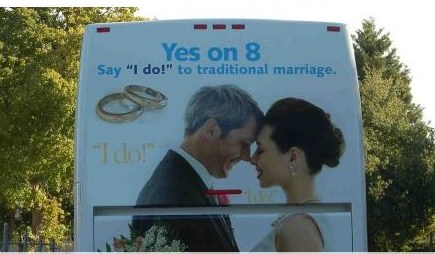
On the one hand, those against gay marriage need to define “marriage” in a way that excludes same-sex couples.  One way to do this is to refer to a “traditional” marriage (image found here).

But there is no such thing as a “traditional” marriage, just a long history of evolving forms of marriage.  For example, few anti-gay marriage types would actually be in favor of returning marriage to one in which women were property that can’t contract, vote, testify in court, own anything, and have no rights to their own bodies or custody of their children (though the idea that women are property is still out there today).  Because there is no such thing as a “traditional” marriage (that is, no reason to privilege one historical form over another), when someone speaks of “traditional” marriage, they actually just mean “the kind of marriage that I like that I am pretending existed throughout all time before this current threat right now.”

On the other hand, to make an argument in favor of gay marriage rights, the movement must either (1) change the collective agreement as to what marriage is (the social construction of marriage) or (2) convince the collective that gay marriage already is what we believe marriage to be.

This ad in favor of gay marriage does the latter. Mobilizing the social construction of marriage as about love, the commercial then defines same-sex relationships as about love. If you accept both premises, then, presto, you are pro-gay marriage.  That is exactly what this commercial is trying to do:

NEW!  This Swedish commercial for Bjorn Borg’s dating website, sent in by Ed L., similarly mobilizes the idea that marriage is for love and that gay men’s marriages are, therefore, beautiful: