Search results for embed

Both Aani B. and Sarah F. sent in a link to a commercial for the new diet Pepsi (Pepsi Max, of course) being aimed at men. 

Also don’t miss this commercial (embedding disabled) in which they describe the ingredients of Pepsi Max as the crushed bones of a Viking, the spit of a rapid Wolverine, pepper spray, and scorpion venom.  The can? Made from the hull of a nuclear submarine.  The crushing of cans on heads ensues.

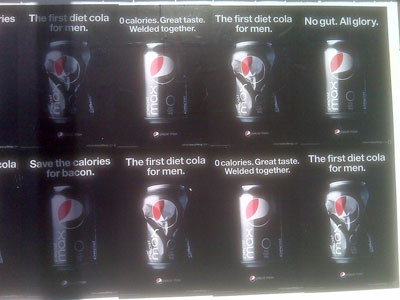
Over at I Blame the Patriarchy, a reader named Kate sent in a snapshot of some advertising for the product at the intersection of 6th and Anza in San Francisco:
3523488128_d3d6c0445e 

Slogans:

“The first diet cola for men.”

“Save the calories for bacon.”

“0 calories. Great taste. Welded together.”

“No gut. All glory.”

This is, of course, all in jest. Yet is still re-affirms the idea that being this way is the epitome of manhood, if taken to a ridiculous extreme.  Eh, I’ll just let Twisty say it. As usual, she says it better than I:

What’s the big whoop? Well, you can’t have a “soda for men” unless “men” are considered a class unto themselves, defined in terms of the bacon-eating, welding, glorious nukular submarine-squashing aspirations that separate them from dainty vulnerable “women.” These ads are jokey, depicting average-looking dudes, but they tacitly allude to the noxious he-man/fragile damsel dichotomy that’s been chapping actual women’s hides lo these many millennia.

It also, of course, points to the fact that dieting really has been for women all along (see posts here and here for examples). In fact, it denies that diet-soda-for-men is about dieting at all: note the slogan “save the calories for bacon” and the name, Pepsi Max, which implies adding something to the beverage as opposed to taking something out.

See other examples of marketing for diet products aimed at men: Nutrisystem (“get ‘er done!”) and Weight Watchers.

Danielle C. sent us a video about “Muslim demographics.” When I saw the title, I assumed it was just a basic informational video about the Muslim population. Oh, indeed not:

There are so many things going on there, I’m having trouble knowing where to start. I’m going to just sidestep the many demographic assertions thrown at us, though readers may have thoughts there. It is interesting how the presence of Muslims is associated with the idea of an Islamic state–at about 3:20 the narrator says that Muslim population growth will turn France into an “Islamic Republic” by 2039 or so. But a Muslim population is not the same as an Islamic republic–one is a religious population, the other is a form of government, and they don’t automatically go together, as, say, Turkey might illustrate.

Also notice the explicit assumption that Muslims are inherently bad and that a country with an increasing Muslim population is automatically in danger (as well as the clear assumption about who “we” and “our” children and grandchildren are). In fact, while the word “immigration” is usually used in a threatening tone of voice in the video, apparently the threat from the Muslim hordes is sufficient that we may even have to accept the need for Latino immigrants, since they may be the only group that can save the U.S. for ending up like Europe, which is a lost cause already.


Jay Smooth speaks to the Asher Roth tweet about “nappy headed hos” and offers some great insights as to how to maintain proper boundaries when blacks and whites form mixed-race communities.

NEW! More with Don Charnas (found here):

We recently critiqued Facebook’s “neutral” avatar for appearing both white and male.  Both Abby J. and Noah Brier pointed us to the fact that Rob Walker at Murketing has been collecting default avatars.  His collection is really interesting.  First, it demonstrates that the avatars don’t need to be gendered at all.

Flikr:

flickr-buddyicon

Hotmail:

hotmail

Google:

googleyeyes

Vimeo:

vimeo

My space:

myspacenophoto

Friendfeed:

nomugshot-large

Yahoo:

nopic_192

Youtube:

youtube140

Second, it demonstrates that the avatars don’t have to human at all:

Twitter:

twitter

Posterous:

posterous

Third, his collection also suggests that, when the avatar is human and discernibly gendered, it usually appears to be male.  There’s the Facebook avatar, as well as…

EBay:

ebay

Car Domain:

cardomain-avatar

Topix:

topix

Yammer:

yammer

The avatar tends to be male, unless the company produces a default male and a default female.

Blip FM:

blipfm

Goodreads:

goodreads-f

goodreads-m

This collection reveals that the appearance of a company’s default avatar is by no means inevitable or accidental.  Companies must make choices and they are, indeed, making choices about what kind of person is the default person.

Check out his whole collection.  It is growing.

Jamie R. sent in a link to a video that presents a lot of attention-grabbing statistics (which may or may not be accurate). At first it appears that the avatar could be unisex, but then at about 1:18, we see the “female” avatar:

Did You Know? from Amybeth on Vimeo.

At no other place in the video do we see the female avatar except when the “neutral” one is presented as married…indicating, from the context of the video, that it is not unisex or neutral, but male.

MORE! You may have noticed that our revamping of the site involved putting our names up.  Lo and behold, these male avatars popped up next to our names.

Capture

So we went into the admin page to see if we had some other option, like maybe something non-human or a female avatar if necessary.  These were our options:

Capture1

First, blank is really the avatar you see in the first screenshot, it’s neutral which, in reality, is male.  So there is no way to opt out of having an avatar (our tech guy, Jon, is still working on it).

Second, there is no female avatar option.

Third, though there is no female avatar, there is a Monster and a Wavatar option, whatever the hell that is.   So WordPress is allowing you to represent yourself as a Wavatar, but you’re not allowed to be a chick.

Amazing.

NEW (Apr. ’10)! Keri sent a screenshot of her WordPress menu which, she noted, represents the users with two different skin colors.  It’s a nice counterpoint to much of what we see above:

For more on how certain kinds of people get imagined as just people, while others get imagined as certain kinds of people, visit our posts on the Body Worlds exhibit, “flesh” colored products, Pixar films, gender and clothes, and Plan and Playmobile toys.

frankie-bioThis post is dedicated to Frankie Manning.  Frankie died this morning of complications related to pneumonia   He was one month shy of his 95th birthday.  I will really miss him.  Frankie is a lindy hop legend.  He choreographed the clip below and is the dancer in the overalls.

In the 1980s, there was a lindy hop revival.  Lindy hop is a partner dance invented by African American youth in Harlem dancing to swing music in the early 1930s. Named after the “hopping” of the Atlantic by Charles Lindbergh Jr., it became wildly popular in the 1930s and ‘40s, traveling from the East to the West Coast and from black to white youth. Since its resurgence, Lindy Hoppers have enjoyed a national scene with websites, workshops, competitions, and city-wide social events that draw national and international crowds.

Though lindy hop was invented by African Americans, lindy hoppers today are primarily white.  These contemporary dancers look to old movie clips of famous black dancers as inspiration.  And this is where things get interesting:  The old clips feature profoundly talented black dancers, but the context in which they are dancing is important. Professional black musicians, choreographers, and dancers had to make the same concessions that other black entertainers at the time made. That is, they were required to capitulate to white producers and directors who presented black people to white audiences. These movies portrayed black people in ways that white people were comfortable with: blacks were musical, entertaining, athletic (even animalistic), outrageous (even wild), not-so-smart, happy-go-lucky, etc.

So what we see in the old clips that contemporary lindy hoppers idolize is not a pure manifestation of lindy hop, but a manifestation of the dance infused by racism. While lindy hoppers today look at those old clips with nothing short of reverance, they are mostly naive to the fact that the dancing they are emulating was a product made to confirm white people’s beliefs about black people.  Let’s look at how this plays out:

This clip, from the movie Hellzapoppin’ (1941) is perhaps the most inspirational clip in the contemporary lindy hopper’s arsenal:

By the way, the dancers are in “service” outfits because of the way lindy hop scenes featuring black dancers were included in movies.   Typically they would have no relationship to the plot; they would occur out of nowhere and then disappear.  This was so that the movie studios could edit out the scene when the movie was going to be shown to those white audiences that were hostile to seeing any positive representation of black people at all.  If you want to see how the scene above emerged (black “help” suddenly discovering musical instruments and spontaneously congregating), you can watch the extended clip here.

The clip features a dance troop called Whitey’s Lindy Hoppers. You can see other famous dance segments in Boy! What A Girl! and Day At The Races.

The clip below, from the Ultimate Lindy Hop Showdown (2006), reveals how powerfully contemporary lindy hoppers have been influenced by clips like the ones above.  Watch for how the styling, moves, and trick reflects the clips above:

Another good example can be found here (but the angle, audio, and visual quality are not very good).

So we have a set of (mostly) white dancers who naively and wholeheartedly emulate a set of black dancers whose performances, now 70 to 80 years old, were produced for mostly white audiences and adjusted according to the racial ethos of the time.  On the one hand, it’s neat that the dance is still alive; it’s wonderful to see it embodied, and with so much enthusiasm, so many years later.  And certainly no ill will can be fairly attributed to today’s dancers.  On the other hand, it’s troubling that the dance was appropriated then (for white audiences) and that it is that appropriation that lives on (for mostly white dancers).  Then again, without those dancers, there would likely be no revival at all.  And without those clips, however imperfect, the dance might have remained in obscurity, lost with the bodies of the original dancers.

As a white lindy hopper myself, for over ten years now, who desperately loves this dance, I find this to be a deep conundrum.

I don’t know what Frankie would have had to say about this critique.  But I do know that he loved lindy hop to his last days and he was grateful for the revival.  Here he is dancing with Dawn Hampton, another legend of lindy hop, at the age of 94:

I’lll miss you, Frankie. And I’ll keep on dancing, embodying, with ambivalence, all the great contradictions of the dance and the history of this country.


UPDATE: A couple commenters asked how, exactly, the dance was changed in order to appeal to white audiences.  This is actually really difficult to say, since few films of social dancing (black dancers dancing only for other black dancers) exist.  But we have some theories.  Evan, in the comments, had this suggestion:

For white audiences of the time, Jazz was Hot Black jungle music – Black people were sex crazy hedonists, and you can see it in the moves, the exaggerated body undulation. the speed. the sweat. the rhythmical drum.

It was like watching a tribe around a fire.

I’m with Evan.  I’d like to also add that, as a person with a trained eye for lindy hop, I see two things in those clips:

(1) I see incredibly effective technique. Unbelievable strength and precision. It’s fantastic.  (By the way, Frankie explained that, by the time they got to the take you see in the Hellzapoppin’ clip, they’d performed that routine more than 20 times in a row… they were amazing athletes.)

(2) But I also see, layered onto and facilitated by that technique, an effort to make the dance appear more out-of-control than it is. They are wild-ing the dance.

At least, that’s how it looks to me.

More than that, though.  As a dancer who has also been inspired by those clips, I know how to do that.  I know how to exaggerate the out-of-control look.  I won’t go into the technical details (I did, and then deleted!), but it’s do-able.  And it’s not that it’s not cool… adding the drama is fun and exciting to watch… but there’s a historical reason why lindy hop has that dimension and that is worth thinking about.

Lisa Wade, PhD is an Associate Professor at Tulane University. She is the author of American Hookup, a book about college sexual culture; a textbook about gender; and a forthcoming introductory text: Terrible Magnificent Sociology. You can follow her on Twitter and Instagram.

We’ve offered many examples of companies co-opting feminism in order to sell products.  In the video below, we see that the co-optation of feminism is nothing new:

(At Vintage Videosift.)

Actually, I shouldn’t be so flippant.  Inventions like the washing machine did, indeed, save women a great deal of time and effort.  From what I understand, however, as women’s cleaning became more efficient, standards of cleanliness rose.  So even as time-saving devices were introduced, the time women spent cleaning did not substantially change.  I’d love to hear more from scholars who have a better handle on this history.

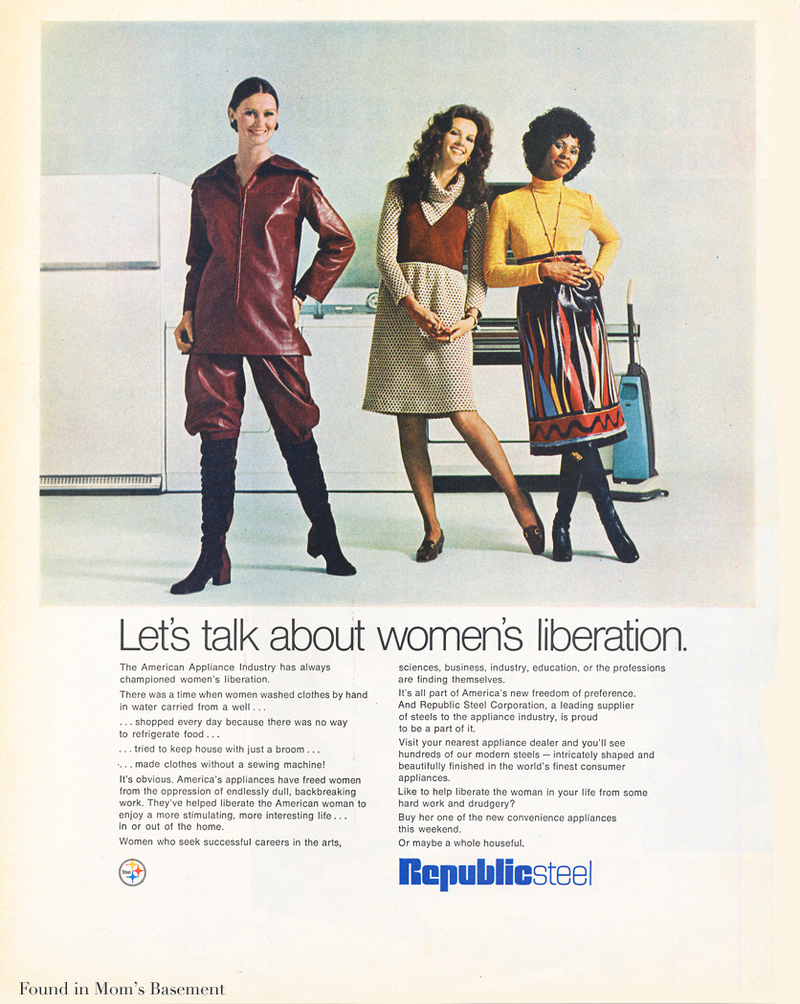
Here’s another step in the trajectory, this one from 1971, also about cleaning appliances (found here):

6a00d83451ccbc69e2010535973e25970c-800wi2

Text:

The American Appliance Industry has always championed women’s liberation.

There was a time when women washed clothes by hand in water carried from a well…

…shapped every day because there was no way to refigerate food…

..tried to keep house with just a broom…

…made clothes without a sewing machine!

It’s obvious.  America’s appliances have freed women from the oppression of endlessly dull, backbreaking work.  They’ve helped liberate the American woman to enjoy a more stimulating, more interesting life…

In or out of the home.

Women who seek successful careers in the arts, sciences, business, industry, education, or the professions are finding themselves.

It’s all part of America’s new freedom of preference.  And Republican Steel Corporation, a leading supplier of steels to the appliance industry, is proud to be a part of it.

Visit your nearest appliance dealer and you’ll see hundreds of our modern steels — intricately shaped and beautifully finished in the world’s finest consumer appliances.

Like to help liberate the women in your life from some hard work and drudgery?

Buy her one of the new convenience appliances this weekend.

Or maybe a whole houseful.

Notice that women’s liberation DOES NOT involve men sharing housework responsibilities, but men replacing women’s labor with tools he purchases for her.  Ultimately, even if she has a “successful career” in “the professions,” it is her responsibility to make sure that the housework is completed (and apparently still wouldn’t be able to buy herself one of these machines).

For contemporary examples, see these posts on make up (here and here), botox, cigarettes (here and here), right-hand diamond rings, cooking and cleaning products, fashion, and other miscellaneous products (here, here, and here).

In the spirit of “Obese blamed for world’s ills” comes this little ad video that shows what happens if you fail to shave your legs to absolute smoothness every single day: utter chaos. Not only will dudes be grossed out, but they could DIE!

Look, ladies, here’s how it is: even if you’re white and thin and traditionally feminine, and you wore your sandals and your cute sundress with the cleavage and you have no problem with your boyfriend groping you on public transit, if you forgot or, heaven forfend, chose not to shave the invisible stubble from your legs, YOU HAVE DOOMED ALL AROUND YOU TO MISERY. A woman may be pinned on her back under a stranger (god, it’s almost like you WANT her to be assaulted), and a perfectly innocent man who just wants to enjoy his perfectly healthy apple despite the fact that you’re not really supposed to eat on the bus will choke almost to death AND THEN EVERYONE WILL GLARE AT YOU AND YOU WILL GET A TEXT MESSAGE FROM YOUR FUTURE SELF OR SOMETHING I DON’T KNOW.

Here’s the thing: this ad would be kinda cute, in its Rube Goldberg-esque way, if it didn’t start from the premise that all women should be available to groping by men at all times. No matter how much you doll yourself up, if there is any part of you that is not sufficiently hairless and smooth, you are persona non grata in terms of beauty. Stubble turns you from a hot chick into a chick so disgusting that men actually leap away from you. You’ve ruined everything by failing to meet the endlessly exacting standards of beauty, which you can only hope to meet by buying our extra-fancy new razor or beauty creme or undergarment.

And remember, even if you look hairless, since your body is available to be groped at any time, your True Hairlessness is subject to scrutiny. If you are cursed with thick body hair, or dark hair against pale skin, you should probably just carry your fancy-ass razor along with you at all times, since your stubble might be noticeable under fluorescent light or when caressed by a (male) baby.

Because I am, as you know, a humorless feminist and a noted misanthropist, I am about to do something that is so dangerous to the fate of dudes everywhere, it will probably cause the dystopian women-only future that right-wingers have nightmares about. I live in Chicago, where it fucking snowed this morning, which should give you a sense of how many months it’s been since I showed my bare legs in public. Also, I am a very pale white woman with dark, thick hair. By now, you’ve sensed what’s coming: tell the menfolk to hide in the storm cellar lest they catch a glimpse of this, my real leg:

Behold: My hairy damn leg

Behold: My hairy damn leg

I have not shaved in WEEKS. Sometime I go the whole winter without shaving at all, and then I have what I think of as a Deforestation Session in March or April. It’s odd; I’ve lived with a man for six years, but he’s never mentioned the horrible chains of events that must happen to him every day because of my hirsute natural state. He must be suffering in silence, the poor thing.

This is what the beauty ideal is designed to erase: the reality of our bodies. This is what is so scary to proponents of fancy razors, diet pills, fake tans, and all that bullshit: the fact that women have hair on their bodies, just like they’re people or something. Some women are fat and some are thin. Some women have straight swingy hair and some have kinky hair and some have frizzy hair and some just stick what they’ve got in a damn ponytail. Some women have big pillowy lips and some don’t. Some women have curves and some have rolls and some have both and some have neither. Women, just like men, live in human bodies, and human bodies are incredibly diverse. We all know that, even the most brainwashed of us: but we also know we’re not supposed to know it. If we all just said that women are real people — if we said that out loud — what on earth might happen?

Chaos would ensue. Dudes might be harmed.

(Via Feministing.)

————————————

Sweet Machine is a twentysomething queer grad student in Chicagoland, where she studies too much and fails to dress appropriately for the weather.  She has been a fat kid, a thin teen, a chubby teen, a fat adult, a thin adult, and an in-between adult. She is particularly interested in the grad school-y aspects of fat, such as its intersections with gender and disability.”

If you would like to write a post for Sociological Images, please see our Guidelines for Guest Bloggers.

————————————

For more body hair confessions from Shapely Prose, visit their posts on women having hair where they “shouldn’t” and not having hair where they “should.”

And for more from Sociological Images on the hairlessness norm for women, visit our posts on shaving the hair down there (here, here, here, and especially here) and our post on early marketing of armpit shaving.

In this ad, the National Organization for Marriage appears to be trying to capitalize on the idea that people of color do not support gay marriage.  Wait till the end for the direct appeal:

Found at Feminocracy.

These screenshots of the anti-gay marriage, Californian “Yes on 8” website also appeal to a multicultural (if segregated) constituency.  See also this post challenging the idea that Black people and gay people are always at odds or even, of course, categorically different groups.

Lisa Wade, PhD is an Associate Professor at Tulane University. She is the author of American Hookup, a book about college sexual culture; a textbook about gender; and a forthcoming introductory text: Terrible Magnificent Sociology. You can follow her on Twitter and Instagram.