Search results for embed

Crazy Vet offers us this rather amazing commercial for BP as an example of “green-washing” or an effort to make a company appear environmentally friendly:

What I think is especially remarkable about this example is how entirely free of any content it manages to be.  The commercial combines pretty colors, animation, babies, cute music, and whistling gas pumps.  That alone, apparently, is effective in convincing us that BP is environmentally benign.  It is pure emotion, completely devoid of an argument.

—————————

Lisa Wade is a professor of sociology at Occidental College. You can follow her on Twitter and Facebook.

[youtube]https://www.youtube.com/watch?v=pPuIuYDDwBs[/youtube]
(Via Jezebel.)

Also interesting… I don’t think we have a concept of “swollen noodles” in the U.S.

Also in the sexualization of food:

1.  Chex Mix gives you curves.
2.  Sexy hot dog lady in a bun.
3.  Hot Indian Chicken.
4.  Sno-Ball head, sexy lady body.
5.  Chopsticks plus fork = hot sex.
6.  Vegetables are hot.
7.  Pasta, naked lady.
8. Women prefer Kellogs to hot men.
9.  Axe makes women love you like chocolate.
10.  Astroglide and Puma get in on the action.

Dozens more!

Lisa Wade, PhD is an Associate Professor at Tulane University. She is the author of American Hookup, a book about college sexual culture; a textbook about gender; and a forthcoming introductory text: Terrible Magnificent Sociology. You can follow her on Twitter and Instagram.

In this 7 1/2 minute video Hans Rosling maps the relationship between life expectancy, GDP, and sexual health and rights over 300 years of Swedish history:

Found at GapMinder.

Burk sent in several Miller beer ads, all directed by Errol Morris, which contain some interesting messages about modern masculinity. Specifically, real men drink beer and don’t worry about stupid things like their diet or health:

This one connects drinking Miller to pro-American patriotism and the value of manpower (and it really means MANpower):

Real men know how to back up Suburbans pulling boats:

Clearly, we’ve lost an important element of manhood when men can no longer do this. Of course, driving a Suburban pulling a boat seems to contradict the whole patriotic non-use of gas element of manhood, but let’s not get into details.

And finally, real men have to restrain themselves while they listen to women:

It’s such a pain to have to interact with gals!

You can find even more here.

UPDATE: In a comment, Chuk says,

In these ads, with the exception of the cyclist, none of the men’s faces are ever fully shown. What if this was a series of adds with images of women? How would the regular poster and commentators normally react to this kind of framing? What would it mean in that context? Does that analysis apply to this context?

I think that’s a good question. One criticism people often make of ads is the way women’s faces are often obscured; this is pointed out as a way of objectifying them, turning them into bodies rather than full people with faces, voices, etc. I certainly think it’s possible to objectify men as well, although it’s also possible to show part of a body because the viewer is supposed to take on the viewpoint of the person in the ad, in which case you can’t, obviously, see the face or head, since you’re supposed to be the face/head. I found the bacon and butter burger ads creepy overall, as well as another one of the Morris ads where a (generally faceless) grandma is cooking for a bunch of men whose faces we never see.

Thanks for the comment, chuk!

Pris S. sent in an ad that ran in the Collegiate Times, the Virginia Tech campus newspaper:

picture-110

Of course, it’s a great example of advertising making people feel as though they aren’t sufficiently attractive so they’ll buy a product. But it’s also interesting because it’s an example of a cosmetic procedure that is increasingly marketed to men as well as women. Women do get laser hair removal, obviously, but so do men. Our standards of male attractiveness increasingly demand control of body hair. Hairy backs and shoulders are a source of ridicule. I have known several men who felt very self-conscious about their body hair, some of whom shaved or waxed some of it. Even chest hair is questionable; most images of shirtless men (in ads, pin-ups, calendars, etc.) show very little chest hair. The “man-0-lantern” chest-waxing scene in “The 40-Year-Old Virgin” of course used men’s concern about body hair for comedic effect.

The other thing that’s interesting here is the connection between having body hair (which, as far as I can tell from the ad, could include just about any type, including pubic hair) with being an “ape,” as though we should be ashamed of the fact that we are, in fact, mammals who have varying amounts of body hair. I suspect that it’s also part of the caveman stereotype–having lots of body hair is sort of associated with being less civilized, less fully human or modern. It’s also a beauty standard that is certainly going to be harder for some groups, those that tend to have more and/or darker body hair, to meet, which could bring up some interesting discussions about whose bodies are considered attractive, etc.

Thanks, Pris!

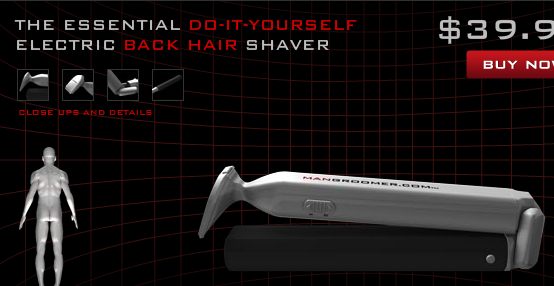
NEW: Andrea G. sent in a link to the line of Mangroomer products, which include electric shavers for back, nose/ear, and “private” hair:

picture-111

picture-112

These would be great for discussion new standards of male attractiveness–which increasingly pressure men to shave body and pubic hair, though not their legs or armpit hair, since that type of shaving is girly!–and also as an example of gendered marketing. Notice the very sciency-techy element to the website, with the graph-type lines in the background, the “swoosh” sounds, and so on.

Andrea also sent in this Nads commercial, in which we learn that the product saved a woman from a life of misery, since neighborhood children taunted her for having a beard:

It’s a great example of the social construction of bodies: we think it’s gross when women have beards, but at least in theory okay when men have them. Of course certain groups, such as Mormons, discourage men from growing beards, and in general full beards are relatively uncommon in the U.S. today and might be seen as unprofessional or otherwise inappropriate in some situations. But men usually won’t be openly mocked for growing hair on their faces (Joaquin Phoenix’s recent transformation aside), whereas for a woman, allowing hair to grow and be visible on her face would be socially unacceptable.

Thanks, Andrea!

@ 0:13 “I dream of kissing him under the Eiffel Tower.”

Yes, the commercial in general is pretty ridiculous, but I’m completely baffled as to why would someone need lap band surgery in order to be able to go to Paris and kiss someone under the Eiffel Tower.

It looks like she’s already with him. So, does she need to lose weight in order to take the relationship to the next step– like traveling together, or getting married and going on a honeymoon to Paris? Or are they already married but she is unable to travel unless she loses weight? Will she only feel good about herself, or enjoy herself in Paris if she lost weight first?

And he looks like he is pretty similar in size to her. Does he also need to lose weight in order to kiss her under the Eiffel Tower?

I don’t know about you, but I want to tell them to skip the surgery and just go to Paris already.

The New York Times has a fascinating peak into marketing logic.  The team at Frito Lay discovered that women prefer to snack on veggies and fruit, but that didn’t deter them.  They’re on a mission to sell more chips to the ladies. 

Through market research, they discovered that women feel guilty.  A lot.  The article reads:

Though Frito-Lay had often tried advertising snacks as guilt-free, this led to the conclusion that “we’re not going to alleviate her guilt,” Ms. Nykoliation said. “This is something in her life. So the question for us was, how do we not trip her guilt?”

Part of the strategy was to follow the success of SunChips by toning down the packaging and showing off healthy ingredients in the snacks.

“She wants a reminder that she’s eating something better for her,” Mr. Jones said.

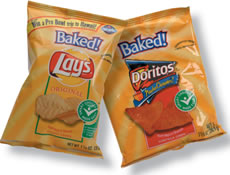
Baked Lay’s will no longer be in a shiny yellow bag, but in a matte beige bag that displays pictures of the ingredients like spices or ranch dressing.

So Frito Lay is attempting a guilt-detour.  You don’t have to justify eating the bad-for-you-chips because they’re good-for-you-chips.  The bag is a natural color instead of neon orange and there are actual food stuffs on the front instead of a Cheetah! 

vending-snack

(image via)

This is a nice example of the appeal to nature as a marketing strategy.  Of all of the marketing strategies out there designed to make us buy things that we don’t need and perhaps don’t even want, I suppose this is rather innocuous (though I could argue that it makes it more difficult for us to actually evaluate what foods are and are not “natural”).

Alongside this makeover, Frito-Lay is also starting a website and animated cartoon serial designed to appeal to women.  I’ve embedded the “trailer” below.  Notice how it affirms the idea that women are obsessed with food and their weight, at the same time that it is carefully crafted so as to encourage women to “cheat.”  As the woman in the video says about her cookie: “So if I eat it standing up, it doesn’t count right?”  And her friend replies: “Absolutely.”  Everyone knows that it still “counts,” but when the one friend eggs on the other, we all feel more comfortable “cheating.”   Frito Lay foods for everyone!

So the commercial reproduces the stereotype that women are boy crazed whiners with a deranged relationship to food and an embarassing obsession with shoes.  [By the way, Gwen and I are, like, totally like this.  It’s amazing we even have time to be sociologists, what with all the traipsing around in high heels, discussing diet fads, and oogling cute boys!]

Okay, so it reproduces rather repugnant ideas about women.  What’s the harm?

On the first day of Sociology of Gender I ask students to introduce themselves and answer a few questions including:  “Are you a stereotypical man or woman?  Why or why not?”  Inevitably the majority of students will say that they do not conform to the stereotype, that they both do and do not have characteristics associated with it, that they display human characteristics, not just ones associated with their sex.  I then ask them:  “What percentage of your friends and family fit the stereotype?”  They respond similarly.  I follow up: “How many of you regularly find yourself starting sentences with ‘Women are so…’ and ‘Men are so…’?”  They all raise their hands.

 This, I suggest, is interesting.  Gender stereotypes don’t come from us and aren’t validated by our actual experiences.  Yet, we still talk as if they were true.   If we don’t affirm the stereotype, where do they come from and why do we believe that they are true?

Well, here’s part of the answer: We know what men and women are like because we are constantly told what women and men are like.   This Frito Lay campaign is one source of this particular stereotype about women; more can be found here, here, here, here, herehere, here, and here.

Another question, and one I’d love to know the answer to, is:  Why is it that, when cultural messages and actual experiences contradict each other, we come out endorsing the cultural messages?

Way back in 1703, French settlers in Mobile, Alabama – at the time, the capital of French Louisiana and not much more than a tiny settlement attached to Fort Louis de la Mobile – decided to celebrate Shrove Tuesday with a feast and a party. Over the next few years, the celebrations grew more elaborate, with the first known parade taking place in 1711: the Boeuf Gras (“fatted ox”) society put together a large papier mache cow’s head and rolled it through town on a cart, which I’m sure made a lot of sense at the time.

(It is at this point that native Mobilians, like myself, like to point out that New Orleans wasn’t even founded until 1718, and that New Orleans’ oldest continually-parading organization, the Mistick Krewe of Comus, was founded by six guys from Mobile. Ahem.)

And so today we celebrate Fat Tuesday – the last hurrah before Lent – by dressing up in funny clothes, drinking to excess, dancing in the streets, and hurling moonpies at each other. To celebrate, I thought I’d share an interesting symbol and recommend an excellent documentary film on Mobile Mardi Gras, director Margaret Brown’s The Order of Myths.

oom

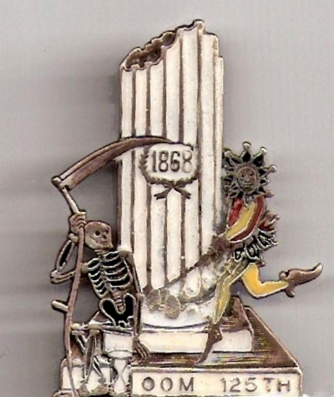
What we have here is Folly chasing Death around a broken Ionic column, while whacking Death with gilded pig bladders; seeing as how during Mardi Gras the normal social order is overturned, why not the natural order as well? Here’s a similar image from a float:

2318194724_3ac36be568

To me, these images sum up a lot of what’s great about Mardi Gras: it’s a finger in the eye of mortality and a celebration of a kind of genial lunacy. But what about that Ionic column? Well, the decoding gets a little stickier there.

I’ve heard a couple of different explanations: one is that the column represents time, the other that it represents the Confederacy or the Old South more generally. It gets a little more complicated when you look at it in context: this particular image is the emblem float of the Order of Myths, and is pulled by donkeys mules and lit by gaslight lamps – which are carried by young African-American men – in the same manner it has been since the founding of the organization shortly after the Civil War. Mobile’s mystic societies, you see, remain firmly segregated, which brings me to Margaret Brown’s excellent film.

Brown – whose first full-length documentary, Be Here To Love Me, is an excellent if crushingly depressing film about Texas songwriter Townes Van Zandt – is a fellow Mobile expat, and her film examines the complexities of race, class, and collective memory in Mobile as embodied in the 2007 Mardi Gras season. She focuses primarily on the two parallel Mardi Gras courts and documents some tentative steps toward integrating the two. I won’t say much more, for fear of spoiling the film for you, except to remark that the past is very much present in the film, in ways that both William Faulkner and Pierre Bourdieu would appreciate. And I’d also add that Brown eschews a heavy-handed or didactic approach in favor of laying the situation out for the viewer and letting them draw their own conclusions, with a few subtle editorial decisions and one late-in-the-game revelation that throws much of the previous hour and a half into a new and intriguing light. Here’s a trailer for the film:

My only real criticism of The Order of Myths is that Brown focuses primarily on the Mardi Gras elite – a little of Joe Cain Day (held the Sunday before Fat Tuesday and known as “the People’s Parade” because pretty much anybody can be in it if they can get a slot) would have gone a long way: class in Mobile is not quite coterminous with race, after all. There’s a lot more to Mobile Mardi Gras than the royal courts, and we don’t really get to see much of that. Similarly, the school featured in the film is more integrated than you’d think, as are the crowds along the parade routes, given what’s shown in the film.

But these are relatively minor points – by and large, Brown tackles the subject with a keen and incisive eye, and I’d highly recommend it to anyone teaching a class on race in the United States.

———————-

For the record, the title of the post translates as “time flies, remember you are mortal, party on.”