Search results for embed

This new commercial for Kentucky Fried Chicken’s grilled option features an assortment of people and, then, two Asian guys in Asian-looking garb with fake Asian accents acting like fools (found at Racialicious):

I’m sort of speechless here. (1) I can’t imagine how KFC could have thought that this made any sense at all. (2) I don’t understand how they could fail to notice that this is racist.

Then again, as we argued about the recent Sotomayor cover, maybe the truth is that it’s simply fine to be racist these days as long as it’s shrouded in the thinnest film of “humor.”

In a post on Racialicious, Arturo Garcia made a point about Sasha Baron Cohen’s work that resonated with me deeply and, I think, captures how I feel about this new brand of satirical humor/hipster racism:

Maybe we’ve had it wrong all along – Borat and the upcoming [film] Bruno aren’t comedies at all – they’re horror movies, holding up the mirror to our new idea of funny.

—————————

Lisa Wade is a professor of sociology at Occidental College. You can follow her on Twitter and Facebook.

Amy D. sent us this really fascinating South African commercial for a light truck:

Contextualizing the commercial, Amy remarks that, given race relations in South Africa, many companies probably do operate as this team does at the first job with the white home owner. Yet, the commercial presents the black and white men as partners, switching roles so as to maximize their customer base. There’s an irony, though: While the partners seem to be cooperating, their cooperation naturalizes an (in this case symmetrical) preference for those within one’s own race.

Amy is optimistic about the impact of the ad:

The tagline “the bakkie that helps build the nation” is a great play on words. Literally, it refers to the fact that many small contractors – builders, pavers, electricians, plumbers – use this small truck as it is cheap and reliable. Figuratively, the need for nation-building in South Africa is crucial. Although we are 15 years into democracy, there are still huge social and economic gaps between racial groupings, and there is a tendency for people to segregate themselves. The way I see it, the two men in this advert are therefore achieving this nation-building by firstly, breaking racial barriers by running a business as partners, and secondly, in the meta-context, by subverting our racial stereotypes through humour.

—————————

Lisa Wade is a professor of sociology at Occidental College. You can follow her on Twitter and Facebook.


Nadya L. sent in a video, embedded below, produced by a Christian anti-pornography initiative. It uses the logic that all women involved in sex work are “somebody’s daughter” and, thus, men should not consume pornography.

Ross Rosenberg at Coilhouse points out that the video erases the possibility that participating in the production of porn does not, inherently, ruin women foreverandever (and, thus, dads and moms should not necessarily be disappointed when their daughter participates in sex work). More provocatively, he asks:

[Why is] the idea of that the object of ones lustful desires is ‘somebody’s daughter’… a functional deterrent…[?]… Really, what is this video talking about here? Is it a serenade to the sanctity of our children’s innocence; the preciousness of their safety or merely the thinking that, if someone masturbates to images of my daughter, she has embarrassed me. If this was your daughter, what shame would it bring down upon you, her father? [Why would it] …be terrible for you and your family if it was discovered that your daughter was a pornstar or a stripper?

In my Power and Sexuality course, I discuss sex work and empowerment. Instead of essentializing both femininity and sex work and arguing that all sex work is inherently oppressive to women, I suggest that social conditions (such as patriarchy) and institutional features (such as pro- versus anti-unionization measures) shape the work environment of sex workers in positive and negative ways. Instead of asking: “Is sex work oppressive to women?” I ask: “What makes sex work more and less oppressive to women?” I think the latter leads to a much more interesting conversation.

For more posts trying to think through the topic of sex work, see here, here, here, here, and here.

—————————

Lisa Wade is a professor of sociology at Occidental College. You can follow her on Twitter and Facebook.

Hans Rosling helps us understand country-by-country carbon dioxide emissions and talks about what we can expect, and hope, from China:

Found at GapMinder.

—————————

Lisa Wade is a professor of sociology at Occidental College. You can follow her on Twitter and Facebook.

In the documentary Dreamworlds 3: Desire, Sex, and Power in Music Video, Sut Jhally investigates how images of sex and violence, and sexualized violence against women, are used in music videos, and how music videos help shape ideas of what is sexy. Here’s a clip:

The entire, unabridged version of the film is available here.

Elle sent in a link to the video for Lady Gaga’s song “Paparazzi,” which features one extended scene of sexualized violence (starting at about 1:45) and several other glimpses of women throughout the video who appear to be dead (it’s really worth watching the entire video–it’s something else):

Of course, Lady Gaga would probably argue that this video is in fact opposing violence against women, since in the end the evil paparazzi boyfriend gets killed. But there’s the same imagery Sut Jhally discusses: the mixture of sexuality with violence and hints of brutality, and of injured or dead women in glamorous, sexy clothing. Notice that in the opening sequence, the “normal” sex doesn’t look too much different than the violence that follows.

Other examples of sexualized or glamorized violence: strangling a woman with your necktie, suffering women as a turn-on, murder in a Wrangler’s ad, photo shoot with Rene Russo, t-shirts trivialize violence against women, is it a passionate embrace or an attack?, condom ads, ad for “The Tudors,” women’s discomfort is fashionable, Hunting for Bambi, the infamous Dolce & Gabbana ad, and “American’s Next Top Model.”

I’ve suggested that the fact that men do not feel compelled to wear make-up is a “triumph of gender ideology over capitalism” (see here).  Companies that sell make-up, after all, have halved their profits by giving up on selling to men.  We should expect, then, a tug-of-war between the profit motive and a gender ideology that suggests that men and women are opposite.   On the one hand, if men and women are opposites, then the requirement that women primp and preen (with the help of dozens of products) would imply that men do not.  On the other hand, if they accept this gender binary, companies lose half their customers.

Accordingly, Gwen and I were shocked to see an ad at Jezebel, sent in by Frank D., overtly marketing scrotum shaving.

philipsthumb52709

We have seen this a bit with products aimed at men and their hair already (see here, here, and here), but I’m still surprised to see this.  I can’t imagine anything harder to shave on anyone’s body, male or female.

So how are they trying to convince men to do it?

They are using the same tactics that they use against women.  They are either (1) shaming men into thinking that they are disgusting and no woman (or man) will have them unless they alter their body (see here, here, and here) or (2) naturalizing shaving such that it is just a fun thing that all men inevitably participate in (see here, here, here, and here).

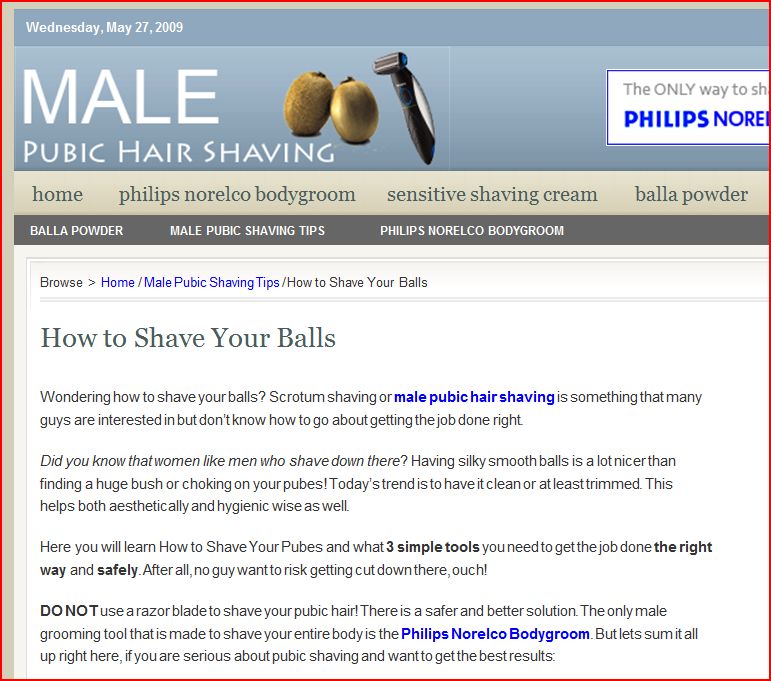
Check out the second paragraph in this screen shot of the Norelco-Phillips website:

capture5

Text:

Did you know that women like men who shave down there? Having silky smooth balls is a lot nicer than finding a huge bush or choking on your pubes!   Today’s trend is to have it clean or at least trimmed.  This helps both aesthetically and hygienic wise as well.

They are also using a gendered logic.  We’ve seen this with other examples of companies trying to sell self-maintenance to men.  They hyper-masculinizing the product.  For examples, see our posts on hair product for men (with “stand tough” hair gel), make-up for men ( with “blo-job bronzing powder”).  We see this with other feminized products and activities too (for example, ice skating and chocolate).  In this case, they don’t say, “If you don’t shave your balls, you won’t be pretty.”  They say, “When there’s no underbrush, the tree looks taller.”

Yeah, no.  I’m not paraphrasing:

One thing we might discuss is whether this this represents a “female gaze” that matches the “male gaze” that requires women to always be a pleasurable object for others to view… or that, alternatively, this is just the male gaze being applied to men.  Some of the marketing for men’s body shaving appears to be clearly marketed towards gay men (see this website, especially here).

Another interesting thing to consider is the extent to which the social invisibility of the pubic area facilitates marketer manipulation.  If you’re straight, unless you’re willing to ask a partner, you have to trust the advertisers to tell you what “today’s trend” is.  What a great deal for the companies.

Oh, and, I’m wondering which you think is going to win this tug-of-war: the companies with their profit motive or gender ideology and a resistance to the feminization of men?

Lisa Wade, PhD is an Associate Professor at Tulane University. She is the author of American Hookup, a book about college sexual culture; a textbook about gender; and a forthcoming introductory text: Terrible Magnificent Sociology. You can follow her on Twitter and Instagram.

Michael G., Sarahjane C., and Marlow sent us this commercial, designed for a small market, advertising a furniture store called The Red House. It was produced by Rhett McLaughlin and Link Neal. It is a real commercial, though it was designed to self-consciously spoof the many poorly-produced and weirdly-sloganed commercials that we’ve all seen advertising local small businesses on late night television. Word on the street is that the commercial has been maligned as racist. What do you think?

McLaughlin and Neal felt obliged to respond to the accusations of racism in another video. In it, they make a distinction between “racist” and “racial” and suggest that the video only seems racist if any and all talk that acknowledges race is considered bad.

This is an example of how the internet operates as a public sphere and can facilitate discussion about difficult topics. Without youtube, attention to this commercial would have remained local and/or restricted to a two minute discussion on the nightly news. Instead, the commercial has been viewed over 1.2 millions times and the response has been viewed over 50,000 times (as of today). Blogs all over the internet have picked up on the controversy and people are chiming in. I wouldn’t say that the discussion is all that sophisticated, but it is really interesting to see so many Americans discussing racism at all.

Then again, maybe the commercial has gotten so much attention because most people conclude that it is not racist. That is, are race and racism more likely to be widely discussed when the collective conclusion is “not racism”? Do we see such wide discussion of clearly racist material?

What do you think? Is this an example of the revolutionary power of the internet? Or just business as usual?

I’m not from a military family so Memorial Day has mostly been about a three day weekend, grilling, and maybe giving a tiny bit of thought to members of the military who have fought in various U.S. wars. But, in the last couple of years, Memorial Day has taken on so much more significance for me, and it seems rather fitting that this weekend I’m working on my dissertation– writing about the mothers of current U.S. service members who have been deployed in the U.S. war on terrorism.

Mothers, and all members of a service person’s family, often refer to themselves as “the silent ranks.” And they are a key part of the “ranks” of the military in many ways. Next to the troops, family members shoulder the majority of this particular war. Unlike previous U.S. wars (WWI and WWII), the public has not been asked to do much– we are not planting victory gardens, living with rations, working in factories, or collecting scrap metal and even lard for the manufacturing of weapons and supplies.

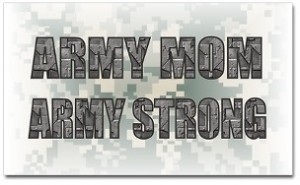
The military knows how important the families of service members are– for both recruitment and deployment support. You may have noticed the Army recruitment commercials specifically target parents. The Army knows they need parental support to enlist new Soldiers. Often these commercials focus on Army service as an opportunity for training, for an education, for a career, while also telling parents how strong their children will become when they join. Thus the motto “You made them strong: We’ll make them Army Strong.”

[youtube]http://www.youtube.com/watch?v=S8MBbaz61kU[/youtube] [youtube]http://www.youtube.com/watch?v=2TUbnGXqI1s[/youtube]

Despite the fact that the military is changing, and more women are joining, homefront support remains largely gendered. The video below “Army Families = Army Strong” is one that the Army put together as a tribute to the work these silent ranks do during wartime.

[youtube]http://www.youtube.com/watch?v=K5RIHo5rh3c[/youtube]

What is striking (but not surprising) to me about this video tribute is how gendered the home front is. With a few exceptions (a few female Soldiers), this video mostly depicts wives left at home taking care of young children. These families (women and children) need to be strong to deal with the stress and anxiety of having a loved one deployed, and to carry on their day to day lives. The military also needs them to be strong– to hold down the home front, send supportive packages and emails to deployed Soldiers, and to be there for Soldiers to come home to. As the voice over says “they wear a different uniform… theirs is a uniform of strength… the strength of courage, integrity, and sacrifice.” Even if they aren’t deployed to a war zone, families are enlisted to military service along with the Soldiers.

For my dissertation I interviewed 60+ mothers of service members (and hundreds more in online support groups) who also describe themselves as part of these “silent ranks.” I would love to be able to share their incredible stories here, but I only have their permission to write about the for research purposes. So instead I’ll write about what I’ve learned from them about how complicated home front war support is for mothers.

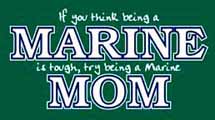
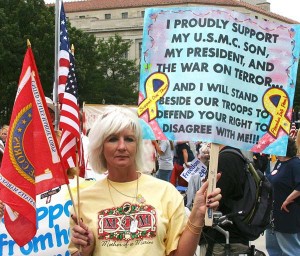
Like other military family members, the mothers of service members also see themselves as members of the military– even when they are more removed from receiving the kinds of benefits a military wife (or husband) would receive. Here are some of the slogans mothers use to identify themselves as a strong, tough, part of the military:

130730295v2_350x350_frontmarinemomlogo

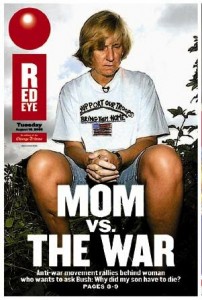
Usually when we think about the mothers of service members, the most publicly active (and anti-war) ones come to mind. Like Cindy Sheehan:

sheehan-momvswar

sheehan-forwhat

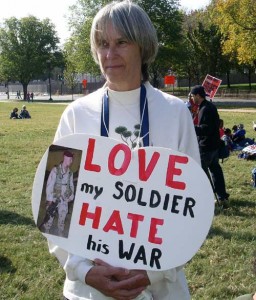
While many mothers of service members take the same war stance as Cindy Sheehan, most have widely different, and often contradictory relationships to war (just as other military family members do, I imagine). My research is about these contradictions. Some mothers disagree with the war, but publicly support their child’s mission– and want the war to succeed. Others disagree with the war but would never say so publicly for fear of being seen as unpatriotic. Some just want the troops to come home safely. Others support the war fully, and some who support the war fully see anti-war mothers like Cindy Sheehan as degrading to the job their children are doing.

halfmyheart-iraq

Mothers of service members may have opposing ideas about war, but they all feel unbelievable anxiety for their deployed child. They cry in the grocery store when they see their son’s favorite food. They panic every time an unknown car pulls into the driveway, fearing that dress uniforms will show up at their door. And they all feel a duty to their deployed child (to send care packages, buy their child supplies etc.), and feel a sense duty to all the troops and military families– taking part in efforts to make sure the troops and their families feel supported.

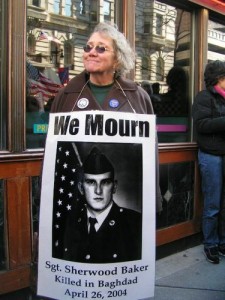
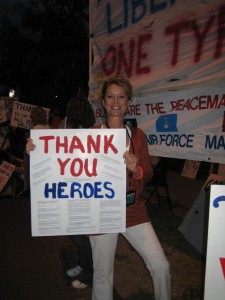
Here are some images of different mothers supporting the troops in different ways (these images are all public domain, and none are mothers in my study):

protest-goldstarmom

protest_05121205

support-thankyou

washington-dc-protest

usa11

Finally, take a few minutes to watch this video interview with Vicki Castro, whose son was killed in Iraq (“life as you know it stops…”). I can’t embed the video here, but it is worth clicking on and watching.