Search results for embed

Sociologist Yen Le Espiritu popularized the idea of a pan-ethnic identity.  “Asian American” is a pan-ethnic identity. It is an invented label applied to dozens of different groups with wildly different cultural traditions and languages. Most Americans (Asian and not), over time, came to accept the term as meaningful. American Indian is also a pan-ethnic term, as is African American and most other such labels.

On the one hand, pan-ethnic labels can be empowering. There is power in numbers. A large community identified across ethnic and national identities by race (however fake that racial designation is) can, for example, become a powerful voting bloc to which politicians must attend, or be mobilized to work together to fight for a common cause.

On the other hand, pan-ethnic labels can be disempowering. They tend to ignore the distinctions that make ethnic and national identities meaningful, and the rough categories erase differences among groups, thus making it more difficult to see and, thus, problematize disadvantage.

This latter problem motivated the Asian Pacific American Coalition (APAC) of the University of California campuses to run its “Count Me In” campaign. They notice that, though “Asian Americans” were well represented on University of California campuses (they make up 43% of incoming frosh in 2006), certain groups deemed “Asian” remain underrepresented. These include students of Cambodian, Hmong, and Laotian descent, among others.

The campaign asked the University of California system to disaggregate their “Asian” category.

In response the University of California added 23 new categories to their application.

For a much more extensive discussion of this issue, see Fatemeh Fakhraie’s post at Racialicious(where I stole this video clip).

—————————

Lisa Wade is a professor of sociology at Occidental College. You can follow her on Twitter and Facebook.
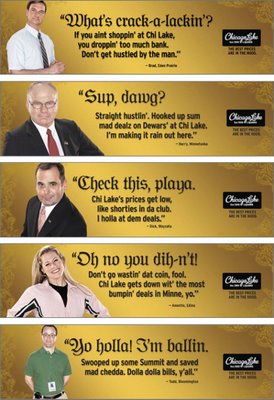
We’re pleased to feature a post by Macon D.  About himself, Macon writes, “I’m a white guy, trying to find out what that means. Especially the ‘white’ part. I live in that heart of the heart of American whiteness, the ever-amorphous ‘Midwest.’”  Macon’s blog, Stuff White People Do, is an excellent source of insights about race and racism.  We thought this post grappled nicely with the complicated phenomenon of (literal and figurative) black face, while addressing a difficult and contemporary form of humor:

————————————

chicagolakeoutdoor

Chicago-Lake Liquors
Minneapolis, Minnesota
(click here for larger version)

On the absorbing and informative blog Kiss My Black Ads, Craig Brimm responds to an ad campaign currently being run by Chicago-Lake Liquors, a store located in a largely black area of Minneapolis, Minnesota.  The images above are apparently billboards, and I’ve embedded below the three TV commercials also included in this campaign. (If you can’t view them, they’re also running now on the store’s site here.)The ads include “black” language, gestures, body language and so on, as performed by white, middle-class men (why no white women?). As I understand it, the joke is that these white folks are making fools of themselves by imitating black people.

Are these ads racist? Or are they making fun of racist white people? And if they’re “only” doing the latter, does that really make the contemporary blackface here any more acceptable?

Does context matter here, with Chicago-Lake Liquors located in a largely black area? Given that, perhaps the ads allow black people to feel superior in a way to these white people, by laughing at their silly efforts to get hip by acting “black.” Maybe, but that seems like a stretch.

Speaking of context — while blackface is largely condemned in the U.S., because it perpetuates and solidifies racist stereotypes, it serves other purposes in some other countries. Take a look at these other examples; as a United States citizen trying to become more aware on a daily level of racism and my own whiteness, I have increasing trouble ever seeing blackface, literal or otherwise, as acceptable. And yet, I’m a strong believer in the meaning-generating significance of social, historical, and cultural context. Many things have different meanings in different contexts.

So, I do find the Chicago-Lake Liquors ads racist. Even though the satiric butt of their central joke is clueless white people instead of black people, their version of blackness is insultingly cartoonish. They also basically revive what amounts to an American white supremacist tradition that deserves to die, blackface minstrelsy.

Still, I wonder — if we consider geographic, sociohistorical context, are some versions of blackface okay? Perhaps even, given its urban location, the contemporary American version in Chicago-Lake Liquors’ ad campaign?

* As Restructure! notes in a comment, Ganguro is one of three such modes of teenage blackface identified in the video; Yamanba, which means “mountain hag,” is the name of the one that’s tied to a comic’s racist parody of an aboriginal Australian. Jonathan Ross, the narrator of the video, notes that when Ganguro appeared after Yamanba, “many thought it was simply an homage” to the comic’s “beloved creation,” but apparently it’s not.

—————————

Lisa Wade is a professor of sociology at Occidental College. You can follow her on Twitter and Facebook.

Lisa Wade, PhD is an Associate Professor at Tulane University. She is the author of American Hookup, a book about college sexual culture; a textbook about gender; and a forthcoming introductory text: Terrible Magnificent Sociology. You can follow her on Twitter and Instagram.

Christopher F. brought our attention to how the release of the four Chinese Uighurs from Guantanmo is being framed in the media. Uighurs are a minority group in China, often facing persecution for being Muslim. These three men had fled China as a result and were detained after the U.S. invaded Afghanistan. They were found innocent in 2003. Now, after years at Guantanamo, they were released and resettled in Bermuda, since there were fears that they could not safely be returned to China. Some images of them in their new home (from USA Today):

6a00d83451b46269e201157114d51b970b1

6a00d83451b46269e20115711526a2970b

What brought Christopher’s attention to the coverage of the Uighurs was a news segment he saw on MSNBC. The Huffington Post has a video of the segment (I can’t figure out how to embed it) and quotes part of the discussion by Tamron Hall:

But first from Gitmo to Bermuda, should former detainees, the ones you’re looking at there, be living what seems to be a pretty good life on one of the most beautiful islands some say in the world?

Another MSNBC host, Andrea Mitchell, said the following in a segment earlier in the day:

Let me talk about Guantanamo: you raised the point about the murky legal situation, one upshot of that is that we’ve got four Uighurs who are Muslim minority from China who are now basically getting ice cream and lolling about on the white sand beaches of Bermuda. It’s sort of incongruous! To see these four men in their polo shirts, from Guantanamo, eating ice cream in Bermuda…I mean, look at that picture! I’m not sure you can see it, but one of the Uighurs is swimming in the ocean. The first time, we’re told, that they had ever been to the ocean. Is this a good outcome?

Over on The Daily Show, Jon Stewart echoed some of these ideas:

The Daily Show With Jon Stewart Mon – Thurs 11p / 10c
Guantanamo Baywatch – Uighur, Please
thedailyshow.com
Daily Show
Full Episodes
Political Humor Jason Jones in Iran

Christopher says, about the photos above,

These images humanize something that has been, for the past 7 or so years, totally inhuman and alien. I find it highly disturbing that even the image of these former detainees enjoying their deserved freedom (we have know for a while now that these people were not complicit in any plot against the United States) is somehow anathema.

Indeed. These are men who were falsely imprisoned as a supposed threat and then remained at Guantamo for years since they were declared innocent and no threat to the U.S. Why are images of them enjoying themselves and living in a nice house and eating ice cream so problematic and offensive? You know, this is just my thought, but if you imprison someone for years for no good reason, really, the least you can do is give them a nice place to live where they won’t be persecuted. And it’s not like they chose Bermuda: when you imprison people for supposed links to terrorist groups, it turns out that when you release them, other countries aren’t eager to take them (and clearly, they can’t be released in the United States because…well, because people in the U.S. still consider them threatening, despite what the government might say). Bermuda was one of the few places that would agree to take them. How the particular house or luxurious ice cream was chosen, I don’t know.

There seems to be an underlying feeling here that the Uighurs simply don’t deserve such nice living conditions, even if we did arrest them, fly them around the world, and detain them for years. Instead of focusing on the fact that several innocent people were released, and that they remained in Guantanamo for six years after the U.S. said they weren’t actually a threat, there’s concern that they were released in a place so nice. If most American citizens don’t live like that, why should they get to? I can’t help but wonder how the coverage might have been different if they were resettled in a poor nation and were shown living in a run-down house.

Toban B. sent us a link to a video that condenses 24 hours of air traffic into a minute and 12 seconds. It’s fascinating to see where planes are going to and coming from on a typical day:

—————————

Lisa Wade is a professor of sociology at Occidental College. You can follow her on Twitter and Facebook.

Thanks to Dmitriy T.M. for sending this speech by Joss Whedon (responsible for Buffy the Vampire Slayer) at an Equality Now event. His comments begin at 2:00 (after an introduction by Meryl Streep):

—————————

Lisa Wade is a professor of sociology at Occidental College. You can follow her on Twitter and Facebook.
Toban B. sent in a link to a clip of a 1935 Department of the Interior movie that includes a scene with African American conservation workers. I couldn’t find an embed code, so you have to click over, but the clip clearly illustrates the “happy-go-lucky,” dancing and singing stereotype of Blacks common to the era. The person who posted the clip says,

The racial stereotyping in this clip is appalling, but not surprising for a 1935 production. Hollywood films of that era also portrayed African-Americans purely for laughs. It was a rare film that showed black people as more than two-dimensional, and when they did – as Hattie McDaniel demonstrated in Gone With The Wind – Hollywood was ready to pat itself on the back.

Of course, Spike Lee’s movie “Bamboozled” implied that this type of stereotypical Black-man-as-happy-man-child-entertainer trope is still alive and well. He’s been criticized for his portrayal, of course, but it’s food for thought.

Oh, man. As if we needed another reminder as to why cartoon art is a medium that can be used for evil as easily as good, comes now the next installment in a series of racist National Review covers trafficking in Asian stereotypical imagery.

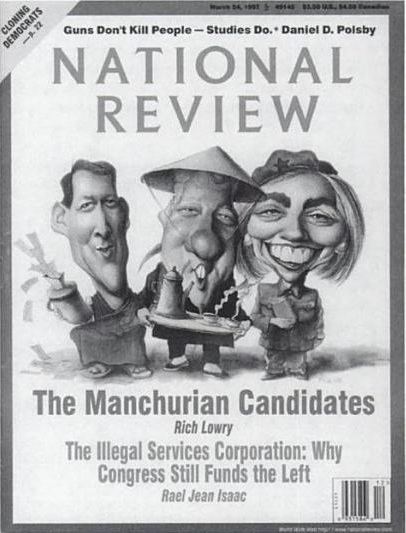
You’ll remember, of course, that back in March 1997, the National Review released the infamous “Manchurian Candidates” cover seen here (which, due to the fact that the Internet was just a tot when that slice of tripe hit the newsstands, I was only able to find in embedded in a journal article written by Darrell Hamamoto, w00t!).

manchucan

Asian Americans understandably reacted with stunned rage at the depiction of then-President Bill Clinton, First Lady Hillary Clinton, and Vice-President Al Gore in stereotypical Chinese garb, their features warped into exaggerated Asian caricatures (slanted eyes, buck teeth).

The National Review was unrepentant in the face of charges that the cartoon was offensive and inflammatory, responding, in part, that:

Caricatures and cartoons …require exaggerated features and, where a social type is portrayed, a recognizable stereotype. Thus, a cartoonist who wants to depict an Englishman will show him wearing a monocle and bowler hat, a Frenchman in beret and striped jersey, a Russian in fur hat, dancing the gopak, etc.

The first point can’t entirely be disputed: The cartoon medium often uses simplified, exaggerated features for emphasis, for satirical purpose and for ease in depicting broad emotion.

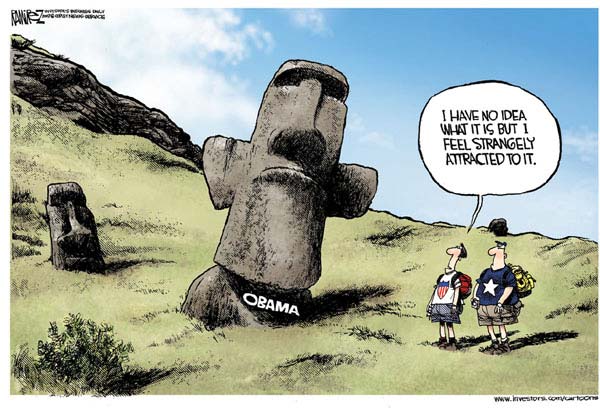
But it’s one thing to exaggerate features — Obama’s protruding ears invariably become giant jug-handles when he’s rendered, for instance. The Mike Ramirez cartoon below actually essentializes Obama’s appearance down to his ears — and still manages to make its point clear.

ramirez

It’s another to incorporate racialized features that weren’t there to begin with: For instance, consider these images — a caricature of Obama from an “Obama Waffles” package, as gleefully sold during the right-wing ” Values Voters Summit,” and a close-up of Obama’s official portrait from his days as Senator from Illinois.

obama

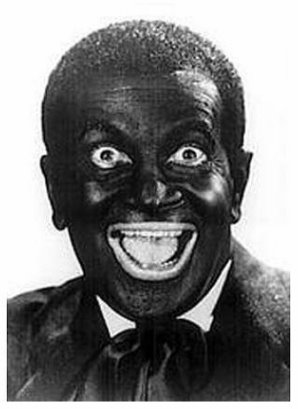
Apart from being overtly racist, the caricature on the box doesn’t remotely resemble Obama — with its pop-eyed expression, darkened skin, enormous, toothy grin and thick lips, it looks a lot more like…well, the picture below can speak for itself, I guess.

blackface

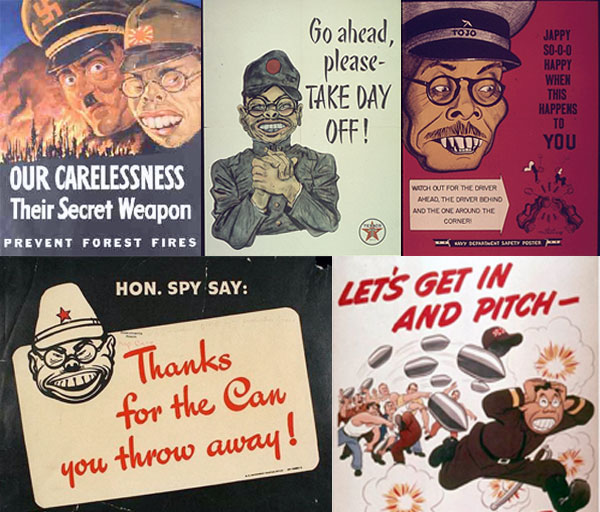
Going back to the National Review “Manchurian Candidates” cover now, what you see is that there’s more going on in the images of the Clintons and Gore than the typical flamboyant exaggeration used in cartooning. In addition to Bill’s bulbous nose and Gore’s pursed, almost sneering lips (both typical of their respective caricatures), you see…hmm…narrowed eyes… oversized, bucked teeth… a Fu Manchu moustache– hey, just about every racist synecdoche in the anti-Asian propaganda library! (At least the stuff that belongs above the waist.)

propag

Just to be clear here: It’s one thing if they were simply drawn in Chinese clothing or doing quaint folkdances, as suggested by the National Review in its disgenuous response. That would arguably be in-bounds satirically (regardless of whether you find the political point being made to be fair or accurate).

But layering yellowface-propaganda memes into the picture transforms the caricature from an act of humor into an act of war. The images to the right are examples of what I’m talking about.

Even if you’re insensitive enough to racial propriety to want to give white people Asian features in order to prove a political point, that simply isn’t what Asian people look like, and never has been. The squinty, buck-toothed Asian person with bright yellow skin and eyes angled at ten minutes to two does not exist in nature. However much you soften it, those false features are in fact weapons of mass destruction, artifacts of an era where it was used to dehumanize the enemy enough so they could be killed without compunction.

rob

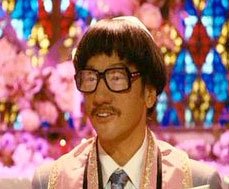
For that reason, there’s no acceptable way they should be invoked in a casual popular context, any more than minstrel stereotypes or anti-semitic “Elders of Zion” caricatures have a place in everyday culture. Discouragingly, they remain persistent in media today — from entertainment (see left: Rob Schneider in 2007’s “I Now Pronounce You Chuck and Larry“) to news and commentary. Well, actually not most news and commentary — it’s really only the profoundly racist right-wing organs that still blithely fart out the yellowface imagery. Like, for instance…the National Review.

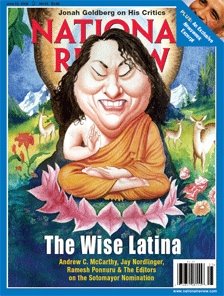
nrcoversoto

This cover to the right is the current issue of the magazine, on stands now. As you can see, it depicts Supreme Court nominee Sonia Sotomayor as the Buddha. Despite the fact that Sotomayor is Catholic and a Latina woman. While the historical Buddha, Siddhārtha Gautama, was Hindu (before the whole Bodhi tree thing), and an Asian man.

The caption, “The Wise Latina,” frankly offers no real f*cking explanation for the image. I suppose it’s because the Buddha was wise, although you could just as easily have depicted Sotomayor as King Solomon if you’re looking for a legendary figure of wisdom; maybe it’s because to the raving radical Right, Buddha is seen as a proto-hippie and probably a pansy too, while King Solomon, that guy threatened to cut babies in half — not very pro-life, but not “empathetic” either. Badass!

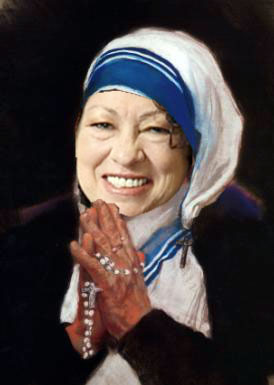
But seriously: If they wanted a figure of wisdom and empathy, why not caricature Sotomayor as someone who’s of the right gender and a coreligionist, at least: Mother Teresa? That would have preserved the necessary level of corrosive offensiveness, right? Too close to home?

mote

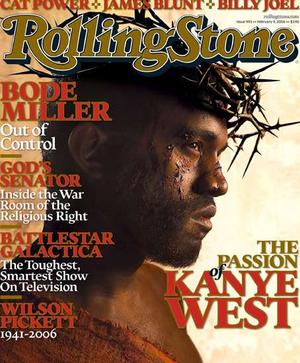
Whatever. As it is, the cover is just stupid and meaningless, as well as offensive — to women, to Latinas, to Buddhists of all backgrounds (note: The National Review guys are of the same ilk that went ballistic when Rolling Stone depicted Kanye as Jesus)…

kw1

…and yes, to Asians. But it bears mentioning that it registers as EPIC FAIL even in the offending Asians category.

Because, unlike their “Manchurian Candidates” cover, where at least they picked the correct racist stereotypes to parade, the “Wise Latina” cover puts the hideously slanted eyes and bucked teeth of East Asian yellowface stereotype onto an image inspired by a Northern Indian man of Brahmin descent.

In fact…. you can see the original image of Siddhārtha Gautama Buddha that the artist used as a reference (it’s actually quite a popular icon). Notice any differences?

buddha_18331

As usual, National Review has been quick with a completely absurd and totally disingenuous retort to the appalled reactions they’ve been getting from, you know, everyone. From editor-in-chief Rich Lowry:

I take it the theory is that we don’t think Latinas can be wise so we had to make her look somewhat Asian. Or something like that. What these people don’t understand is the entire concept of caricature (or of a joke). Caricature always involves exaggerating someone’s distinctive features, which is all that our artist Roman Genn did with Sotomayor. Oh, well. Keep it humorless, guys, keep it humorless.

No, Rich, the theory is that you took a Latina woman and turned her into a North Indian man with horribly racist East Asian-stereotypical features because you guys are clueless morons. And actually, that’s kind of funny, in that Lowry and the National Review don’t quite get that the joke, ultimately, is on them.

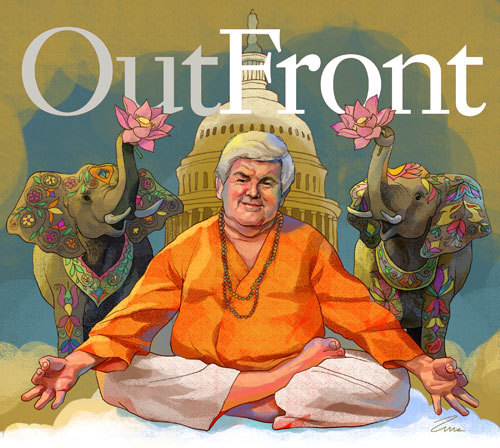
NEW! Kate M. pointed out an image similar to the one of Sotomayor as the “wise Latina.”  This one is of Newt Gingrich as a “guru” and ran in the liberal magazine Mother Jones:

Newt-Guru

Is this more or less offensive than the Sotomayor example cover? The thing that I think distinguishes the two is that Gingrich’s features are not exaggerated into a warped stereotype of Asian features, possible the most offensive element of the Sotomayor caricature.

——————————-

Jeff Yang is the editor-in-chief at Secret Identities: The Asian American Superhero Blog and the Asian Pop columnist for the San Francisco Chronicle. You can follow him on Twitter and friend him on Facebook.

If you would like to write a post for Sociological Images, please see our Guidelines for Guest Bloggers.


Andrea G. sent us a link to this five-minute peek into Sut Jhally and Jackson Katz’s documentary Wrestling with Manhood, about masculinity and professional wrestling.

Jackson Katz has an earlier documentary, Tough Guise, about masculinity and violence. Here are seven-minutes of excerpts:

See also Gwen’s post on changing ideals of masculinity (measured in guns and cars) inspired by Tough Guise.

For more on masculinity and violence, see our posts about how men’s violence is naturalized or made invisible (here and here), our posts on finding humor in men’s violence (here, here, here and here), and some I’m not sure how to characterize (here, here, here, here, and here).

—————————

Lisa Wade is a professor of sociology at Occidental College. You can follow her on Twitter and Facebook.