Search results for embed

Burk and Paul I.-M. both sent me this video that sums up the current credit crisis:

[youtube]https://www.youtube.com/watch?v=w4gcdQA33aI[/youtube]

It’s helpful for understanding the situation, but I can’t help pointing out a few issues, like the gendering–almost all the bankers, investors, brokers, and other members of the financial systems are male (I believe one of the investors was female). Also, I found the image of families interesting: “responsible” families are thin and have one kid while irresponsible ones smoke, drink, get fat, and have tons of kids.

Also, it didn’t explain too much about the types of loans made available to the subprime market, particularly the fact that monthly payments often went up significantly after a couple of years, so you might want to throw that in if you show the video–it wasn’t always that people got loans they couldn’t afford at the initial rate, it’s that when the interest rate changed and their payments increased, they couldn’t afford the higher rates. And of course many perfectly “responsible” families took subprime loans, planning on flipping the property for a nice profit, driving real estate prices up for everyone…and now often going into foreclosure along with everybody else.

Those caveats aside, it’s a pretty useful video for boiling down some basic causes behind the credit crisis.

NEW! (Mar. ’10): Caity sent in this video by Westpac, an Australian bank, in which they attempt to explain the credit crisis in a way that some have felt was self-serving and condescending. Caity explains,

Nearly all Australian home loans are on variable interest rates. Our reserve bank recently put up the national rate by 0.25%. Usually, the banks raise (or lower) their rates about in line with the reserve bank’s changes, but this time Westpac (one of our biggest banks) put theirs up by 0.45% – and then emailed this video to all of their home loan customers to explain why.


Gwen Sharp is an associate professor of sociology at Nevada State College. You can follow her on Twitter at @gwensharpnv.


Jay Smooth over at Ill Doctrine interviewed Elizabeth Mendez Berry (who wrote an article in Vibe several years ago about domestic violence in the hip-hop community) about the issue, which has received renewed attention in the wake of the Chris Brown/Rihanna incident:

It brings up some interesting issues–the pressure on women to not ruin the reputation of men by “airing dirty laundry” and the still-common assumption that women who are abused might have deserved it, higher rates of domestic abuse experienced by African American and Latina women than White women, etc. You might also use it to talk about the fact that both men and women hit their partners, and what that dynamic means. Overall, women in the U.S. hit more often in terms of total incidents (this includes things like the stereotypical slap across the face, not just punches), but are much less likely than men to inflict significant physical harm. Though the rates of harm caused by female aggression toward males is surely underestimated, there is little doubt that women simply do not inflict the levels of physical injury on men that men do on women each year in this country, particularly harm that requires a hospital stay or that ends in death. But I often encounter the sort of equivalency argument Jay Smooth mentions in the video–if women hit, they should be expect to be hit back, etc. It’s always a really interesting discussion, and Berry’s response might be useful for sparking some thoughts about domestic violence, personal responsibility, appropriate reactions (is hitting someone who has hit you first really the most appropriate response?), and so on.

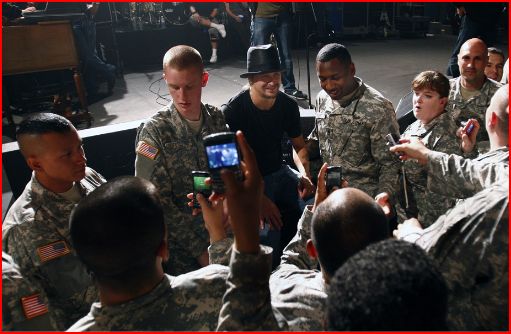
Stephen W. sent in a link to a music video promoting the National Guard.   He saw the video before a screening of Taken in Sioux Falls, SD. At the moment, the National Guard website (warning: noisy) features Kid Rock and Dale Earnhardt Jr.  The opening graphics, set to a snippet of Rock’s Warrior, feature a military helicopter followed by a race car and then a picture of an anonymous African-American National Guard member with the rock star and car star:

capture

A few clicks into the website leads you to this music video:

[youtube]https://www.youtube.com/watch?v=QeVt4j_T7-8[/youtube]

In the photographs made available, pictures of Kid Rock’s life as a rock star are mixed with pictures of people in the National Guard, and the lines between the two blur:

captureh
capturex

capturel

capturez

capturep1

Some observations on the marketing of military service:

First, the glorification of military service is an American phenomenon.  (See this post which features an American and a Swedish military recruitment commercial back-to-back.  The difference is quite amazing.)  In this video, the glorification is particularly acute when the light-skinned driver of the Hummer manages to avoid hitting the blue-eyed, olive-skinned, dark-haired boy and then comes out with his giant gun to kick the ball back to him, inspiring a look of awe from the child who’s country he is likely (given the politics in the last 8 years) invading.  We’re left, assured, that the U.S. military are all around good folk.

Second, in this case we have military service being marketed with celebrity tie-ins.  The website deliberately blurs the line between being a famous rock star, a celebrated race car driver, and a member of the National Guard.  Similarly, this Air Force recruitment ad blurs the line between various extreme sports and military service:

These links between military service, skateboarding, and being a rock star are disingenuous, to say the least.  And it reminds me of a series of recruitment ads I’ve been seeing lately that highlight the super cool jobs you could end up doing in the Air Force (like being a fighter pilot). I don’t know about you, but both of my family members who joined the military (in their cases, the Army) ended up being bus drivers.

Third, which celebrities are being used to market the National Guard tells us something about who they are trying to recruit.  Clearly, they are reaching out to young, working class, perhaps rural, white men.  This is not part of the National Guard marketing aimed specifically at this group, the entire National Guard website (warning: noisy), at this time, is entirely devoted to this theme. It speaks to who fights American wars?  Studies have shown that, while once military service was required of elites, this changed during Vietnam.  Today military service is overwhelmingly performed by working- and middle-class men.

Finally, the re-framing of the role from “soldier” to “warrior,” one who wages war, is very interesting.  I’d love to hear your thoughts about this.

More fodder for discussion, if you need it:

Lisa Wade, PhD is an Associate Professor at Tulane University. She is the author of American Hookup, a book about college sexual culture; a textbook about gender; and a forthcoming introductory text: Terrible Magnificent Sociology. You can follow her on Twitter and Instagram.

Hortense at Jezebel writes:

The ad depicts a horde of completely insane women, screaming with excitement… if, as the ad claims, these packs are “goodies for grown-ups,” then why are women the only ones going crazy over the cookies in this ad? The men in this ad react to the woman with a mix of “WTF” and “oh my god, you’re crazy” which only serves to make the women look even more pathetic and ridiculous.

This commercial tells a similar story: women totally lose it in the face of low calorie sweets.

NEW (Nov. ’09)! And, of course, there is holiday shopping (found at Ad Freak):

[youtube]https://www.youtube.com/watch?v=wer7b29mreA[/youtube]

Lisa Wade, PhD is an Associate Professor at Tulane University. She is the author of American Hookup, a book about college sexual culture; a textbook about gender; and a forthcoming introductory text: Terrible Magnificent Sociology. You can follow her on Twitter and Instagram.

In From Motherhood to Citizenship, Nitza Berkovich traces a global shift.  Sometime during the 20th century, nation-states became convinced that women could boost national economies and foster development.  Accordingly, states began thinking of their women as potential productive workers instead of reproductive mothers.  It was this economic argument, not necessarily a feminist one, that led to women’s incorporation into the public sphere as citizens (workers, voters, etc).

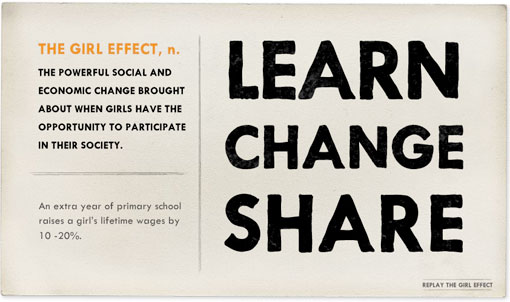
I was reminded of Berkovitch’s book by a short video sent in by Fran.  The video, produced by a non-profit called Girl Effect*, argues that if you get girls into school and give them cows, the world will be a better place.  As Fran puts it:  “Apparently, girls are only worth supporting if they improve the economy!” Here is an image from the website:

girleffect_01

“Girl Effect” is defined as:

The powerful social and economic change brought about when girls have the opportunity to participate in their society.

The logic is not that girls deserve education or the opportunity to sustain their livelihoods (a feminist argument); the logic is that we should invest in girls because it is good for the world (a global improvement or humanist argument or something).  I’m not arguing that the former is better or worse than the latter, only pointing out that it’s interesting that feminist initiatives (helping girls) can be supported with non-feminist logics.

The video:

*  As an aside, I always think it’s interesting when and how people choose to use the word “girl” as opposed to “woman.”  In this case, I suspect the activists think girls are more sympathetic than women.  Kids always pull at the heart purse strings moreso than adults.  I suppose this is because we ascribe to children a sort of innocence.  That, in itself (though socially constructed), doesn’t seem troublesome… but, if we can give the benefit of the doubt, we can also take it away.  I always wonder, for example: When do boys growing up in poverty transition from innocent victims of circumstance to potential criminals?  When do their sisters transition to welfare queens?  When do we decide to retract our generous offering of benevolence and replace it with malevolence?  These are just things I wonder.

Francisco pointed us to a spoken word poem by Andrea Gibson in which she talks about what it’s like to be ambiguously gendered:

Transcript (borrowed from Francisco):

So, I teach in a preschool. Hehe… I make a goddamn difference, now what about you. That’s one point I had to make before I read this poem. The second point is, I usually have hair that is much much shorter than this. That’s all you need to know.

“Are you a boy or a girl?” he asks, staring up at me in all three feet of his pudding face grandeur, and I say “Dylan, you’ve been in this class for three years and you still don’t know if I’m a boy or a girl?” And he says “Uh-uh.” And I say “Well, at this point, I don’t really think it matters, do you?” And he says “Uhhhm, no. Can I have a push on the swing?” And this happens every day. It’s a tidal wave of kindergarten curiosity rushing straight for the rocks of me, whatever I am.

And the class, when we discuss the Milky Way galaxy, the orbit of the Sun around the Earth… or whatever. Jupiter, Saturn, Mars, and kids, do you know that some of the stars we see when we look up in the sky are so far away, they’ve already burned out? What do you think of that? Timmy? “Umm… my mom says that even though you got hairs that grow from your legs, and the hairs on your head grow short and poky, and that you smell really bad, like my dad, that you’re a girl.” “Thank you, Timmy.”

And so it goes. On the playground, she peers up at me from behind her pink power puff sunglasses and then asks, “Do you have a boyfriend?” And I say no, and she says “Oh, do you have a girlfriend?” And I say “No, but if by some miracle, twenty years from now, I ever finally do, then I’ll definitely bring her by to meet you. How’s that?” “Okay. Can I have a push on the swing?”

And that’s the thing. They don’t care. They don’t care. Us, on the other hand… My father sitting across the table at Christmas dinner, gritting his teeth over his still-full plate, his appetite raped away by the intrusion of my haircut, “What were you thinking? You used to be such a pretty girl!” Frat boys, drunken, screaming, leaning out of the windows of their daddys’ SUVs, “Hey! Are you a faggot or a dyke?” And I wonder what would happen if I met up with them in the middle of the night.

Then of course there’s always the somehow not-quite-bright enough fluorescent light of the public restroom, “Sir! Sir, do you realize this is the ladies’ room?” “Yes, ma’am, I do, it’s just that I didn’t feel comfortable sticking this tampon up my penis in the men’s room.”

But the best, the best is always the mother at the market, sticking up her nose while pushing aside her daughter’s wide eyes, whispering “Don’t stare, it’s rude.” And I want to say, “Listen, lady, the only rude thing I see is your paranoid parental hand pushing aside the best education on self that little girl’s ever gonna get, living with your Maybelline lipstick after hips and pedi kiwi, vanilla-smelling beauty; so why don’t you take your pinks and blues, your boy-girl rules and shove them in that car with your fucking issue of Cosmo, because tomorrow, I stop my day with twenty-eight miles and I know a hell of a lot more than you. And if I show up in a pink frilly dress, those kids won’t love me any more, or less.”

“Hey, are you a boy or a — never mind, can I have a push on the swing?” And some day, y’all, when we grow up, it’s all gonna be that simple.

Thanks to Captain Crab for letting me know about this fun 20-minute video by Annie Leonard called The Story of Stuff.  It it, using animation, she explains how “[f]rom its extraction through sale, use and disposal, all the stuff in our lives affects communities at home and abroad.”  Basically it’s about the externalized costs that allow us to get things for $1.99 at our local big-box store:

Found at The Story of Stuff.

NOTE: As several commenters have pointed out, this video is definitely a simplification–it is, after all, a very brief overview of an extremely complex process. The video still provides a fairly accurate portrayal of some concerns expressed by critics of globalization, despite the simplifications.

One commenter in particular argues that the statistics used in the video are flawed or even entirely made up. I really have no way to judge that one way or the other, not being an expert on this. At the website for The Story of Stuff, there are citations for all of the numbers used, so if you’re really interested in that, you might want to look more fully into where the data came from. Again, I can’t take a real stance here one way or the other because this isn’t my area of expertise; the data might be flawed, but the commenter doesn’t provide other data to contradict it. It might make for an interesting discussion on the use of data and why people with different views on globalization might use different numbers. You take students through it and ask “What’s useful here? What statistics might be inaccurate? Why might they be presented that way? Why is it possible to come up with statistics that say completely different things about the same issue?”

Click here for a discussion of how one Professor uses it in a Rhetoric and Writing class.

Via Alas a Blog.