
Search results for embed

Muriel Minnie Mae and an anonymous contributor sent in contrasting examples of cell phone marketing that draws on the idea of nature. The two ad campaigns, side by side, are a great illustration of how we can imagine nature to be either our enemy or our friend.

The campaign for the Motorola Brute portrays nature as aggressive and destructive.  The Brute is designed to beat nature in this battle (anthropomorphized as “mother”) by being able to withstand “extreme temperatures, blowing rain, dust, shock, vibration, pressure and humidity…”  Mother nature is a bitch, indeed!  She does deserve a slap in the face!

In dramatic contrast, this ad for AT&T cellular service portrays nature as the source of grace and beauty.  Cell phones bloom out of flowers and are carried on the wind by dandelion fluff:

The two examples together show us that the nature of nature is socially constructed; humans portray it in multiple ways, using it as a resource to tell stories about ourselves… and cell phones.

Lisa Wade, PhD is an Associate Professor at Tulane University. She is the author of American Hookup, a book about college sexual culture; a textbook about gender; and a forthcoming introductory text: Terrible Magnificent Sociology. You can follow her on Twitter and Instagram.


Amanda M. and Lisa C. both submitted a recent Toy Story 3-themed commercial for Visa, pointing out how nice it is to see the Buzz Lightyear character advertised to girls.

I won’t disagree that it’s nice that girls are being included in the marketing for Toy Story 3 (especially as the movie appears to be as boy-centric as most), but I don’t see it as revolutionary. In fact, because we largely value masculine characteristics and pursuits, the idea that girls would be interested in boy things (like space travel) is generally regarded as cute, neat, or even awesome (this is why I like to order bourbon neat on a first date — impresses the men every time). The problem is that the reverse is not true. Because we devalue feminine characteristics and pursuits, we rarely respond to boys’ experimentation with girly things in the same way. In that case, it’s worrisome, strange, or even grotesque. We call the valuing of masculinity over femininity “androcentrism.”

So I would argue that this particular advertisement actually fits nicely with the source of gender inequality today: a devaluation of feminine things at the same time that women are required to perform some degree of femininity (the girl in the commercial is still girly, wearing baby blue, a skirt, and hugging Buzz delightedly before she blasts him off). Of course, this means that men’s life options are narrower than women’s because they have to avoid the stigma of femininity (and that must suck, truly), but at least the things men are restricted to doing and being are valued (both abstractly and with money).

More posts on androcentrism: “woman” as an insult, good god don’t let men wear make up or long hair, don’t forget to hug like a dude, saving men from their (feminine) selves, men must eschew femininity, dinosaurs can’t be for girls, and sissy men are so uncool.

Lisa Wade, PhD is an Associate Professor at Tulane University. She is the author of American Hookup, a book about college sexual culture; a textbook about gender; and a forthcoming introductory text: Terrible Magnificent Sociology. You can follow her on Twitter and Instagram.


The ad below is the first-ever British TV commercial advertising abortion services family planning options, including abortion.  It is being shown late at night and says:

If you’re late for your period, you could be pregnant. If you’re pregnant and not sure what to do, Marie Stopes International can help.

I don’t remember ever seeing such a commercial. Condoms, birth control pills, pregnancy tests, herpes medication, HPV vaccines, tampons, Viagra, and sex, sex, sex, YES. Abortion, NEVER. Salon seems to claim that it’s the first of its kind anywhere.

Have you ever seen such a thing where you live? What do you imagine are the politics around the airing of a commercial advertising abortion services?

Via Feministing.

Lisa Wade, PhD is an Associate Professor at Tulane University. She is the author of American Hookup, a book about college sexual culture; a textbook about gender; and a forthcoming introductory text: Terrible Magnificent Sociology. You can follow her on Twitter and Instagram.
Sent along by Dmitiry T.M.

Lisa Wade, PhD is an Associate Professor at Tulane University. She is the author of American Hookup, a book about college sexual culture; a textbook about gender; and a forthcoming introductory text: Terrible Magnificent Sociology. You can follow her on Twitter and Instagram.

Stephanie DeH., Cara McC., and our intern, Lauren McGuire, sent in this CPR certification campaign that embraces the idea that sex sells.  I initially added it to our post on using sex to sell unlikely things (e.g., organ donation and sea monkeys), but I changed my mind and decided it deserved its own discussion.

What was interesting to me about this example is the sexualization of the possibility of dying. The fact that a person might die is apparently not serious enough to make it unsexy.  It actually took me a minute to even notice the weirdness of sexualizing the risk of death.  After I noticed I thought “How crazy!”  But then I thought again: in a society that regularly sexualizes violence and murder, the sexualization of near-death is par for the course (which, of course, is why it didn’t strike me as particularly weird in the first place.

NSFW and possibly triggering, so images are after the jump:

more...

A huge number of Public Service Announcements (PSAs) have been devoted to the topic of disability, but capturing disability in 30 seconds is like editing War and Peace down to a novella. You might get the message, but it’s rarely the full picture. But that isn’t to say PSAs can’t be poignant, effective, and positive.

Disability-related PSAs cover a wide range of topics, but generally there are three main categories that the message falls into: how people with disabilities are viewed/treated by society, their value in the job market and society, and what their lives are like. Although these are pretty straightforward messages, there is a great deal of variety in the ways in which these basic messages are presented.

First, there are those that I like to call the “twist ending” PSA, where you see a person doing something difficult or exciting and it is not revealed until the last few seconds that the person in question has a disability. These are a very common form of PSA and they are meant to challenge the assumption that disabled people can’t do things that an able-bodied person can do. They show that disability does not stop people from living a successful and exciting life. The revealing of the disability at the end is meant to get an emotional reaction from the viewer. It’s meant to surprise and to get the viewer to rethink the capabilities of people with disabilities.

Second, there are the “interview gone wrong” PSAs that show the unfair scrutiny placed on job candidates with disabilities. Usually this involved one or more insensitive able-bodied people asking inappropriate or condescending questions to a job candidate. Sometimes it’s presented in humorous way, where the bumbling interviewer unintentionally offends the applicant over and over again. These try to show you the kind of discrimination and misunderstanding that can happen in the workplace (sometimes in an exaggerated manner).

Finally, there are PSAs there are the “just like us” PSAs that show people with disabilities talking about their lives or doing something ordinary. The message is simply to show what it’s like to be disabled. Sometimes these PSAs are used to describe the extra challenges disabled people face from day to day, like inaccessibility or being constantly forced to prove their intelligence and worth. They also show that disabled are pretty much like everyone else and want the same rights and privileges. This is one in a series of animations of real interviews:

This one also shows a person with a disability doing something ordinary, but also shows how the simplest actions are often misjudged by able-bodied people:

Since disability is a broad but personal topic, I am curious to see which style you find most compelling. I feel that the ”twist-ending” PSAs have an unintended negative undertone. I understand that the point they are trying to get across is that people with disabilities can be super successful, skydive, ride a horse, or do anything they want. But I feel the problem here is twofold. First, the “surprise” ending paints the person as a novelty and reinforces the thought that people with disabilities don’t normally do awesome things. They are expecting the viewer to be shocked that the person relating her amazing skydiving experience is blind. Second, it doesn’t take into account that there are people that can’t jump out of a plane or work a traditional 9-5 job. These people can enjoy an exciting and fulfilling life too. So I feel like these types of PSAs are excluding a lot of people.

The ”interview gone wrong” PSAs can help the viewer see how ridiculous the stereotypes can be by making fun of the person who stereotypes the job candidate. But some people may feel that this message trivializes the disproportionate amount of scrutiny people with disabilties face in the job market. I would not be surprised if many suc people have been in a similar work situations and it’s probably not so funny then.

Personally, I think the creature discomfort videos have the most straightforward and effective message. Having real people describe their experiences reveals that they have basically the same desires as everyone else. If the goal of the PSA is to put a human face to disability, then what better way is there to do so than to listen to actual people. Some may think that using animated animals instead of actual people is a cop-out since it avoids engaging the viewer with disability directly. But I don’t think the animals are used just to make disability friendly to the eye (although it’s possible that that plays a role). I’m thinking they used the animals because they are relate-able but very attention-getting, probably more attention-getting than video clips or animations of people.

I am curious to see which style you find most compelling and why.

———————

Lauren McGuire is a SocImages intern and an assistant to a disability activist.  She recently launched her own blog, The Fatal Foxtrot, that is focused on the awkward passage into adulthood.

If you would like to write a post for Sociological Images, please see our Guidelines for Guest Bloggers.

Talking Points Memo posted a campaign ad for Rick Barber, a Tea Party-aligned Republican running for Congress in Alabama. In the ad, Barber first speaks briefly to George Washington about taxes. Then he turns to Abe Lincoln and makes a comparison between funding social services and slavery. The screen then flashes photographs of slaves, prisoners in Communist work camps, and Nazi concentration camps…because paying taxes and those historical events are all basically the same, you know:

Aside from the trivialization of some of the most horrendously cruel acts against humans in modern history, it’s rather ironic that Barber says, “We shed a lot of blood in the past to stop that, didn’t we?” I understand there were many conflicting allegiances in both the North and the South during the Civil War; I have ancestors who owned slaves and sided with the Confederacy and others who fought for the Union. You certainly can’t paint all Southerners with a broad brush. However, it still seems odd to have a guy running for office in a state that seceded from the nation, whose platform emphasizes opposition to social programs that disproportionately help non-Whites (that is, Whites are the majority of recipients, but non-Whites are represented at rates higher than their proportions in the U.S. population as a whole), co-opting the anti-slavery position, which certainly wasn’t a mainstream attitude among Southern conservatives at the time. [Note: I am not implying that opposing social programs is the same as slavery, but only that because the discourse around opposition to them is so often racialized — think the “welfare queen” stereotype — that it makes a jarring companion to associations with ending slavery.]

In another re-writing of history, the ad ignores the following (from the TPM post):

…Lincoln was a lifelong champion of the traditional Whig policies of “internal improvements” — that is levying taxes, usually through tariffs, to fund infrastructure projects throughout the country, and incorporating the principle of central banking. In addition to prosecuting the Civil War, Lincoln’s administration put all of those policies into effect, as his Republican Party’s political coalition was built upon the foundation of the northern Whigs.

Also, Lincoln was president when Congress passed the first income tax, implemented to raise money for the Civil War (U.S. Treasury):

When the Civil War erupted, the Congress passed the Revenue Act of 1861, which restored earlier excises taxes and imposed a tax on personal incomes. The income tax was levied at 3 percent on all incomes higher than $800 a year.

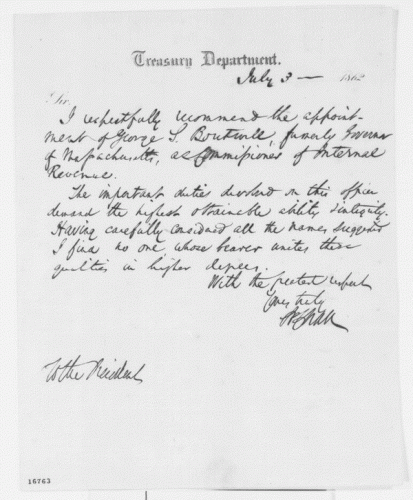
Here’s a letter from the Treasury Secretary to President Lincoln recommending someone for the new position of Commissioner of Internal Revenue (Library of Congress):

It’s a great example of the re-writing of, or ignoring huge parts of, history (which certainly both Democrats and Republicans do) to suit current political positions. Lincoln is useful as a symbol, not as a complex figure whose policy positions (including ambivalence about ending slavery) actually matter.

Related posts: MTV PSAs reference Holocaust, PETA’s Holocaust on Your Plate ads, romanticizing picking cotton, different ways of remembering national tragedies, Mammie souvenirs, Black women tend to White women, and the corporate plantation.


Chloe Angyal (from Feministing) sent me a link to an interesting, if disheartening, segment of her from GRITtv with Laura Flanders about women’s willingness to suffer as they try to meet beauty ideals. Seems that if you want to discourage women women from using tanning beds, don’t warn them about skin cancer. Just tell them it’ll make them ugly. For instance:

The women in the study were more concerned about avoiding ugliness than about avoiding potentially deadly cancer.

UPDATE: Be sure and check out the comments to the video over at YouTube. Really fascinating: lots of comments about Angyal’s appearance and statements like, “chole looks like a feminist, very ugly.” For an interesting discussion of the “feminists are ugly” reaction, read this post at Yes Means Yes.