Search results for embed


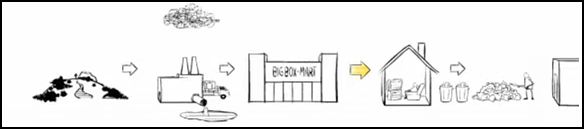
We previously posted Annie Leonard’s breakthrough video, The Story of Stuff, and a follow up, The Story of Bottled Water. Kraig H. sent along another by Leonard on how cap and trade will not stop climate change:

Lisa Wade, PhD is an Associate Professor at Tulane University. She is the author of American Hookup, a book about college sexual culture; a textbook about gender; and a forthcoming introductory text: Terrible Magnificent Sociology. You can follow her on Twitter and Instagram.


Danielle Q. sent us this gem, a 1980s commercial for a doll called My Child. It teaches girls all the important parts of being a mom:

  • Others will judge you as a mother based on how well-dressed and groomed your kids are.
  • Mothering requires a lot of repetitive, time-consuming work, but good moms think “it’s a pleasure.”
  • At age 8 or so, you should already be thinking of yourself as a “little mommy.”

Here you go:


Last week I linked to the first episode of the 1972 BBC documentary, Ways of Seeing (thanks again to Christina W.).  The second episode, partially embedded below offers an art historian’s perspective on the objectification of women in European art and advertising, starting with paintings of nude women.  “To be naked,” he argues, “is to be oneself.  To be nude is to be seen naked by others and yet not recognized for oneself. A nude has to be seen as an object in order to be a nude… they are there to feed an appetite, not to have any of their own.”

And there’s a very provocative statement about hair and hairlessness (down there) in the midst.

Parts One and Two of Four:

Lisa Wade, PhD is an Associate Professor at Tulane University. She is the author of American Hookup, a book about college sexual culture; a textbook about gender; and a forthcoming introductory text: Terrible Magnificent Sociology. You can follow her on Twitter and Instagram.

Chris Marshal and Captain Crab sent along this gem from The Second City Network:

Borrowed from Evolving Thoughts, via Pharyngula.

More on Disney: media consolidation and Tinkerbell, the real Johnny Appleseed, fallen princesses, modernizing the fairy tale, pickaninny slaves in Fantasia? yes, racist Disney characters, infantilizing adult women, gendered Disney t-shirts for kids, Deconstructing Disney princesses, are the new Disney princesses feminist?, race and gender in Princess and the Frog, socializing girls into marriage, and…

…did you know that the very first political tv commercial was made by Disney?  I like Ike!

Lisa Wade, PhD is an Associate Professor at Tulane University. She is the author of American Hookup, a book about college sexual culture; a textbook about gender; and a forthcoming introductory text: Terrible Magnificent Sociology. You can follow her on Twitter and Instagram.
Dmitriy T.M. sent along a Slate slideshow chock full of interesting information on cigarettes and health warnings internationally. I found this particular tidbit most compelling:

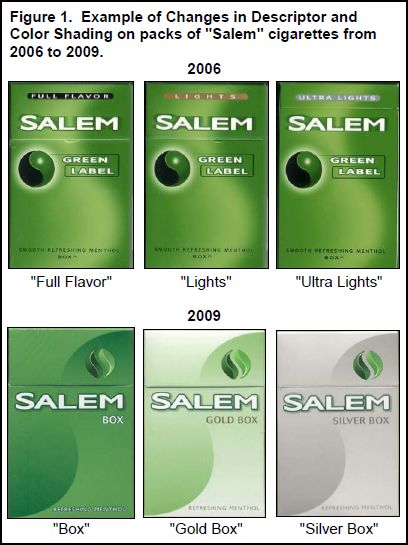
As of June 22, 2010, U.S. cigarette manufacturers are no longer allowed to use the words “light,” “low,” and “mild” to describe their product because it gives the false impression that these cigarettes are better for you than others (source). In place of the words, however, manufacturers are using light and dark colors.  Between 2006 and 2009, for example, Salem cigarettes phased out their packages labeled with words (top) and moved to color based differentiation (bottom):

Marlboro has issued a “cheat sheet,” showing the move from descriptors to colors:

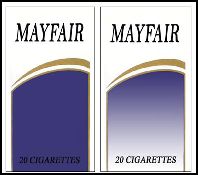
This is a very strategic move on the part of cigarette manufacturers, who know that the colors give consumers the same impression as the words.  At least one study has shown as much:

Scientists at Roswell Park Cancer Institute in Buffalo, N.Y., studied 197 smokers and 200 nonsmokers who were shown two mock cigarette packs, one light blue and one dark blue.

They were then asked, “Which one would you buy if you were trying to reduce the risks to your health?” Eighty-seven percent of those surveyed selected the lighter-shaded pack, while just 8 percent chose the darker-shaded pack.

The New York City Health Department is trying to combat this new strategy with commercials aimed at exposing it:

Lisa Wade, PhD is an Associate Professor at Tulane University. She is the author of American Hookup, a book about college sexual culture; a textbook about gender; and a forthcoming introductory text: Terrible Magnificent Sociology. You can follow her on Twitter and Instagram.


Christina W. alerted us to the availability of the first episode of John Berger’s 1972 BBC documentary, Ways of Seeing.  Berger was is a artist, author, and art critic.  In the first episode of the documentary (in four parts below) he asks how the ease of reproduction made possible by the camera (both still and moving) has changed the meaning of art.  The episode is a bit slow (for my taste), but has some interesting ideas.

First he argues that the ability to reproduce works of art in books, on posters, postcards, and television screens means that art is experienced in a decontextualized way (or in the context of, say, your living room). No longer something we pilgrimage to, to consume in a very specific context, they come to us.  This, he argues, has multiplied a work of art’s possible meanings.

As an aside, he makes an interesting argument that the obsession with authenticity — “usually linked with cash value,” he says, “but also invoked in the name of culture and civilization” — is actually “a substitute for what paintings lost when the camera made them reproducible.”

He then talks about how our experience of art is mediated by media (whether it be an art book or a discussion of art in a television program), so that our reaction to it is inevitably shaped by its re-interpretation.  The art critic, for example, tells us what to think about a piece of art. (No doubt, his call for skepticism certainly can be applied to Sociological Images.)

But reproduction and the multiplication of meaning also makes it easier to make connections and have personalized reactions.

(Btw, there is a pretty awesome moment at 4:38 of the third installment.)

Start watching Episode Two here.

Lisa Wade, PhD is an Associate Professor at Tulane University. She is the author of American Hookup, a book about college sexual culture; a textbook about gender; and a forthcoming introductory text: Terrible Magnificent Sociology. You can follow her on Twitter and Instagram.
This two-minute clip from Toddlers and Tiara’s (a reality show about child beauty pageants), sent in by Dmitriy T.M., is a great example of how mothers teach their daughters that beauty hurts… and that pain is a price they should be willing to pay:

Lisa Wade, PhD is an Associate Professor at Tulane University. She is the author of American Hookup, a book about college sexual culture; a textbook about gender; and a forthcoming introductory text: Terrible Magnificent Sociology. You can follow her on Twitter and Instagram.


Sociologist Geographer David Harvey’s analysis of the current economic crisis is engagingly illustrated in this 11-minute video.  Harvey evaluates individual, institutional, ideological, cultural, and policy explanations for the recession.  He then explains Marx’s insights into the “internal contradictions of capital accumulation”:  capitalists want to pay low wages, but if they’re paying low wages, then no one can buy their stuff.  If both high wages and low wages translate into no profits, where does that leave capitalism?

From Cognitive Media via BoingBoing and Karl Bakeman.

Buy Harvey’s book, The Enigma of Capital and the Crises of Capitalism.

Lisa Wade, PhD is an Associate Professor at Tulane University. She is the author of American Hookup, a book about college sexual culture; a textbook about gender; and a forthcoming introductory text: Terrible Magnificent Sociology. You can follow her on Twitter and Instagram.