

Neha M. sent us this fun little video that looks at women in beer commercials. Enjoy!
Search results for embed
The Equal Justice Initiative just released a report about racial bias in jury selection, particularly in the South. I first heard about it on NPR. Racial discrimination in jury selection is illegal, but evidence suggests it’s still quite common, particularly through the use of peremptory challenges (the ability of attorneys to exclude a certain number of potential jurors without having to say why or justify it).
The results are striking; for instance, “…in Houston County, Alabama, 80% of African Americans qualified for jury service have been struck by prosecutors in death penalty cases” (p. 4 of the report).
Here’s a short video about one case:
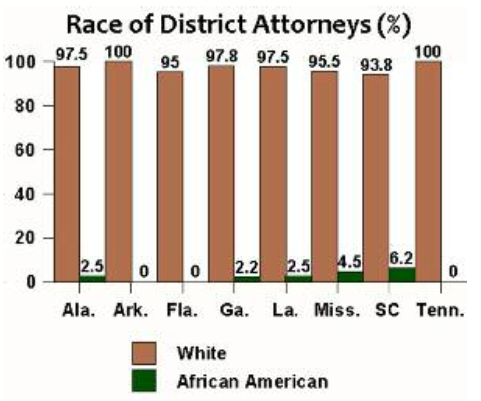
The report doesn’t have as many informational images as I’d like, but here’s one showing the race of District Attorneys in several Southern states:
This video gives a historical overview, though it’s maybe not the most captivating description you’ll ever encounter:
And with that, dear readers, I’m off to court, as I got a jury summons and now must find out if I’ll end up on an actual jury. I’m taking lots of reading material.

Today we’ve got two examples of the sexual objectification of Black men.
Margaret M. sent us this commercial she recently saw on TV in Budapest. It’s for an ice cream bar called Maxi King, and I think it’s not stretching to say that the ice cream bar is a stand-in for the guy’s penis:
The placement of the container she takes it out of, her sexy look, the shot of the ice cream with the white center and the caramel goo…yeah, that’s a penis. And the commercial is playing on the stereotype that Black men are particularly well-endowed. Massive satisfaction!
In both cases, Black men’s sexuality is fetishized for White audiences. They represent a fantasy of exotic, hypersexual, and sexually-gifted Black men. While the stereotype could appear positive — after all, they’re presented as desirable sexual partners — the flip side is that Black men are thus also often presented as more animalistic and sexually aggressive than White men, a stereotype that has been used against them time and time again.
And as we see in the second commercial, representing a fantasy means you are interesting because of that fantasy, not because of who you are. When the man failed to live up to the woman’s fantasy, not only did she no longer find him attractive, she and her friend found the situation laughable…because you certainly wouldn’t want to sleep with, or even date, a Black man from Shropshire. If he’s not an exotic sexual fantasy, what’s the point?
UPDATE: Reader Carlo says,
I took the joke in the second commercial to be on the woman. She allowed her race based assessment of the man as an exotic other to make a fool of her when the man proved to be just like her (from somewhere local). Even though this commercial is obviously playing on recognized stereotypes (women find exotic men attractive), it sort of points out the ridiculousness of those assumptions. In the end, her friend is laughing at her for being, essentially, that daft white audience that equates blackness with the exotic.
For another take on fetishizing Black men, see our post on male sex workers in the Caribbean.
Gwen Sharp is an associate professor of sociology at Nevada State College. You can follow her on Twitter at @gwensharpnv.

Mitchel Stein sent in a video a woman took of the “USA” section of the ethnic food aisle in a German grocery store. It’s an interesting look at what types of foods/brands are associated (at least in this store) with the U.S.:
I suspect that a lot of citizens of the U.S. wouldn’t necessarily think of those items if they tried to think of quintessentially American foods, much like foods defined as Chinese often aren’t found in China (e.g., the fortune cookie). It’s a good example of the social construction of national foods — that is, a set of food items become associated with a particular culture or nation, which may or may not align with the foods members of that culture most prefer or eat most frequently.
Also, apparently we in the U.S. are most associated with processed sweet/dessert items, and BBQ sauce.
Though I was super excited to see Head Country BBQ sauce, since it’s made in northern Oklahoma!
Tom Megginson of Change Marketing and Kandirra sent us a stunning example of the objectification of women in advertising. It’s a commercial for Rosgosstrakh, the largest insurance company in Russia, advertising their car insurance. How do they do so? By painting pictures of vehicles on (headless) women’s breasts and showing various hands fondling/smushing/jiggling them.
Reader lizardbreath pointed out that showing breasts on TV wouldn’t be as shocking in a lot of cultures as it would be in the U.S., which I think is a valid point. What makes it seem objectifying to both of us isn’t just the breasts themselves, but the headless women (so you have disembodied breasts). I also noticed that at one point a woman pushes the (also disembodied) male hands away, which implies she’s being groped when she doesn’t want to be.
more...
A reader who asked to remain anonymous sent in a video about a recent interview by Star Jones with the lawyer for Kelsey Peterson, a teacher accused in 2007 of fleeing to Mexico in order to live with a 13-year-old student of hers (he was 12 at the time they began having sex together). In the interview, the lawyer for Peterson says he “resents” the boy being referred to as a child because he is a “Latino machismo teenager” (a phrase that doesn’t even make sense) and “manly”:
Notice that the lawyer also argues, at about 1:25, that teen boys have a high sex drive, which somehow excuses an adult woman having sex with a 12-year-old. In addition, at 3:30 in Jones mentions that some individuals have implied the kid couldn’t be a victim because he was physically larger than other kids his age (5′ 6″ in 8th grade, which doesn’t sound super unusual to me); it sounds like Peterson’s defenders have questioned his age because of his size.
Jones calls him out on his implication that Latino teens are hyper-sexual and therefore this boy shouldn’t be seen as a victim. At about 5:45 one of her guests discusses the adultification of non-White children — that is, the way they are often treated as adults, regardless of their age. Ann Arnett Ferguson discusses this process at length in her book, Bad Boys: Public Schools in the Making of Black Masculinity. This adultification includes assumptions that they are sexual at earlier ages than White children.
From what Jones and one of her guests say, it also appears that the fact that he was an undocumented immigrant has also been used as a way to undermine his ability to claim victim status. At about 7:55 a guest discusses the way that referring to people as “aliens” dehumanizes them, making it easier to deny them equal legal protection. (Side note: Jones mentions the history of immigration in the U.S. and in doing so says everyone in the U.S. is descended from immigrants, something Native Americans might find surprising, though I suppose if you go back a few thousand years to the migration from Asia to North America, technically yes, they are immigrants.)
When I searched for news stories about the case, I came across one at ABC news in which the boy is described as “a sexually-active sixth-grade student with a crush on her,” which seems to me to be reminiscent of the way female rape victims are often asked about their sexual history, as though they cannot be true victims if they have been sexually active.
The ABC story contains this quote from Peterson’s lawyer:
From the beginning, he was trying to entice her. There’s no question about that…He would try to kiss her, he would grab her, he would do these things. She didn’t initiate this relationship. That young man did.
Again the blame is placed not on the adult woman but on a 12-year-old boy. Peterson says she was shocked the first time he kissed her, which was in her kitchen — a place that maybe a thinking person wouldn’t have a 12-year-old student in. She also says his parents knew about and were fine with their sexual interactions; they dispute this.
Perhaps drawing on the stereotype of macho Latino men, her lawyer said,
He used to tell her what she could wear. And whether she could wear makeup and the length of her skirts in terms of where they were gonna go and what they were gonna do…He had a very, very strong influence over her in terms of controlling her behavior.
The comments to the ABC story are pretty fascinating too.
This is a disturbing example of the way that boys, and particularly non-White boys, are generally denied victim status when it comes to sex because our cultural beliefs include the idea that boys want sex and attempt to get it at an early age, and thus can’t really be vulnerable to sexual assault or coercion. For another example, see this post about how Jimmy Kimmel reacts when Lil’ Wayne confirms that he lost his virginity at age 11.
In “Sports, Jobs, and Taxes: Are New Stadiums Worth the Cost?”, Roger Noll and Andrew Zimbalist question whether athletic stadiums are a useful or effective means of economic development for communities.* When new stadiums are built, they are often heavily subsidized by taxpayers, particularly by issuing state or city bonds.
Cities do this in the hopes of improving the economy. They argue that new arenas directly create construction jobs and indirectly create more employment opportunities by bringing in fans who patronize local businesses. They also often hope that the prestige of having a new stadium will make the city more attractive to companies looking to relocate, as well as tourists.
Noll and Zimbalist looked at the effects of stadium construction in a number of cities, as have others. They conclude,
In every case, the conclusions are the same. A new sports facility has an extremely small (perhaps even negative) effect on overall economic activity and employment. No recent facility appears to have earned anything approaching a reasonable return on investment. (p. 249)
However, cities continue to subsidize stadiums, despite the evidence that they aren’t economically practical, as well as frequent public opposition. Among other things, they often face a form of economic blackmail: teams threaten to move to another city that will build them an updated facility, with fancier concessions, luxury seats, club boxes, and the like, if their host city won’t. While the benefit to cities is doubtful, the additional revenue brought in by these luxuries definitely benefits the teams.
I thought of their findings when I saw a video over at Jay Smooth’s blog about the new stadiums built for the Yankees and the Mets. It’s 18 minutes long, but it’s pretty funny and also highlights some of the issues Noll and Zimbalist bring up (particularly why teams want updated stadiums, effects on the local economy, fans’ differing reactions to new facilities, and teams’ threats to move if they didn’t get what they wanted). You might want to skip the intro, which is about 40 seconds long.
Stadium Status from Internets Celebrities on Vimeo.
* Source: Sport in Contemporary Society, 6th edition, edited by D. Stanley Eitzen. 2001. P. 248-255.
Many of you have probably by now seen this video of a group of young girls dancing to Beyonce’s Single Ladies on the World of Dance tour. Huong L., Jeff S., and Dmitriy T.M. sent it in and asked us to comment on it. First, the video… which is stunning:
I think I’ve watched this a half dozen times and I’m mesmerized.
But to the analysis…
After the Single Ladies video came out there was a rash of parents uploading videos of their kids dancing along to the video. We featured a particularly impressive example of a preschool-aged girl dancing to the video and offered it as an example of how kids are active agents in their own socialization. You might also apply this idea to this video, sent in by Heather B. (which I am not going to comment on because I can’t figure out the context).
Certainly children do make choices about what to mimick. In a culture that highly sexualizes young girls, we shouldn’t be that surprised when they make choices that we find incongruent with (our beliefs about) childhood. The World of Dance routine, however, is not simply an example of children being active in their own socialization and responding to the powerful messages of self-objectification aimed at girls of all ages. In this case, many, many adults were instrumental in producing the product: their dance teacher(s), the choreographer, their parents, and the producers of the tour, to name the obvious. These girls are performing a highly sexualized routine because many adults chose to sexualize them.
For more examples of the sexualization of young girls, see our posts on sexually suggestive teen brands, adultifying children of color, “trucker girl” baby booties, “future trophy wife” kids’ tee, House of Dereón’s girls’ collection, “is modesty making a comeback?“, more sexualized clothes and toys, sexist kids’ tees, a trifecta of sexualizing girls, a zebra-striped string bikini for infants, a nipple tassle t-shirt, even more icky kids’ t-shirts, “are you tighter than a 5th grader?” t-shirt, the totally gross “I’m tight like spandex” girls’ t-shirt, and a Halloween costume post.
—————————
Lisa Wade is a professor of sociology at Occidental College. You can follow her on Twitter and Facebook.
Lisa Wade, PhD is an Associate Professor at Tulane University. She is the author of American Hookup, a book about college sexual culture; a textbook about gender; and a forthcoming introductory text: Terrible Magnificent Sociology. You can follow her on Twitter and Instagram.
The Equal Justice Initiative just released a report about racial bias in jury selection, particularly in the South. I first heard about it on NPR. Racial discrimination in jury selection is illegal, but evidence suggests it’s still quite common, particularly through the use of peremptory challenges (the ability of attorneys to exclude a certain number of potential jurors without having to say why or justify it).
The results are striking; for instance, “…in Houston County, Alabama, 80% of African Americans qualified for jury service have been struck by prosecutors in death penalty cases” (p. 4 of the report).
Here’s a short video about one case:
The report doesn’t have as many informational images as I’d like, but here’s one showing the race of District Attorneys in several Southern states:
This video gives a historical overview, though it’s maybe not the most captivating description you’ll ever encounter:
And with that, dear readers, I’m off to court, as I got a jury summons and now must find out if I’ll end up on an actual jury. I’m taking lots of reading material.
Today we’ve got two examples of the sexual objectification of Black men.
Margaret M. sent us this commercial she recently saw on TV in Budapest. It’s for an ice cream bar called Maxi King, and I think it’s not stretching to say that the ice cream bar is a stand-in for the guy’s penis:
The placement of the container she takes it out of, her sexy look, the shot of the ice cream with the white center and the caramel goo…yeah, that’s a penis. And the commercial is playing on the stereotype that Black men are particularly well-endowed. Massive satisfaction!
In both cases, Black men’s sexuality is fetishized for White audiences. They represent a fantasy of exotic, hypersexual, and sexually-gifted Black men. While the stereotype could appear positive — after all, they’re presented as desirable sexual partners — the flip side is that Black men are thus also often presented as more animalistic and sexually aggressive than White men, a stereotype that has been used against them time and time again.
And as we see in the second commercial, representing a fantasy means you are interesting because of that fantasy, not because of who you are. When the man failed to live up to the woman’s fantasy, not only did she no longer find him attractive, she and her friend found the situation laughable…because you certainly wouldn’t want to sleep with, or even date, a Black man from Shropshire. If he’s not an exotic sexual fantasy, what’s the point?
UPDATE: Reader Carlo says,
I took the joke in the second commercial to be on the woman. She allowed her race based assessment of the man as an exotic other to make a fool of her when the man proved to be just like her (from somewhere local). Even though this commercial is obviously playing on recognized stereotypes (women find exotic men attractive), it sort of points out the ridiculousness of those assumptions. In the end, her friend is laughing at her for being, essentially, that daft white audience that equates blackness with the exotic.
For another take on fetishizing Black men, see our post on male sex workers in the Caribbean.
Gwen Sharp is an associate professor of sociology at Nevada State College. You can follow her on Twitter at @gwensharpnv.
Mitchel Stein sent in a video a woman took of the “USA” section of the ethnic food aisle in a German grocery store. It’s an interesting look at what types of foods/brands are associated (at least in this store) with the U.S.:
I suspect that a lot of citizens of the U.S. wouldn’t necessarily think of those items if they tried to think of quintessentially American foods, much like foods defined as Chinese often aren’t found in China (e.g., the fortune cookie). It’s a good example of the social construction of national foods — that is, a set of food items become associated with a particular culture or nation, which may or may not align with the foods members of that culture most prefer or eat most frequently.
Also, apparently we in the U.S. are most associated with processed sweet/dessert items, and BBQ sauce.
Though I was super excited to see Head Country BBQ sauce, since it’s made in northern Oklahoma!
Tom Megginson of Change Marketing and Kandirra sent us a stunning example of the objectification of women in advertising. It’s a commercial for Rosgosstrakh, the largest insurance company in Russia, advertising their car insurance. How do they do so? By painting pictures of vehicles on (headless) women’s breasts and showing various hands fondling/smushing/jiggling them.
Reader lizardbreath pointed out that showing breasts on TV wouldn’t be as shocking in a lot of cultures as it would be in the U.S., which I think is a valid point. What makes it seem objectifying to both of us isn’t just the breasts themselves, but the headless women (so you have disembodied breasts). I also noticed that at one point a woman pushes the (also disembodied) male hands away, which implies she’s being groped when she doesn’t want to be.
more...
A reader who asked to remain anonymous sent in a video about a recent interview by Star Jones with the lawyer for Kelsey Peterson, a teacher accused in 2007 of fleeing to Mexico in order to live with a 13-year-old student of hers (he was 12 at the time they began having sex together). In the interview, the lawyer for Peterson says he “resents” the boy being referred to as a child because he is a “Latino machismo teenager” (a phrase that doesn’t even make sense) and “manly”:
Notice that the lawyer also argues, at about 1:25, that teen boys have a high sex drive, which somehow excuses an adult woman having sex with a 12-year-old. In addition, at 3:30 in Jones mentions that some individuals have implied the kid couldn’t be a victim because he was physically larger than other kids his age (5′ 6″ in 8th grade, which doesn’t sound super unusual to me); it sounds like Peterson’s defenders have questioned his age because of his size.
Jones calls him out on his implication that Latino teens are hyper-sexual and therefore this boy shouldn’t be seen as a victim. At about 5:45 one of her guests discusses the adultification of non-White children — that is, the way they are often treated as adults, regardless of their age. Ann Arnett Ferguson discusses this process at length in her book, Bad Boys: Public Schools in the Making of Black Masculinity. This adultification includes assumptions that they are sexual at earlier ages than White children.
From what Jones and one of her guests say, it also appears that the fact that he was an undocumented immigrant has also been used as a way to undermine his ability to claim victim status. At about 7:55 a guest discusses the way that referring to people as “aliens” dehumanizes them, making it easier to deny them equal legal protection. (Side note: Jones mentions the history of immigration in the U.S. and in doing so says everyone in the U.S. is descended from immigrants, something Native Americans might find surprising, though I suppose if you go back a few thousand years to the migration from Asia to North America, technically yes, they are immigrants.)
When I searched for news stories about the case, I came across one at ABC news in which the boy is described as “a sexually-active sixth-grade student with a crush on her,” which seems to me to be reminiscent of the way female rape victims are often asked about their sexual history, as though they cannot be true victims if they have been sexually active.
The ABC story contains this quote from Peterson’s lawyer:
From the beginning, he was trying to entice her. There’s no question about that…He would try to kiss her, he would grab her, he would do these things. She didn’t initiate this relationship. That young man did.
Again the blame is placed not on the adult woman but on a 12-year-old boy. Peterson says she was shocked the first time he kissed her, which was in her kitchen — a place that maybe a thinking person wouldn’t have a 12-year-old student in. She also says his parents knew about and were fine with their sexual interactions; they dispute this.
Perhaps drawing on the stereotype of macho Latino men, her lawyer said,
He used to tell her what she could wear. And whether she could wear makeup and the length of her skirts in terms of where they were gonna go and what they were gonna do…He had a very, very strong influence over her in terms of controlling her behavior.
The comments to the ABC story are pretty fascinating too.
This is a disturbing example of the way that boys, and particularly non-White boys, are generally denied victim status when it comes to sex because our cultural beliefs include the idea that boys want sex and attempt to get it at an early age, and thus can’t really be vulnerable to sexual assault or coercion. For another example, see this post about how Jimmy Kimmel reacts when Lil’ Wayne confirms that he lost his virginity at age 11.
In “Sports, Jobs, and Taxes: Are New Stadiums Worth the Cost?”, Roger Noll and Andrew Zimbalist question whether athletic stadiums are a useful or effective means of economic development for communities.* When new stadiums are built, they are often heavily subsidized by taxpayers, particularly by issuing state or city bonds.
Cities do this in the hopes of improving the economy. They argue that new arenas directly create construction jobs and indirectly create more employment opportunities by bringing in fans who patronize local businesses. They also often hope that the prestige of having a new stadium will make the city more attractive to companies looking to relocate, as well as tourists.
Noll and Zimbalist looked at the effects of stadium construction in a number of cities, as have others. They conclude,
In every case, the conclusions are the same. A new sports facility has an extremely small (perhaps even negative) effect on overall economic activity and employment. No recent facility appears to have earned anything approaching a reasonable return on investment. (p. 249)
However, cities continue to subsidize stadiums, despite the evidence that they aren’t economically practical, as well as frequent public opposition. Among other things, they often face a form of economic blackmail: teams threaten to move to another city that will build them an updated facility, with fancier concessions, luxury seats, club boxes, and the like, if their host city won’t. While the benefit to cities is doubtful, the additional revenue brought in by these luxuries definitely benefits the teams.
I thought of their findings when I saw a video over at Jay Smooth’s blog about the new stadiums built for the Yankees and the Mets. It’s 18 minutes long, but it’s pretty funny and also highlights some of the issues Noll and Zimbalist bring up (particularly why teams want updated stadiums, effects on the local economy, fans’ differing reactions to new facilities, and teams’ threats to move if they didn’t get what they wanted). You might want to skip the intro, which is about 40 seconds long.
Stadium Status from Internets Celebrities on Vimeo.
* Source: Sport in Contemporary Society, 6th edition, edited by D. Stanley Eitzen. 2001. P. 248-255.
Many of you have probably by now seen this video of a group of young girls dancing to Beyonce’s Single Ladies on the World of Dance tour. Huong L., Jeff S., and Dmitriy T.M. sent it in and asked us to comment on it. First, the video… which is stunning:
I think I’ve watched this a half dozen times and I’m mesmerized.
But to the analysis…
After the Single Ladies video came out there was a rash of parents uploading videos of their kids dancing along to the video. We featured a particularly impressive example of a preschool-aged girl dancing to the video and offered it as an example of how kids are active agents in their own socialization. You might also apply this idea to this video, sent in by Heather B. (which I am not going to comment on because I can’t figure out the context).
Certainly children do make choices about what to mimick. In a culture that highly sexualizes young girls, we shouldn’t be that surprised when they make choices that we find incongruent with (our beliefs about) childhood. The World of Dance routine, however, is not simply an example of children being active in their own socialization and responding to the powerful messages of self-objectification aimed at girls of all ages. In this case, many, many adults were instrumental in producing the product: their dance teacher(s), the choreographer, their parents, and the producers of the tour, to name the obvious. These girls are performing a highly sexualized routine because many adults chose to sexualize them.
For more examples of the sexualization of young girls, see our posts on sexually suggestive teen brands, adultifying children of color, “trucker girl” baby booties, “future trophy wife” kids’ tee, House of Dereón’s girls’ collection, “is modesty making a comeback?“, more sexualized clothes and toys, sexist kids’ tees, a trifecta of sexualizing girls, a zebra-striped string bikini for infants, a nipple tassle t-shirt, even more icky kids’ t-shirts, “are you tighter than a 5th grader?” t-shirt, the totally gross “I’m tight like spandex” girls’ t-shirt, and a Halloween costume post.
—————————
Lisa Wade is a professor of sociology at Occidental College. You can follow her on Twitter and Facebook.
Lisa Wade, PhD is an Associate Professor at Tulane University. She is the author of American Hookup, a book about college sexual culture; a textbook about gender; and a forthcoming introductory text: Terrible Magnificent Sociology. You can follow her on Twitter and Instagram.