
Search results for embed

After reading my recent post on how Gypsy jazz guitarist Django Reinhardt survived World War II (hint: rank-and-file Nazis loved jazz!), Dmitriy T.M. sent me a link to a fascinating account of a German jazz band, called Charlie and His Orchestra, that was put together by Joseph Goebbels, a Nazi propaganda guy.

To recap, jazz music was labeled “Neggernmusik.”  Attributed (rightly) to blacks and Jews, it was considered pollution to German sensibilities.  Jazz lovers, jazz musicians, and swing dancers were all sent to concentration camps.
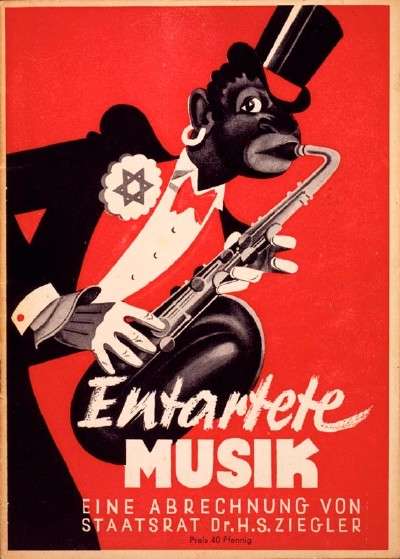
Nevertheless, Undercover Black Man describes how Goebbels saw potential in the music and, so, “weaponized” it to “screw with British and American minds.”

Charlie and His Orchestra recorded jazz standards, but changed the lyrics to “anti-British, anti-American, anti-Communist or antisemitic messages.”

The songs were broadcast via medium-wave and short-wave radio to Great Britain and North America. It was all about taunting and demoralizing the Allies… and trash-talking Winston Churchill and F.D.R. by name.

In this clip, the Orchestra, covering Goody Goody, is accompanied by WWII photographs. The propaganda starts at 1:04:

For more, check out the Charlie and His Orchestra versions of You Can’t Stop Me From Dreaming, You’re Driving Me Crazy, and Makin’ Whoopee.

Lisa Wade, PhD is an Associate Professor at Tulane University. She is the author of American Hookup, a book about college sexual culture; a textbook about gender; and a forthcoming introductory text: Terrible Magnificent Sociology. You can follow her on Twitter and Instagram.

Tom Schaller recently posted over at FiveThirtyEight about a new Hyundai commercial. The commercial suggests that you need to get a safe car because of all the young drivers on the road:

Here’s another:

Schaller argues that, while the commercials may be entertaining enough, he can’t help but wonder how people would react to similar commercials mocking the other age group over-represented in accidents — the elderly, according to the Insurance Institute for Highway Safety:

Is Hyundai wrong to say that teens, particularly those who just got their licenses, are more dangerous drivers than other age groups? No. But though people might joke about elderly drivers, I agree with Schaller — I can’t imagine a company putting out ads with a similar mocking tone and not immediately getting a ton of negative feedback ending in pulling the commercials and apologizing.

And this likely has a lot to do with the fact that older Americans are organized and represented by groups like the AARP and are thus able to wield political pressure and protest negative portrayals in a way that teens aren’t. This doesn’t mean that older people don’t get mocked (especially in TV shows and movies), but that a company is likely to be much more afraid of insulting them than insulting 16-year-olds.

Gwen Sharp is an associate professor of sociology at Nevada State College. You can follow her on Twitter at @gwensharpnv.


Leah S. asked us to talk about Beyoncé’s new video, Why Don’t You Love Me, and I think Ann at Feministing had some interesting things to say, so I’m going to borrow her insights.

Noting both Beyoncé’s video and the recently released video for Babyfather by Sade, Ann observes:

…both Sade and Beyonce are cast as “traditional” homemakers in retro-styled videos. Beyonce’s retro romp seemed (at least to me) a bit tongue-in-cheek, whereas Sade pretty earnestly makes Jell-O and keeps house. But regardless, they’re both wearing vintage-looking sexy slips, making dinner, hanging out at home during the day, etc.

But they’re not simply nods to the ’50s.  Because both women are black, the videos also potentially subvert the idea of the perfect housewife of that era.  Ann continues:

I know there were certainly upper-middle-class women of color in the ’50s and ’60s, but this image of the happy-but-secretly-unhappy housewife is stereotypically white. By virtue of race, Beyonce and Sade are twisting that stereotype.

And that twist is very political.  Consider this: In American politics today, the “perfect” mother is one who does not work and stays home with her children.  Unless she’s poor.  Poor women who want to stay home with their children are called lazy, welfare cheats.  If you’re poor, you can only be a good mother by working.

Because race and class are correlated in U.S. society, and the “welfare queen” is a race-specific trope that usually refers to poor, black women, these videos might very well challenge the white-middle/upper-class-homemaker conflation.

Beyoncé, Why Don’t You Love Me:

Sade, Babyfather:

Lisa Wade, PhD is an Associate Professor at Tulane University. She is the author of American Hookup, a book about college sexual culture; a textbook about gender; and a forthcoming introductory text: Terrible Magnificent Sociology. You can follow her on Twitter and Instagram.

This 4-minute 20-second video, by Colorlines, uses true stories to illustrate the impact of a 1996 law that authorizes the (sometimes retroactive) deportation of non-citizens convicted of any crime, including misdemeanors and traffic violations.  In 2008, the video reports, the U.S. government deported almost 360,000 people on these grounds.

Via Racewire.

Lisa Wade, PhD is an Associate Professor at Tulane University. She is the author of American Hookup, a book about college sexual culture; a textbook about gender; and a forthcoming introductory text: Terrible Magnificent Sociology. You can follow her on Twitter and Instagram.


Yael S. sent along a 10-minute educational video by FilmFixation. In it, she asks viewers to consider the conditions in which historical photographs came to be.  “Why was it created,” she asks, “by whom, and for what purpose?”  It starts off a bit slow, but picks up with voiceover.  Please be alerted that there are images of racialized violence:

Lisa Wade, PhD is an Associate Professor at Tulane University. She is the author of American Hookup, a book about college sexual culture; a textbook about gender; and a forthcoming introductory text: Terrible Magnificent Sociology. You can follow her on Twitter and Instagram.


Tanita sent in this funny short video that addresses the sexism female authors have often faced when trying to get their work published or taken seriously in literary circles (some, such as Mary Ann Evans, better known as George Eliot, resorted to using male pen names to combat these problems).

What better way for female authors to deal with the situation than use their action-hero superpowers to combat sexist publishers? I present to you the Brontësaurus:

Confession: I know this will make many of you scream in horror, and that the book has all kinds of feminist overtones and is greatly beloved and majorly influenced literature, and I’m showing myself to be a literary heathen with no appreciation for the arts, but I read Jane Eyre once, and I think Charlotte Brontë’s most effective weapon might be her ability to get you bogged down reading lengthy Gothic descriptions of moors and stuff.

Though if you ever need to make me cringe and run, tell me you’re going to make me read Tess of the d’Urbervilles. I tried reading it just for fun once, and I have never been so pained.

Snehata K. sent in two commercials for Miller Lite that reproduce ideas of masculinity while encouraging men to do something usually seen as feminine: care about calories. In the commercials we see that it’s ok to drink beer with fewer calories than the regular, as long as you do it in a manly way:

What’s a feminine way of drinking light beer? Prioritizing calorie content over the taste. If you’re a guy, you can care about health/diet and thus want a lower-calorie beer, but only if you show you still care about beer the way men are supposed to: you appreciate the taste and won’t sacrifice it for anything.

Guys who forget that are embarrassingly girly. And being feminized is clearly stigmatizing, worthy of ridicule. Even women are disgusted by feminized men. So not only will men who fail to adequately perform masculinity be ridiculed by men, they’ll lose any chance with hot chicks, too. As they do so often, men are receiving a clear message: be sure you’re masculine in every way, all the time, or you risk losing any claim you have to a respected version of manhood.

Of course, if you really want to be manly, you need to stop caring about silly things like your health altogether and drink Miller High Life.


How have adults and young people weathered the worldwide economic downturn? This two-minute 12-second video shows that young people have been harder hit by joblessness in almost all OECD countries:

From the OECD Factblog.

Lisa Wade, PhD is an Associate Professor at Tulane University. She is the author of American Hookup, a book about college sexual culture; a textbook about gender; and a forthcoming introductory text: Terrible Magnificent Sociology. You can follow her on Twitter and Instagram.