Search results for The

***TRIGGER WARNING for racism and enslavement***

During a dark period of world history, intellectuals pondered where to draw the line between human and animal.  They arrayed humans hierarchically, from the lightest to the darkest skin.  Believing that Africans were ape-like, they weren’t sure whether to include apes as human, or Africans as apes.

One artifact of this thinking was the “human zoo.”  Kidnapped from their homes at the end of the 19th century and into the next, hundreds of indigenous people were put on display for white Westerners to view.  “Often they were displayed in villages built in zoos specifically for the show,” according to a Spiegel Online sent in by Katrin, “but they were also made to perform on stage for the amusement of a paying public.”  Many died quickly, being exposed to diseases foreign to them.

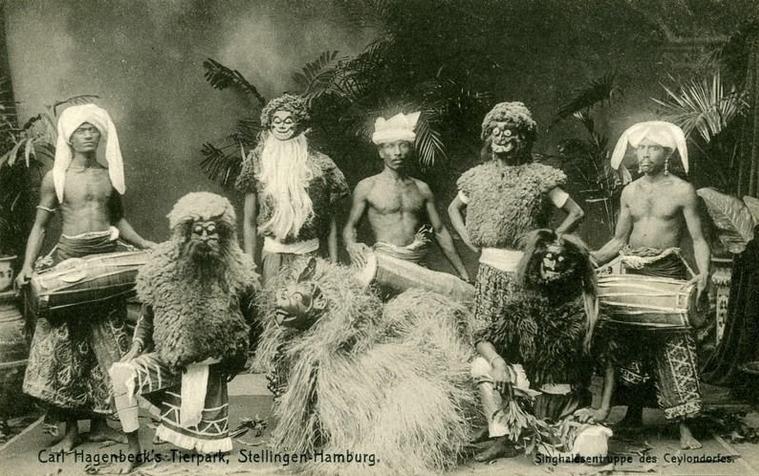
This group of captives is from Sri Lanka (called  Ceylon at the time):
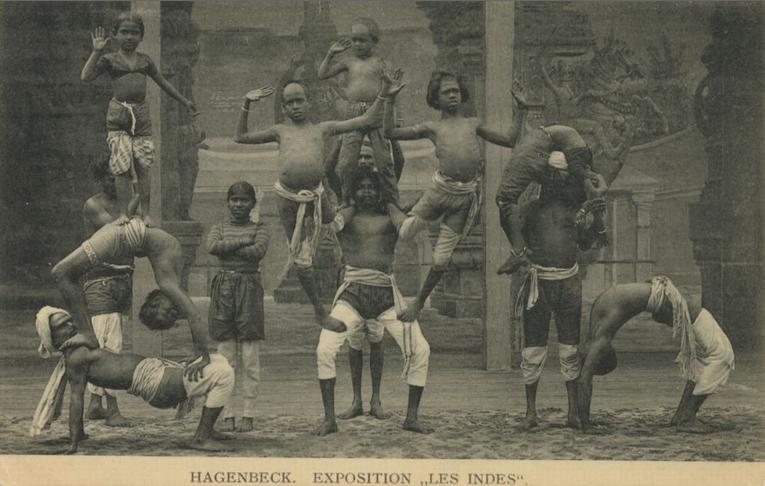
This photograph commemorates a show called “Les Indes,” featuring captives from India:
These captives are from Oromo in Ethiopia:
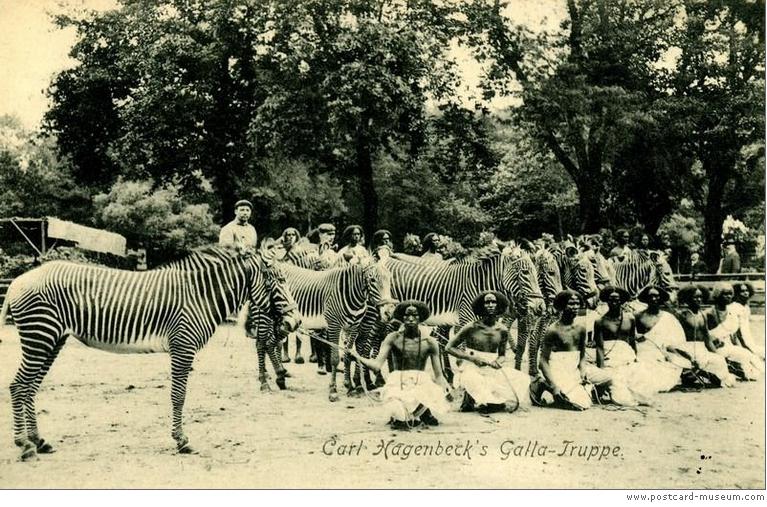
A German named Carl Hagenbeck was among the more famous men involved in human zoos.  He would go on expeditions in foreign countries and bring back both animals and people for European collections.  In his memoirs, he spoke of his involvement with pride, writing: “it was my privilege to be the first in the civilized world to present these shows of different races.”

The zoo in Hamburg still bears his name.

Lisa Wade, PhD is an Associate Professor at Tulane University. She is the author of American Hookup, a book about college sexual culture; a textbook about gender; and a forthcoming introductory text: Terrible Magnificent Sociology. You can follow her on Twitter and Instagram.
Cross-posted at Montclair SocioBlog.

Back in June, Mitt Romney said:

I want to make sure that we keep America a place of opportunity, where everyone… get[s] as much education as they can afford

After all, Mitt got as much education as he (his parents, really) could afford, so he thought it best if everyone had that same opportunity.

Opportunity – How much is that in American money?

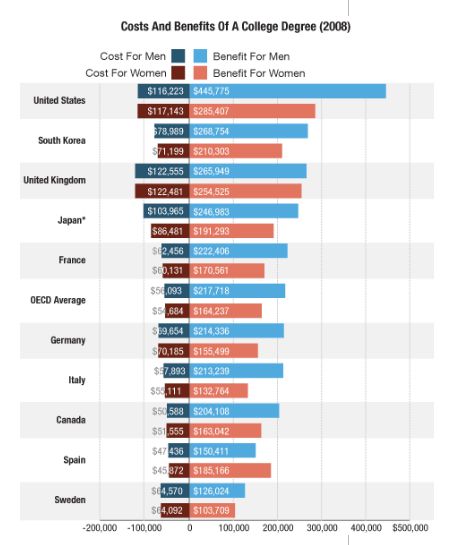
Yesterday, Planet Money  posted this graph showing the costs and benefits of a college education in several countries.

The title of the post summarizes the interpretation of the college-educated folks at Planet Money:

“College Costs More In America, But The Payoff Is Bigger”

But what if you look at the data from the other side?  Here’s the half-empty-glass title:

“College in the US Costs a Lot, and If You Can’t Afford It, You’re Really Screwed”

…or words to that effect.

What the chart seems to show is inequality — specifically, the inequality between the college educated and everyone else.  In advanced economies, like the those of the countries in the chart, education is important. But some of those countries, like the Scandinavian countries, have reduced the income sacrificed by non-college people relative to the college educated. Other countries favor a more unequal distribution of income.

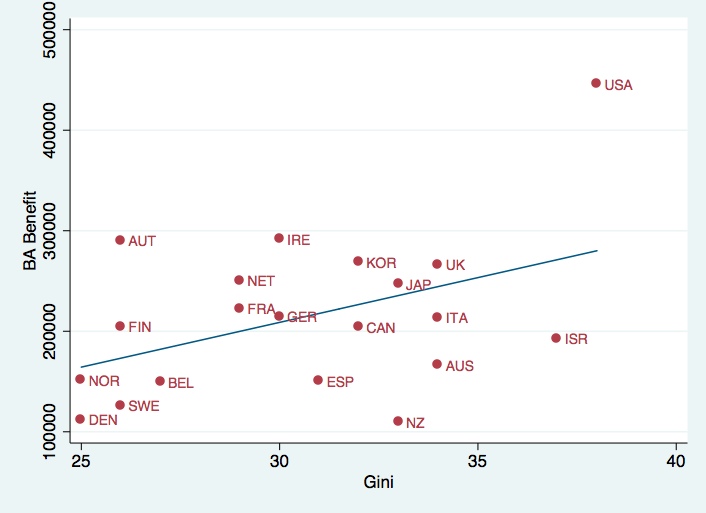
To look a little closer, I looked at the relationship between the payoff of a BA degree for men and a country’s Gini coefficient, a measure of inequality.  I used the ten countries in the Planet Money chart and added another ten OECD countries.

The correlation is 0.44.  The US is the clear outlier.  In the land of opportunity, if you’re a male, either you pay the considerable price of going to college, or you pay the price for not going to college.

With this inequality come the kinds of social consequences that Charles Murray elaborates in his latest book about non-educated Whites — disability, divorce, demoralization, death.

—————————

Jay Livingston is the chair of the Sociology Department at Montclair State University.  You can follow him at Montclair SocioBlog or on Twitter.

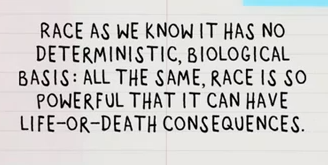
Dalton Conley’s newest animated video provides an overview of the social construction of race: the categories we define as race aren’t based in biology, yet they’re incredibly important factors that influence our opportunities, constraints, and life outcomes.

The Massachusetts Senate race between Scott Brown and Elizabeth Warren has brought heightened attention to claims of Native American ancestry in the U.S.. Warren appears to have at times claimed such ancestry, Cherokee and Delaware in particular. The Washington Post provided a thorough round-up of the issue. From what we know thus far, there’s no clear evidence of her claim. Like many families, especially in Oklahoma, her family has a vague account of one or more American Indian ancestors. The vagueness doesn’t necessarily mean it isn’t true, nor does a lack of tribal records. However, there’s a well-known “Indian princess” syndrome, where notably large numbers of people in the U.S. claim a distant Native American ancestor, about whom the details are usually sketchy and inconsistent. Certainly some of these family oral histories are based in some truth, but others are likely apocryphal (though the individuals reporting them may truly believe them).

So Warren’s claim to some Native American ancestry is at least unverified, and there’s an interesting issue there in why so many Americans happily accept stories of native ancestry with little question.

But I was struck by opponent Scott Brown’s comment in one of his debates with Warren. Via abc News:

“Elizabeth Warren said she was a Native American, a person of color,” Brown said, gesturing toward Warren. “As you can see, she’s not.”

The statement implies that we can tell, just from looking, whether someone is really Native American. We can see, obviously, that she isn’t. This gets at a bigger issue about judgements of authenticity. Individuals often have preconceived ideas about what a Native American should look and act like; their Indianness is expected to be clearly visible, both physically and culturally.

Given this, I was particularly struck by a video Katrin recently sent in a link to the Represent series created by The 1491s. The videos challenge the viewer to recognize that American Indians and their cultures are still vital and vibrant. But they also illustrate the problem with assuming that anyone can easily tell who is or isn’t Native American, and how they integrate or represent that identity in their daily lives. Here are a few, but I’d check out the full set at the 1491s website.

W.W. Norton has released a fun little animation answering this thorny question. It has to do with abundance and hoarding, and the technological innovations that underlie these things, as well as government’s willingness to redistribute wealth.

Enjoy:

See more of Norton’s videos at their YouTube channel.

Lisa Wade, PhD is an Associate Professor at Tulane University. She is the author of American Hookup, a book about college sexual culture; a textbook about gender; and a forthcoming introductory text: Terrible Magnificent Sociology. You can follow her on Twitter and Instagram.
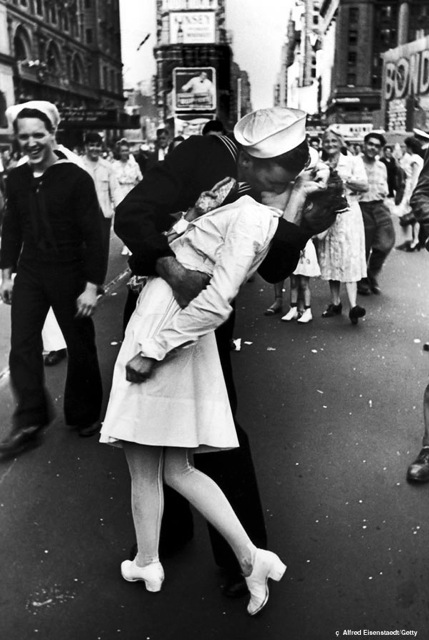
The photograph of a sailor kissing a woman on V-J Day in Times Square is an iconic one. Taken by photographer Alfred Eisenstaedt in Times Square on August 14, 1945, it is probably one of the most memorable images of WWII. As the Japanese surrender, the image seems to capture the jubilation at the end of a long war:

The image has become ubiquitous; you can buy it on posters and Valentine’s Day cards. Couples have re-enacted the famous image in Times Square. After the repeal of Don’t Ask Don’t Tell in 2012, the photograph was compared with one of a gay Marine kissing his boyfriend after returning from a tour.

Recently the people in the original photograph were identified. From their story, we now know that George Mendonsa was on a date with another woman when the Japanese surrendered. After a few drinks at a nearby bar, he went out on the street and grabbed Greta Zimmer Friedman for a kiss. According to the Mail Online,

“The excitement of the war being over, plus I had a few drinks,” he told CBS. “So when I saw the nurse, I grabbed her, and I kissed her.”

The article continues with an explanation of Friedman’s description of the experience:

“I did not see him approaching, and before I know it, I was in this vi[s]e grip.” Of course, that moment of wild elation, gratitude and passion was captured by LIFE photographer Alfred Eisenstaedt.

Later in the article, Friedman states,

That man was very strong. I wasn’t kissing him. He was kissing me.

Does a strong man grabbing a woman on the street in a “vise grip” and kissing her describe “wild elation, gratitude and passion”? Or does it describe a case of sexual assault? Feministing blogger Lori argues that the photograph does not capture the romantic moment that we believe it does. After reading her argument and studying the picture, I don’t think I could ever see it as anything other than the depiction of public sexual assault. As Lori argues,

 A closer look at the image in question shows corroborating details that become stomach-turning when properly viewed: the smirks on the faces of the sailors in the background; the firm grasp around the physically smaller woman in his arms such that she could not escape if she tried; the woman’s clenched fist and limp body.

Knowing the context has changed the meaning of the photograph. What was once read as the depiction of spontaneous romance at the end of WWII can now be read as one of spontaneous sexual assault.

The context of war also matters here. During war women typically hold roles that are supportive to men — supporting the war effort or supporting men sexually during war. As Cynthia Enloe argues in Maneuvers: The International Politics of Militarizing Women’s Lives, militarization relies on constructions of masculinity and femininity that make women both victims who need protection and objects to be sexually oppressed. The sailor in the photograph is hyper-conforming to wartime masculinity. He grabs the nearest nurse and kisses her to celebrate the end of war.

It is an iconic image, just not for the reasons we always thought it was.

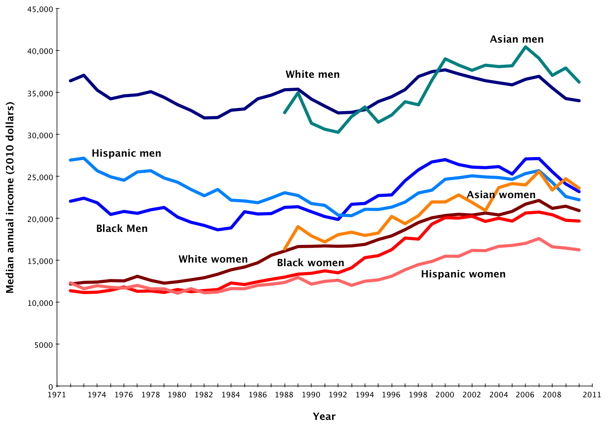
The Washington Post has a post up by Dylan Matthews that looks at the U.S. gender wage gap over time. It has several charts that illustrate trends in pay very clearly. Here’s a breakdown of median income (in constant 2010 dollars) by gender and race/ethnicity, for all workers, both full- and part-time:

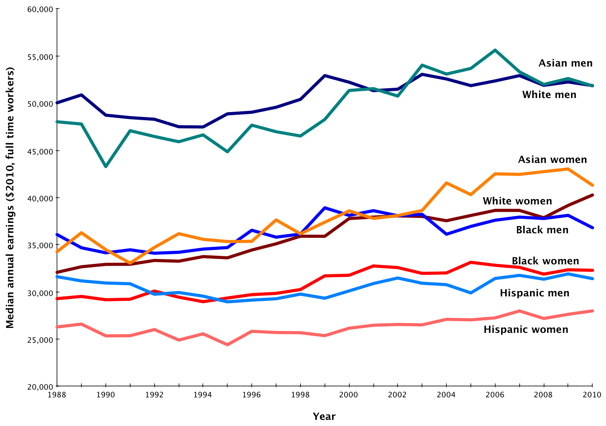
The gap remains for full-time, year-round workers, too. Women have gained ground, but within every racial/ethnic category, women’s median income is lower than men’s and every other group earns significantly less than Asian and White men. However, there’s a clear racial earnings hierarchy visible in the chart as well, which isn’t getting nearly the attention that the gender wage gap is:

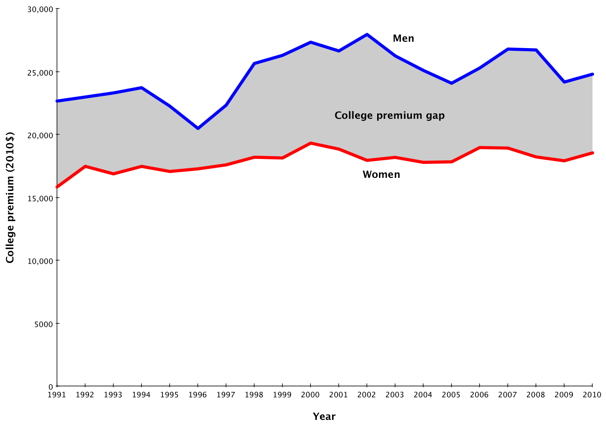
Moreover, the income bump received from earning a college degree is still higher for men than for women:

There are additional charts further breaking down differences in pay among men and women in the original post. As Matthews argues, and as Philip Cohen has posted about here at Soc Images, the data just don’t support the “impending female economic dominance” narrative that has become popular recently.

Cross-posted at Montclair SocioBlog.

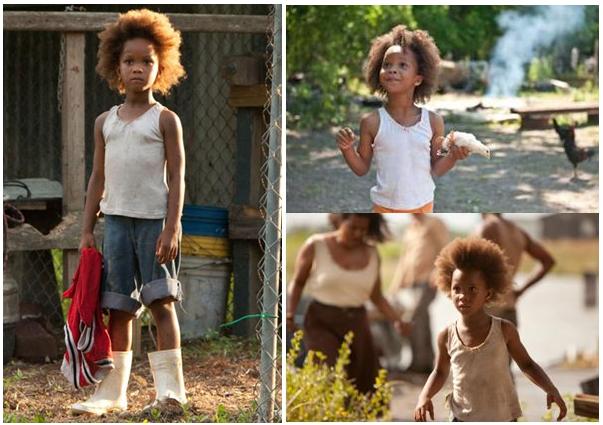
The crucial moment in “Beasts of the Southern Wild,” for me at least, was the sight of Hushpuppy  in a new purple dress.  Hushpuppy, a seven-year-old girl is the central figure in the film, and up until that point we have seen her, dressed in the same clothes every day, living in The Bathtub, a bayou area south of a fantastical New Orleans-inspired city, on the unprotected side of the levee.**

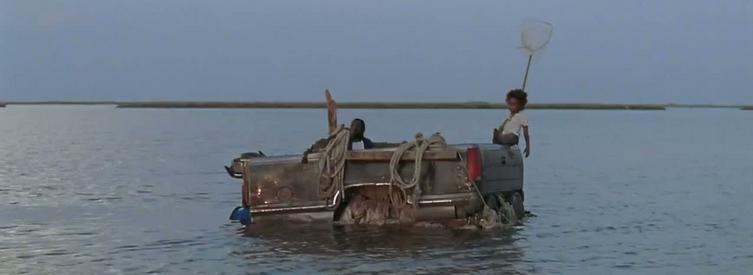
Life in The Bathtub is harsh.  The people there (“misfits, drunks and swamp-dwellers” — Washington Post) live in shacks cobbled together from scrap metal and wood.  They fish from boats that are similarly improvised.  They scavenge.  The children’s education comes from the idiosyncratic stories of one woman.

They are wild people living among wild things, unconstrained by laws or walls, reliant on ancient prophecies and herbal cures, at home with the water that may overwhelm them at any moment.  — New York Review

After a Katrina-like flood, the authorities force the evacuation of The Bathtub.  Hushpuppy and the others are housed in a shelter – a large, brightly-lit room (a high school gym?) – and given new clothes.  This is when we see Hushpuppy in her new purple dress heading out the door, presumably to a real school.

No, no, no, I thought. This is all wrong. This is not her.  She belongs back in The Bathtub, for despite its rough conditions, the people there are a real and caring community.  Her father loves her and prepares her for life there.  The people there all love her and care for her, as they care, as best they can, for one another.

That was the voice of cultural relativism telling me to look at a society on its own terms, with understanding and sympathy.

At the same time, though, the voice of ethnocentrism was whispering in my other ear.  This is America, it said.  These conditions are the things you deplore and want to improve — lack of decent health care, education, clothing, shelter, and basic safety.  (In an early scene, Hushpuppy tries to light her stove with a blowtorch, nearly incinerating her shack and herself.)  It’s wrong that people in America live like this.

It was not much of a contest.  Cultural relativism won.

In turning the audience into cultural relativists, the movie plays on old themes in American culture.  We’ve always had our suspicions of civilization and refinement, and we’ve had a romantic attachment to the unrefined and rugged.  In “Beasts,” the shelter — sterile, impersonal, and bureaucratic — is contrasted with The Bathtub — rough-hewn, but an authentic community nonetheless.

Then there is Hushpuppy.  I’ve commented before (here, for example) that children in American films are often wiser, more resourceful, and more honest than the adults, especially those who would try to change them.   Add Hushpuppy to the list.*

In the end, the audience seemed relieved when she and the others make their escape.  We don’t want Huck to be civilized by Aunt Sally.  And we do want Hushpuppy to light out for the territory of The Bathtub.

———————

* I should add that much of the credit for convincing the audience goes to the unforgettable six-year-old actress who plays Hushpuppy.

** Images borrowed from dirty-mag, allmoviephoto, thevisualvamp, filmreviewonline, boscosgrindhouse, and tampabaytimes.