Katrin sent in a delightful video by the 1491s, a sketch comedy troupe that frequently skewers popular representations of Native Americans and their various cultures. The group recently released a new video featuring footage of 1491s member Ryan Red Corn dancing at the Santa Fe Indian Market interspersed with shots of visitors to the market and examples of appropriation of Native cultures, all set to Irving Berlin’s “I’m an Indian Too,” from Annie Get Your Gun. It’s a great send-up of the whole Native-culture-as-fashion-statement trend:
Search results for The
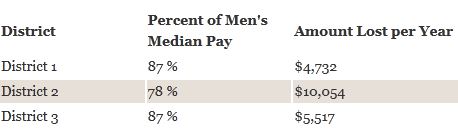
The National Partnership for Women & Families has posted an interactive map that displays the gender pay gap in each state and in the Congressional districts within the state. It uses Census Bureau data comparing full-time, year-round workers (that is, the scenario in which we’d expect women’s income to be closest to men’s). When you click on any state, it brings up information about it. For instance, in Nevada, women make 85% of what men do. Women working full-time have a median income of $35,484, while men’s median income is $41,803. The gap is smallest in the 1st and 3rd districts (both including parts of the greater Vegas metro area), but significantly larger in District 2, which covers the rest of the state, much of it rural:
Here are the 10 U.S. Congressional districts with the largest gender gap in median pay:
They don’t list the state or districts with the smallest gap. Just from casually and non-systematically clicking around, the state with the most parity that I found was in Washington D.C., where women make 90% as much as men. Let us know in the comments if you find anywhere with an even smaller gap.
In the 3-minute video below we see 100 people, filmed by Jeroen Wolf, from ages one to one hundred. The one-year-old mostly just stares, the remainder look into the camera and state their age.
What I find interesting is the uneven way that people age. As you watch the clip, people’s ages become increasingly difficult to pin down. You know that each person is about one year older than the last, but their appearance betrays this knowledge. One might look significantly older than the one before, or quite a bit younger. How old we look doesn’t ascend nicely in a linear fashion, but varies tremendously. No doubt this is based, in part, on genetics and life choices, but it is also dependent on opportunities and expectations related to ascribed identities and social structures.
Enjoy:
Lisa Wade, PhD is an Associate Professor at Tulane University. She is the author of American Hookup, a book about college sexual culture; a textbook about gender; and a forthcoming introductory text: Terrible Magnificent Sociology. You can follow her on Twitter and Instagram.
Last week a secretly-taped video of Romney made headlines. In it, he said that 47% of America believes that they are “victims,” is “dependent” on the government, and likes it that way. SocImages, like many places around the web, did some talking about who the 47% of people who pay no income taxes really are.
In this post, however, I’d like to make a different kind of point about framing and the sociological imagination, inspired by Ill Doctrine‘s Jay Smooth and Slate’s William Saletan.
Reacting to the release of the video, the media returned to a similarly clandestine video of Obama that had made the rounds during his first run for the presidency. In it, Obama refers to Americans who are “bitter” and “cling to guns or religion, or antipathy toward people who aren’t like them, or anti-immigrant sentiment…” So, six-of-one, half-dozen-of-the-other right? Both statements are equally tone deaf and biased right?
No. In fact, one is embedded in a deep empathy and an understanding that circumstance (i.e., that thing that sociologists study) can shape one’s outlook, sometimes in negative ways. The other is a straightforward criticism of a group’s character, with a lack of empathy and understanding.
Let’s take a closer look at how Obama introduced his (fairly criticized) comment about the bitter clinging to guns (transcript). He begins by saying that people have a good reason to be unhappy with politicians:
In a lot of these communities in big industrial states like Ohio and Pennsylvania, people have been beaten down so long, they feel so betrayed by government, that when they hear a pitch that is premised on not being cynical about government, there’s a part of them that just doesn’t buy it…
Then, instead of writing off these people as bad people who will never vote for the right guy, Obama argues that he wants to reach them (calling it a “challenge”), further validating how they might feel given the circumstances of their lives:
…our challenge is to get people persuaded that we can make progress when there’s no evidence of that in their daily lives. You go into some of these small towns in Pennsylvania, Ohio — like a lot of small towns in the Midwest, the jobs have been gone now for 25 years, and nothing’s replaced them. And they fell through the Clinton administration and the Bush administration. And each successive administration has said that somehow these communities are going to regenerate. And they have not. So it’s not surprising then that they get bitter, and they cling to guns or religion, or antipathy toward people who aren’t like them, or anti-immigrant sentiment, or, you know, anti-trade sentiment [as] a way to explain their frustrations.
In contrast, Romney’s comments are dismissive and accusing (transcript). His targets — the 47% of people who are exempt from paying income taxes — aren’t embattled, fighting for a decent life despite political neglect, they’re “entitled” to something they haven’t earned. They’re happy to be dependent on the government and don’t want it any other way. They’re leeches, parasites, freeloaders, bums.
And, instead of saying that its his job to help those people see life a different way, Romney dismisses them entirely:
[They’ll] vote for the [current] president no matter what… my job is not to worry about those people — I’ll never convince them that they should take personal responsibility and care for their lives…
So, while some are arguing that Romney’s comments are just a politically-right version of Obama’s — equally biased and cynical — nothing could be farther from the truth. Obama looks at Americans who will not likely vote for him and sees social structural reasons that their negative emotions are valid (even when they’re aimed at him), he expresses empathy for their plight, and seeks to connect with them. Romney does nothing of the sort. Instead, he condemns them as individuals and blows them off as potential constituents; and he encourages others to do the same.
In short, Obama has a sociological imagination that enables, even presses him to see the bigger picture. He sees both individuals and the circumstances they live in. Romney, for whatever reason, does not exercise a similar imagination.
Wanna hear it straight from Jay? I would too:
Lisa Wade, PhD is an Associate Professor at Tulane University. She is the author of American Hookup, a book about college sexual culture; a textbook about gender; and a forthcoming introductory text: Terrible Magnificent Sociology. You can follow her on Twitter and Instagram.
Cross-posted at Reports from the Economic Front.
There are those that argue that lowering the top marginal tax rates on “ordinary” income (from wages or salary) and capital gains will stimulate economic growth. Thomas L. Hungerford, in a Congressional Research Report, tests and rejects this claim.
He finds no statistical relationship between changes in either of these top tax rates and private savings, investment, productivity, or real per capita GDP growth. However, he does find a strong statistical relationship between changes in these tax rates and income inequality. More specifically, raising top tax rates can be expected to promote greater income equality without causing harm to the economy.
Tax Trends
There are two main tax concepts: the marginal tax rate, which is the tax paid on the last dollar of income received, and the average tax rate, which is the proportion of all income that is paid in taxes. How much a person pays on the last dollar received depends on whether it is classified as ordinary income or capital gains.
Most importantly, as the chart below shows, the very top tax payers have enjoyed a steady decline in their average tax rate.
The next chart shows trends in top marginal tax rates on ordinary income and capital gains. The top marginal tax rate on ordinary income has clearly been on the decline: from 91% in the 1950s, 70% in the 1960s and 1970s, to a low of 28% in 1986. It now stands at 35%. The top marginal capital gains tax rate has not changed as much. It was 25% in the 1950s and 1960s, 35% in the 1970s, and is now 15%.
The Tests
Hungerford used econometric methods to test whether changes in top marginal tax rates affect private savings, investment, productivity, and/or per capita GDP growth. Simply plotting the movement of top tax rates and each of these variables suggests that a decline in top tax rates is associated with a positive movement in each of these economic variables.
However, as Hungerford correctly states, correlation is not the same as causation. Using regression analysis, he found that the relationships were only coincidental or spurious; there was no statistically significant connection between changes in the top tax rates and movements in any of the variables.
Hungerford also tested to see if changes in top marginal tax rates had any effect on the distribution of income. The first chart below shows the scatter plot of top tax rates and the share of income going to the top 0.1% for the years 1945-2010. The second shows the same with the top 0.01% of income earners.
As we can see the fitted lines suggest a very strong relationship between the variables. As before, Hungerford used regression analysis to determine whether the relationships were statistically significant. This time his answer was yes in both cases; changes in top marginal tax rates do affect income concentration. In other words, lowering the top rates increases income inequality, raising them reduces it.
It is time for us to start agitating for raising the top tax rates.
The NFL referees have been on strike. In their place the league has hired replacements in order to keep the season underway. Word on the street is that the replacements are doing a distinctly terrible job. Writes Ed at Gin and Tacos:
Since professional and amateur football have different rules — in some cases very different — the results have been predictably disastrous. From their failure to do basic things like spot the ball and operate the game clock to major rules of which they appear to be totally ignorant, they have proven thus far that there is nothing they can’t botch.
Others, too, are finding humor in their ineptitude.
Ed wonders if NFL fans are internalizing the economic lesson in this debacle:
In a surplus labor market you can always find someone willing to do a job for less, but they’re probably not going to do it well. Even the type of person who blames the work stoppage on the union… can’t deny that the end result is the replacement of trained, experienced professionals with a clown car load of knuckleheads who act like they’ve never seen a football before.
He concludes, suggestively: “maybe all human capital is not interchangeable …and maybe there are some noticeable downsides to a market in which whoever will work for the least gets the job.”
The NFL, being entertainment and all, isn’t the best example, but when we apply the same logic to occupations like school teachers and air traffic controllers, we should sit up and notice. Maybe at this moment, when something so beloved is at stake, it’ll raise America’s consciousness just a little bit. Ed, for what it’s worth, isn’t optimistic.
Lisa Wade, PhD is an Associate Professor at Tulane University. She is the author of American Hookup, a book about college sexual culture; a textbook about gender; and a forthcoming introductory text: Terrible Magnificent Sociology. You can follow her on Twitter and Instagram.
Cross-posted at Caroline Heldman’s Blog.
On Monday, Mother Jones released a video recorded in May of presidential candidate Mitt Romney speaking at a $50,000-a-plate fundraiser in the Boca Raton home of “private equity party boy” and “sexy party” host, Marc Leder. A hidden camera caught controversial remarks about Israel, Iran, and a joke about being more electable if his parents had been born in Mexico, but the topic of this post is Romney’s use of the 47% Meme.
The 47% Meme is the idea that half of Americans take from rather than contribute to tax coffers. It sometimes surfaces in the form of the “takers vs. makers” frame. I have encountered this “argument” for years on Fox News, so it is surprising to see it gaining national attention now. Romney did a superb job articulating the 47% Meme in response to a question of how he might win in November:
There are 47 percent of the people who will vote for the president no matter what. All right, there are 47 percent who are with him, who are dependent upon government, who believe that they are victims, who believe the government has a responsibility to care for them, who believe that they are entitled to health care, to food, to housing, to you-name-it. That that’s an entitlement. And the government should give it to them.
Many myths start with a kernel of truth. The 47% Meme is loosely based on the statistic that 47% of Americans pay no income tax (down to 46% in 2011). This meme is wildly dishonest since people pay a host of other federal, state, and local taxes. It’s about as honest as saying a person doesn’t eat vegetables because she only eats carrots, celery, bell peppers, cucumbers, and cabbage, but not broccoli.
So who is paying taxes, and what taxes are they paying?
Federal Income Tax
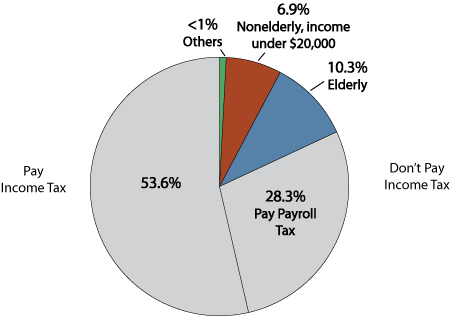
The Tax Policy Center finds that two main groups comprise the 46% who do not pay federal income tax: (1) The poor whose subsistence-level income is not taxable, and (2) those who receive tax expenditures. This chart shows that the lion’s share of tax expenditures goes to senior citizens, children, and the working poor, with the notable exception of 7,000 millionaires who paid no income tax in 2011.
Other Federal Taxes
But enough about income tax since this narrow focus only serves to further the misleading 47% Meme. The chart below shows a more accurate picture of who pays federal taxes. If we don’t count retirees, only 8% of Americans pay no income or payroll taxes.
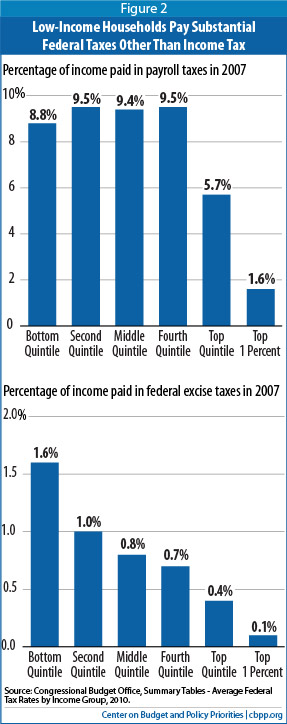
Americans also pay federal excise tax on gas, liquor, cigarettes, airline tickets, and a long list of other products, so virtually every American pays federal taxes in some form. And contrary to the 47% Meme, poor and middle-class Americans actually pay a greater percentage of their income in federal payroll and excise taxes than wealthier Americans.
State and Local Taxes
When it comes to state and local taxes, the Institute on Taxation and Economic Policy finds that the poor pay more in state and local taxes in every state except Vermont. As the chart below indicates, state and local taxes are regressive, meaning that those who can least afford to pay, pay more.
Romney has apologized for the inelegance of his statements, but stands by their substance, despite ample data debunking the dependency (above) and entitlement bases for the 47% Meme. I don’t believe that Romney believes that half of the people in the U.S. are pathetically entitled “victims.” He is a smart person, and this is a ludicrous line of reasoning. But what does it say about our bitterly partisan nation that heaping unmitigated scorn on the poor brings in big bucks from the base?
In Wayward Puritans: A Study in the Sociology of Deviance, Kai Erikson states,
…the agencies built by society for preventing deviance are often so poorly equipped for the task that we might well ask why this is regarded as their “real” function in the first place. (p. 14)
He notes that the amount of deviance and crime found in a society is largely related to how many resources we commit to looking for it. And once we’ve created institutions and industries to deal with particular types of deviance, we tend to continuously find enough deviance to continue to justify the system’s existence. If we’ve built a large criminal justice system, that system takes on a self-sustaining life of its own. Even if we eradicated all major crime as we know it, Erikson suggests, the agencies would turn their attention to behaviors we’ve previously ignored or treated as relatively unimportant, finding a new reason for the system’s existence and access to resources.
In the past several decades, fighting the War on Drugs has become an important role of the U.S. criminal justice system. Drug infractions are a major cause of the growth in imprisonment rates and, especially, the racial gap in incarceration.
I thought of Erikson’s insights when I recently saw the trailer for The House I Live In, an upcoming documentary about the impact of the War on Drugs. The trailer highlights the way that low-level drug dealers and addicts are fed as raw material into the criminal justice system. Law enforcement agencies often benefit directly from seizures of cash or property during drug busts, which then becomes property of the agency; additionally, agencies that design programs to target drug use/sales often get access to federal funds for training and equipment that they’d have no way to purchase otherwise:
The War on Drugs is an industry, one with vested interests with a powerful motivation to ensure its continued existence and expansion, regardless of any objective cost-benefit analysis of the consequences of incarcerating such a large proportion of the population or even of the effectiveness of our policies for actually decreasing drug use.
The National Partnership for Women & Families has posted an interactive map that displays the gender pay gap in each state and in the Congressional districts within the state. It uses Census Bureau data comparing full-time, year-round workers (that is, the scenario in which we’d expect women’s income to be closest to men’s). When you click on any state, it brings up information about it. For instance, in Nevada, women make 85% of what men do. Women working full-time have a median income of $35,484, while men’s median income is $41,803. The gap is smallest in the 1st and 3rd districts (both including parts of the greater Vegas metro area), but significantly larger in District 2, which covers the rest of the state, much of it rural:
Here are the 10 U.S. Congressional districts with the largest gender gap in median pay:
They don’t list the state or districts with the smallest gap. Just from casually and non-systematically clicking around, the state with the most parity that I found was in Washington D.C., where women make 90% as much as men. Let us know in the comments if you find anywhere with an even smaller gap.
In the 3-minute video below we see 100 people, filmed by Jeroen Wolf, from ages one to one hundred. The one-year-old mostly just stares, the remainder look into the camera and state their age.
What I find interesting is the uneven way that people age. As you watch the clip, people’s ages become increasingly difficult to pin down. You know that each person is about one year older than the last, but their appearance betrays this knowledge. One might look significantly older than the one before, or quite a bit younger. How old we look doesn’t ascend nicely in a linear fashion, but varies tremendously. No doubt this is based, in part, on genetics and life choices, but it is also dependent on opportunities and expectations related to ascribed identities and social structures.
Enjoy:
Lisa Wade, PhD is an Associate Professor at Tulane University. She is the author of American Hookup, a book about college sexual culture; a textbook about gender; and a forthcoming introductory text: Terrible Magnificent Sociology. You can follow her on Twitter and Instagram.
Last week a secretly-taped video of Romney made headlines. In it, he said that 47% of America believes that they are “victims,” is “dependent” on the government, and likes it that way. SocImages, like many places around the web, did some talking about who the 47% of people who pay no income taxes really are.
In this post, however, I’d like to make a different kind of point about framing and the sociological imagination, inspired by Ill Doctrine‘s Jay Smooth and Slate’s William Saletan.
Reacting to the release of the video, the media returned to a similarly clandestine video of Obama that had made the rounds during his first run for the presidency. In it, Obama refers to Americans who are “bitter” and “cling to guns or religion, or antipathy toward people who aren’t like them, or anti-immigrant sentiment…” So, six-of-one, half-dozen-of-the-other right? Both statements are equally tone deaf and biased right?
No. In fact, one is embedded in a deep empathy and an understanding that circumstance (i.e., that thing that sociologists study) can shape one’s outlook, sometimes in negative ways. The other is a straightforward criticism of a group’s character, with a lack of empathy and understanding.
Let’s take a closer look at how Obama introduced his (fairly criticized) comment about the bitter clinging to guns (transcript). He begins by saying that people have a good reason to be unhappy with politicians:
In a lot of these communities in big industrial states like Ohio and Pennsylvania, people have been beaten down so long, they feel so betrayed by government, that when they hear a pitch that is premised on not being cynical about government, there’s a part of them that just doesn’t buy it…
Then, instead of writing off these people as bad people who will never vote for the right guy, Obama argues that he wants to reach them (calling it a “challenge”), further validating how they might feel given the circumstances of their lives:
…our challenge is to get people persuaded that we can make progress when there’s no evidence of that in their daily lives. You go into some of these small towns in Pennsylvania, Ohio — like a lot of small towns in the Midwest, the jobs have been gone now for 25 years, and nothing’s replaced them. And they fell through the Clinton administration and the Bush administration. And each successive administration has said that somehow these communities are going to regenerate. And they have not. So it’s not surprising then that they get bitter, and they cling to guns or religion, or antipathy toward people who aren’t like them, or anti-immigrant sentiment, or, you know, anti-trade sentiment [as] a way to explain their frustrations.
In contrast, Romney’s comments are dismissive and accusing (transcript). His targets — the 47% of people who are exempt from paying income taxes — aren’t embattled, fighting for a decent life despite political neglect, they’re “entitled” to something they haven’t earned. They’re happy to be dependent on the government and don’t want it any other way. They’re leeches, parasites, freeloaders, bums.
And, instead of saying that its his job to help those people see life a different way, Romney dismisses them entirely:
[They’ll] vote for the [current] president no matter what… my job is not to worry about those people — I’ll never convince them that they should take personal responsibility and care for their lives…
So, while some are arguing that Romney’s comments are just a politically-right version of Obama’s — equally biased and cynical — nothing could be farther from the truth. Obama looks at Americans who will not likely vote for him and sees social structural reasons that their negative emotions are valid (even when they’re aimed at him), he expresses empathy for their plight, and seeks to connect with them. Romney does nothing of the sort. Instead, he condemns them as individuals and blows them off as potential constituents; and he encourages others to do the same.
In short, Obama has a sociological imagination that enables, even presses him to see the bigger picture. He sees both individuals and the circumstances they live in. Romney, for whatever reason, does not exercise a similar imagination.
Wanna hear it straight from Jay? I would too:
Lisa Wade, PhD is an Associate Professor at Tulane University. She is the author of American Hookup, a book about college sexual culture; a textbook about gender; and a forthcoming introductory text: Terrible Magnificent Sociology. You can follow her on Twitter and Instagram.
Cross-posted at Reports from the Economic Front.
There are those that argue that lowering the top marginal tax rates on “ordinary” income (from wages or salary) and capital gains will stimulate economic growth. Thomas L. Hungerford, in a Congressional Research Report, tests and rejects this claim.
He finds no statistical relationship between changes in either of these top tax rates and private savings, investment, productivity, or real per capita GDP growth. However, he does find a strong statistical relationship between changes in these tax rates and income inequality. More specifically, raising top tax rates can be expected to promote greater income equality without causing harm to the economy.
Tax Trends
There are two main tax concepts: the marginal tax rate, which is the tax paid on the last dollar of income received, and the average tax rate, which is the proportion of all income that is paid in taxes. How much a person pays on the last dollar received depends on whether it is classified as ordinary income or capital gains.
Most importantly, as the chart below shows, the very top tax payers have enjoyed a steady decline in their average tax rate.
The next chart shows trends in top marginal tax rates on ordinary income and capital gains. The top marginal tax rate on ordinary income has clearly been on the decline: from 91% in the 1950s, 70% in the 1960s and 1970s, to a low of 28% in 1986. It now stands at 35%. The top marginal capital gains tax rate has not changed as much. It was 25% in the 1950s and 1960s, 35% in the 1970s, and is now 15%.
The Tests
Hungerford used econometric methods to test whether changes in top marginal tax rates affect private savings, investment, productivity, and/or per capita GDP growth. Simply plotting the movement of top tax rates and each of these variables suggests that a decline in top tax rates is associated with a positive movement in each of these economic variables.
However, as Hungerford correctly states, correlation is not the same as causation. Using regression analysis, he found that the relationships were only coincidental or spurious; there was no statistically significant connection between changes in the top tax rates and movements in any of the variables.
Hungerford also tested to see if changes in top marginal tax rates had any effect on the distribution of income. The first chart below shows the scatter plot of top tax rates and the share of income going to the top 0.1% for the years 1945-2010. The second shows the same with the top 0.01% of income earners.
As we can see the fitted lines suggest a very strong relationship between the variables. As before, Hungerford used regression analysis to determine whether the relationships were statistically significant. This time his answer was yes in both cases; changes in top marginal tax rates do affect income concentration. In other words, lowering the top rates increases income inequality, raising them reduces it.
It is time for us to start agitating for raising the top tax rates.
The NFL referees have been on strike. In their place the league has hired replacements in order to keep the season underway. Word on the street is that the replacements are doing a distinctly terrible job. Writes Ed at Gin and Tacos:
Since professional and amateur football have different rules — in some cases very different — the results have been predictably disastrous. From their failure to do basic things like spot the ball and operate the game clock to major rules of which they appear to be totally ignorant, they have proven thus far that there is nothing they can’t botch.
Others, too, are finding humor in their ineptitude.
Ed wonders if NFL fans are internalizing the economic lesson in this debacle:
In a surplus labor market you can always find someone willing to do a job for less, but they’re probably not going to do it well. Even the type of person who blames the work stoppage on the union… can’t deny that the end result is the replacement of trained, experienced professionals with a clown car load of knuckleheads who act like they’ve never seen a football before.
He concludes, suggestively: “maybe all human capital is not interchangeable …and maybe there are some noticeable downsides to a market in which whoever will work for the least gets the job.”
The NFL, being entertainment and all, isn’t the best example, but when we apply the same logic to occupations like school teachers and air traffic controllers, we should sit up and notice. Maybe at this moment, when something so beloved is at stake, it’ll raise America’s consciousness just a little bit. Ed, for what it’s worth, isn’t optimistic.
Lisa Wade, PhD is an Associate Professor at Tulane University. She is the author of American Hookup, a book about college sexual culture; a textbook about gender; and a forthcoming introductory text: Terrible Magnificent Sociology. You can follow her on Twitter and Instagram.
Cross-posted at Caroline Heldman’s Blog.
On Monday, Mother Jones released a video recorded in May of presidential candidate Mitt Romney speaking at a $50,000-a-plate fundraiser in the Boca Raton home of “private equity party boy” and “sexy party” host, Marc Leder. A hidden camera caught controversial remarks about Israel, Iran, and a joke about being more electable if his parents had been born in Mexico, but the topic of this post is Romney’s use of the 47% Meme.
The 47% Meme is the idea that half of Americans take from rather than contribute to tax coffers. It sometimes surfaces in the form of the “takers vs. makers” frame. I have encountered this “argument” for years on Fox News, so it is surprising to see it gaining national attention now. Romney did a superb job articulating the 47% Meme in response to a question of how he might win in November:
There are 47 percent of the people who will vote for the president no matter what. All right, there are 47 percent who are with him, who are dependent upon government, who believe that they are victims, who believe the government has a responsibility to care for them, who believe that they are entitled to health care, to food, to housing, to you-name-it. That that’s an entitlement. And the government should give it to them.
Many myths start with a kernel of truth. The 47% Meme is loosely based on the statistic that 47% of Americans pay no income tax (down to 46% in 2011). This meme is wildly dishonest since people pay a host of other federal, state, and local taxes. It’s about as honest as saying a person doesn’t eat vegetables because she only eats carrots, celery, bell peppers, cucumbers, and cabbage, but not broccoli.
So who is paying taxes, and what taxes are they paying?
Federal Income Tax
The Tax Policy Center finds that two main groups comprise the 46% who do not pay federal income tax: (1) The poor whose subsistence-level income is not taxable, and (2) those who receive tax expenditures. This chart shows that the lion’s share of tax expenditures goes to senior citizens, children, and the working poor, with the notable exception of 7,000 millionaires who paid no income tax in 2011.
Other Federal Taxes
But enough about income tax since this narrow focus only serves to further the misleading 47% Meme. The chart below shows a more accurate picture of who pays federal taxes. If we don’t count retirees, only 8% of Americans pay no income or payroll taxes.
Americans also pay federal excise tax on gas, liquor, cigarettes, airline tickets, and a long list of other products, so virtually every American pays federal taxes in some form. And contrary to the 47% Meme, poor and middle-class Americans actually pay a greater percentage of their income in federal payroll and excise taxes than wealthier Americans.
State and Local Taxes
When it comes to state and local taxes, the Institute on Taxation and Economic Policy finds that the poor pay more in state and local taxes in every state except Vermont. As the chart below indicates, state and local taxes are regressive, meaning that those who can least afford to pay, pay more.
Romney has apologized for the inelegance of his statements, but stands by their substance, despite ample data debunking the dependency (above) and entitlement bases for the 47% Meme. I don’t believe that Romney believes that half of the people in the U.S. are pathetically entitled “victims.” He is a smart person, and this is a ludicrous line of reasoning. But what does it say about our bitterly partisan nation that heaping unmitigated scorn on the poor brings in big bucks from the base?
In Wayward Puritans: A Study in the Sociology of Deviance, Kai Erikson states,
…the agencies built by society for preventing deviance are often so poorly equipped for the task that we might well ask why this is regarded as their “real” function in the first place. (p. 14)
He notes that the amount of deviance and crime found in a society is largely related to how many resources we commit to looking for it. And once we’ve created institutions and industries to deal with particular types of deviance, we tend to continuously find enough deviance to continue to justify the system’s existence. If we’ve built a large criminal justice system, that system takes on a self-sustaining life of its own. Even if we eradicated all major crime as we know it, Erikson suggests, the agencies would turn their attention to behaviors we’ve previously ignored or treated as relatively unimportant, finding a new reason for the system’s existence and access to resources.
In the past several decades, fighting the War on Drugs has become an important role of the U.S. criminal justice system. Drug infractions are a major cause of the growth in imprisonment rates and, especially, the racial gap in incarceration.
I thought of Erikson’s insights when I recently saw the trailer for The House I Live In, an upcoming documentary about the impact of the War on Drugs. The trailer highlights the way that low-level drug dealers and addicts are fed as raw material into the criminal justice system. Law enforcement agencies often benefit directly from seizures of cash or property during drug busts, which then becomes property of the agency; additionally, agencies that design programs to target drug use/sales often get access to federal funds for training and equipment that they’d have no way to purchase otherwise:
The War on Drugs is an industry, one with vested interests with a powerful motivation to ensure its continued existence and expansion, regardless of any objective cost-benefit analysis of the consequences of incarcerating such a large proportion of the population or even of the effectiveness of our policies for actually decreasing drug use.