Search results for The

Cross-posted at Montclair SocioBlog.

About two weeks ago, Chris Hayes said, “It is undeniably the case that racist Americans are almost entirely in one political coalition and not the other.”

The case, it turns out, is very deniable.  Alex Tabarrok at Marginal Revolution denied it with data from the 2002 and 2008 General Social Survey (GSS).  He looked at three questions…

  • Favor laws against interracial marriage
  • Would vote for a Black for president
  • Blacks should not be pushy

…and concludes:

It is undeniable that some Americans are racist but racists split about evenly across the parties.

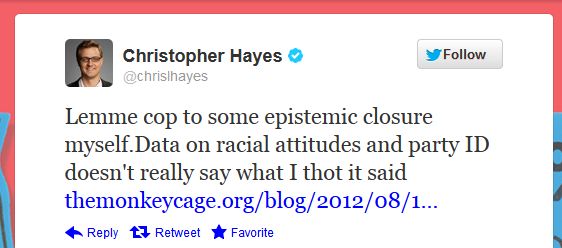
Hayes then tweeted a retraction.
End of story?

To begin with, the sample sizes Tabarrok uses are small.  In the 2002 GSS, only 87 respondents went on record against interracial marriage, and in 2008, only 80 said they wouldn’t vote for a Black for president.  (All the tables and graphs presented here and in Tabarrok’s post are based on Whites only.)

Only about 5% of the sample takes the racist response to these items.  But I would run the table differently.  Instead of asking what percent of each party is racist, I would ask where do those few racists go.
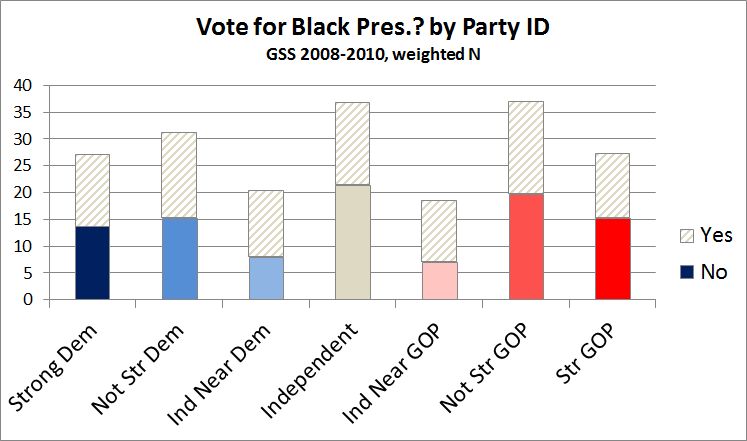
The differences are small, but the edge goes to the Republicans.

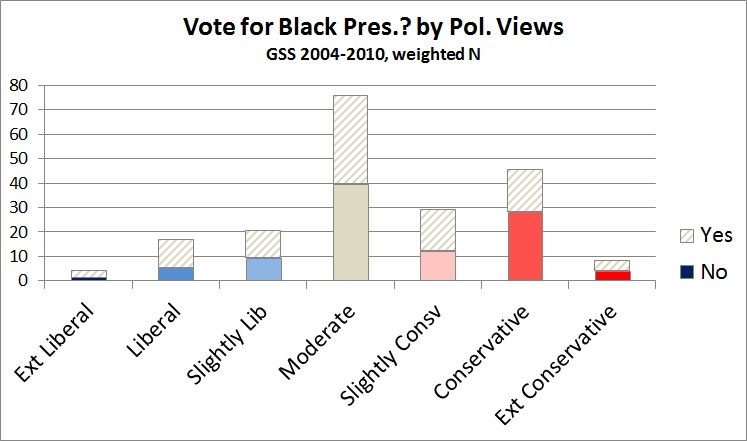
Second, there is a difference between party identification and political ideology.  If you ask not about party but about political views, the differences become sharper.
The GSS has other questions that might stand as a proxy for racism.  For example:

On the average (negroes/blacks/African-Americans) have worse jobs, income, and housing than white people. Do you think these differences are because most (negroes/blacks/African-Americans) just don’t have the motivation or willpower to pull themselves up out of poverty?
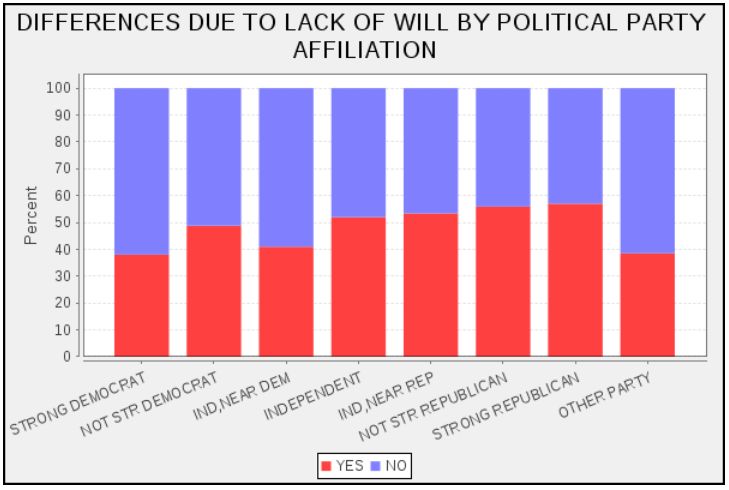
Again, the differences are small, with White Republicans slightly more likely (50% vs. 45%) to say Blacks’ economic problems are caused by lack of motivation and will power.  And again, the differences are larger when the independent variable is political ideology rather than party identification.

In that same GSS question about the cause of Black economic troubles, another choice is:

Do you think these differences are mainly due to discrimination?

The differences for both Party ID and Political views are clear.  White Democrats and liberals are much more likely to see discrimination as a major cause.
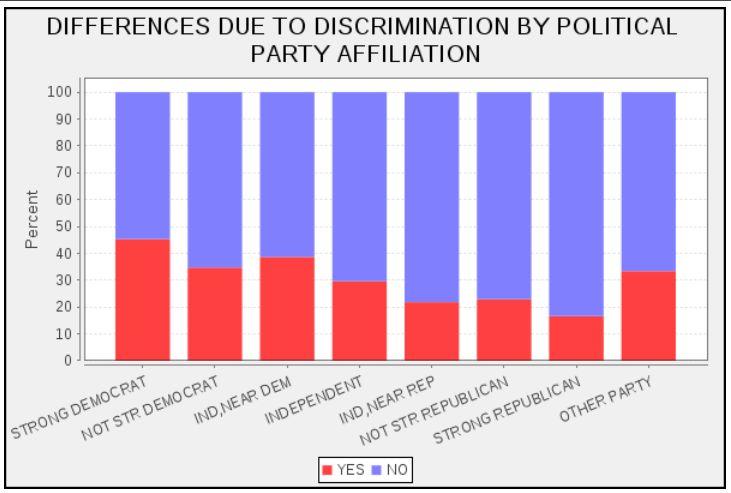
But is this racist?  Not necessarily.  It might well be part of a general view of the causes of human behavior, one that emphasizes personal factors (ability, motivation, etc.) and downplays structural forces the individual has little power over (discrimination).   Conservatives might use that same  explanation for unemployment and low income among Whites as well.  But I do not know of any GSS questions about the causes of White economic problems.  (Perhaps these exist, but I am not a GSS expert.)

We do know that racists (those who say they would not vote for a Black president) are more likely to take the conservative position on the “Willpower” explanation (76% vs. 50%) and on the Discrimination explanation (78% vs. 64%) compared with those who say yes, they would vote for a Black president.  But that does not mean that the other conservatives who agree with them and who deny that racial discrimination affects the lives of Black people are also racists. People can come to the same position from different places.  But people can also hide their racism behind seemingly non-racial issues.  In the 1960s ,70s, and 80s, many observers thought that the Republicans were using first school busing and then crime as a proxy for race, as Republican strategist Lee Atwater famously explained.  And some observers today (Tom Edsall, for example) argue that the Republicans are using welfare in the same way this time around.

Other bloggers have written about the questions Hayes raised — Tabarrok has links to three of these.  The most interesting I’ve come across is Will Wilkinson’s (here).  His original views apparently were individual-centered and much in line with Margaret Thatcher’s dictum that “there is no such thing as society.”  But that was “when I was a Rand-toting libertarian lad.”

He has now come to see that individuals, with their ideas and attitudes and “non-coercive” behavior, can add up to something greater than the sum of its parts, i.e, society.  But he got to this idea by walking down the left fork of the libertarian road – the road not to serfdom but to sociology.

Eventually I realised that actions that are individually non-coercive can add up to stable patterns of behaviour that are systematically or structurally coercive, depriving some individuals of their rightful liberty. In fact, rights-violating structures or patterns of behaviour are excellent examples of Hayekian spontaneous orders—of phenomena that are the product of human action, but not of human design.
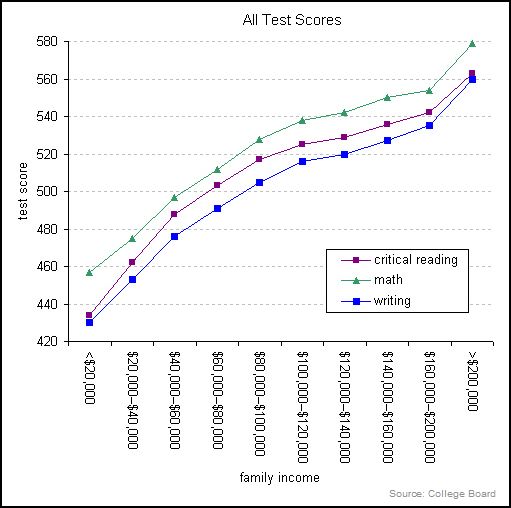
Today is the first day of school at the college where I teach, so I thought it would be a nice time to re-post this oldie-but-goodie on the relationship between income and SAT scores.  I’m sure all of our students are brilliant, of course, but whether the SAT measures intelligence fairly is up for debate.

The College Board is an education association that, among other things, administers the SAT college entrance examination.  A report on the scores from 2009, reviewed by the New York Times, included a break down of scores by the household income of the student. Scores correlate strongly and positively with income:

I can think of two explanations for the correlation.

First, it is certainly true that children with more economic resources, on average, end up better prepared for standardized tests.  They tend to have better teachers, more resource-rich educational environments, more educated parents who can help them with school and, sometimes, expensive SAT tutoring.

Second, the test itself may be biased towards wealthier students.  These tests tend to be written and evaluated by privileged individuals who may inadvertently include class-based knowledge, not just knowledge, in the exam (asking questions, for example, that rely on background information about golf instead of basketball).

In any case, this correlation should give us pause; it calls into question, quite profoundly, the extent to which the SAT is functioning as a fair measure.  Perhaps it measures preparedness for college, but whether it measures potential is up for debate.

Lisa Wade, PhD is an Associate Professor at Tulane University. She is the author of American Hookup, a book about college sexual culture; a textbook about gender; and a forthcoming introductory text: Terrible Magnificent Sociology. You can follow her on Twitter and Instagram.

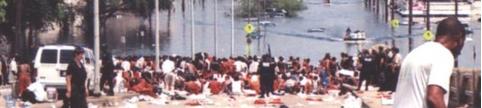
August 29th is the anniversary of the day that Hurricane Katrina devastated the Gulf Coast and side-swiped New Orleans, breaching the levees.  These posts are from our archives:

Was Hurricane Katrina a “Natural” Disaster?

Racism and Neglect

Disaster and Discourse

Devastation and Rebuilding

Lisa Wade, PhD is an Associate Professor at Tulane University. She is the author of American Hookup, a book about college sexual culture; a textbook about gender; and a forthcoming introductory text: Terrible Magnificent Sociology. You can follow her on Twitter and Instagram.

[Note: The last item on this page might be NSFW in some workplaces; it’s behind a jump, but if you came to the post directly, be careful about scrolling down past the raincoats.]

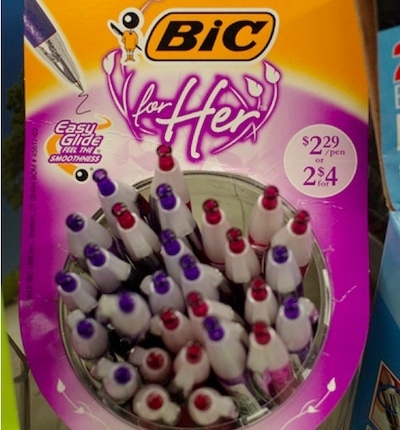
Seven readers — Aneesa D., mouskatel, Brandi B., Lisa B., Jared B., Tom Megginson (of Work that Matters), and sociologist Michael Kimmel — all let us know about the attention Bic’s “for Her” pens have been getting, so I thought it was a good day for another round-up of the many items we have decided must be differentiated into versions for men and women. We’ve featured pens like this before; Bic’s are designed just for us ladies and our special pen needs, which apparently include the colors pink and purple and “easy glide” and “smoothness”:

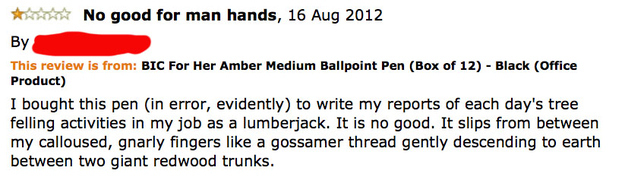
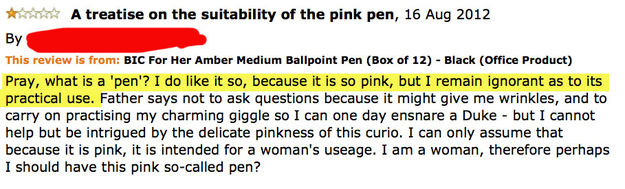
The pens are for sale on Amazon in the UK, and they’ve inspired a lot of push-back over the gendering, with people writing reviews mocking the product and its packaging. Buzzfeed featured a number of the reviews, which highlight the way that internet marketing certainly helps companies, but also opens up more avenues for the public to complain about or ridicule products in a very direct, immediate way that can quickly attract others to do the same — a much faster form of complaint than the days when you had to write a letter to a company’s headquarters:

But don’t worry, guys! There are products just for you, too! J.V. is happy to report that there’s now a hair dryer for men, called the Man Groomer. After all these years of wishing you had some way to quickly dry your hair the way women can, a solution is at hand:

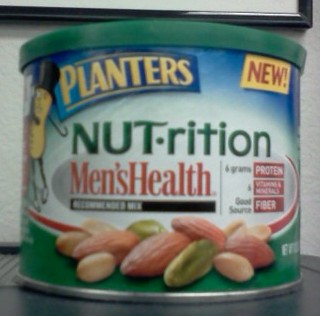
And Sean discovered that Planters is helpfully now selling cans of mixed nuts that are specifically chosen to support men’s health. Obviously women may eat almonds, peanuts, and pistachios separately, but when combined, these form a magical Man Food that addresses men’s unique needs for protein, vitamins, minerals, and fiber:

UPDATE: Reader Kat says,

The Men’s Health on the can of nuts is because they are a product the editors of the magazine Men’s Health felt were a healthy option…The can of nuts aren’t gender specific they are just boasting their “award” of being well liked by the editors of this particular magazine. No different than when any other product has the label “recognized by *fill in the blank* magazine.”

In other gendered products news, Jessie L. noticed these face masks for sale in Taiwan. They are different sizes, but instead of simply presenting them as Medium and Large, for whoever might need those sizes, those size differences are clearly connected to expectations about gender. They’re differentiated by color, by the person shown wearing each one, and the pink package even has a heart-shaped hole that lets you feel the mask.

Similarly, Joonas L. saw his-and-hers versions of disposable raincoats for sale in Helsinki, Finland, and couldn’t see anything different about them except the color and the use of language (miesten = men’s, naisten=women’s) to explicitly gender them:

Finally, Megan C. pointed out an example of gendered personal lubricant. The exact same product it “Tush Eze” when it’s pink and features a woman, but “Anal Eze” in the blue bottle featuring a man. I’m putting it after the jump, just in case it’s not safe for some workplaces:

more...

We have a fun post about the various ways in which Prince Charles was posed with Princess Diana in order to obscure the fact that she was about his height.  Building on this, Geoffrey Arnold at The Social Complex has collected some examples of men’s height being manipulated in order to preserve the social illusion that men are taller (or at least not shorter) than women.

See also Arnold’s guest posts introducing the concept of heightism as a gendered prejudice and discussing heightism (and other icky stuff) at Hooters.

Lisa Wade, PhD is an Associate Professor at Tulane University. She is the author of American Hookup, a book about college sexual culture; a textbook about gender; and a forthcoming introductory text: Terrible Magnificent Sociology. You can follow her on Twitter and Instagram.

Well, crap. It turns out I might be a terrorist. I wasn’t aware of this, but then Dave A. sent in a video from Houston’s Make the Call anti-terrorism initiative, and it isn’t looking good.

The evidence:

  • I sometimes walk off and leave bags unattended in public spaces.
  • I gather information about routines in public spaces, often sending operatives out to stand by entrances and exits. They covertly take notes, and I specifically tell them not to draw attention to themselves. Occasionally they even take photos of the layouts of public places or ask employees detailed questions about the inner workings of the organization. I have cleverly disguised these surveillance activities as sociology assignments.
  • I sometimes carry small electronic gadgets that might not be immediately recognizable to every single person sitting at a cafe.
  • I get cold easily and often wear sweaters or bulky hoodies in summer, even in Vegas.
  • I can be kind of hyper and nervous-acting, which probably makes me “sketchy”.
  • I always forget the security code at my friend Robin’s housing complex, so I usually just sneak in behind someone else.
  • I have been known to park in prohibited areas.

Watch the video and see for yourself:

This method of fighting terrorism is extremely unrealistic. The behaviors listed in the video are things people do all the time, in a variety of contexts. If every citizen of Houston reported every incident they see that is mentioned in this video, the Houston PD would be overwhelmed and unable to function because of the number of calls they’d have to investigate. I’d have to call the police every time I saw a woman wearing Ugg boots in Vegas, because it’s never cold enough here to justify them.

The video tells viewers not to ignore their “instincts.” But do we have an instinct for detecting “sketchy” people or behavior? Given what we know about stereotyping and selective perception, the reality is that people will view behavior through their pre-existing beliefs. Their interpretations of behavior as unusual or inappropriate will be influenced by how comfortable they otherwise are with the person engaging in it, which is impacted by race/ethnicity, class, and many other social categories. A guy leaving a backpack unattended is scary if that guy has a mohawk or, you know, looks scary and stuff, but when I do it, no one bats an eye. This video basically legitimizes turning anyone who makes you at all uncomfortable in public in to the police, on the argument that you are simply following your “instinct.” When you ask every citizen to become an intelligence agent, reporting every incident they perceive as odd, the result is the increasing stigmatization and semi-criminalization of those who can’t or won’t conform to pretty narrow standards of physical appearance, dress, and behavior.

UPDATE: There’s an interesting discussion in the comments about how you balance the need to avoid paranoia with the fact that, for instance, some rapes on college campuses would be prevented if people didn’t leave dorm doors ajar or let people in without knowing who they are, and that’s a conversation worth having. However, I’m also interested in the issue of feasibility here: If all the citizens of Houston literally did what this video suggests, law enforcement would grind to a halt and response times would slow for everyone.

As for why I sometimes leave bags unattended in public…Because there’s nothing of value in it and I left it on an outside table while I go inside to order, or because I’m gathering a lot of books at the library and I get sick of lugging my bag while I do this and leave it on a table while I go into the stacks, or because I realize I forgot to grab something on another aisle at the grocery store and I run around the corner to grab it without thinking to grab my bag. My point isn’t that any of the things I do are laudable or even smart, but rather that people do these things, sometimes on purpose, sometimes because we get distracted or make mistakes, and it’s going to take a massive increase in law enforcement if we really want citizens to start vigilantly reporting them.

Originally posted at YouGov.

Race has recently taken center stage in the presidential campaign.  From Joe Biden’s suggestion that a Romney-Ryan presidency would re-enslave African-Americans, to some liberal commentators’ contentions that the Romney campaign is using racial code words like “welfare” and “anger” to mobilize anti-black sentiments against President Obama, charges and counter-charges of playing the race card now abound.

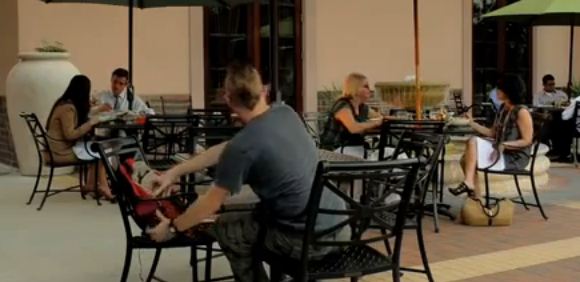
Part of this racialized turn in the campaign involves Romney’s welfare ad earlier this month—an ad that questionably accused Obama of ending welfare for work requirements.  While that charge may seem race-neutral, there is a long-standing and strong association in white Americans’ minds between welfare and “undeserving” African-Americans (see here and here).  According to Jonathan Chait, then, “the political punch of this messaging derives from the fact that white middle-class Americans understand messages about redistribution from the hard-working middle-class to the lazy underclass in highly racialized terms.”  An extensive body of social science research described as racial priming seems to support Chait’s contention.  That research shows that such code words as “welfare” and “inner-city,” especially when combined with racial imagery (e.g., the hardworking whites in Romney’s ad), can make racial attitudes a more central determinant of political evaluations (see: 12345).  One might therefore expect the welfare ad to activate racial attitudes in public opinion.

We can test that expectation thanks to some unique experimental data collected last week by YouGov.  The survey randomly assigned half of its 1,000 respondents to view the Romney welfare ad (see above) while the remaining half of the sample did not see the ad.  Respondents then answered a series of questions to discern whether and how the ad affected their opinions.  Unfortunately, these follow-up questions did not include vote choice or candidate favorability, which were asked earlier in the survey.  We did, however, ask respondents how well Mitt Romney and Barack Obama’s policies would benefit the following groups in society: the poor, the middle class, the wealthy, African-Americans and white Americans.  Answers were then recoded to range from 0 (“hurt them a great deal”) to 100 (“help them a great deal”).

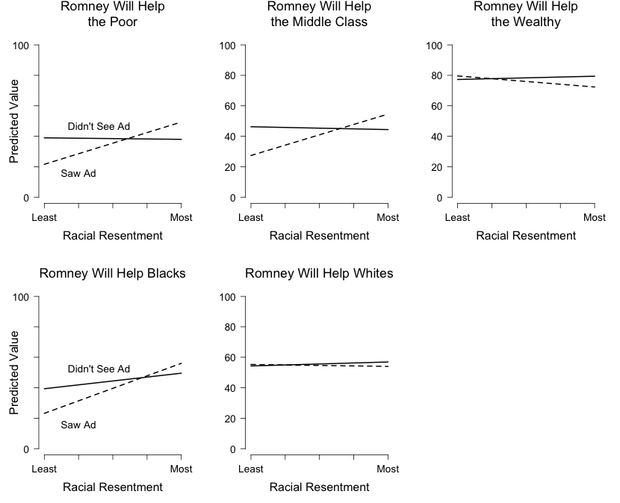
The welfare ad did not appear to affect people’s overall answers to those questions.  However, it did make attitudes toward blacks a stronger predictor of respondents’ views about the consequences of Romney’s policies for the poor, the middle class, and African-Americans.  To measure attitudes toward blacks, we use a scale called “racial resentment” in the scholarly literature.  For respondents to this survey, we actually assessed racial resentment much earlier, when these respondents were first interviewed in a December 2011 survey.  The four questions that make up this measure are here.

The figure below shows that there was almost no relationship between racial resentment and the opinions of people who did not see the ad.  But among those who saw it, racial resentment affected whether people thought Romney will help the poor, the middle class, and African-Americans.  Moreover, seeing the ad did not activate other attitudes, such as party or ideological self-identification.  It only primed racial resentment:

(Note: Predicted values were calculated from OLS coefficients by setting partisanship, ideology, and race to their sample means.  Source: YouGov Survey, August 2012)

At the same time, the ad failed to “racialize” views of whether Romney’s policies would benefit whites and the wealthy.  This likely stems from the fact that Romney favorability ratings are strongly related to thinking his policies will help the poor, the middle class, and blacks, but only weakly related to believing he’d help whites and the wealthy.

Interestingly, the ad did not appear to further racialize the perceived consequences of Obama’s policies, either.  This is probably because racial attitudes are already linked to Obama, and a single political ad isn’t enough to significantly strengthen an already strong relationship.

Nevertheless, the results from our experiment suggest that ads like the one in this post may well contribute to the growing polarization of public opinion by racial attitudes beyond the voting booth in the age of Obama.

[I thank Brendan Nyhan for suggesting a study of this topic, and John Sides and Lynn Vavreck for help in designing the survey questions.]

—————

Michael Tesler is Assistant Professor of Political Science at Brown University and co-author of Obama’s Race:The 2008 Election and the Dream of a Post-Racial America.

Yesterday NPR discussed the results of a new study on charitable giving by the Chronicle of Philanthropy.  The study affirmed that lower income people give a larger percentage of their income to charity, but also discovered that how much wealthy people give is strongly correlated with the type of neighborhood they live in.

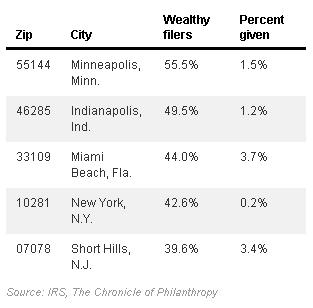
It turns out that wealthy people who live mostly with other wealthy people give the least amount of money to charity, on average.  Here are five zip codes with high-densities of rich people according to the IRS (= % of “wealthy filers”) and the percent of their incomes that they donated to charity (= “percent given”):

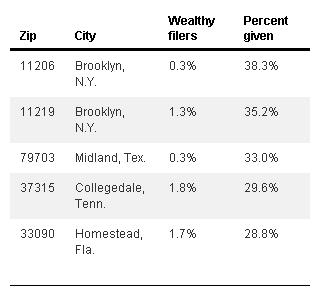
In contrast, here are five zip codes with a great deal of economic diversity.  In this case, the far right column shows a dramatic increase in the percent of their incomes that they donate to charity:

Wow, so rich people in Manhattan donate less than 1% of their income to charity, whereas the rich in Brooklyn give 35%.  That’s a pretty amazing divergence!

—————————

There are (at least) three explanations for this finding.   One is that living in a diverse neighborhood makes you more inclined to give, whatever your inclination before moving there.  Another is it that generous rich people move to diverse neighborhoods and stingy rich people isolate themselves.   A third is that some other variable (e.g., political affiliation, religiosity) is correlated with both neighborhood preference and generosity.

A social psychologist interviewed by, Paul Piff, suggests that it’s the first explanation.  Rich people tend to be isolated, he says, so they just don’t notice that other people need help. But, if they see need, they do show compassion.

I’m sure Piff knows his stuff, but if I had the opportunity to follow up with him on this argument, I’d ask him more about what he means by “see.”  It seems to me that anyone that reads the news these days will be exposed to plenty of evidence of economic need and, if you care enough to dig for it a little bit, you’ll find stunning data documenting income inequality and heart-rending stories of widespread suffering.  It may be easy to be isolated, but I imagine one would have to at least occasionally turn a blind eye to these things.

But perhaps knowledge about need isn’t sufficient; perhaps we only “see” need when we come into direct contact with human beings, the ones with who become familiar to us. There is evidence that we find it easy to blame strangers for their misfortune, but chock it up to bad luck when it’s us, our friends, or our families.  So perhaps raising consciousness about poverty isn’t enough, perhaps we really do need to get the rich to rub elbows with the disadvantaged.

In any case, the results are pretty impressive and no doubt have some wide-ranging implications for how to make us a more compassionate and generous society.

Lisa Wade, PhD is an Associate Professor at Tulane University. She is the author of American Hookup, a book about college sexual culture; a textbook about gender; and a forthcoming introductory text: Terrible Magnificent Sociology. You can follow her on Twitter and Instagram.