Search results for The

OLYMPUS DIGITAL CAMERA

Emile Durkheim, founding father of sociology and author of The Elementary Forms of Religious Life, would love  the Macy’s Thanksgiving Day Parade. Consider this excerpt from a British observer, Jonathan Raban, who watched the parade twenty years ago from a window on Central Park West. The parade, he said, was…

…the secular, American descendant of the European Catholic Easter procession in which all the icons and saints’ bones are removed from the churches and carried ceremonially around the town. The baseball hero, the gaseous, rubbery Mickey Mouse, the Mayflower pilgrims were the totems and treasure relics of a culture, as the New Orleans jazz and Sousa marches were its solemn music.

Had a serious-minded Martian been standing at the window, he would have learned a good deal by studying the parade’s idyllic version of American history. [guns, refugees, rebels]… The imaginative life of children was honored to a degree unknown on Mars — which was, perhaps, why matters of fact and matters of fiction were so confusingly jumbled up here, with Santa Claus and George Washington and Superman and Abraham Lincoln all stirred into the same pot.

He would be struck by the extraordinarily mythopoeic character of life in this strange country. People made myths and lived by them with an ease and fertility that would have been the envy of any tribe of Pacific islanders. Sometimes there were big myths that took possession of the whole society, sometimes little ones, casually manufactured, then trusted absolutely.

In my class, when we read about religion, Durkheim mostly, I have students write a paper about a secular ritual. One goal of the assignment is to get them to see that, from a functional perspective, a ritual is a way to generate and distribute the energy for binding the members of a society together.  It doesn’t really matter whether the ritual is officially secular or religious. In fact, if you’re a complete stranger to the culture, you probably couldn’t tell the difference.

potato1

No student has ever chosen the Macy’s parade. I wonder why not. Raban, who is from England, not Mars, senses the religious aura of the parade with its many gods. Had there been a Macy’s in ancient Greece, the parade would no doubt have had balloon representations of Demeter (god of the harvest), Poseidon (god of the sea), Aphrodite (god of beauty), Hermes (god of silk scarves), and of course in the U.S., Hebe (goddess of youth). And all the rest. We’re not Athenians. Instead, we throng the streets for icons like Snoopy and Spiderman, Pikachu, Bullwinkle, and Spongebob, but the idea is the same. They are our totems, our gods.

I imagine Durkheim on Central Park West, watching the children and grown-ups that have come together here to look up to these huge embodiments of our cultural ideals. Durkheim feels a frisson, a shiver of recognition. What better way to symbolize the idea about the binding power of ritual social energy?

Durkheim smiles.

Cross-posted at Montclair SocioBlog. Photographs by Kay West.

Jay Livingston is the chair of the Sociology Department at Montclair State University. You can follow him at Montclair SocioBlog or on Twitter.
Cross-posted at Jezebel.

This holiday season, a dollhouse may be a feminist gift for a little girl.

A tweet from Natalie Novik inspired me to look into the toy.  She had discovered a gender-neutral dollhouse being sold at Etsy.  Following up on her lead, I went over the Toys R Us website to see what gender messages dollhouses were sending.  Some of the results surprised me.

Among the 22 best selling dollhouses at Toys R Us, four came without people, six came with a preponderance of females, ten came with a male, female, and children, and there were two I couldn’t categorize.  (All humans were white — some dollhouses included non-human creatures — and just about everyone appears to be wealthy.)

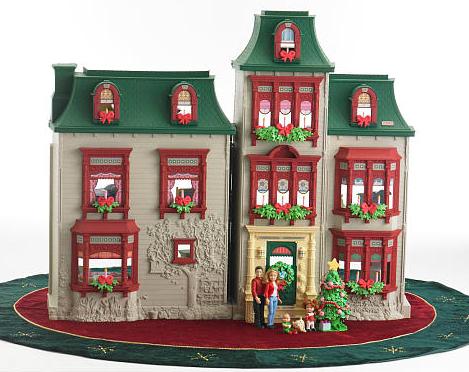
The majority of dollhouses, then, came in two types.  The first was an explicitly family-themed toy.  The message of these was heteronormative, for sure, and also pro-coupling and pro-reproduction.   The Fisher-Price Loving Family Home for the Holidays Dollhouse is an example:

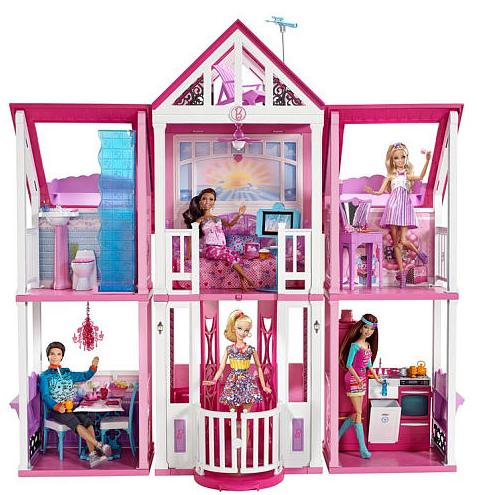
The second type of house, however, had themes of friendship and, dare I say, female-independence.  These houses had only women or, more often, a group of women and one man.  They gave the impression of female home-ownership and female-dominated social interaction.  The Exclusive Barbie Malibu Dreamhouse is an example:

Interestingly, most of the dollhouses that fell into this second type were Barbie affiliated.  People disagree as to whether Barbie is a good role model for young women.  She is roundly criticized for upholding a harmful standard of beauty, but she also tells women they can run for President and go to the moon.  In this case, Barbie is sending girls the message that they can have fulfilling lives and own homes without a husband.

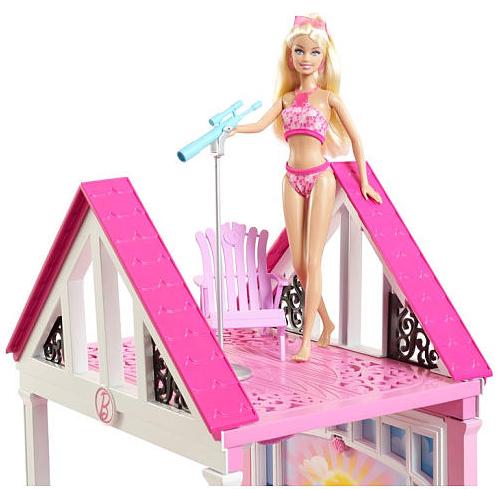
As if to capture the paradox completely, the dollhouse featured above comes complete with a Barbie in a bikini doing astronomy:

Children, of course, play with toys both creatively and in resistance to the messages they send.  We’d be happy to hear your stories and observations in the comments.

Lisa Wade, PhD is an Associate Professor at Tulane University. She is the author of American Hookup, a book about college sexual culture; a textbook about gender; and a forthcoming introductory text: Terrible Magnificent Sociology. You can follow her on Twitter and Instagram.

***TRIGGER WARNING for racism and enslavement***

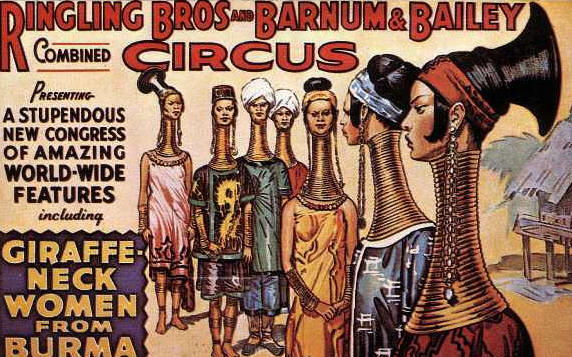
Last month I posted about the human zoo captives popular during the 1800s and early 1900s in Europe and America.  Today I discovered an archive documenting the capture and display of members of a Burmese ethnic minority, the Kayan (also called Padaung), who have historically practiced neck-lengthening.

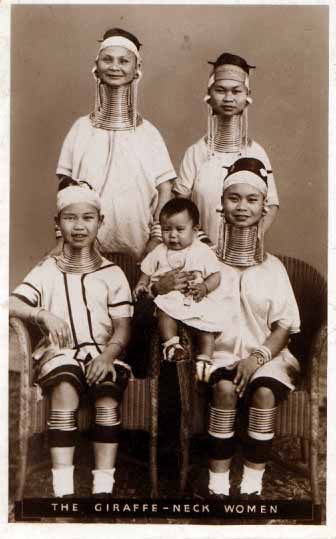
The archive, at Sideshow World, includes posters from the Hagenbeck-Wallace Circus and the Ringling Bros. and Barnum and Bailey Circus, as well as promotional photographs of the captives.  This material typically referred to the women as “giraffe-necked.”

Promotional posters:

Promotional photograph:
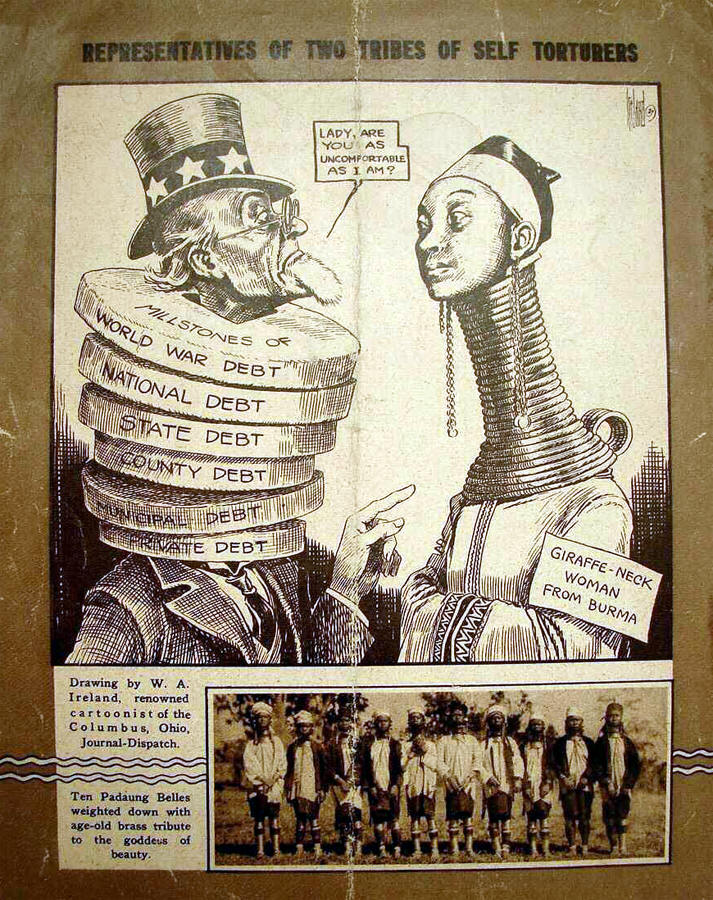
This political cartoon reveals the degree to which the “giraffe-necked woman” had become a well-known icon in the U.S.:

These women and the many others from various parts of the colonized world were typically kidnapped from their communities and put on display.  Many died young, exposed to diseases their bodies were not prepared to fight.  In some cases their remains — sometimes preserved as “freakish” samples — are still being repatriated.

Lisa Wade, PhD is an Associate Professor at Tulane University. She is the author of American Hookup, a book about college sexual culture; a textbook about gender; and a forthcoming introductory text: Terrible Magnificent Sociology. You can follow her on Twitter and Instagram.

In the five minute video below, U.C. Santa Barbara sociologist Richard Appelbaum discusses the global changes that are driving our uncertain economic future.  While economists have rightly focused on many proximate factors, he says, sociologists have emphasized “changing nature of the economy in the world today.”  He offers a quick history of economic transformations throughout human history and then focuses on the ongoing changes that we call “globalization.”  This includes lightning speed communication and extremely fast movement of goods from one part of the world to another.

Globalization, he goes on, has caused a migration of work out of wealthy and into poor countries.  Meanwhile, businesses that have no national boundaries are increasingly independent. Not beholden to any given country, it has become more difficult to regulate industries in ways that benefit any given state and its citizens.

Appelbaum finishes with a quick discussion of what all this means for young people who are educating themselves today with the hopes of a bright future tomorrow.

Video by Norton Sociology.

Lisa Wade, PhD is an Associate Professor at Tulane University. She is the author of American Hookup, a book about college sexual culture; a textbook about gender; and a forthcoming introductory text: Terrible Magnificent Sociology. You can follow her on Twitter and Instagram.

The hidden curriculum refers to the unspoken and unofficial norms, behaviors, and values that kids learn at school in addition to the official curriculum of math, reading, science, and so on. These can include expectations about how to act in public (standing in line), how to interact with non-parental authority figures, patriotism (saying the Pledge of Allegiance each morning), and messages about social hierarchies (who it’s ok to ridicule, what it means to get different grades), and so on.

Gender is an important element of the hidden curriculum. Schools reinforce larger cultural messages about gender, including the idea that gender is an essential characteristic for organizing social life.

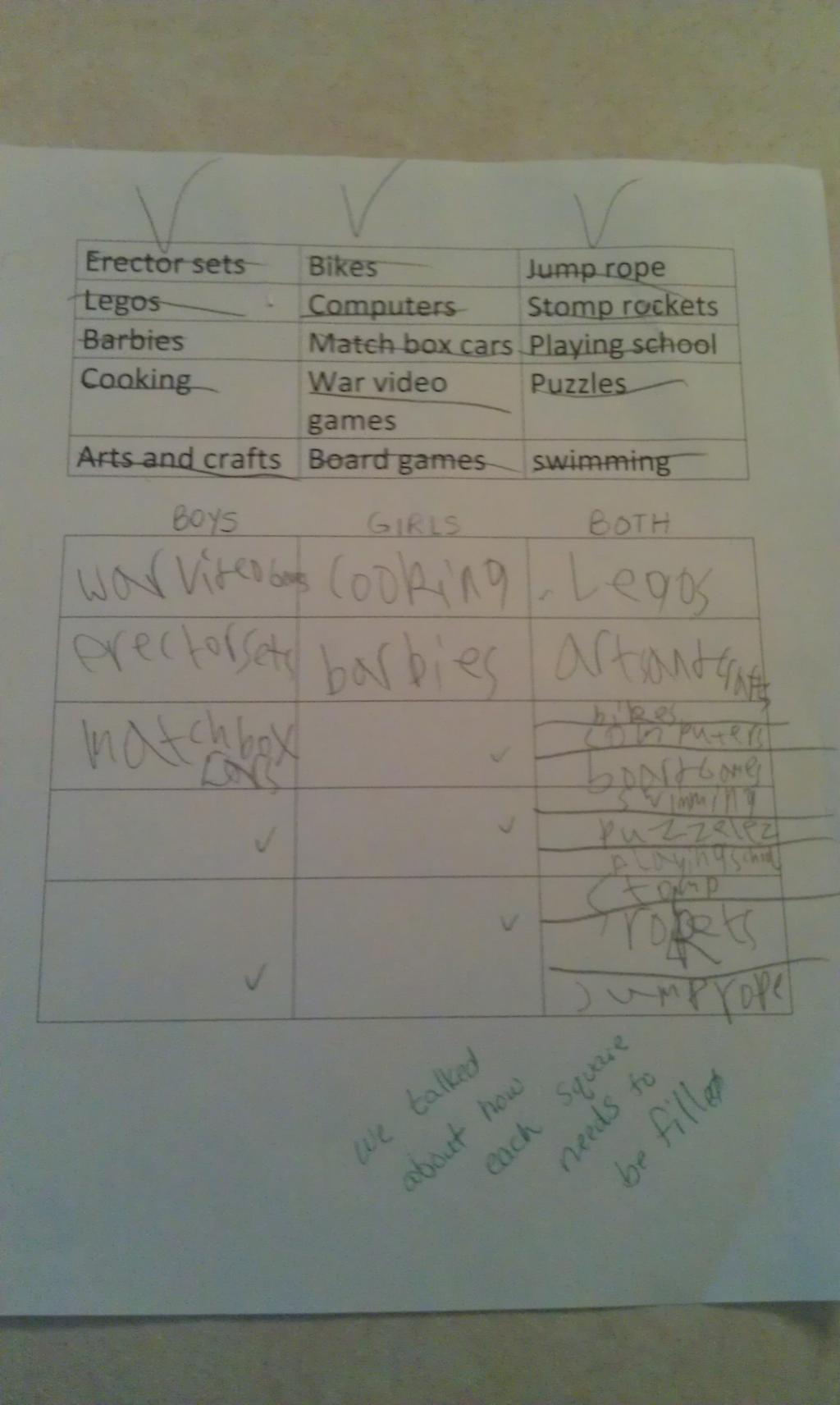
Marissa P. sent in a great example of this. Steve Bowler tweeted a photo of an assignment that his 8-year-old daughter’s teacher said she did incorrectly. The homework assignment had a list of toys or activities, and the kids were supposed to categorize them based on whether they were for boys, girls, or both, with equal numbers in each box. The assignment takes for granted the gendering of toys, and that there is a “correct” answer to the question of which gender they are appropriate for.

Bowler’s daughter did the assignment differently. After placing 3 items in the “boys” category and 2 in the “girls” group, she made additional boxes to add more things in the “both” column:

But at the bottom, the teacher notes that the assignment wasn’t done correctly. The point of the assignment is to categorize; the implicit message — that boys and girls are different types of people who like different types of things — isn’t questioned. A child sees this list of items and doesn’t gender them in the way the lesson took for granted; the reaction wasn’t to acknowledge her innovation and perhaps question the gendering, it was simply to say she did it wrong.

It’s one small example of the way that the hidden curriculum reinforces gendered messages, teaching kids expectations for gender and that gender itself is a coherent, meaningful characteristic.

Bowler, for the record, said he was proud his daughter failed the assignment and just wished she’d done even worse on it.

UPDATE: Reader Kama notes that the assignment accompanied a reading about a girl who wasn’t allowed to play basketball. The overall message of that story challenged the idea that girls can’t play basketball, requiring kids to categorize the toys and activities by gender as part of the lesson:

…this was assigned following reading a book about a girl who wanted to play basketball but was told it’s a boy’s sport.  She kept at it, got better, and earned the respect of the boys who were telling her off earlier.  According to the guy who posted the picture, the teacher was trying to discuss gender bias.  Did the teacher go about it the right way?  No, not really – especially when your end goal is showing that these biases are wrong.  That being said, this particular assignment doesn’t really fit with the idea of a hidden gender curriculum.  The teacher wasn’t trying to say that these are boy and girl toys, the teacher was trying (and failing) to point out that we are biased in our thinking about what’s for boys and what’s for girls.

Sorry for the misunderstanding on my part.

Gwen Sharp is an associate professor of sociology at Nevada State College. You can follow her on Twitter at @gwensharpnv.

The internet is exciting, in part, because it offers people an opportunity to produce as well as consume content.  This is why it’s sometimes called “democratizing”; it spreads around the power to influence our collective conversations.

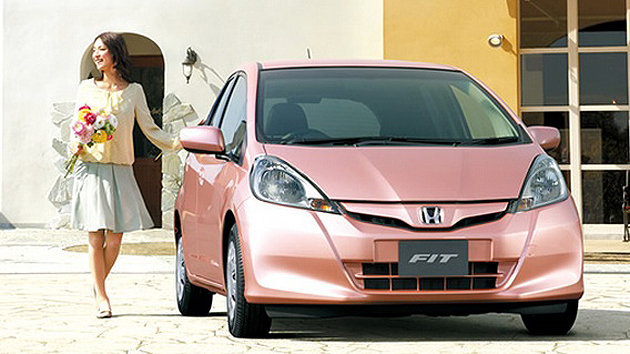
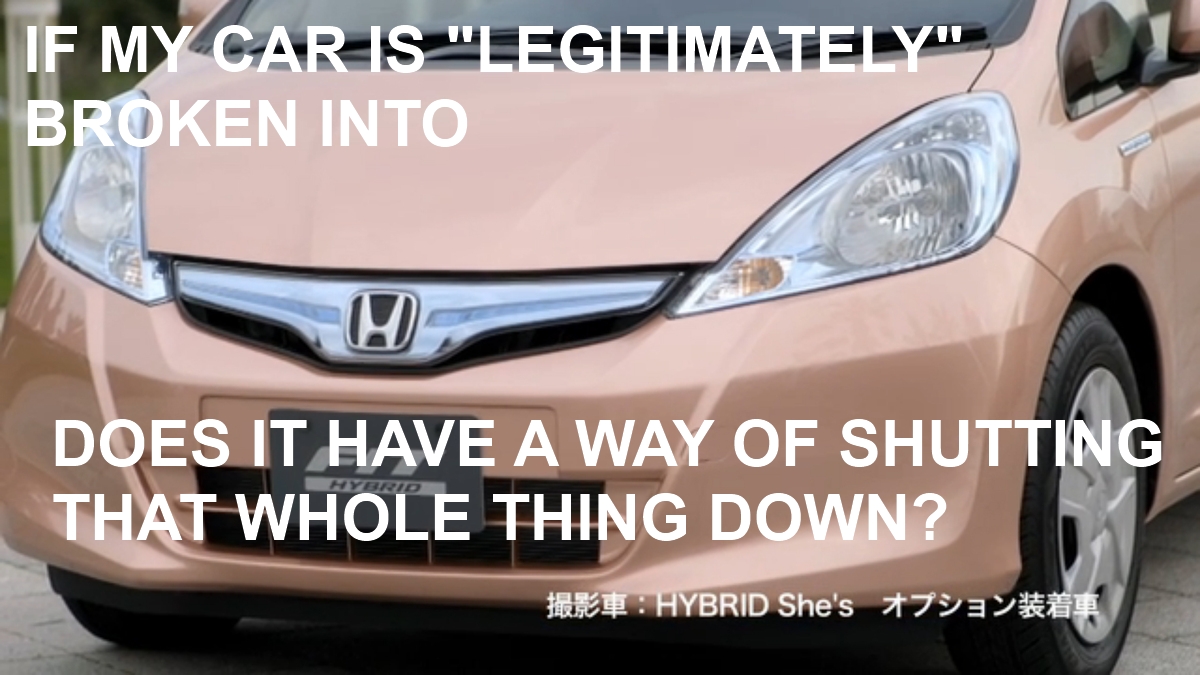
One reaction to the new Honda Fit She’s illustrates a form of resistance through the production of media content.  The She’s is a 1950s throwback being marketed to women in Japan.  In addition to coming in several shades of pink and the inclusion of a heart in the logo, it has pink stitching inside, windows that cut ultraviolet rays (to prevent wrinkles) and a special air conditioning system designed to improve skin quality (to erase wrinkles).

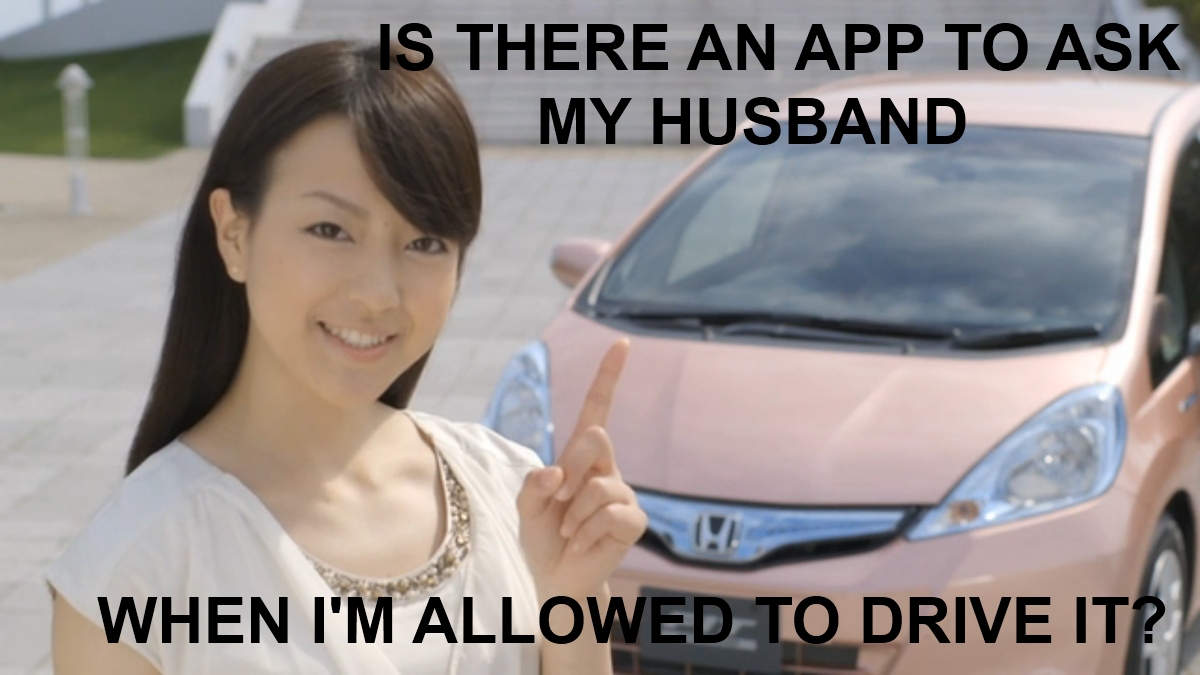
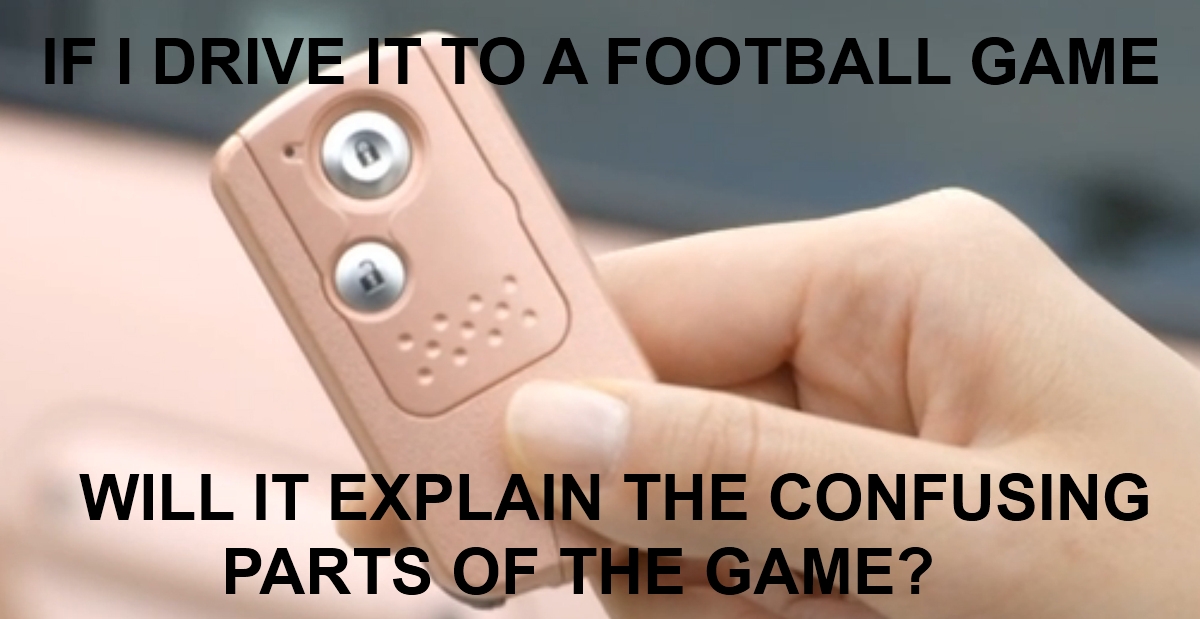
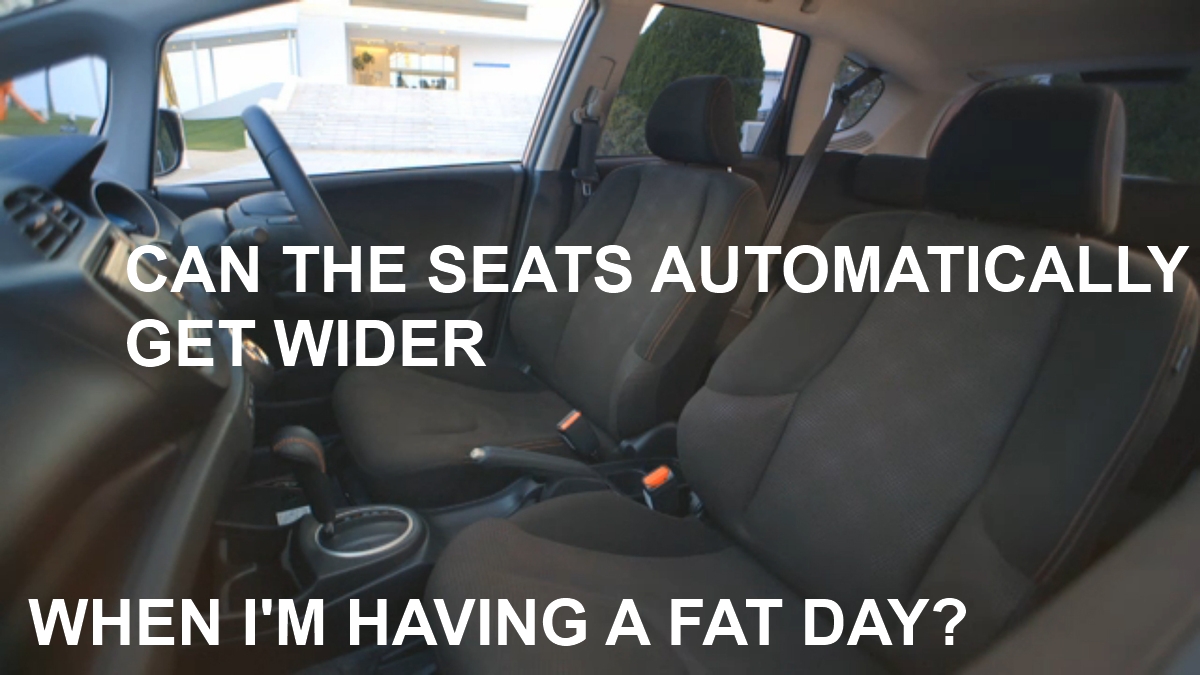
A website, called IdeasForHonda, has emerged in response.  It mocks Honda’s stereotyping of women with satire, offering its own ideas for what women want. Here are some of the entries:

This is just part of  a wider internet response to the She’s and this type of reaction has prompted companies to make changes.  Recently, for example, Gap pulled a t-shirt with the phrase Manifest Destiny and we’ve posted about successful resistance to the Obama sock monkey, the Pretzel Crisps “You Can Never Be too Thin” ad campaign, Nivea’s “Re-Civilize Yourself” ads, and the Abercrombie push-up bikini for kids.  Here’s to democratization.

Lisa Wade, PhD is an Associate Professor at Tulane University. She is the author of American Hookup, a book about college sexual culture; a textbook about gender; and a forthcoming introductory text: Terrible Magnificent Sociology. You can follow her on Twitter and Instagram.

There is growing talk that the economy is finally on its way to recovery — “A Steady, Slo-Mo Recovery” — in the words of Businessweek.

Here is how Peter Coy, writing in Businessweek, explains the growing consensus:

Job growth is poised to continue increasing tax revenue, which will make it easier to shrink the budget deficit while keeping taxes low and preserving essential spending. All this will occur without any magic emanating from the Oval Office. It would have occurred if Mitt Romney had been elected president. “The economy’s operating well below potential, and there’s a lot of room for growth” regardless of who’s in office, says Mark Zandi, chief economist of forecaster Moody’s Analytics.

Something could still go wrong, but the median prediction of 37 economists surveyed by Blue Chip Economic Indicators is that during the next four years, economic growth will gather momentum as jobless people go back to work and unused machinery is put back into service. “The self-correcting forces in the economy will prevail,” predicts Ben Herzon, senior economist at Macroeconomic Advisers, a forecasting firm in St. Louis.

Before we get lulled to sleep, we need some perspective about the challenges ahead.  How about this: we face a 9 million jobs gap between the number of jobs we have and the number we need, and this doesn’t even address the low quality of the jobs being created.

The chart below, taken from an Economic Policy Institute blog post, illustrates the gap.

As Heidi Shierholz, the author of the post, explains:

The labor market has added nearly 5 million jobs since the post-Great Recession low in Feb. 2010. Because of the historic job loss of the Great Recession, however, the labor market still has 3.8 million fewer jobs than it had before the recession began in Dec. 2007. Furthermore, because the potential labor force grows as the population expands, in the nearly five years since the recession started we should have added 5.2 million jobs just to keep the unemployment rate stable. Putting these numbers together means the current gap in the labor market is 9.0 million jobs. To put that number in context: filling the 9 million jobs gap in three years — by fall 2015 — while still keeping up with the growth in the potential labor force, would require adding around 330,000 jobs every single month between now and then.

Unfortunately, our “job creators” only created 171,000 net jobs in October. And that was considered a relatively good month.   The chart below, from the Center on Budget and Policy Priorities,  gives a sense of what we are up against.

Of course, weak job growth in the past doesn’t mean that we cannot have strong job growth in the future.  On the other hand, such a change would require consensus on radically different policies than those currently being discussed and debated by those in power.

—————————

Martin Hart-Landsberg is a professor of Economics and Director of the Political Economy Program at Lewis and Clark College.  You can follow him at Reports from the Economic Front.


Cross-posted at Montclair SocioBlog.

In a democracy, all votes are created equal — one person, one vote -– but apparently some votes are more equal than others.  Obama won the electoral college vote 62% – 38%, though his margin in the popular vote was much smaller: 51% – 48%.

A similar discrepancy happened in the vote for Congressional representatives.  The Republicans control the House of Representatives, where they have 54% of the seats. But if you add up all the votes for those seats, the Democrats come out slightly ahead (by about 500,000 votes).  More votes but fewer seats.

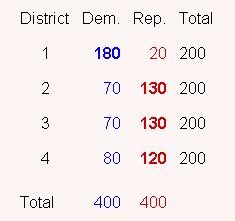
That discrepancy arises from the distribution of Democrats and Republicans in a state’s Congressional districts.  Take a hypothetical state with four districts, each with 200 people.  The popular vote splits evenly –- 400 Democrats, 400 Republicans. Here are the election results:

The Republicans have 50% of the popular vote but get 75% of the seats.
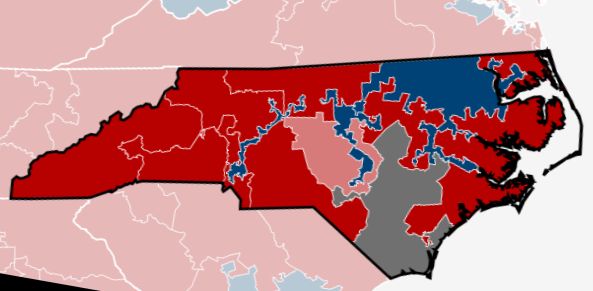
Less hypothetically, in North Carolina, Democratic candidates outpolled Republicans 2.22 million to 2.14 million.  But Republicans won 10 of the 14 seats.  The Democratic votes were crowded into four districts.  In three of those four districts, the Democrats won big – by an average of 133,000 votes.  (If the 7th district, where Democrats now have a slim lead, goes Republican, that average margin will be 177,000.)  Had some of the Democrats from one of those districts been mapped into the neighboring district, they might have won both, though by smaller margins.  The Republican districts had secure but smaller majorities.  Republican winning margins averaged 50,000 votes, less than half the margin where Democrats won.

My first thought was that this was pure Gerrymandering.  State legislatures get to draw the maps of their Congressional districts.  And many more state legislatures are controlled by Republicans.  In fact, some of the North Carolina districts have unusual shapes.  The NC-12, the thin blue line along Interstate 85 stretching nearly to the border, was created as a “majority-minority” district so that Black votes would not be diluted.  The downside for Democrats is that it packs those votes into that narrow corridor.  So the Democrats take that district by over 180,000 votes.  The Republicans with the neighboring districts but by much smaller margins – 23,000, 25,000, and 53,000.  In those four districts, the Democrats got 53% of the vote, but Republicans took three of the four seats.

The Democratic district snaking down through the middle of the state is the 4th, which contains “the Triangle” to the north, but now has that tail stretching down.  Democrats carried the district  by 170,000 votes.  Surrounding it is the 2nd (in pink), which Republicans carried by only 45,000 votes.

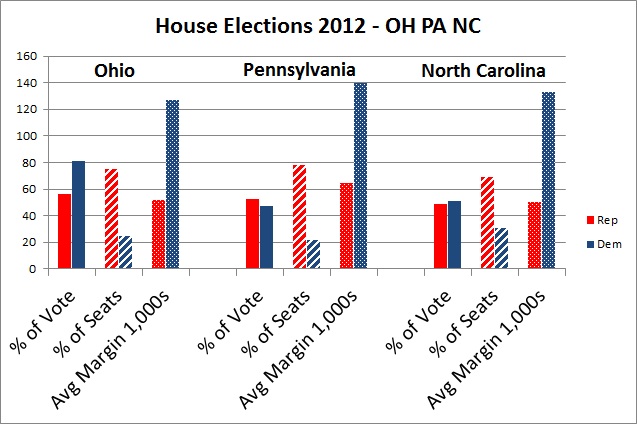
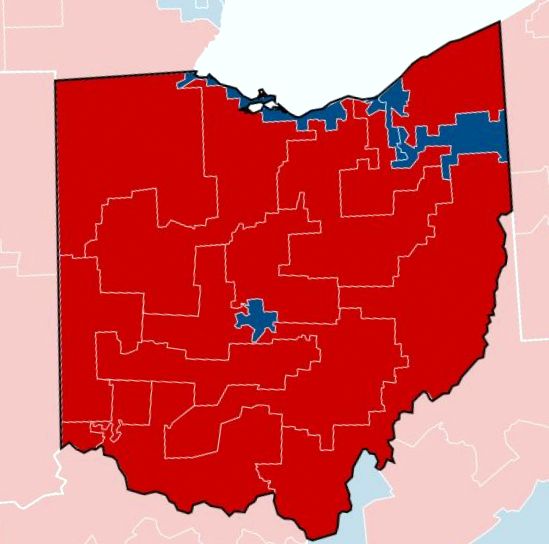
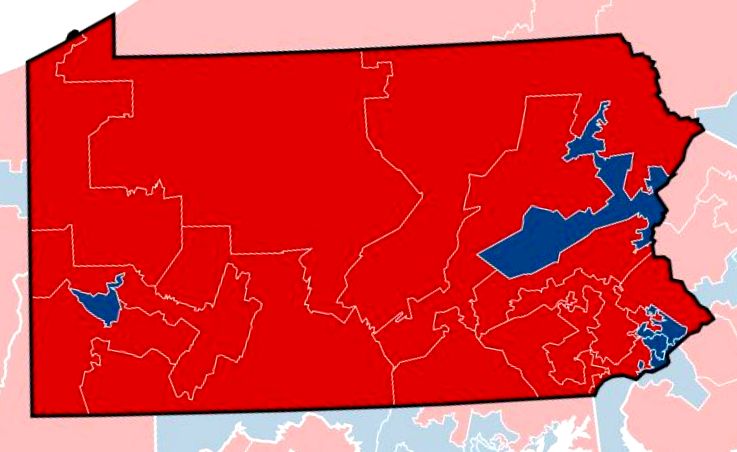
Similar differences crop up in Ohio and Pennsylvania. The popular vote is close, and in two of these states it goes to the Democrats.  But Republicans get most of the seats.  Republicans win their seats by less than half the margin of Democratic winners.  Here is a graph of the actual returns from Ohio, Pennsylvania, and North Carolina. (The Ohio total does not include the vote from the two uncontested districts, one Democrat, one Republican.  For the maps and election results, check out Politico.)

The Republican share of Congressional seats is far out of proportion to its share of the vote.  In Ohio and North Carolina, Democrats received more votes, but Republicans got 70-75% of the House seats.  It certainly is possible that Republican-dominated state legislatures drew the districts so as to cram Democratic voters into electoral ghettos.

I don’t know enough about the demography and geography of these states, but I do wonder why the districts are drawn this way.  A paper by Chen and Rodd (here) that uses 2000 election data argues that what looks like gerrymandering is in fact the result of “human geography.”  It’s not the legislatures that pack Democrats together, it’s the Democrats themselves.  They cluster in cities.  As for Democrats outside of cities,

many rural, small-town, and suburban precincts that lean Democratic are often subsumed into moderately Republican districts. . . . There are isolated pockets of support for Democrats in African-American enclaves in the suburbs of big cities and in smaller towns with a history of railroad industrialization or universities. However, these Democratic pockets are generally surrounded by Republican majorities, thus wasting these Democratic votes. As a result, the Democrats are poorly situated to win districts outside of the urban core.

Regardless of intent, the effect is to keep Democratic votes concentrated in the 4th.  If that blue tail of the NC-04 were subsumed into the pink NC-02, both districts might be blue.

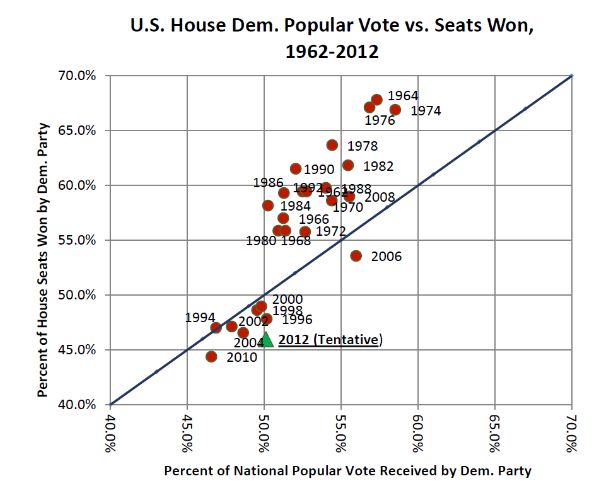
In any case, Democrats have not always been on the wrong side of the seat/vote discrepancy.  John Sides at The Monkey Cage posted this graph showing the ratio for the last twenty-six elections.

Sides quotes Matthew Green on the general trends:

  • the winning party usually gets a “boost” in the number of seats
  • that boost used to be much larger

That trend might fit with the deliberate-gerrymander explanation, provided that in the earlier decades more state legislatures were controlled by Democrats.  But I’m not sure how it fits with Chen and Rodden’s human geography idea of “unintentional gerrymandering.”

—————————

Jay Livingston is the chair of the Sociology Department at Montclair State University.  You can follow him at Montclair SocioBlog or on Twitter.
Jay Livingston is the chair of the Sociology Department at Montclair State University. You can follow him at Montclair SocioBlog or on Twitter.