Search results for The

Larry Harnisch, of L.A.’s The Daily Mirror, let us know that 4th Estate analyzed the racial and ethnic breakdown of reporters covering the presidential election for 38 major print media outlets. The analysis included front-page articles published between January 1st and October 12th of this year.

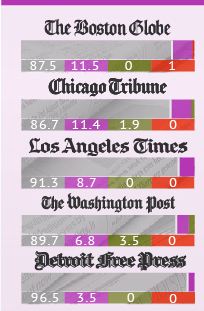
Here’s the key for all of the following images:

For every major topic, the overwhelming majority of front-page articles were written by non-Hispanic Whites, while racial/ethnic minorities were underrepresented compared to the overall U.S. population:

Major newspapers varied in the diversity of those writing their feature articles. The Dallas Morning News was the most diverse, with a particularly large percentage (18.8) of front-page stories written by African American reporters. The San Francisco Chronicle had the least diversity; 100% of its feature political stories were written by White non-Hispanics:
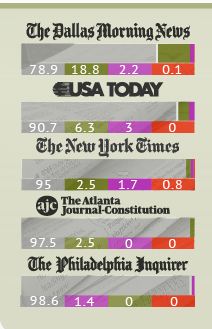
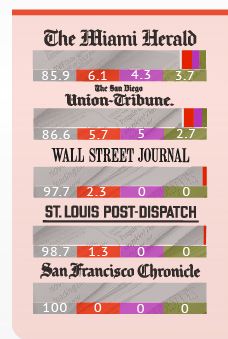
Overall, 93% of the feature articles analyzed in the database were written by White non-Hispanics, 4% by Asian Americans, about 2% by African Americans, and less than 1% by Hispanics. Compare that with each group’s proportion of the overall U.S. population:


These numbers clearly matter in terms of career opportunities and exposure for minorities within the industry. But they also should concern us readers. What does the lack of diversity mean in terms of the issues covered, the political contacts and average-Joe-voters spoken to, the topics seen as important enough to cover?

Also see our earlier post on the gender of those quoted in news stories about the election.

Gwen Sharp is an associate professor of sociology at Nevada State College. You can follow her on Twitter at @gwensharpnv.


Amie G. sent along a five minute documentary in which a series of artists and entrepreneurs talk about why the Day of the Dead has become so popular in parts of the United States.

While they don’t discuss issues of cultural appropriation (like at Halloween), they have some interesting things to say about why it is so appealing to a broad audience. A professor of Art History, Ray Hernández Durán, for example, traces it to the growing Latino demographic, the way media has changed, and a history of the U.S. being open to cultural influence.

—————————

Lisa Wade is a professor of sociology at Occidental College. You can follow her on Twitter and Facebook.

In this five-minute interview, Sociologist Joel Best debunks the idea that people are poisoning Halloween candy and talks about how his research in the area prompted his career studying the social construction of social problems:

Lisa Wade, PhD is an Associate Professor at Tulane University. She is the author of American Hookup, a book about college sexual culture; a textbook about gender; and a forthcoming introductory text: Terrible Magnificent Sociology. You can follow her on Twitter and Instagram.

Cross-posted at Caroline Heldman’s Blog.

During a debate this past Tuesday, Indiana Republican senate nominee, Richard Mourdock, made the case against the rape exception for abortions: “I’ve struggled with it myself for a long time, but I came to realize that life is that gift from God, and even when life begins in that horrible situation of rape, that it is something that God intended to happen.”

So according to Mourdock, God intends for rape to happen, and the outcome of rape is a gift from God.

What puzzles me is how Mourdock’s rape enthusiast comments fit with Missouri Republican senate candidate Todd Akin’s recent comments that “legitimate rape” (read“forcible rape”) rarely leads to pregnancy because, ”If it’s a legitimate rape, the female body has ways to try to shut that whole thing down.”

Mourdock and Akin’s beliefs, when considered together, produce a bizarre philosophy. I would like to know: Why would God create female bodies that reject God’s “gifts”? And if women don’t get pregnant from “forcible rape,” does that mean that God doesn’t intend ”forcible rapes”? Put another way, does God only intend certain types of rape, you know, the ones that come with “the gift”?

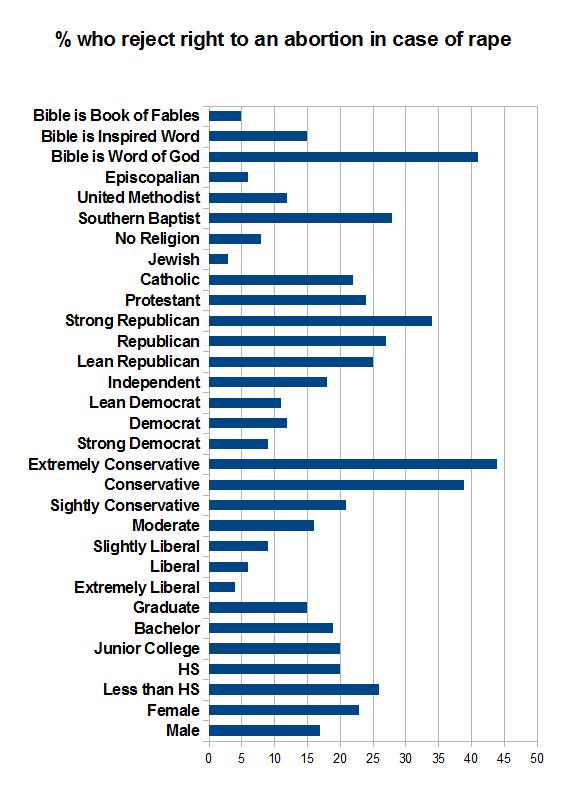
One-in-five Americans agree with Mourdock and Akin’s abortion stance. Razib Khan’sanalysis of the General Social Survey shows that 20% of Americans think abortion should be illegal in cases of rape. Republicans with lower levels of education who identify as extremely conservative and believe the Bible is the word of God are more likely than other Americans to hold this belief.

For Mourdock, Akin, and more than 50 million other Americans, God truly does work in mysterious ways.

Caroline Heldman is a professor of politics at Occidental College. You can follow her at her blog and on Twitter and Facebook.

If you’re paying any attention to the U.S. presidential election, you’ve likely heard a lot about campaign spending on ads. So how much is being spent? And where?

Dmitriy T.C. sent in an interactive graphic that the Washington Post created that allows you to look at one particular type of campaign spending: commercials in various television markets. Spending, and thus exposure to presidential campaign commercials, is very unevenly distributed. Many states get almost no attention from the national campaigns and the interest groups and PACS that support them, since their voting outcomes are seen as all but inevitable.

I, on the other hand, live in the largest city in a swing state; $37 million has been spent on over 47,000 commercials here:

Here’s the key for the map; the darkest green shade indicates more than 20,000 ads, a number roughly equal to how many times I have been called by political pollsters during the past three months:

You can also limit the map to look just at Democratic or Republican spending.

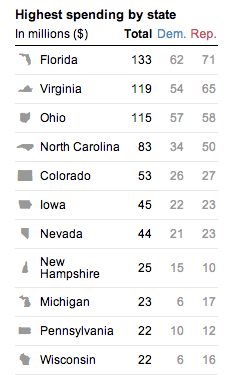
Florida leads the nation in amount spent on TV ads by the two campaigns. The Republicans have outspent the Democrats in all of the top 11 states except New Hampshire:

The site also has a graph that lets you track spending in the most competitive states by week between mid-April and  now.

This is just one element of campaign spending. Add in the cost of all the mailers, campaign trips, online ads, the conventions themselves, and Get out the Vote efforts by the presidential campaigns or interest groups and SuperPACs associated with them, and the amount spent to elect our president is truly mind-boggling.

Gwen Sharp is an associate professor of sociology at Nevada State College. You can follow her on Twitter at @gwensharpnv.
Cross-posted at Caroline Heldman’s Blog.

Last Thursday, Republican Representative and Tea Party favorite, Joe Walsh (R-Ill), told reporters that when it comes to abortion, “there’s no such exception as life of the mother” because of “advances in science and technology.” This astounding claim was news to the medical community.

Walsh joins the ranks of some other prominent Republican men who don’t understand basic lady parts science: Representative Todd Akin (R-MO), who claimed that pregnancy from “legitimate rape” is “really rare” because “the female body has ways to shut the whole thing down,” and conservative comedian Rush Limbaugh, who doesn’t understand the basics of birth control pills. (He thinks you take a pill every time you have sex!)

These remarks would be humorous if it weren’t for the fact that these men are part of a broader effort by the extreme wing of the Republican Party to take aim at women’s reproductive health.

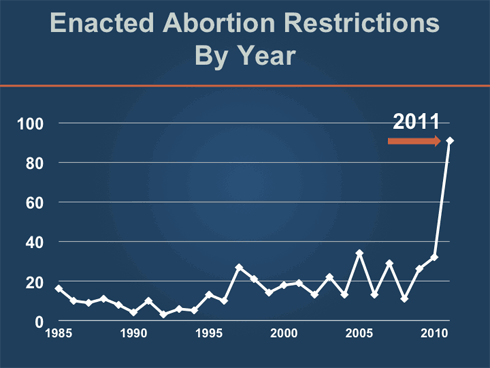
At the state level, Republican lawmakers enacted a record number of anti-abortion measures in 2011, four times as many as the previous year. A study from the Guttmacher Institute shows that legislators in 45 state capitals introduced 944 provisions to limit women’s reproductive health and rights in the first three months of 2012. These states are proposing/passing abortion ultrasound requirements, gestational limits, health insurance exemptions for contraception coverage, and stringent limitations on medical abortions.

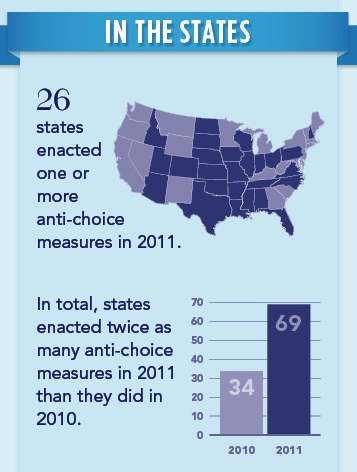
In the past two years, 19 states have introduced bills modeled on a Nebraska law that bans abortion 20 weeks after fertilization. The Oklahoma State Senate redefined “person” as starting at conception, while the Mississippi House approved a bill requiring women who want an abortion to undergo an examination to determine if there is a fetal heartbeat. Texas and Virginia require women to undergo an ultrasound prior to receiving an abortion, and many other states have similar proposals underway. Texas recently cut reproductive services for 130,000 poor women.  As this chart from NARAL indicates, twice as many states passed anti-choice laws in 2011 than in 2010.


At the federal level, in 2010, the newly elected House Republican majority was quick to propose major cuts to reproductive health services. They made several attempts to eliminate funding for Planned Parenthood, the largest family planning provider in the U.S. that has been around for a century. They also tried to gut Title X, a program that funds family planning and preventive breast and cervical cancer screenings. Both proposals were stopped by Senate Democrats. Ironically, on the same day that House Republicans tried to eliminate Title X funding, Representative Dan Burton (R-IN) proposed contraceptive funding for wild horses (something that we desperately need, actually).

Congressional Republicans also proposed an amendment to the health care bill that allows federally funded hospitals to turn away women in need of an abortion to save their lives. This is by far the most brazen attack on the “mother’s health” exception to restrictions on abortions. In May of 2012, Republicans proposed a veto on sex-selective abortions that failed to pass the House, despite broad Republican support for the bill. And in early 2012, Republicans in Congress held hearings on whether the new health care law should include contraception coverage. These hearings included virtually no female experts, so House Democrats held more inclusive hearings that (gasp) included women. Limbaugh assailed one hearing participant, Georgetown student Sandra Fluke, calling her a “slut” and a “prostitute.”

Prominent conservatives, including Republican Party leadership, have roundly dismissed the assertion that the party is engaged in a War on Women, but the recent flurry of legislation curbing reproductive freedoms tells a different story. Given baffling comments from the likes of Walsh, Akin, and Limbaugh, the generals in this War on Women obviously need to include lady parts science as part of basic training.

 ——————
Caroline Heldman is a professor of sociology at Occidental College.  You can follow her at her blog and on Twitter and Facebook.

Cross-posted at Reports from the Economic Front.

Presidential candidate Mitt Romney’s low federal tax rate — 14.1% — has called attention to the fact that our tax code favors people who make their money from investments rather than labor.  According to the conventional wisdom, this is as it should be.  It encourages people, like our job creators, to invest their money, thereby boosting growth and the well-being of all working people.  Sounds plausible, but the facts don’t support the policy.

BusinessWeek lays out the background and political context for our current low taxation rates on investment income as follows:

Since 1950 capital gains have generally been taxed at a lower rate than income, to spur investment. The rate under President George W. Bush went from 20 percent to 15 — the lowest ever — and was billed as a way to stimulate the economy. (If nothing’s done by Jan. 1 to change tax and budget provisions already passed by Congress, the rate will snap back to 20 percent, a scenario both parties hope to avoid.) Mitt Romney wants to ditch capital gains tax altogether for people earning less than $250,000. President Barack Obama, in his Affordable Care Act, increased the rate by 3.8 percent for high earners beginning in 2013, and has proposed the so-called Buffett Rule, which would among other things end an accounting interpretation that allows private equity and hedge fund managers (and Romney) to save money by paying tax on their earnings at the capital gains rate. Neither candidate, though, contests the Bush administration’s basic logic: that a lower capital gains rate encourages investment, which creates jobs and helps the economy grow. That doesn’t mean they’re right.

Leonard E. Burman, a tax expert, took on this issue in recent testimony before the House Committee on Ways and Means and the Senate Committee on Finance.   A good place to start is with who benefits from lower capital gains taxes.

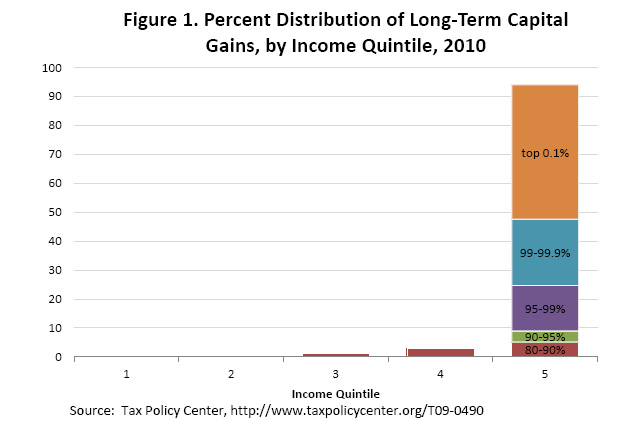
Not surprisingly, as the figure below (which is taken from Burman’s testimony) shows, the benefits are extremely concentrated.  As Burman noted:

In 2010, the highest-income 20 percent realized more than 90 percent of long-term capital gains according to the TaxPolicyCenter.  The top 1 percent realized almost 70 percent of gains and the richest 1 in 1,000 households accrued about 47 percent. It is hard to think of another form of income that is more concentrated by income.

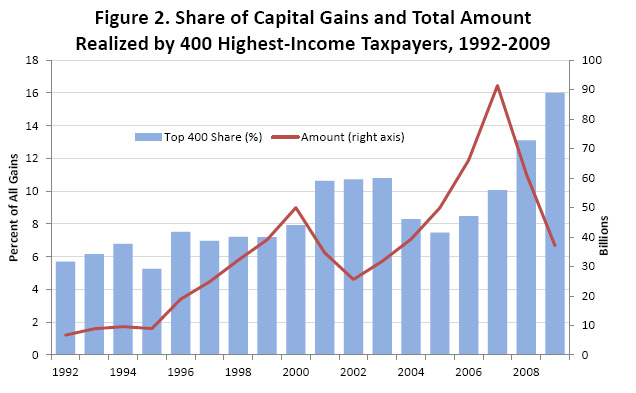
Moreover, as the next figure shows, the concentration of capital gains has grown over time.  Given that the rich fund political campaigns, this certainly helps to explain why both political parties are so determined to keep the rate low.

But, to the main question — do lower capital gains taxes actually boost growth? This is what Burman had to say in his testimony:

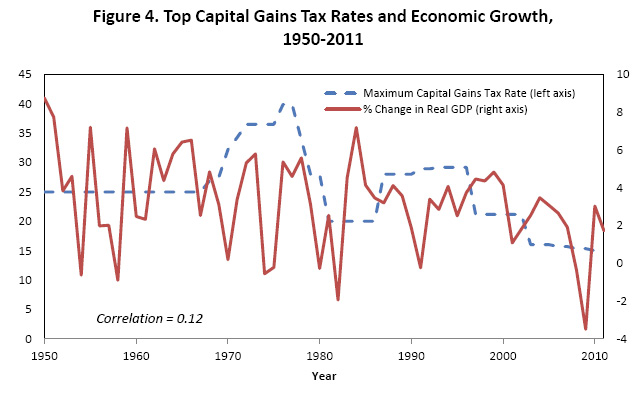
The heated rhetoric notwithstanding, there is no obvious relationship between tax rates on capital gains and economic growth. Figure 4 [below] shows top tax rates on long-term capital gains and real economic growth (measured as the percentage change in real GDP) from 1950 to 2011. If low capital gains tax rates catalyzed economic growth, we’d expect to see a negative relationship — high gains rates, low growth, and vice versa — but there is no apparent relationship between the two time series. The correlation is 0.12, the opposite sign from what capital gains tax cut advocates would expect, and not statistically different from zero. Although not shown, I’ve tried lags up to five years and using moving averages, but there is never a larger or statistically significant relationship.

Burman notes that he posted this figure on his blog and offered the data to anyone interested, challenging readers to find support for lower rates.  “A half dozen or so people, including at least one outspoken critic of taxing capital gains, took me up on the offer, but nobody to my knowledge has been able to tease a meaningful relationship between capital gains tax rates and the GDP out of the data.”

As reported in a previous post, Thomes L. Hungerford, writing for the Congressional Research Service, came to the same conclusion about the lack of any relationship between the capital gains tax and GDP.  In fact, he concluded raising the top income and capital gains tax rates would likely reduce income inequality without causing harm to the economy.

So, if we are really concerned with the budget deficit, rather than slashing spending on social programs lets raise the top tax rates.  Wonder if this will come up during our presidential debates?

—————————

Martin Hart-Landsberg is a professor of Economics and Director of the Political Economy Program at Lewis and Clark College.  You can follow him at Reports from the Economic Front.

A few years back we featured a series of Playboy drawings from the 1960s and ’70s that trivialized the social movements of the time: feminism, the anti-war movement, native rights, and the civil rights movement.  You should really go take a look; they’re something else.

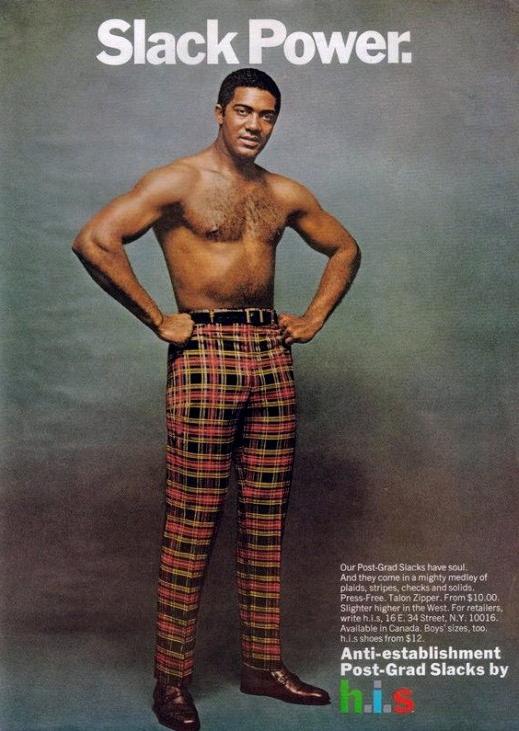
In any case, Peter from Denmark sent in another example from the same time period.  A 1970s JC Penney ad for pants; “slack power” is a reference to “Black power” and it’s no coincidence that an African American man is modeling.  Notice, too, that it calls the pants “anti-establishment” in the bottom right.

While companies like Komen are getting a lot of critical attention these days for turning cancer awareness into consumption, this strategy has been around a long time.

For examples of appropriation of feminism, see these framing consumption of clothesmake-upjewelry, cigarettesmagazines, and cosmetic procedures as expression of freedoms.

Lisa Wade, PhD is an Associate Professor at Tulane University. She is the author of American Hookup, a book about college sexual culture; a textbook about gender; and a forthcoming introductory text: Terrible Magnificent Sociology. You can follow her on Twitter and Instagram.