Search results for The

Cross-posted at Reports from the Economic Front.

Politicians always seem to be talking about the middle class.  They need some new focus groups.  According to the Pew Research Center, over the past four years the percentage of adult Americans that say they are in the lower class has risen significantly, from a quarter to almost one-third (see chart below).

Pew also found that the demographic profile of the self-defined lower class has also changed.  Young people, according to Pew, “are disproportionately swelling the ranks of the self-defined lower classes.”   More specifically some 40% of those between 18 to 29 years of age now identify as being in the lower classs compared to only 25% in 2008.

Strikingly, the percentage of whites and blacks that see themselves in the lower class is now basically equal.  The percentage of whites who consider themselves in the lower class rose from less than a quarter in 2008 to 31% in 2012.  This brought them in line with blacks, whose percentage remained at a third.  The percentage of Latinos describing themselves as lower class rose to 40%, a ten percentage point increase from 2008.

And not surprisingly, as the chart below shows, many who self-identify as being in the lower class are experiencing great hardships.   In fact, 1 in 3 faced four or all five of the problems addressed in the survey.

In short, there is a lot of hurting in our economy.

Confirmation bias is the tendency to search for or interpret information in a way that reaffirms our pre-existing beliefs. We may selectively notice information; for instance, if we think the full moon makes people act weird, we’re likely to notice and remember strange things we see people doing during a full moon better than strange things we observe at other times (or than all the people we see acting perfectly normally during a full moon). We tend to perceive what we expect to see, our brains struggling to come up with reasons that justify what we already think.

Dmitriy T.C. sent in a video that illustrates this particular type of selective thinking. Jimmy Kimmel gave people on the street an exclusive look at the iPhone 5 and asked what they thought of it. Except, of course, the iPhone 5 isn’t available yet. What he actually gave them was an iPhone 4S. But when told they’re looking at a new version of the iPhone, everyone immediately perceives clear improvements that make it better than the iPhone 4.

You might expect this from people who don’t have much knowledge of iPhones; they don’t have a clear basis for comparison, so whatever features seem neat, they assume are new. But even people holding their own iPhone 4 up for direct comparison perceive the “iPhone 5” Kimmel hands them to be superior, noting a range of details — it’s lighter, faster, just clearly better. They think a new version of a gadget must be way more awesome than the previous version, and Apple has an aura of coolness that leads people to expect their new products should be extra amazing. Since people expect a new iPhone to be awesome, they notice, or invent, features that confirm that it is, indeed, awesome.

It’s a really fun demonstration of this cognitive bias:

Cross-posted at Montclair SocioBlog.

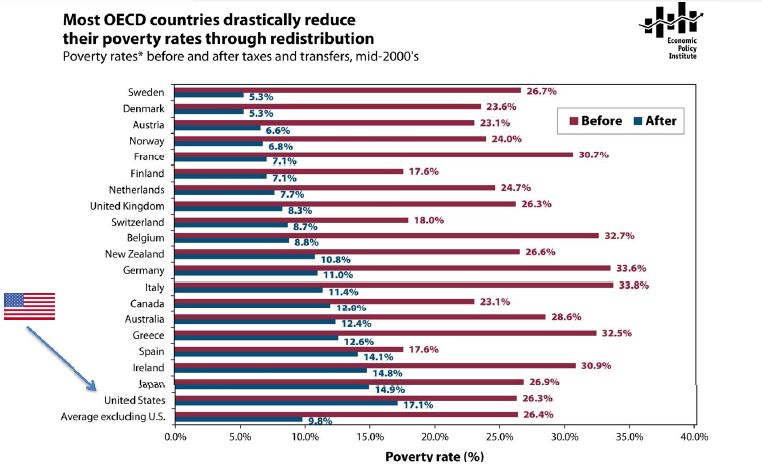
The poverty rate in the US in the mid-2000s was about 17%.  In Sweden, the poverty rate was 5.3%; in Germany, 11%.   That was the rate after adding in government transfers.  In Germany, the poverty rate before those transfers was 33.6%, ten points higher than that in the US.  Sweden’s pre-transfer poverty rate was about the same as ours.

Jared Bernstein has this chart showing pre-transfer and post-transfer rates for the OECD countries (click to enlarge):

Three  points:

1.  Governments have the power to reduce poverty, and reduce it a lot.  European governments do far more towards this goal than does the US government.

2.  It’s unlikely that America’s poor people are twice as lazy or unskilled or dissolute as their European counterparts.  Individual factors may explain differences between individuals, but these explanations have little relevance for the problem of overall poverty.  The focus on individual qualities also has little use as a basis for policy.  European countries have fewer people living in poverty, but not because those countries exhort the poor to lead more virtuous lives and punish them for their improvident ways.  European countries have lower poverty rates because the governments provide money and services to those who need them.

3.  The amount of welfare governments provide does not appear to have a dampening effect on the overall economy.

Cross-posted at Family Inequality.

In 2010, 28% of wives were earning more than their husbands. And wives were 8-times as likely as their husbands to have no earnings.

I still don’t have my copies of The End of Men, by Hanna Rosin, or The Richer Sex, by Liza Mundy. But I’ve read enough of their excerpts to plan out some quick data checks.

Both Rosin and Mundy say women are rapidly becoming primary earners, breadwinners, pants-wearers, etc., in their families. It is absolutely true that the trend is in that direction. Similarly, the Earth is heading toward being devoured by the Sun, but the details are still to be worked out. As Rosin wrote in her Atlantic article:

In feminist circles, these social, political, and economic changes are always cast as a slow, arduous form of catch-up in a continuing struggle for female equality.

Which is right. So, where are we now, really, and what is the pace of change?

For the question of relative income within married-couple families, which is only one part of this picture — and an increasingly selective one — I got some Census data for 1970 to 2010 from IPUMS.

I selected married couples (called “heterogamous” throughout this post) in which the wife was in the age range 25-54, with couple income greater than $0. I added husbands’ and wives’ incomes, and calculated the percentage of the total coming from the wife. The results show and increase from 7% to 28% of couples in which the wife earns more than the husband (defined as 51% or more of the total income):

(Thanks to the NYTimes Magazine for the triumphant wife image)

Please note this is not the percentage of working wives who earn more. That would be higher — Mundy calls it 38% in 2009 — but it wouldn’t describe the state of all women, which is what you need for a global gender trend claim. This is the percentage of all wives who earn more, which is what you need to describe the state of married couples.

But this 51% cutoff is frustratingly arbitrary. No serious study of power and inequality would rest everything on one such point. Earning 51% of the couple’s earnings doesn’t make one “the breadwinner,” and doesn’t determine who “wears the pants.”

Looking at the whole distribution gives much more information. Here it is, at 10-year intervals:

These are the points that jump out at me from this graph:

  • Couples in which the wife earns 0% of the income have fallen from 46% to 19%, but they are still 8-times as common as the reverse — couples where the wife earns 100%.
  • There have been very big proportionate increases in the frequency of wives earning more — such as a tripling among those who earn 50-59% of the total, and a quadrupling among those in which the wife earns it all.
  • But the most common wife-earning-more scenario is the one in which she earns just over half the total. Looking more closely (details in a later post) shows that these are mostly in the middle-income ranges. The poorest and the richest families are most often the ones in which the wife earns 0%.

Maybe it’s just the feminist in me that brings out the stickler in these posts, but I don’t think this shows us to be very far along on the road to female-dominance.

Previous posts in this series…

  • #1 Discussed The Richer Sex excerpt in Time (finding that, in fact, the richer sex is still men).
  • #2 Discussed that statistical meme about young women earning more than young men (finding it a misleading data manipulation), and showed that the pattern is stable and 20 years old.
  • #3 Debunked the common claim that “40% of American women” are “the breadwinners” in their families.
  • #4 Debunked the description of stay-at-home dads as the “new normal,” including correcting a few errors from Rosin’s TED Talk.
  • #5 Showed how rare the families are that Rosin profiled in her excerpt from The End of Men

In 1956 sociologist C. Wright Mills published a book titled The Power Elite.  In it, he argued that our democracy was corrupt because the same people exercised power in business, the military, and politics.  This small group, with so many important roles and connections, had an influence on our society that was far out-of-proportion with their numbers.  This, he concluded, was a dire situation.

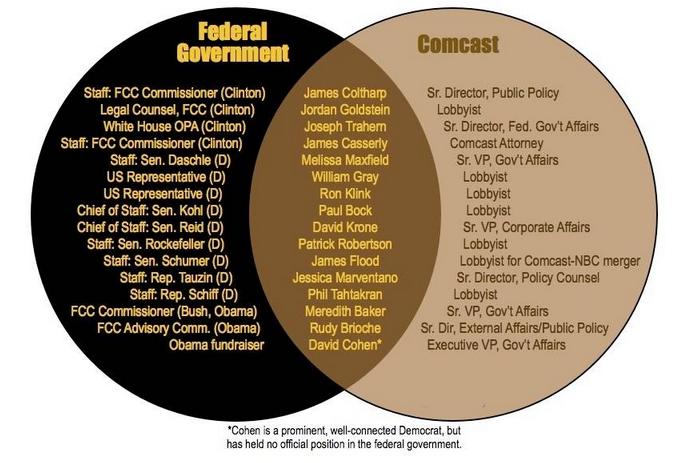
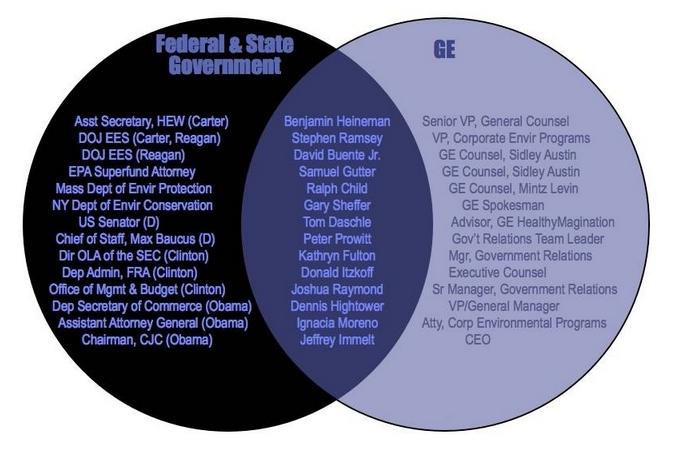
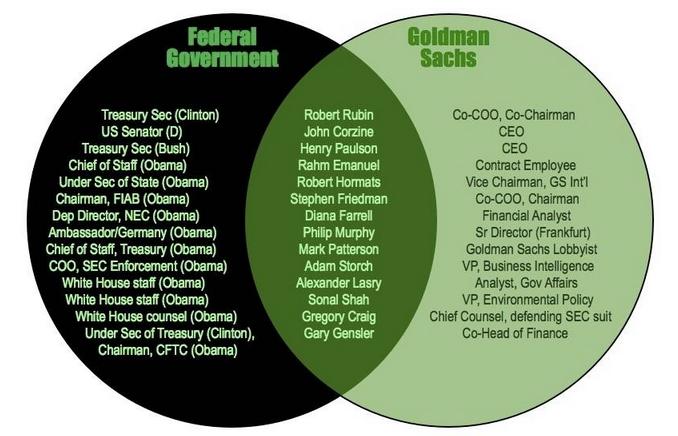
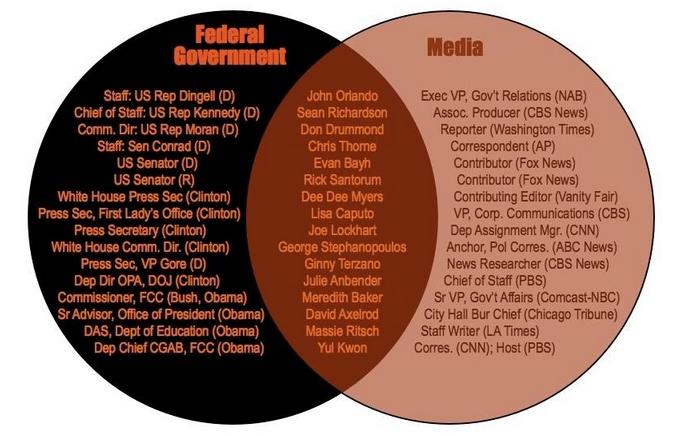
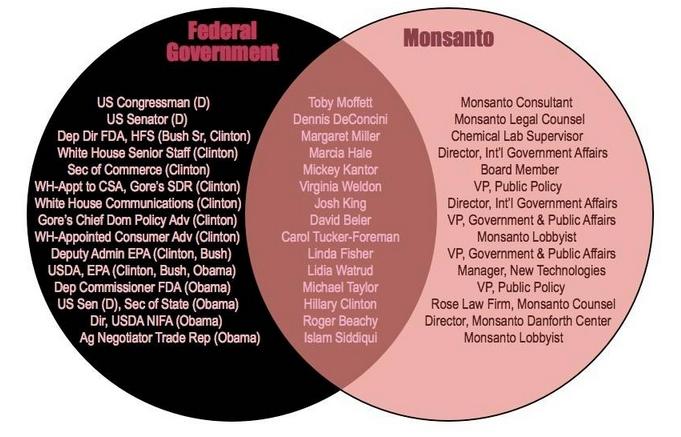
Fast forward to 2012 and Lambert Strether posted a series of Venn diagrams at Naked Capitalism.  Strether writes:

[This] nifty visualization… shows how many, many people, through the operations of Washington’s revolving door, have held high-level positions both in the Federal government and in major corporations. To take but one example, the set of all Treasury Secretaries includes Hank Paulson and Bob Rubin, which overlaps with the set of all Goldman Sachs COOs. The overlapping is pervasive. Political scientists and the rest of us have names for such cozy arrangements — oligarchy, corporatism, fascism, “crony capitalism” — but one name that doesn’t apply is democracy.

UPDATE: I’ve included a criticism of the methodology after the diagrams; the overlap portrayed here is almost exclusively among Democratic politicians and the diagrams were explicitly intended to point out connections among progressives.

See for yourself:

On the methods for putting together these diagrams, Strether writes about the person who’s behind the diagrams:

Herman’s honest: Her goal is to “expose progressive corporatism,” and — assuming for the sake of the argument that D[emocrat]s are progressive, and that “progressives” are progressive — her chart does exactly that, and very effectively, too.

But what her data does not do is expose corporatism as such; there are very, very few Rs listed; it strains credulity that Hank Paulson was the only high-level GS operative in the Bush administration, for example, and if GS isn’t the R[epublican]s’ favorite bank, there’s surely another.

Hence, Herman’s chart, if divorced from context[2], might lead somebody — say, a child of six — to conclude that the only corporatists in Washington DC are D[emocrat]s.

Thanks to Carolyn Taylor for pointing out the methods bias.

Lisa Wade, PhD is an Associate Professor at Tulane University. She is the author of American Hookup, a book about college sexual culture; a textbook about gender; and a forthcoming introductory text: Terrible Magnificent Sociology. You can follow her on Twitter and Instagram.

Cross-posted at Racialicious.

Race as biology has largely been discredited, yet beliefs about one race being biologically superior to another still seem to pervade one social arena: sports.  Claims that different races have genetic advantages to play particular sports persists both because individual athletic ability obviously has some basis in biology (even though that does not mean it is racial biology at play) and athletics appears to be one social arena where racial minorities succeed over whites in certain sports.

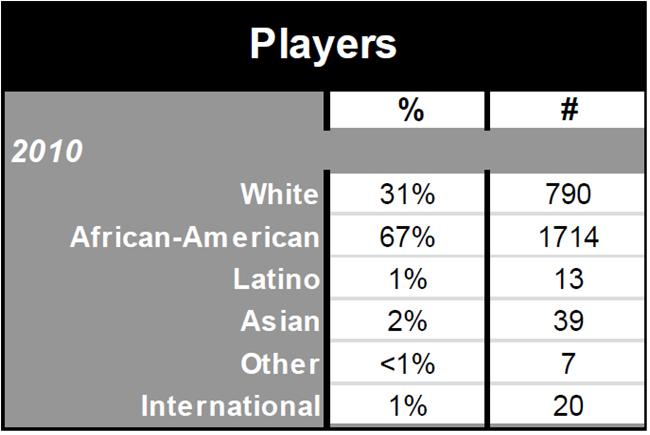
For example, according to the Institute for Diversity and Ethics in Sports’ 2011 Racial and Gender Report Card on The National Football League (http://www.tidesport.org), over 2/3rds of players in the NFL are African American — far higher than the proportion of Blacks in the general population of the United States.  This report also shows that all other racial groups are under-represented in the NFL relative to their proportion in the general population, including Asians who make up only 2% of the players in the league.

These statistics compel many to assume that racial biology plays a large part in athletic success.  However, the 60 Minutes investigation Football Island debunks this assumption during a trip to the place where most of the Asian players in the NFL come from: American Samoa.   This small island is a U.S. Territory in the Pacific and has a population small enough to seat comfortably in most professional football stadiums.  Yet the average Samoan child “is 56 times more likely to get into the NFL than any other kid in America.”

60 Minutes finds Samoans succeed at football only in small part because of their size and strength.  Rather, their success grows mostly out of a “warrior culture” that instills a strong work ethic in young men.  Also, on the island the daily chores that are a necessary part of survival provide a lifetime of athletic conditioning.  In short, many of the Asian players in the NFL are successful because of their nurturing, and not their nature.

[vimeo]https://vimeo.com/60688464[/vimeo]

Samoans are also driven to succeed at football because they come from a place plagued by poverty and often their only chance at a better life is through athletics (that, or follow another Samoan tradition and join the Armed Forces).  In the video, the most famous Samoan player, Troy Palamalu of the Pittsburgh Steelers, explains “football is a ‘meal ticket.’  Just like any marginalized ethnic group, you know, if you don’t make it to the NFL, what do you have to go back to?”

—————————-

Jason Eastman is an Assistant Professor of Sociology at Coastal Carolina University who researches how culture and identity influence social inequalities.

Lisa Wade, PhD is an Associate Professor at Tulane University. She is the author of American Hookup, a book about college sexual culture; a textbook about gender; and a forthcoming introductory text: Terrible Magnificent Sociology. You can follow her on Twitter and Instagram.

Cross-posted at Montclair SocioBlog.

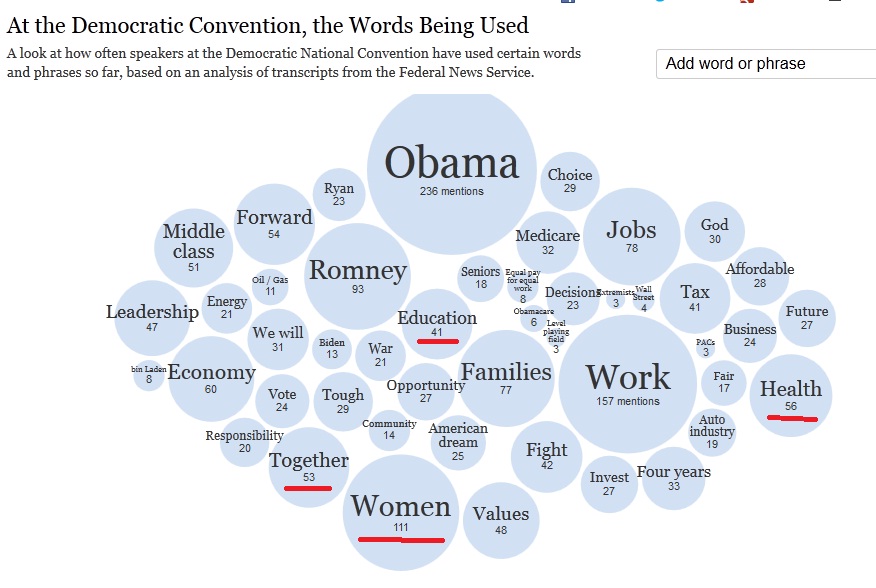
The New York Times ran these graphics showing the word frequencies of the Republican and Democratic conventions.  I’ve added underlining on the keywords that seem to differentiate the two conventions. (The data on the Democrats runs only through Sept. 4, but it looks like the themes announced early on will be the ones that are repeated.)

Both parties talked about leadership, the economy, jobs, and families.  More interesting are the differences.  Democrats talked a lot about Women, a word which seems to be absent from the Republican vocabulary.  The Democrats also talked about Health and Education.  I find it curious that Education does not appear in the Republican word cloud.

The Republican dictionary falls open to the page with Business – ten times as many mentions as in the Democrats’ concordance.  If you go to the interactive Times graphic, you can click on Business and see examples of the contexts for the word.  Many of these excerpts also contain the word Success.

You can put the large-bubble words in each graphic in a sentence that condenses the party’s message about government, though that word – Government – does not appear in either graphic.   For the Republicans, government should lower Taxes so that Business can Succeed, creating Jobs.

For the Democrats, government should protect the rights of Women and ensure that everyone has access to Health and Education.

Perhaps the most telling most interesting word in the Democratic cloud is Together.  The Republican story is one of individual success in business, summed up in their repeated phrase, “I built that.”  The Democrats apparently are emphasizing what people can accomplish together.  These different visions are not new.  They go back at least to the nineteenth century.  (Six years ago, I blogged here about these visions as NFL brands — Cowboys and Steelers — and their parallels in US politics.)

(HT: Neal Caren who has posted his own data about the different balance of emotional expression at the two conventions.)

Most people assume that the various benefits we collectively describe as “welfare” go to people who aren’t working.  The truth is, however, that some people with full-time jobs still find themselves below the poverty line.  The U.S. federal minimum wage is $7.25 an hour.  A full-time employee who doesn’t miss a single day of work for a year earns $290 a week; that’s 15,080 a year.  According to how the government measures poverty, that’s enough to support a single adult.  For a single adult with a child, however, it’s officially below the poverty line. It’s $4,000 below the poverty line for a family of three.  When a person has a full-time job, but still lives in poverty, they are what sociologists call the “working poor.”

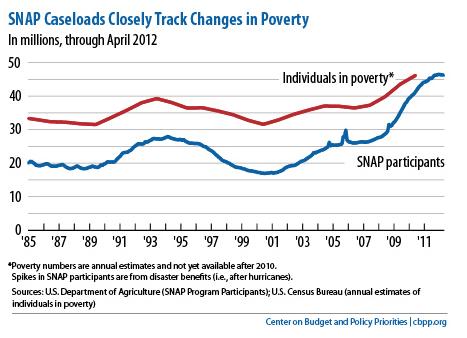
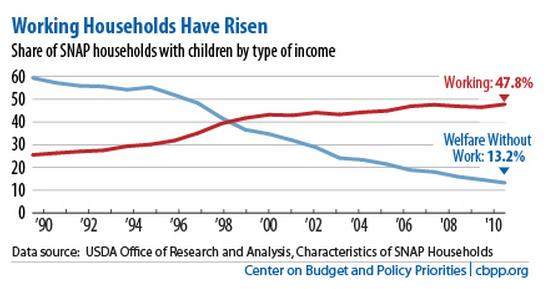
Some welfare benefits, then, go to people who do work.  The  Supplemental Nutrition Assistance Program, better known as food stamps, is an example.  Working parents have always comprised a large percentage of people receiving food stamps.  Today the number of working families who rely on food stamps is higher than it’s been in over 20 years (source).  These numbers reflect the impact of the recession generally, but also the extra-burden placed on already struggling families.  The first chart shows the rise of poor families, the second shows the increase in the working poor using food stamps.

This kind of data inspires me to ask if this is what a functional economy looks like.  We have policies — e.g., the federal minimum wage and somewhat laissez faire free market policies — that create a situation in which working full time doesn’t allow a single parent to support even one child.  When we hear criticisms of people who receive benefits, then, we should be careful to remember that their economic crisis is not a straightforwardly personal characteristic, one that can be explained by a poor work ethic or disorderly personality. There are structural reasons that people end up in need.  We have three choices: let them suffer and perhaps die, help them, or change our society.

Lisa Wade, PhD is an Associate Professor at Tulane University. She is the author of American Hookup, a book about college sexual culture; a textbook about gender; and a forthcoming introductory text: Terrible Magnificent Sociology. You can follow her on Twitter and Instagram.