Search results for The

Screenshot_1Earlier on SocImages, Lisa Wade drew attention to the tourism industry’s commodification of Polynesian women and their dancing. She mentioned, briefly, how the hula was made more tourist-friendly (what most tourists see when they attend one of the many hotel-based luaus throughout the islands is not traditional hula).  In this post, I want to offer more details on the history and the differences between the tourist and the traditional hula.

First, Wade states that, while female dancers take center stage for tourists, the traditional hula was “mostly” a men’s dance.  While it has not been determined for certain if women were ever proscribed from performing the hula during the time of the Ali’i (chiefs), it seems unlikely that women would have been prevented from performing the hula when the deity associated with the hula is Pele, a goddess. Furthermore, there is evidence that women were performing the dance at the time of Captain James Cook’s arrival in Hawai’i.

Second, while the traditional dances were not necessarily sexualized, they were very sensual.  The movement of hips and legs that are seen as sexual by some visitors, and showcased as such by the tourism industry, certainly existed in early practices.

In fact, the supposedly lascivious and blasphemous nature of the hula prompted missionaries to censure the public practice of hula, and in 1830 Queen Ka’ahumanu enacted a law prohibiting the public performance of the hula. This law was highly ineffective, however, and when King Kalakaua ascended the throne he actively encouraged public hula performances and other expressions of Native Hawaiian culture, earning him the moniker “Merrie Monarch.”

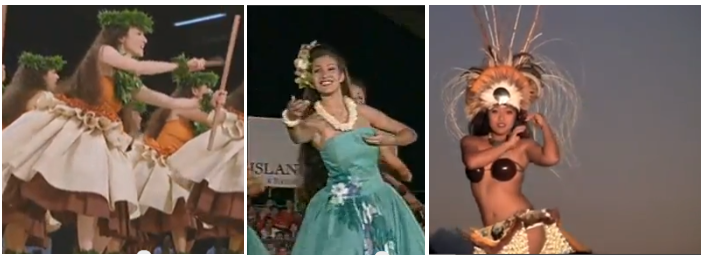
Eventually, a modernized dance emerged that did not incorporate much religiosity and employed modern music rather than chants. This is closer to what you would find at a hotel luau, but differs drastically in costuming and lacks the uncomfortable cloud of objectification associated with hotel-style hula (that is, the focus is on the dance rather than the dancers).  Below are some examples of the evolution.

Hula (men’s dance, traditional):

Hula (contemporary):

These examples of hula, and other Polynesian dances, are vastly different from what one finds in a hotel’s “Polynesian Revue” luau.

Hula (hotel):

In conclusion, it is true that the hula dances, and other dances of Polynesia, have been usurped by the tourism industry and commodified.  The culturally authentic forms, however, still thrive. Native dances are impressive enough without the ridiculous costuming and disrespectful bending of the islands’ histories seen at hotel luaus; unfortunately, it is difficult to find any culturally sensitive displays of Polynesian culture due to the huge influence of tourism over these locations.

*The information in this post was gleaned from various courses I’ve taken at the University of Hawai’i at Manoa. For more information on hula and the commodification of the Hawaiian culture, see Haunani-Kay Trask’s From A Native Daughter.

Sarah Neal is currently working on obtaining her M.A. in English at North Carolina State University.
Cross-posted at Montclair Socioblog.

We got another reminder last week that despite complaints about federal government programs that give money to the poor, when it comes to taxes, the government is much more generous to the wealthy.  The news came from a report from the Congressional Budget Office on tax expenditures.

These are the ways that the government uses the tax system to give money to people. Some expenditures are tax credits, which can take the form of cash payments.  Others are tax breaks — taxing people less than the going rate. For example, if I am in the 35% tax bracket, but the government charges me only 15% on the $100,000 I made playing the stock market, the government is giving me $20,000 it could otherwise have had me pay in taxes. That’s an expense. The preferential rate for my luck in the market costs the government $20,000.

The justification for these expenditures is that they are a way the government can encourage people to do something that it wants them to do.  With tax breaks, the government is basically paying people by not charging them full tax fare — encouraging them to buy a house or give to charity or get health insurance at their work.  Similarly with the tax credits that go mostly to the poor. We want people to hold a job and to care for their kids.  The child tax credit gives people more money to care for their children.  The Earned Income Tax Credit pays them for working, even at jobs that pay very little.  By the same logic, the government is paying me to invest my money in companies — or put another way, to play the stock market.

This government largesse, however, benefits some people more than others:

1

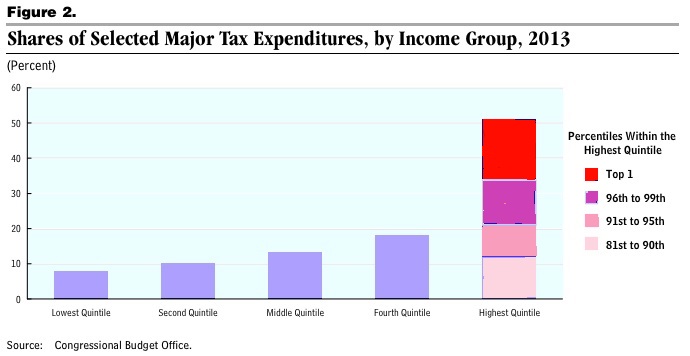
About half of all tax expenditures go to the top quintile (top 20% of income earners).  The bottom 80% of earners divide the other half.  And within that richest quintile, the top 1% receive 15% of all tax expenditures (this distribution of tax breaks roughly parallels the distribution of income). Were you really expecting Sherwood Forest?

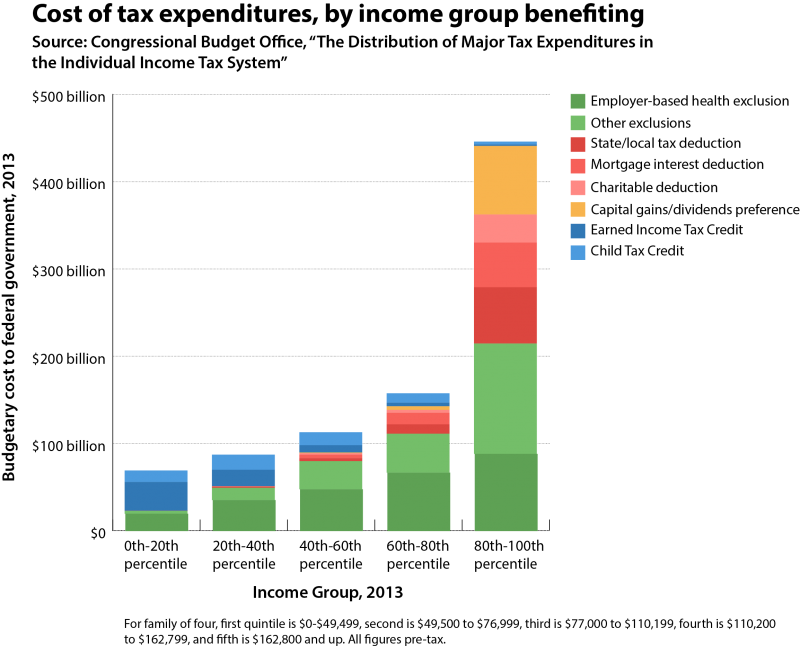
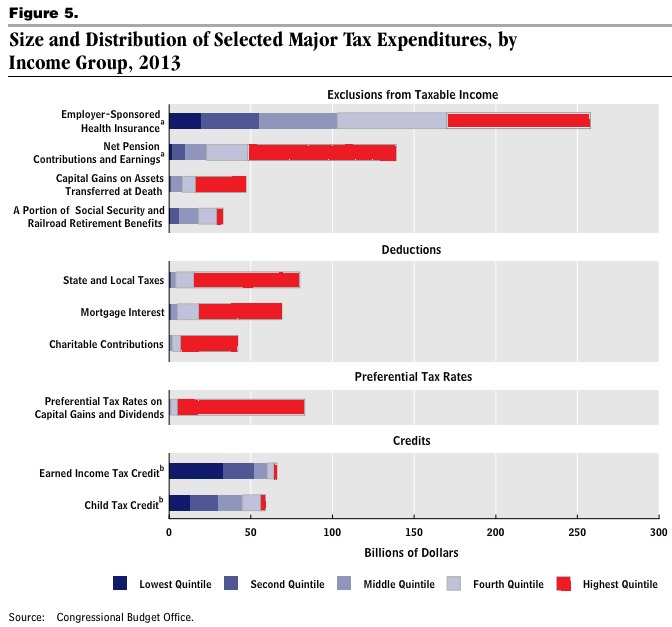
Here is a breakdown of the costs of these different tax expenditures:

2

The Earned Income Tax Credit, which benefits mostly the poor, costs less than $40B.  The tab for the low tax on investment income (capital gains and dividends) is more than twice that, and nearly all of that goes to the top quintile.  More than two-thirds goes to the richest 1%.

Dylan Matthews at the Washington Post WonkBlog regraphed the numbers to show the total amounts overall plus the amounts in each category for each income group:

3

The point? People complain about government payments to the poor, but tax breaks are also payments, though less obviously so, to the rich.  And those tax breaks cost the government a lot more money.

Jay Livingston is the chair of the Sociology Department at Montclair State University. You can follow him at Montclair SocioBlog or on Twitter.

This post originally appeared in 2010.

Most of us familiar with Down‘s Syndrome know that it brings characteristic facial features and delayed or impaired cognitive development. People with Down, however, are also more vulnerable than the general population to diabetes, leukemia, and infectious and autoimmune disease, and about 40% are born with heart defects.

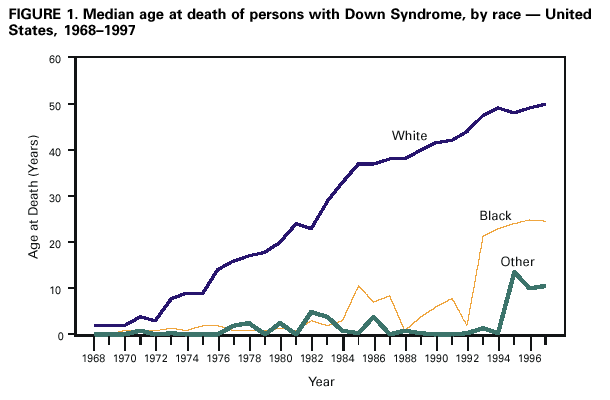
For most of history, then, the life expectancy of people with Down was very low.  But, with advances in knowledge and access to health care, life expectancy has risen dramatically… especially for white people:

The Centers for Disease Control explain that severity of Down does not vary by race, so most likely the cause of the gap in life expectancy is differences in the quantity and quality of health care.

Possibilities include differences in factors that may be associated with improved health in the general population such as socioeconomic status, education, community support, medical or surgical treatment of serious complications, or access to, use of, or quality of preventative health care.

This is just one striking example of the wide racial gap in health outcomes and access to care.  We see data with similar patterns most everywhere we look.  As examples, pre-term birthscancer diagnosis and treatment, and likelihood of living near a toxic release facility.

Morbidity and Mortality Weekly Report, via Family Inequality.

Lisa Wade, PhD is an Associate Professor at Tulane University. She is the author of American Hookup, a book about college sexual culture; a textbook about gender; and a forthcoming introductory text: Terrible Magnificent Sociology. You can follow her on Twitter and Instagram.

1The phrase “social construction” refers to the fact that things, symbols, places, sounds — basically everything — is devoid of meaning until we, collectively, agree as to what something means.  Once that happens, it has been “socially constructed” and we can refer to it as a “social construct.”

The fact that gestures have any meaning at all, and that they can have different meanings in different places, is a simple example of this basic sociological concept.  Enjoy this one minute compilation of examples!

Via Blame It On The Voices.

Lisa Wade, PhD is an Associate Professor at Tulane University. She is the author of American Hookup, a book about college sexual culture; a textbook about gender; and a forthcoming introductory text: Terrible Magnificent Sociology. You can follow her on Twitter and Instagram.

Cross-posted at Girl w/ Pen.

Having written about sexually transmitted HPV (human papillomavirus) for 13 years, I’ve been waiting for the day when a celebrity would lend his or her fame to spotlight the realities of HPV infection, especially of HPV-related oral cancers.  That day has come: this week Michael Douglas has announced that his cancer was caused by an HPV infection that was likely transmitted through oral sex.  The mucus membrane tissue of mouth and throat are similar to those of genital skin, so researchers have known for some time that, like herpes, HPV could be transmitted oral to genital, as well as genital to oral.

My hopes are that big news can be a long-needed catalyst for change.  Back in 2009, the research findings were already clear: oral transmission of cancer-causing HPV means that almost all of us are more likely at risk than we are safe from risk.  For my 2010 feature article in Ms. Magazine, I focused on the importance of not only educating the public about HPV-related cancers in men but also about the HPV-oral cancer link. In addition, I advocated for the need to destigmatize all STDs: my research and book have shown that STD stigma makes it more likely for at-risk/infected  individuals to put off getting tested and treated. STD stigma also makes it less likely for individuals to disclose their sexual health status to partners, placing those partners at greater risk for infection.  In addition, negative stereotypes about the “types” of women and men likely to be infected distort our ideas of who is at risk.

I’ll wrap up this post with a call: for us to come together, to learn the facts and not be swayed by incomplete media coverage and confusing pharmaceutical claims.  We must support significant funding increases to investigate exactly how we can prevent HPV-related oral/throat cancers, which research shows to be steadily on the rise and more fatal than cervical cancers in the U.S.

Adina Nack is the author of Damaged Goods? and a professor of Sociology at California Lutheran University.  She specializes in medical sociology, gender inequality, and sexual health and writes for Girl w/ Pen.

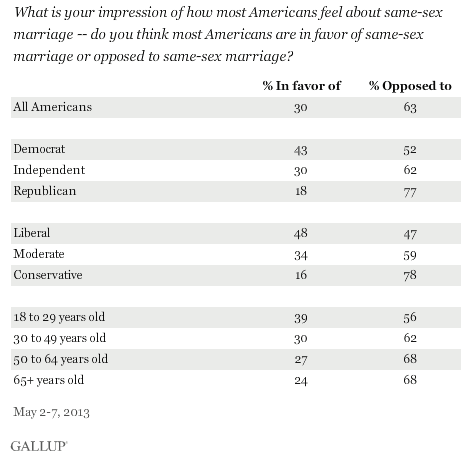
Here’s an interesting new wrinkle in the data on support for same sex marriage.  According to Gallup, 53% of Americans now favor such marriages, but we don’t necessarily think other people do.  Overall, Americans, on average, think that 63% of their fellow citizens oppose same sex marriage; in fact, 45% do.  That’s an over-estimate of 18 percentage points!

2

Interestingly, Americans of all stripes — Democrat and Republican, liberal and conservative, old and young — underestimate support for same sex marriage.  Liberals come the closest, thinking that 48% approve; conservatives are the farthest off, thinking that only 16% do.

This data resonates with the recent finding that both Democratic and Republican politicians underestimate their constituents’ progressiveness.  I suspect that these misconceptions may make politicians wary about pressing for progressive policies; I wonder how similar misconceptions among the voting public might shape the pace and trajectory of social change.

h/t @tylerkingkade. Cross-posted at Pacific Standard.

Lisa Wade, PhD is an Associate Professor at Tulane University. She is the author of American Hookup, a book about college sexual culture; a textbook about gender; and a forthcoming introductory text: Terrible Magnificent Sociology. You can follow her on Twitter and Instagram.

1In a really fantastic post at Shakesville, Time Machine argues that rape jokes are problematic, even when uttered by people who would never assault anyone, because they signal to actual rapists that their behavior is acceptable and normal.

A lot of people accuse feminists of thinking that all men are rapists. That’s not true. But do you know who think all men are rapists?  Rapists do.

So, when someone drops a rape joke and people laugh, the small percent of men who are rapists think that they’re surrounded by like-minded friends.  Speaking to the joke-teller:

That rapists who was in the group with you, that rapist thought that you were on his side. That rapist knew that you were a rapist like him. And he felt validated, and he felt he was among his comrades.

What’s interesting about this observation is that it reminds us that we need to be more aware of the impact of our words not on victims (as the usual argument against the rape joke goes), but on perpetrators.  This is a much-needed re-framing of the problem that we call, passively, “violence against women,” but should really be called “men’s violence against women and men.”  While both men and women are victims, the vast majority of interpersonal violence is committed by men.

The need for a shift in frame — from the survivor to the perpetrator — is also a theme of this TedTalk by anti-violence educator Jackson Katz. He uses another really interesting way of showing the linguistic erasure of men in this discussion (at 4:08).

He also dismisses “sensitivity training” because it, too, centers the survivor of the violence instead of drawing our attention to the perpetrator (sensitivity to who?).  Instead, Katz argues, men need to step up and be leaders in the fight against men’s violence against women and men.  Because violence is not a “women’s issue,” it’s a men’s issue.

Lisa Wade, PhD is an Associate Professor at Tulane University. She is the author of American Hookup, a book about college sexual culture; a textbook about gender; and a forthcoming introductory text: Terrible Magnificent Sociology. You can follow her on Twitter and Instagram.

Cross-posted at Montclair SocioBlog.

The magic of demographic knowledge is a memorable moment in John Sayles’s 1984 movie “Brother From Another Planet.” On the A train, a young man shows an elaborate card trick to the title alien, who looks like an African American but seems to have no understanding of the trick. So the magician offers another.

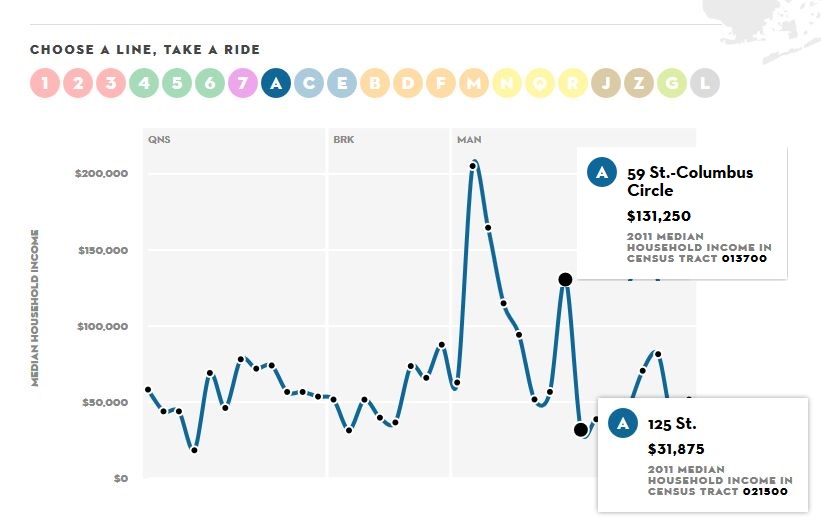
From 59th St. to 125th St. is one stop on the express.  But as the movie shows, that short ride covers a large demographic change, and it’s not just racial.  The New Yorker has posted interactive graphics showing the median income of the census tracts surrounding subway stations.

1

Take the A train one stop — from the southern border of Central Park to a few blocks above its northern border — and see median income drop by $100,000.

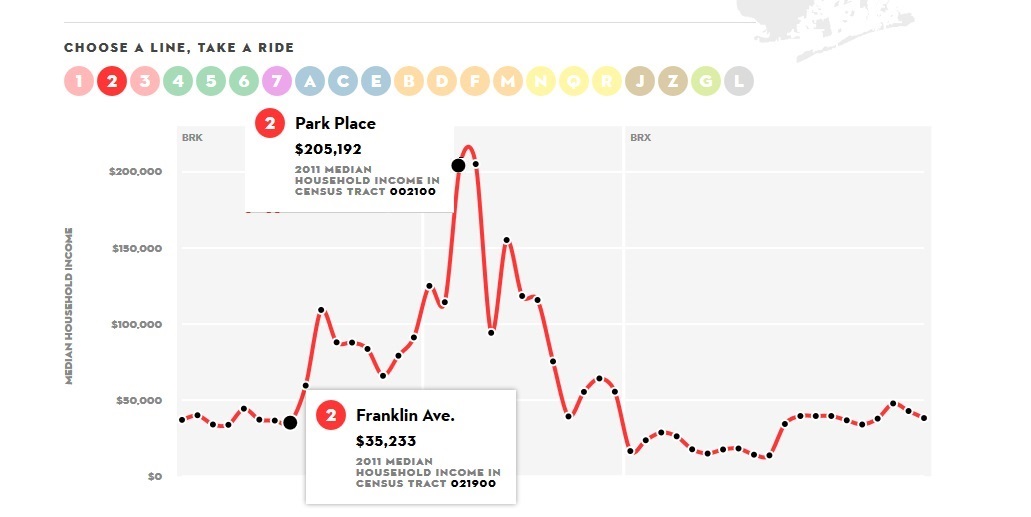
Many other lines travel the extremes of economic inequality.  My line is the 2:

2

In the early morning commute, I see blue collar workers in their hoodies or rough jackets and steel-toe boots next to well-dressed people reading The Wall Street Journal.  They didn’t get on at the same stop.  The people who live in and work in the Wall Street census tract, which includes Park Place, are not on the train.  Here’s what their housing looks like:

BATTERY PARK CITY: as a pioneer. It's all Green, environmentally friendly.

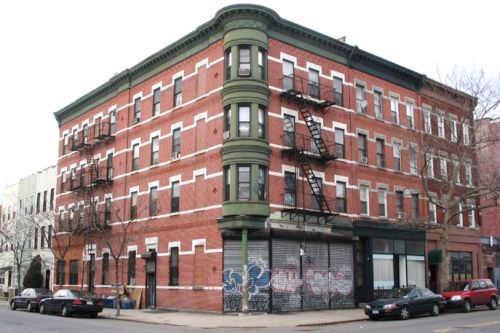
And here is Franklin St., Brooklyn:

4

The subway demographic trick is not limited to New York. Here’s a time-lapse video of the Red Line of Chicago’s CTA.

Despite the social class segregation in housing, in cities like New York and Chicago, people of vastly different economic circumstances are likely to share the same subway car, at least for a few stops.  Yet I don’t get a sense of strong resentment or even envy among the have-nots (though I wish I had systematic data on this).  This is similar to the findings of Rachel Sherman, who studied how workers at high-end hotels thought of their guests.

New York and Chicago, however, are also where the rich are more likely to be liberal and in favor of redistributionist policies.  As Andrew Gelman has shown, the wealthy in rich states are far more liberal than the wealthy in poor states.  That may be partly because in rich states, the wealthy live in the large cities.  It would be interesting to see if we saw the same effect if we looked at Upstate New York, Downstate Illinois, or Massachusetts outside Rte. 128.

HT: Jenn Lena for the link.

Jay Livingston is the chair of the Sociology Department at Montclair State University. You can follow him at Montclair SocioBlog or on Twitter.