Search results for The

1I know this is boring and it should go without saying, but apparently it hasn’t been said enough: this idea that fembots are the perfect women is just wrong.  It suggests that men want someone over which they have perfect control.  And that’s creepy… and boring.

Here’s an example of the phenomenon (via About-Face):

That part where they make eyes at each other, he instructs the GPS to take them home, and she hits the button to heat up her (cold, hard) “seat.”  Just… ew.

Here’s another especially troubling example, sent in by a reader.  It’s some sort of ad for Play Station 3. It features a fembot being assembled and “woken.”  The narration explains that she will “cook, watch the house, take care of the kids” and be “entirely at your disposal as a sexual partner.”

At some point the fembot realizes she is being sold and expresses shock and disappointment.  The man in charge explains, “Of course you’re merchandise, baby.”  When she says that she’d thought she was alive, he labels her “defective.”  That thought was not “part of the protocol,” he says, “You’re not supposed to think at all.”  He then decides to destroy her, but succumbs to her pleas to let her “live” after all.  Again, a super creepy story about the ideal woman.

Lisa Wade, PhD is an Associate Professor at Tulane University. She is the author of American Hookup, a book about college sexual culture; a textbook about gender; and a forthcoming introductory text: Terrible Magnificent Sociology. You can follow her on Twitter and Instagram.
Fashion designer Vera Wang is known world-wide for her bridal gowns, costing from thousands of dollars to tens of thousands of dollars.  She opened her first store — in New York City — in 1990.  In 2011, her gowns started appearing at the discount David’s Bridal, for as little as $600.  Today she has a line at Kohl’s.

Why would someone who can sell a $25,000 wedding dress turn around and sell their name to a low-end department store?  The answer has to do with money, of course, but it also tells a story about class and distinction.  Typically trends start at “the top” with wealthy and high-profile elites.  Elites embrace an expensive new look, designer, or product (e.g., men and high heels) in order to distinguish themselves from the rest of the population.  The rest then imitate the trend-setters, such that the trend diffuses down throughout the population one class strata at a time.  That’s why Wang’s David’s Bridal and Kohl’s collections are called “diffusion lines.”

Vera Wang is hanging in there, but lots of trends die when they diffuse down to the working class.  If the working class can take part in the trend, the rich can’t use it to show that they’re special (which is why they sometimes defend their exclusive rights).  So it gets dropped.  Once the elites move onto something new, the process begins again.

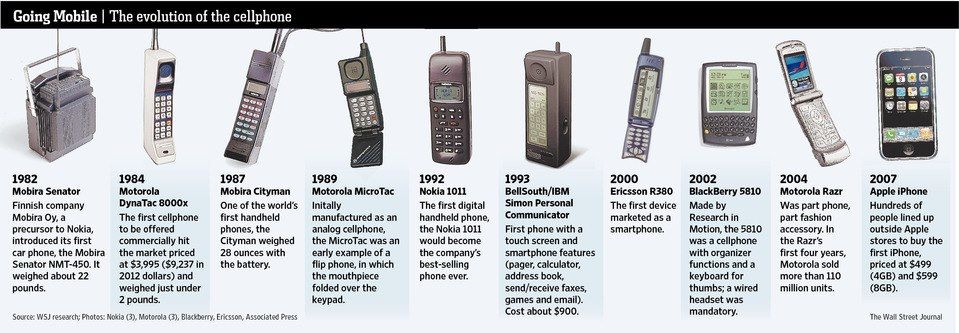
Interestingly, Whitney Erin Boesel, writing for Cyborgology, applies this process to cell phones, or what are better described as “mobile devices.”  It applies, of course, to the never-ending stream of newer, faster, shinier devices, but also to the very idea of a cell phone/mobile device.  As much as we make fun of the clunky cell phones of the 1980s and ’90s, very few people had them, so having one suggested that you were a Very Important Person. She writes:

When you picture someone using one of those cumbersome early cell phones, whom do you picture? Is it a white guy in a suit, maybe wearing a Rolex and 1980s sunglasses? Yeah, I thought so. When they first came out, cell phones — like pretty much every brand new, expensive technology — were status markers. A cell phone said, “I am wealthy, I am powerful, and I am so important that people must be able to reach me even when I am away from my home or office.”

1Today, of course, though certain models do a little to distinguish one user from another, the possession of a mobile device doesn’t signify elite status.  As Boesel points out, more people have cell phones than toilets.

Enter Google glass.

Slate reports that Google co-founder Sergey Brin is arguing that smart phones are “emasculating.”  Using masculinity is a metaphor for power, he is appealing to the elite to move on to the next technology.  A smart phone, in other words, “no longer signifies [that is a person is] a member of the power elite.”  It’s a pretty snappy — and downright Bourdieuian — way of marketing a new technology to the very people who will drive its success.

Brin starts his discussion about this at 4 minutes, 25 seconds:

Cross-posted at Pacific Standard.

Lisa Wade, PhD is an Associate Professor at Tulane University. She is the author of American Hookup, a book about college sexual culture; a textbook about gender; and a forthcoming introductory text: Terrible Magnificent Sociology. You can follow her on Twitter and Instagram.
I live in Los Angeles where saying that you don’t like movies is tantamount to claiming atheism in a church. But I don’t like movies, generally speaking. In contrast, I quite like TV. Does this seem weird?

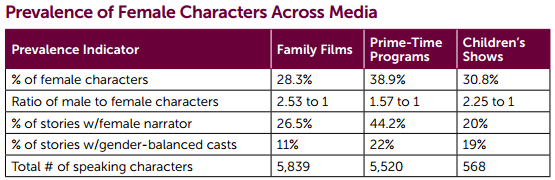
The Geena Davis Institute on Gender and Media offers a clue as to why I might lean towards television.  The Institute did a content analysis of 11,927 speaking characters in “family films” (G, PG, and PG-13) and prime-time and children’s TV shows (see it here).  They looked at the presence of female and male characters and the jobs those characters were doing.  In almost every instance, women had greater visibility, and better jobs, on prime-time TV than they did in either movies or children’s shows.

Presence

Women are, for example, 39% of characters on prime time, but only 31% of characters on kids’ shows and only 28% in movies.  Casts are twice as likely to be gender-balanced on prime time (45-55% female), compared to movies.   Half of the casts of family films are 75% or more male, compared to only 20% of the casts on TV shows and 39% of children’s shows.

1

Occupations

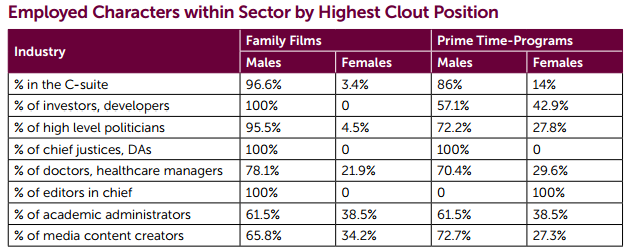
Almost half of all American workers are female, but they hold only 20% of the jobs on the big screen and 25% of the jobs on children’s shows. Again, here prime-time does somewhat better: 34% of the jobs on evening TV are held by women.

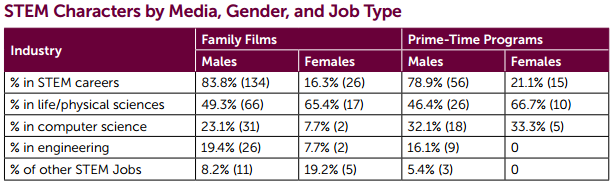
The next two tables reveal how men and women are distributed among different kinds of occupations in films and on prime time.  Men are over-represented in almost all cases, but the disproportion in movies is almost always significantly worse than it is on TV.

2

3

If you’re one of the people that contributed to Star Trek Into Darkness$70.6 million opening weekend this week, this data might not be surprising.  I didn’t count, but I suspect it falls into the 50% of films that has a cast that is at least 75% male.  It certainly didn’t pass the Bechdel Test; the two female speaking characters, if I remember correctly, never spoke to one another at all, and so they couldn’t have spoken to each other about something other than a man (that’s the test).   (Oh wait, I think one of the twins with tails in bed with Kirk said “hey” when he leapt out to go do something important, so that’s three women with speaking roles).

So, like in lots and lots of films, women in Star Trek were woefully under-represented except as love interests for the two protagonists (Uhura in this movie and Carol, it was foreshadowed, in the next).  I’m used to it, so it doesn’t really stir me up, but that doesn’t mean I have to like movies.  I’ll stick to TV, thank you very much. It’s not perfect, but it’s a hell of a lot better than Hollywood.

Cross-posted at BlogHerPacific Standard, and The Huffington Post.

Lisa Wade, PhD is an Associate Professor at Tulane University. She is the author of American Hookup, a book about college sexual culture; a textbook about gender; and a forthcoming introductory text: Terrible Magnificent Sociology. You can follow her on Twitter and Instagram.
Cross-posted at PolicyMic, Huffington Post, BlogHer, and Pacific Standard.

Writer Peg Streep is writing a book about the Millennial generation and she routinely sprinkles great data into her posts at Psychology Today.  

Recently she linked to at study by Net Impact that surveyed currently-enrolled college students and college-graduates across three generations Millennials, Gen Xers, and Baby Boomers.  The questions focused on life goals and work priorities.  They found significant differences between students and college grads, as well as interesting generational differences.

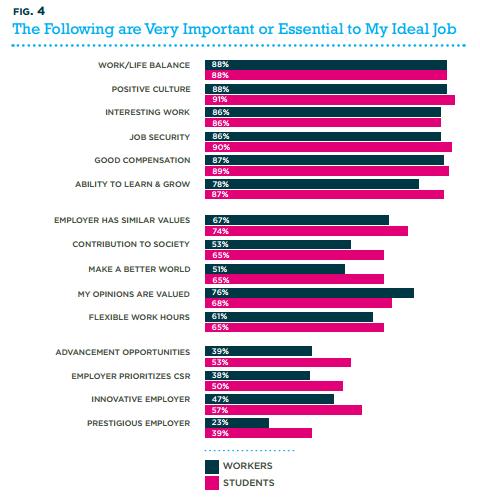
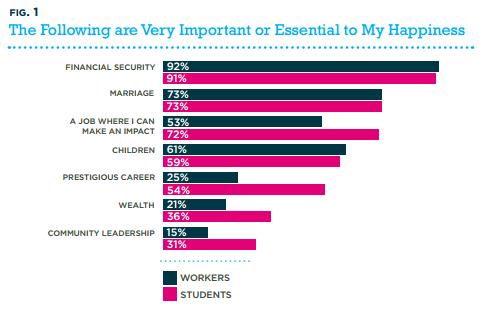
First, students have generally higher demands on the world; they are as likely or more likely than workers to say that a wide range of accomplishments are “important or essential to [their] happiness”:

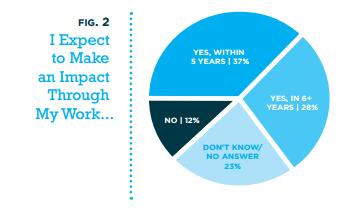
In particular, students are more likely than workers to say it is important or essential to have a prestigious career with which they can make an impact.  More than a third think that this will happen within the next five years:

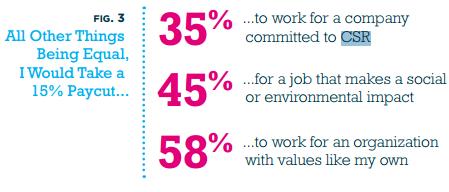
Wealth is less important to students than prestige and impact.  Over a third say they would take a significant pay cut to work for a company committed to corporate social responsibility (CSR), almost half for a company that makes a positive social or environmental impact, and over half to align their values with their job:

Students stand out, then, in both the desire to be personally successful and to make a positive contribution to society.

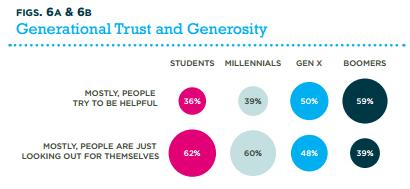
At the same time, they’re cynical about other people’s priorities.  Students and Millennials are far more likely than Gen Xers or Boomers to think that “people are just looking out for themselves.”

This data rings true to this college professor.  Despite the recession, the students at my (rather elite, private, liberal arts) school surprise me with their high professional expectations (thinking that they should be wildly successful, even if they’re worried they won’t be) and their desire to change the world (many strongly identify as progressives who are concerned with social inequalities and political corruption).

Some call this entitlement, but I think it’s at least as true to say that today’s college youth (the self-esteem generation) have been promised these things.  They’ve always been told to dream big, and so they do.  Unfortunately, I’m afraid that we’ve sold our young people a bill of goods.  Their high expectations sound like a recipe for disappointment, even for my privileged population, especially if they expect it to happen before they exit their twenties!

Alternatively, what we’re seeing is the idealism of youth.  It will be interesting to see if they downshift their expectations once they get into the workforce.  Net Impact doesn’t address whether these are largely generational or age differences.  It’s probably a combination of both.

Lisa Wade, PhD is an Associate Professor at Tulane University. She is the author of American Hookup, a book about college sexual culture; a textbook about gender; and a forthcoming introductory text: Terrible Magnificent Sociology. You can follow her on Twitter and Instagram.
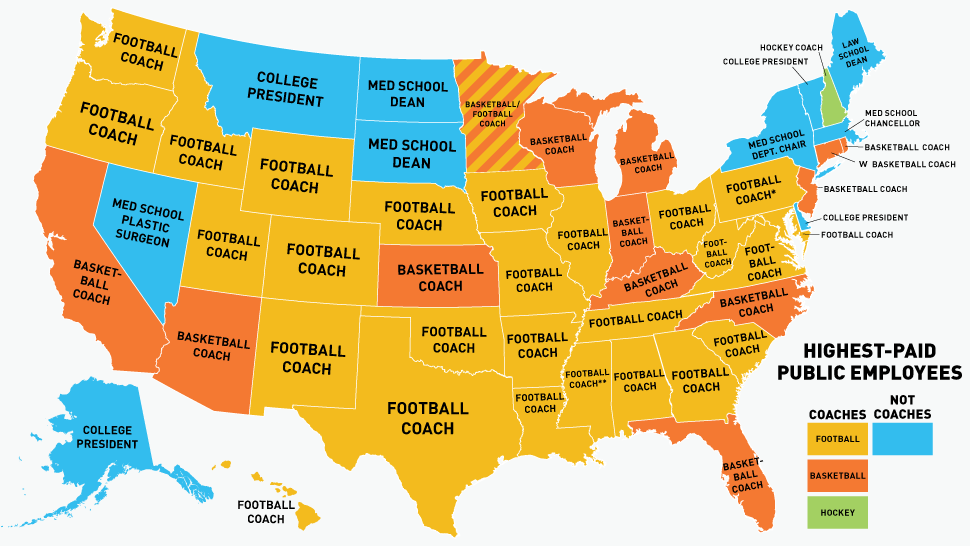
Hint from Dmitriy T.C.: he probably wears shorts to work.

Here’s the infographic, sent in also by sociologist Michael Kimmel, revealing the highest paid employee in each state.  Yellow, orange, and green states are all ones in which the most money goes to an athletic coach.  More details at DeadSpin.

1

Lisa Wade, PhD is an Associate Professor at Tulane University. She is the author of American Hookup, a book about college sexual culture; a textbook about gender; and a forthcoming introductory text: Terrible Magnificent Sociology. You can follow her on Twitter and Instagram.
Cross-posted at The Huffington Post and Pacific Standard.

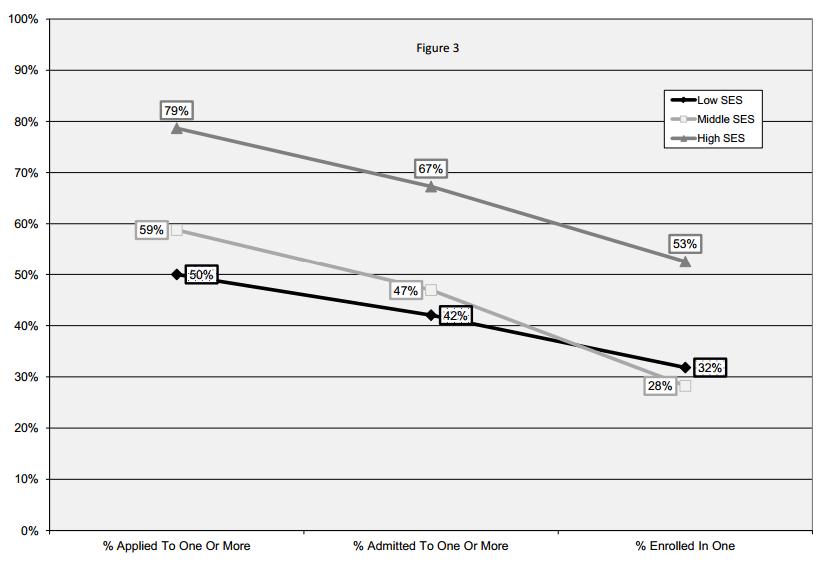
Sociologist Alexandria Walton Radford has some new research that is rather disheartening.  Radford was interested in the college choices of ambitious and high-performing high school students from different class backgrounds.  Using a data set with about 900 high school valedictorians, she asked whether students applied to highly selective colleges, if they got in, and whether they matriculated.

She found a stark class difference on all these variables, especially between high socioeconomic status (SES) students and everyone else.  Over three-quarters of high SES valedictorians (79%) applied to at least one highly selective college.  In contrast, only 59% of middle SES and 50% of low SES valedictorians did the same.  Admission and matriculation rates followed suit.

2

Interviews with a smaller group of these valedictorians shed light on why we see such dramatic differences in the application choices of low, middle, and high SES students.  Radford explains that most students applied to schools with which they were already familiar. High SES students were much more likely to know people who had attended highly selective colleges, so they were more comfortable applying.  They also felt more confident that they’d be successful at such an institution; less affluent students were more intimidated by these schools.

Radford concludes by arguing that it’s a mistake to leave decisions about whether and how to apply for college admission to families.  Doing so, she writes, “allows the advantages (and disadvantages) of one generation to be passed on to the next generation.”  School-based college guidance would go some way towards evening out the differences and making higher education admissions more meritocratic.

Lisa Wade, PhD is an Associate Professor at Tulane University. She is the author of American Hookup, a book about college sexual culture; a textbook about gender; and a forthcoming introductory text: Terrible Magnificent Sociology. You can follow her on Twitter and Instagram.
Cross-posted at The Atlantic and Family Inequality.

The Census Bureau has a new report on nonmarital births. Based on the American Community Survey — the largest survey of its kind, and the only one big enough to track all states — the report shows that 35.7 percent of births in 2011 were to unmarried mothers.

Beneath the headline number, two patterns in the data will receive a lot of attention: education and race/ethnicity. I have a brief comment on both patterns.

Education

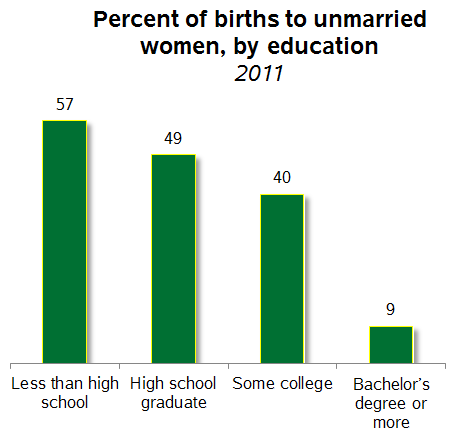
The education patterns show a very steep dropoff in nonmarital births as women’s education increases. From 57 percent unmarried among those who didn’t finish high school to just nine percent among those who have graduated college.

1

Given the hardships faced by single mothers (especially in the United States), it looks like women with more education are making the more rational decision to avoid childbearing when they’re not married. And I don’t doubt that’s partly the explanation. But we need to think about marriage, education and childbearing as linked events that unfold over time. The average high-school dropout mother was 26, while the average college-graduate mother was 33. Delaying childbearing and continuing education are decisions that are made together, based on the opportunities people have. And completing more education increases both the likelihood of marriage and the earning potential of one’s spouse.

So I think you could tell the story like this: Women with better educational opportunities delay childbearing, which increases their marriage prospects, and makes it more likely they will be married and financially better off when they have children in their 30s.

Race/Ethnicity

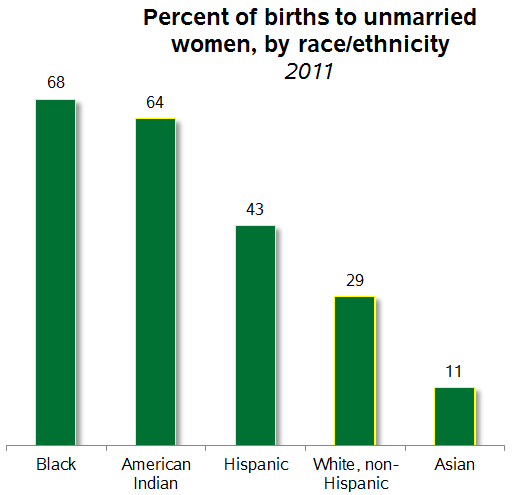
The differences in nonmarital birth rates between race/ethnic groups in the U.S. are shocking, from about two-thirds for black and American Indian women to 29 percent for whites and 11 percent for Asians.

2

This pattern is related to the education trend, naturally, but that’s not the whole story. One aspect of the story is race/ethnic geography of opportunity in this country. I’ve written before about the shortage of employed men available for women to marry, a particular expression of racial disparity first popularized by sociologist William Julius Wilson a quarter century ago.

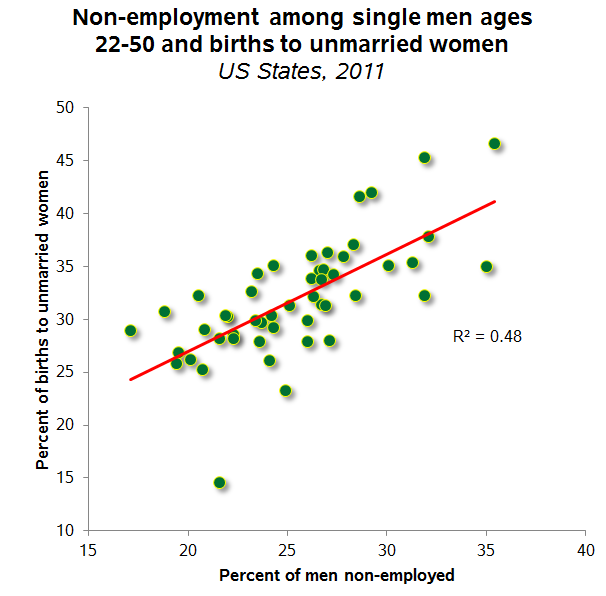
Using the new numbers on nonmarital birth rates for each state from the Census report, I compared them to the male non-employment rate — specifically, the percentage of unmarried men ages 22-50 that are not currently employed. Here’s the relationship:

3

The states with more single men out of work have higher rates of nonmarital births. Single mother, meet jobless man.

My conclusion from these patterns is that unmarried parenthood is primarily a symptom of lack of opportunity, especially for education and employment. Surely that’s not the whole story. Maybe we should be persuading people to marry younger or shaming them into avoiding parenthood. But I think those approaches increase stigma more than they change behavior or improve wellbeing — Pew surveys show that 77 percent of people already say raising a family is easier if you’re married and only 12 percent of single people say they don’t want to marry. So who needs convincing? Meanwhile, if we addressed the problems of education and employment, is there any doubt family security and stability would improve, and with it the wellbeing of children and their parents?

Philip N. Cohen is a professor of sociology at the University of Maryland, College Park, and writes the blog Family Inequality. You can follow him on Twitter or Facebook.

Please enjoy these posts from Mother’s Days past: