Search results for The

Last week the U.S. Congress made headlines when it quickly adjusted the sequester cuts that affected air traffic control. How quickly?  Parts of it were hand-written (via The Daily Show):
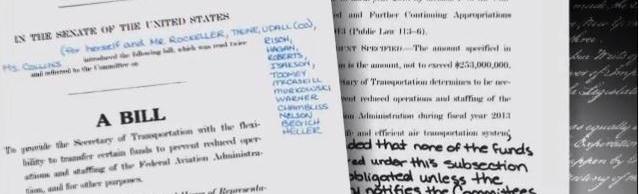
1 The move was interpreted as one meant to a certain class of voters, but it was also as a purely self-interested move, since Congress members fly quite frequently.

Riffing on this, Bloomberg Businessweek put together a short video about a little-known congressional perk: free and convenient parking at Reagan National Airport.

This little perk, saving congress members time and $22-a-day parking fees, is a great example of the way that privilege translates into being “above society.” The more power, connections, and money you have, the more likely you are to be able to break both the legal and social contract with impunity. Sometimes this just means getting away with breaking the law (e.g., the fact that, compared to the crimes of the poor and working classes, we do relatively little to identify and prosecute so-called “white collar” criminals and tend to give them lighter or suspended sentences when we do). But these perks are also often above board; they’re built into the system. And who builds the system again?

In other words, some of the richest people in the world get free parking at the airport because they’re the ones making the rules. I like this as a concrete example, but be assured that there is a whole universe of such rules and, like this sudden revelation about free parking, most of them go entirely unnoticed by most of us most of the time.

Lisa Wade, PhD is an Associate Professor at Tulane University. She is the author of American Hookup, a book about college sexual culture; a textbook about gender; and a forthcoming introductory text: Terrible Magnificent Sociology. You can follow her on Twitter and Instagram.

1Research has shown that college students largely think that asking for sexual consent — “Do you want to have sex?” — “ruins the mood.”  This is partly because it violates their sexual script, the norms and expectations that guide sexual encounters.

If explicit consent violates the sexual script, then students are left trying to discern consent from more subtle and implicit verbal and non-verbal cues.  I did a research project to determine how they do this, interviewing 19 college students about their perceptions of sexual consent in popular television programs. 

I discovered that students often interpreted the same scenes dramatically differently. For example, I showed them this scene from The Vampire Diaries:

Eleven of my 19 respondents brought up the issue of verbal consent.  Five said the verbal interchange in the scene indicated consent; six said it did not.  Their contrasting perceptions focused on the male character’s statement, “Let’s get out of here.”  The five students who saw the scene as consensual were inclined to classify the declaration, “Let’s get out of here” as the moment where verbal consent is given.  For example, Hannah said:

…like I mean he doesn’t outright say “do you wanna have sex” but he says “do you want to get out of here” and she’s like “yes.”  That’s like the only one where there’s like an actual yes! [giggling] I mean like a verbal yes.

Hannah said the scene indicated consent because she equated “getting out of here” with sex.

In contrast, Natalie and five others disagreed with Hannah and those who considered the verbal exchange between Tyler and Caroline to be a form of verbal consent:

No, I would say, there was like no talk of consent, really… In the Vampire Diaries one, by him saying like, “let’s get out of here,” there might be an assumption associated with that and then her saying, “Okay,” like could be consent, quote, unquote.  But, I don’t really think that qualifies, either.

Natalie believed there was a correct way to obtain verbal consent.  When I asked her what would make this scene consensual, Natalie replied, “Basically saying ‘Do you want to, do you want to go through with this?’—something like that.”  Obviously, Natalie viewed consent as a different kind of verbal question.

The differences in these responses to The Vampire Diaries scene are striking. While verbal consent is often held up as the gold standard, I found disagreement as to exactly which statements constitute consent.  This disagreement sets the stage for serious miscommunication about students’ sexual intentions.  Some students interpret a phrase such as “Do you want to leave?” as “Do you want to leave this party and have sex at my house?” while other students believe that only a phrase such as “Do you agree to have sex with me?” communicates sexual consent.

Nona Gronert will graduate from Occidental College this May with a degree in Sociology and Spanish Literary Studies.  She aspires to become a professor of Sociology.

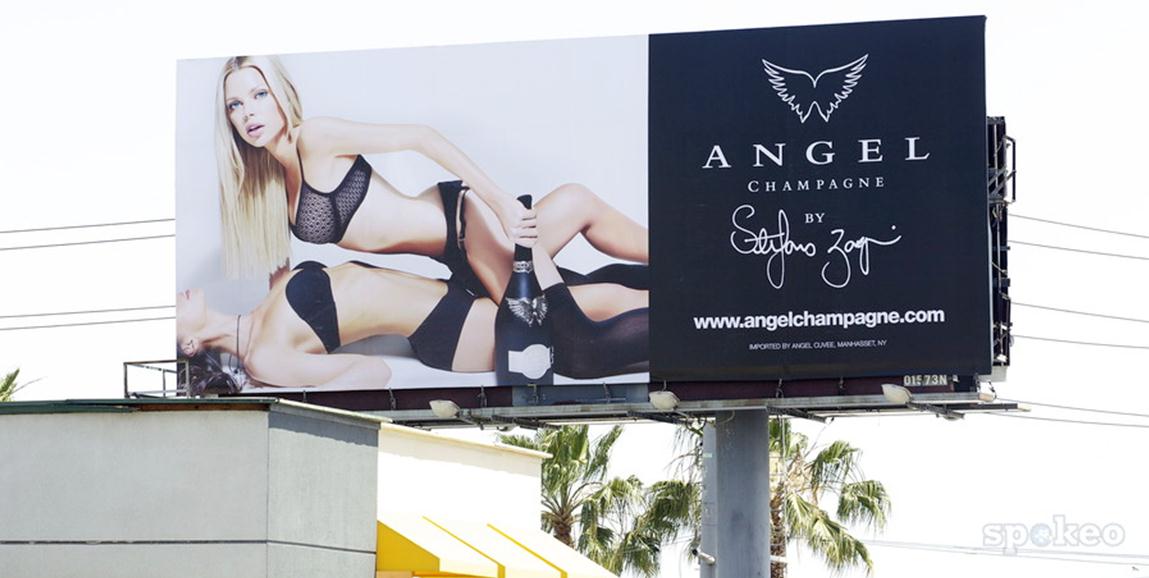
Clearly depicting a sexual encounter between two women, this billboard — posted on Doheny Drive in Los Angeles — looks like it would undermine heteronormativity: an invisibility of same-sex sexual and romantic relationships.

1

In fact, I don’t think it does.  For one, the aim of the advertisement is to appeal to male consumers. The women’s appearance is in conformity with the demands of the hypothetical heterosexual male gaze.  They have long groomed hair and are wearing sexy lingerie and make-up. They are arching their backs and sticking out their busts and butts. The performance of male gaze-compliant femininity is clear, making the male viewer an implicit part of the advertisement.  This enforces heterosexuality and promotes heternormativity instead of undermining it.

Moreover – and stay with me here – that implicit male manifests himself symbolically in the shaft of the champagne bottle.  The woman’s hand gripping the bottle turns this image into a depiction of a threesome rather than a lesbian encounter. This billboard, then, reinforces heterosexuality instead of disrupting it.

Sianni Rosenstock is a freshman at Occidental College. She is an intended Sociology major and Studio Art minor. 

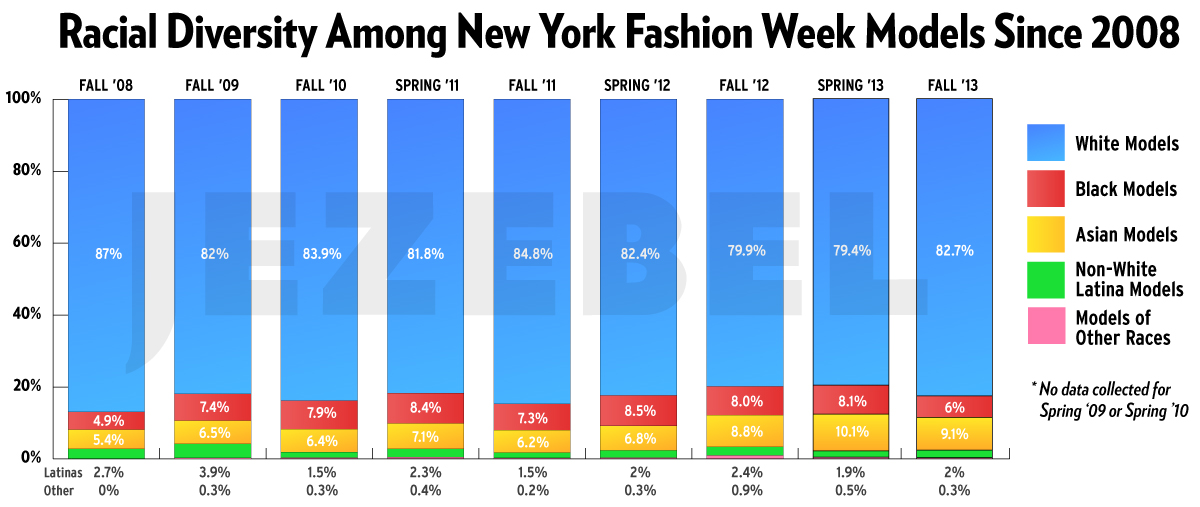
The fashion industry is not inclusive of racial and ethnic minorities. Many of the industry’s most celebrated and acclaimed fashion houses rarely cast models of color for their runway shows. Fall 2013 was one of the worst seasons in diversity for casting. Almost 83% of the models on the runway were white (source):

1The result is an incredibly homogeneous look on the runway.  Check out photos of the Fall 2013 Gucci show (source) and the Fall 2013 Calvin Klein show (source).

Faintly aware of this critique, some designers put a minority model on the runway every odd season. But while look-alike white models are hired en masse, designers often limit just how much color they’re willing to include.  Chanel Iman, an extremely successful multiracial model, told The Times: “Designers have told me, ‘We already found one black girl. We don’t need you anymore.’”

Leila Ananna, a casting director for Burberry, Gucci, Emilio Pucci, Saint Laurent, and more, thinks that this is okay.  Commenting on the lack of runway diversity, she said: “We think we need to keep in mind that these are shows. A show needs to make you dream, and it doesn’t necessarily need to represent reality.”

Ananna’s words pose many concerns. The idea that fashion shows are supposed to make you dream suggests that everyone is white in this idealized world. In contrast, I find the idealization of the homogeneous aesthetic to be a reflection of racism; this is a nightmare, not a dream.

Rebs (Wooyoung) Lim is currently a student attending Occidental College. She is interested in minoring in Sociology and majoring in Urban and Environmental Policy. She does not have a twitter account, sadly.

Cross-posted at Tim Wise’s website and Pacific Standard.

As the nation weeps for the victims of the horrific bombing in Boston yesterday, one searches for lessons amid the carnage, and finds few. That violence is unacceptable stands out as one, sure. That hatred — for humanity, for life, or whatever else might have animated the bomber or bombers — is never the source of constructive human action seems like a reasonably close second.

But I dare say there is more; a much less obvious and far more uncomfortable lesson, which many are loathe to learn, but which an event such as this makes readily apparent, and which we must acknowledge, no matter how painful.

It is a lesson about race, about whiteness, and specifically, about white privilege.

I know you don’t want to hear it. But I don’t much care. So here goes.

White privilege is knowing that even if the Boston Marathon bomber turns out to be white, his or her identity will not result in persons like yourself being singled out for suspicion by law enforcement, or the TSA, or the FBI.

White privilege is knowing that even if the bomber turns out to be white, no one will call for your group to be profiled as terrorists as a result, subjected to special screening, or threatened with deportation.

White privilege is knowing that if the bomber turns out to be white, he or she will be viewed as an exception to an otherwise non-white rule, an aberration, an anomaly, and that he or she will be able to join the ranks of Tim McVeigh and Terry Nichols and Ted Kaczynski and Eric Rudolph and Joe Stack and George Metesky and Byron De La Beckwith and Bobby Frank Cherry and Thomas Blanton and Herman Frank Cash and Robert Chambliss and James von Brunn and Robert Mathews and David_Lane and Michael F. Griffin and Paul Hill and John Salvi and James Kopp and Luke Helder and James David Adkisson and Scott Roeder and Shelley Shannon and Wade Michael Page and Byron Williams and Kevin Harpham and William Krar and Judith Bruey and Edward Feltus and Raymond Kirk Dillard and Adam Lynn Cunningham and Bonnell Hughes and Randall Garrett Cole and James Ray McElroy and Michael Gorbey and Daniel Cowart and Paul Schlesselman and Frederick Thomas and Paul Ross Evans and Matt Goldsby and Jimmy Simmons and Kathy Simmons and Kaye Wiggins and Patricia Hughes and Jeremy Dunahoe and David McMenemy and Bobby Joe Rogers and Francis Grady and Demetrius Van Crocker and Floyd Raymond Looker, among the pantheon of white people who engage in politically motivated violence meant to terrorize and kill, but whose actions result in the assumption of absolutely nothing about white people generally, or white Christians in particular.

And white privilege is being able to know nothing about the crimes committed by most of the terrorists listed above — indeed, never to have so much as heard most of their names — let alone to make assumptions about the role that their racial or ethnic identity may have played in their crimes.

White privilege is knowing that if the Boston bomber turns out to be white, you will not be asked to denounce him or her, so as to prove your own loyalties to the common national good. It is knowing that the next time a cop sees you standing on the sidewalk cheering on runners in a marathon, that cop will say exactly nothing to you as a result.

White privilege is knowing that if you are a student from Nebraska — as opposed to, say, a student from Saudi Arabia — that no one, and I mean no one would think it important to detain and question you in the wake of a bombing such as the one at the Boston Marathon.

And white privilege is knowing that if this bomber turns out to be white, the United States government will not bomb whatever corn field or mountain town or stale suburb from which said bomber came, just to ensure that others like him or her don’t get any ideas. And if he turns out to be a member of the Irish Republican Army we won’t bomb Dublin. And if he’s an Italian American Catholic we won’t bomb the Vatican.

In short, white privilege is the thing that allows you — and me — to view tragic events like this as merely horrific, and from the perspective of pure and innocent victims, rather than having to wonder, and to look over one’s shoulder, and to ask even if only in hushed tones, whether those we pass on the street might think that somehow we were involved.

It is the source of our unearned innocence and the cause of others’ unjustified oppression.

That is all. And it matters.

Tim Wise is among the most prominent anti-racist writers and educators in the United States.  The author of six books on race in America, he has spoken on over 800 college and high school campuses and to community groups across the nation.  His new book, The Culture of Cruelty, will be released in the Fall of 2013.

Last week someone sent me a link to an article about Brad Paisley’s new song, “Accidental Racist,” which features LL Cool J. Given that you’re a Soc Images reader, chances are good you’ve heard about this song. I don’t remember what I was expecting when I saw the title of the song, but man. I really was not prepared for that experience. There’s no official video available on YouTube at the moment, but someone made a video of the song with the lyrics:

In Racism without Racists: Color-Blind Racism and the Persistence of Racial Inequality in the United States, Eduardo Bonilla-Silva discusses the rhetorical strategies that Whites often use to minimize the existence of racial inequality today. As being openly racist has become increasingly stigmatized in the U.S., a version of “color-blind” racism has emerged.

One argument that underpins color-blind racism is the framing of racial oppression and injustice as elements of the past that, while regrettable, can’t be remedied now. Moreover, it’s history; since African Americans aren’t enslaved or legally segregated today, we need to move on from here and treat everyone as equals, with no special considerations for anyone. As one of Bonilla-Silva’s interviewees explained, “…what happened in the past is horrible and it should never happen again, but I also think that to move forward you have to let go of the past…And it should really start equaling out…” (p. 78).

Along with this is often an attempt to equate the discrimination faced by some groups of European immigrants (Italians, the Irish, Jews, etc.) to the experience of African Americans, as this interviewee did: “…they were slaves back in the past and yet, how often do you hear about the people who were whites that were slaves…Boy, we should get reparations, the Irish should get reparations from the English…” (p. 79). From this perspective, African Americans are just one of many groups that had it bad; the impacts of a legally institutionalized racist system that denied African Americans full citizenship or access to opportunities is ignored. This storyline of “we all had it bad” equalizes various experiences of racial and ethnic inequality.

And this is the problem with Paisley’s song (well, it’s one of the problems, but let’s focus). Take these lyrics (found here):

And it ain’t like you and me can re-write history
Our generation didn’t start this nation
We’re still pickin’ up the pieces, walkin’ on eggshells, fightin’ over yesterday
And caught between southern pride and southern blame

And we’re still paying for the mistakes
That a bunch of folks made long before we came

And these contributions from LL Cool J:

If you don’t judge my gold chains…I’ll forget the iron chains

The past is the past, you feel me…Let bygones be bygones

While Paisley may mean well, his song presents racial inequality or conflict as the result of long-past history, “mistakes…made long before we came,” something we need to just get past so we can appreciate each other. And it equates wildly divergent issues, presenting everyone has having a fair, legitimate complaint. Slavery (“iron chains”) and adopting an aesthetic style (“gold chains”) that some Whites might not like are, apparently, equivalent issues. Ending racism is just a matter of everybody deciding to be nicer. If Whites can get over not liking what some African Americans wear, well then hey, African Americans will get over a history of institutionalized racial oppression and the impacts it still has today.

In the world of color-blind racism, this is a fair, plausible compromise.

You might also enjoy SNL’s take.

Gwen Sharp is an associate professor of sociology at Nevada State College. You can follow her on Twitter at @gwensharpnv.

Cross-posted at The Huffington Post.

One of our Pinterest boards collects images that reveal that men are the “neutral” sex in contemporary Western cultures. This means that (1)  the image that pops up in our minds when we say “person” or “human” or “worker” is usually implicitly male, (2) non-sexed representations of people are usually assumed to be male (e.g., cartoon animals appear female to us unless we slap on eyelashes and lipstick), (3) items for sale often get marketed as either “item” or “women’s item” (e.g., “deodorant” and “women’s deodorant”), and (4) men and male bodies get to stand in for humanity (e.g., in scientific research).

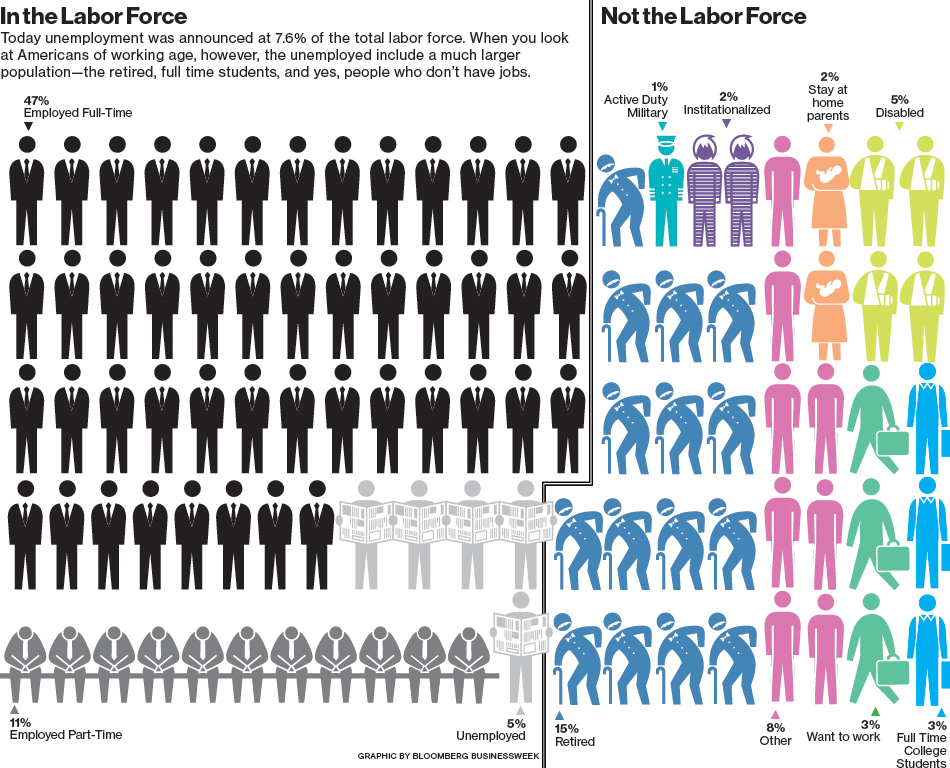
Instances of this phenomenon have been a fun series on the blog; we featured another one just this past weekend, on how (not) to write obituaries.  Then today SocImages Contributor Philip Cohen sent along another great example that we couldn’t resist sharing. The graphic below, released by Bloomberg Business Week, is meant to help us understand who is in and out of the labor force.  While 3% of Americans want to work but can’t find a job, large proportions are also permanently or temporarily out of work on purpose: they’re retired, in college, in the military, disabled, or a stay-at-home parent.

For our purposes in this post, what’s interesting is the way they illustrate the categories.  See what you see:

1

In all cases but one, the stick figured is either non-sexed and therefore implicitly male (e.g., the newspaper reader and the disabled) or explicitly male (the business-suited full-time employees, the mustachioed retiree).  The one exception, of course, is for the stay-at-home parent.  Suddenly the stick figure is a female.  We see this all over.  As soon as parenting or housework is involved, all those neutral/male stick figures sprout skirts.

Now, to be fair, 97% of stay-at-home parents are female, but so is 50% of the American workforce. You wouldn’t guess so, however, by this graphic.  Also, for what it’s worth, it doesn’t have to be like this.

Lisa Wade, PhD is an Associate Professor at Tulane University. She is the author of American Hookup, a book about college sexual culture; a textbook about gender; and a forthcoming introductory text: Terrible Magnificent Sociology. You can follow her on Twitter and Instagram.
Cross-posted at Family Inequality.

The U.S. Census Bureau has released its new report on childcare, written by Lynda Laughlin. This provides a good followup treatment for the hyperventilation induced by fear of fathers taking over (or being relegated to) childcare.

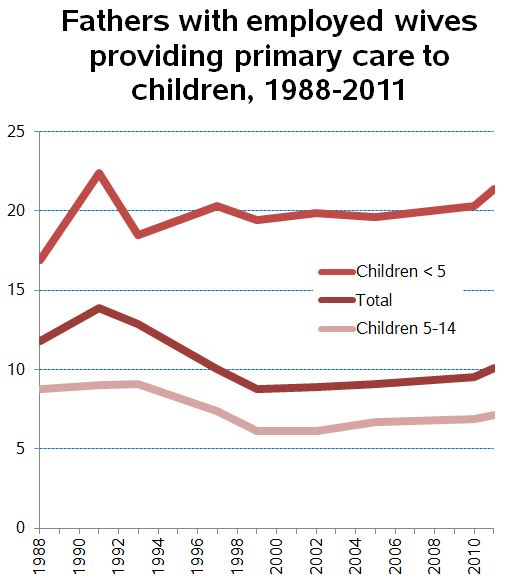
First, the trend that fits my story of stalled gender progress. Among married fathers with employed wives, how many are providing the “primary care” for their children? That is, among the various childcare arrangements the children are in while their mother is at work, how many are in their fathers’ care more than in any other arrangement? Answer:  10%, which is virtually unchanged from a quarter-century ago:

1

Not a lot of change for a quarter century in which we’re told everything has changed.

However, in fairness to the change-is-happening community, here is the trend for the percentage of fathers who say they are providing ANY care to their children while their mothers were at work.

2

I don’t give this much weight since it might reflect greater sensitivity to the importance of saying fathers provide care, but there you have it: it’s higher, and it shows some increases up until the early 1990s, which is when gender equality in general stalled on many indicators. Since the mid-1990s: Nothing.

Please note these figures don’t show the total contribution of fathers, but only reflects those married with children, whose wives are employed.

One interesting source of father care is mothers’ shiftwork. As Harriet Presser reported two decades ago, the 24/7 economy stimulates some task sharing among couples. In the current report, Laughlin writes:

Preschoolers whose mothers worked nights or evenings were more likely to have their father as a child care provider than those with mothers who worked a day shift (42 percent and 23 percent, respectively)

Philip N. Cohen is a professor of sociology at the University of Maryland, College Park, and writes the blog Family Inequality. You can follow him on Twitter or Facebook.