Search results for The

1This four-minute BBC video documents a population of ethnic German-Americans. They are the descendants of Germans who immigrated to Texas 150 years ago.  Over the generations, the language evolved into a unique dialect.  Today linguist Hans Boas is trying to document the dialect before it dies out.  While it persisted for a very long time, World War II, and the ensuing stigma against anything German, brought an end to its transmission.  Today’s speakers are all 60 or older and will soon be gone.

Lisa Wade, PhD is an Associate Professor at Tulane University. She is the author of American Hookup, a book about college sexual culture; a textbook about gender; and a forthcoming introductory text: Terrible Magnificent Sociology. You can follow her on Twitter and Instagram.

The Stonewall Riots, widely described as the birth of the modern gay and transgender rights movement, occurred on this day in 1969.

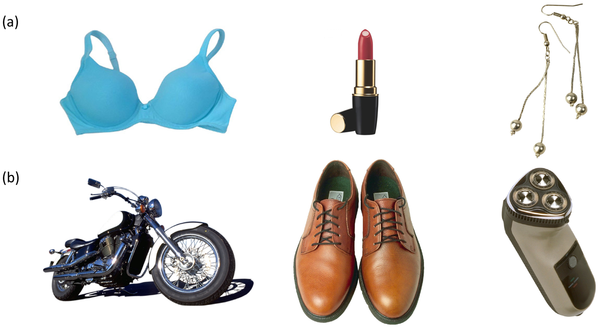
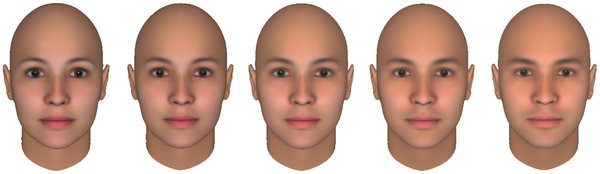
Elana M. sent along a fascinating study revealing the gender binary in our brains.  The researchers, Homayoun Javadi and Natalie Wee, asked subjects to look at a series of gendered objects — either (a) or (b) — and then judge the masculinity or femininity of a series of androgynous faces.  Gender mattered, but not how you might think.

Condition 1:1
2

Condition 2:

2 2

The findings were counter-intuitive to me.  Subjects who saw the feminine objects judged the faces to be more masculine, and vice versa for subjects who saw the masculine objects.  The researchers interpret this as an “adaptation effect,” a neurological phenomenon in which “looking at something for a long time makes you more likely to see its opposite” (source).  For example if you look at a white screen after looking at a red one for a while, the white screen will appear green (red’s opposite).  Or, if you look at lines moving right for a while and then look at static lines, they will appear to move left.

Javadi and Wee’s findings suggest that our brains give gender to both objects and people and that we place masculinity and femininity in a binary.  We are “opposite sexes,” then, but only in our minds.

Lisa Wade, PhD is an Associate Professor at Tulane University. She is the author of American Hookup, a book about college sexual culture; a textbook about gender; and a forthcoming introductory text: Terrible Magnificent Sociology. You can follow her on Twitter and Instagram.

Cross-posted at the Los Angeles Times, Huffington Post, and BlogHer.

In an Op-Ed article on hookup culture in college, Bob Laird links binge drinking and casual sex to sexually transmitted diseases, unwanted pregnancies, confusion, low self-esteem, unhappiness, vomiting, ethical retardation, low grades and emotional inadequacy. “How nice of The Times to include this leftover piece from 1957 today,” snarked a reader in the online comments.

Fair enough, but Laird is more than out of touch. He also fundamentally misunderstands hookup culture, the relationships that form within it and the real source of the problems arising from some sexual relationships.

Laird makes the common mistake of assuming that casual sex is rampant on college campuses. It’s true that more than 90% of students say that their campus is characterized by a hookup culture.  But in fact, no more than 20% of students hook up very often; one-third of them abstain from hooking up altogether, and the remainder are occasional participators.

If you do the math, this is what you get: The median number of college hookups for a graduating senior is seven. This includes instances in which there was intercourse, but also times when two people just made out with their clothes on. The typical student acquires only two new sexual partners during college. Half of all hookups are with someone the person has hooked up with before. A quarter of students will be virgins when they graduate.

In other words, there’s no bacchanalian orgy on college campuses, so we can stop wringing our hands about that.

Laird argues that students aren’t interested in and won’t form relationships if “they are simply focused on the next hookup.” Wrong. The majority of students — 70% of women and 73% of men —report that they’d like to have a committed relationship, and 95% of women and 77% of men prefer dating to hooking up. In fact, about three-quarters of students will enter a long-term monogamous relationship while in college.

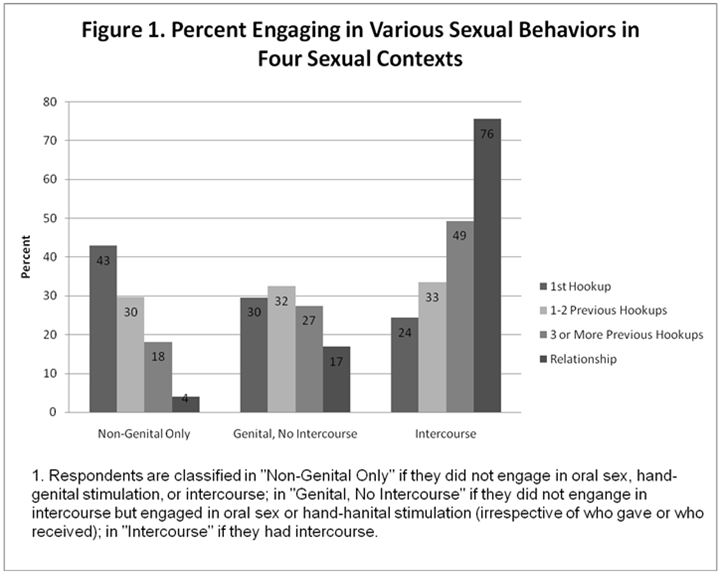
And it’s by hooking up that many students form these monogamous relationships. Roughly, they go from a first hookup, to a “regular hookup,” to perhaps something that my students call “exclusive” — which means monogamous but not in a relationship — and then, finally, they have “the talk” and form a relationship.  As they get more serious, they become more sexually involved (source):

1

Come to think of it, this is how most relationships are formed — through a period of increasing intimacy that, at some point, ends in a conversation about commitment. Those crazy kids.

So, students are forming relationships in hookup culture; they’re just doing it in ways that Laird probably doesn’t like or recognize.

Finally, Laird assumes that relationships are emotionally safer than casual sex, especially for women.  Not necessarily. Hookup culture certainly exposes women to high rates of emotional trauma and physical assault, but relationships do not protect women from these things. Recall that relationships are the context for domestic violence, rape and spousal murder.

It’s not hooking up that makes women vulnerable, it’s patriarchy. Accordingly, studies of college students have found that, in many ways, hookups are safer than relationships. A bad hookup can be acutely bad; a bad relationship can mean entering a cycle of abuse that takes months to end, bringing with it wrecked friendships, depression, restraining orders, stalking, controlling behavior, physical and emotional abuse, jealousy and exhausting efforts to end or save the relationship.

Laird’s views seem to be driven by a hookup culture bogeyman. It might scare him at night, but it’s not real.  Actual research on hookup culture tells a very different story, one that makes college life look much more mundane.

Lisa Wade, PhD is an Associate Professor at Tulane University. She is the author of American Hookup, a book about college sexual culture; a textbook about gender; and a forthcoming introductory text: Terrible Magnificent Sociology. You can follow her on Twitter and Instagram.
As part of an ongoing series about inequality in the U.S., tonight PBS will air a segment on the psychology of wealth: that is, how the experience of being (or feeling) well-off impacts our attitudes and behaviors.

As this video clip explains, having wealth appears to affect us in a number of ways. Having more tends to make individuals feel entitled to even more; research shows they feel less generous and more entitled to take resources (such as candy they have been told is for children coming in later), more willing to cheat, and more accepting of unethical behavior. Privileged individuals — even those whose privilege is just having Monopoly rules rigged to ensure they win in an experiment — tend to believe they deserve their privilege.

These patterns show up regardless of political orientation, affecting both liberals and conservatives. Whatever good intentions we might have, the experience of being wealthy appears to affect us in ways it may be hard for individuals to notice, making privileged people feel they deserve their position and justifying behaviors that consolidate even more advantages.

Transcript available at the PBS website. Also check out our earlier posts presenting PBS clips on Americans’ misperceptions of the level of inequality in the U.S. and the health impacts of inequality.

Gwen Sharp is an associate professor of sociology at Nevada State College. You can follow her on Twitter at @gwensharpnv.

Cross-posted at The Wild Magazine.

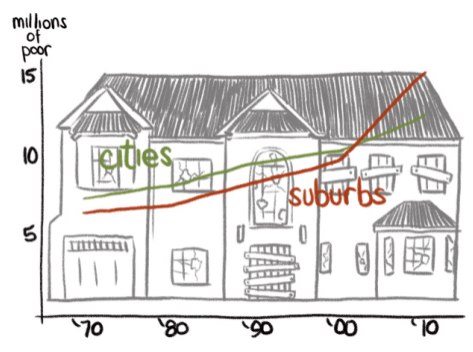
Poverty in the United States is stereotypically associated with racial minorities in urban centers. However, a closer look at social geography reveals a more complex situation: a majority of poor people are white and live in the suburbs. This makes sense when you consider that whites are the largest racial group in the U.S., making up 75% of the population, and that there are three times as many suburbanites than urbanites.

A majority of Americans are losing wealth, and we know it’s going straight to the top. This is not a conspiracy theory, but the economic arrangement of the last 40 years. The New Deal, which created the middle class and the American Dream, was systematically dismantled by elite interest. The revolving door, the shuffling of elites in top positions of power between the public and private sectors, made this possible. The New Deal was abandoned for neoliberal policy. As a result, the comfortable middle class lifestyle was replaced by unemployment and working class struggle.

Suburban poverty normally reflects the spread of metropolitan poverty, but in recent years, suburban poverty has been growing at a faster rate. From 2010-2011, poverty in America’s 100 largest metro areas increased by 5.9% overall. Suburban poverty grew at a rate of 6.8%, while urban poverty grew only 4.7%. In general, the poverty rates in urban areas are still higher (21%) than those in the suburbs (11%). Most notable is the rate of change in the suburbs, which can be attributed to increasing inequality, the housing market crash, gentrification, efforts to make low-income people more mobile, and public housing vouchers.

Screenshot_1

For the past decade, suburbanites commuted between suburbs rather than into cities for work. More affluent, nearby suburbs provide low-wage service jobs in food and retail. Poverty rates in suburbia are rising due to a crumbling middle class, but the poor are still mainly concentrated in inner-ring suburbs close to cities, and on the fringe — former rural areas consumed by suburban sprawl.

Poverty’s expansion to the suburbs is a symptom of an increasingly unequal society. The geographic isolation of the suburban poor in the inner and outer rings of suburbia troubles the validity of the claim that poverty moved to the suburbs. More accurately, people are getting poorer and more people live in the suburbs—or areas now designated as such. It’s plausible that economic inequality and leapfrog developments have changed the sociogeographic landscape. Low-income earners are displaced to the outskirts of the city (inner-ring of the suburbs) due to gentrification, and the rural poor are now more easily counted among the suburban poor due to suburban sprawl. Whatever the case, suburban poverty presents unique challenges to policy makers because federal antipoverty resources are tailored for densely populated urban areas. The stereotypical images of inner city poverty and suburban affluence are the ultimate fiction.

Kara McGhee is a PhD student in sociology at the University of Missouri specializing in culture, identity, and inequalities. She is a regular contributor for The WILD Magazine

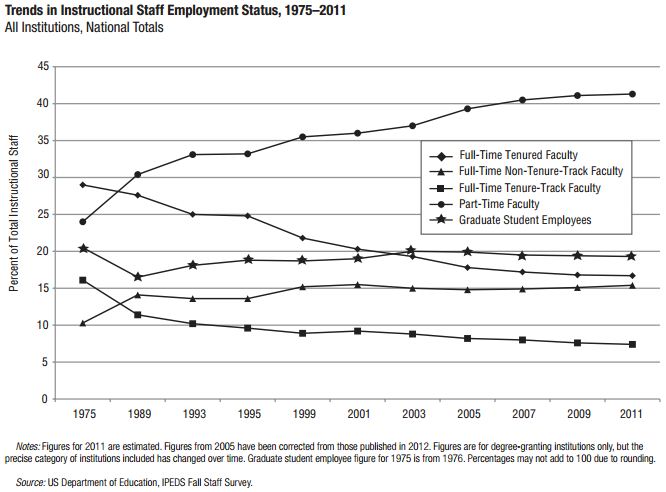
While the stereotype of the college professor might still be an elbow-patched intellectual cozied up in an office, it might be more accurate to place him in his car.  A new report from the American Association of University Professors finds that more than 40% of college instructors are part-time, often driving from campus to campus to cobble together enough classes to enable them to pay rent.  These types of employees far outnumber tenured and tenure-track faculty, who make up less than a quarter.

1

This data suggest that the term “precariat” applies well to a significant proportion of college and university professors. Coined by economist Guy Standing, the term is meant to draw attention to the economic fragility of many lower wage workers in today’s labor market.  It’s a combination of the word “precarious” and “proletarian,” a word that is used to refer to the working class under capitalism.

Part-time faculty count as part of the precariat because their jobs are contingent (renewed semester to semester), low paid, and bring little or no benefits.  Let me put it this way.  I just finished my first year as a tenured professor after six years on the tenure track.  I teach five classes.  An adjunct at a public research university would have to teach more than twenty-three classes to earn my salary (average pay is $3,200/class); someone teaching at community colleges would have to teach more than thirty-three (at $2,250/class).  Of course, my salary also reflects research and institutional service, but my hourly wage is obviously far out-of-proportion to that of part-time faculty.  Plus I get a wide range of benefits; adjuncts usually get nothing.

When government funding of higher education shrinks, colleges and universities respond by cutting corners where they can.  Hiring adjuncts is one way to do that.  It’s important to remember, then, that funding cuts hurt not only students; they also hurt jobs.

See also How Many PhDs are Professors?

Via Jordan Weissman at The Atlantic. Cross-posted at Pacific Standard.

Lisa Wade, PhD is an Associate Professor at Tulane University. She is the author of American Hookup, a book about college sexual culture; a textbook about gender; and a forthcoming introductory text: Terrible Magnificent Sociology. You can follow her on Twitter and Instagram.

Please enjoy these posts from Father’s Days past:

Stereotyping Men on Dad’s Day

Also…