Search results for The

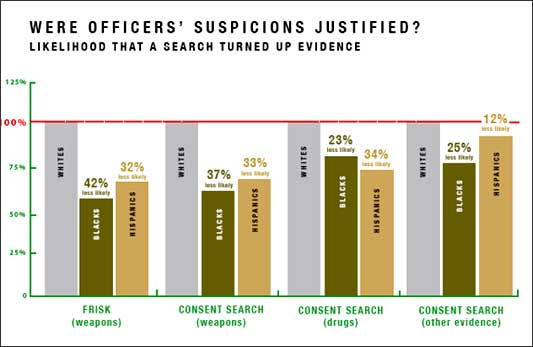
Jay Livingston at Montclair SocioBlog discussed the two figures below (full report here).  The first shows that Black and Hispanic drivers are more likely to be stopped by Los Angeles Police than White drivers.  The second shows that, when stopped, if searched, police are more likely to find weapons and drugs on Whites than on either Blacks or Hispanics.  Conclusion: Blacks and Hispanics are being racially profiled by the L.A.P.D. and racial profiling does not work.  Data from New York City in 2008 tells a similar story.
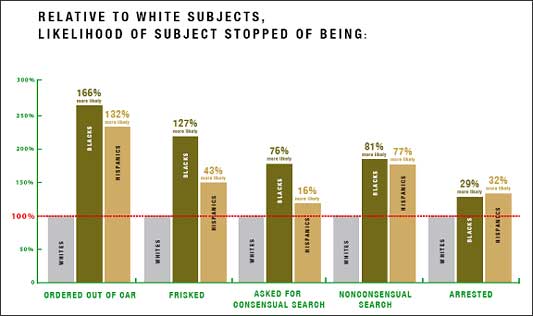
The New York Civil Liberties Union reports that the NYPD stopped 161,000 people in the first quarter of 2011. A record number.  Eighty-four percent of those stopped were Black or Latino.  The Civil Liberties Union has filed a lawsuit, claiming that the practice is unconstitutional.

Originally posted in 2011. Re-posted in solidarity with the African American community; regardless of the truth of the Martin/Zimmerman confrontation, it’s hard not to interpret the finding of not-guilty as anything but a continuance of the criminal justice system’s failure to ensure justice for young Black men.

Lisa Wade, PhD is an Associate Professor at Tulane University. She is the author of American Hookup, a book about college sexual culture; a textbook about gender; and a forthcoming introductory text: Terrible Magnificent Sociology. You can follow her on Twitter and Instagram.
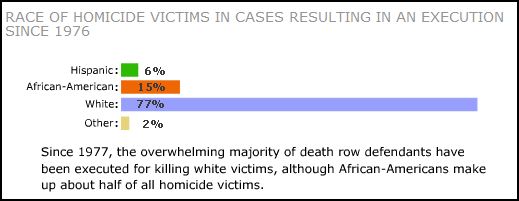
There is much to be worried about when one considers the role racial discrimination plays in delivering the death penalty.  Scholars are newly looking to the way that the race of homicide victims, instead of the defendants, shape outcomes.  It turns out a disproportionate number of people who are executed under the death penalty have been convicted of murdering a white person (Amnesty International):

“[H]olding all other factors constant,” Amnesty International summarizes, “the single most reliable predictor of whether someone will be sentenced to death is the race of the victim.”

Originally posted in 2010. Re-posted in solidarity with the African American community; regardless of the truth of the Martin/Zimmerman confrontation, it’s hard not to interpret the finding of not-guilty as anything but a continuance of the criminal justice system’s failure to ensure justice for young Black men.

Lisa Wade, PhD is an Associate Professor at Tulane University. She is the author of American Hookup, a book about college sexual culture; a textbook about gender; and a forthcoming introductory text: Terrible Magnificent Sociology. You can follow her on Twitter and Instagram.
Cross-posted at Montclair SocioBlog.

According to an op-ed in the Times, America is the global leader in broadband, with high speeds and great service. And it’s all because the government restrained “onerous” regulation and let companies like Verizon do what they want and charge what they want.

It was written by the CEO of Verizon, Lowell McAdam.

I pay Mr. McAdam’s company about $115 each month for my land line, wi-fi, and cable (all FIOS).  Mr. McAdam compares the U.S. favorably with Europe, “where innovation and investment in advanced networks have stagnated under an onerous regulatory regime.”  I asked a friend who lives in Paris what he pays for his FIOS phone, wi-fi, and cable.  The monthly bill:  39.90€ ($52) or half of what I pay Verizon.  Maybe there’s an upside to stagnant and onerous.

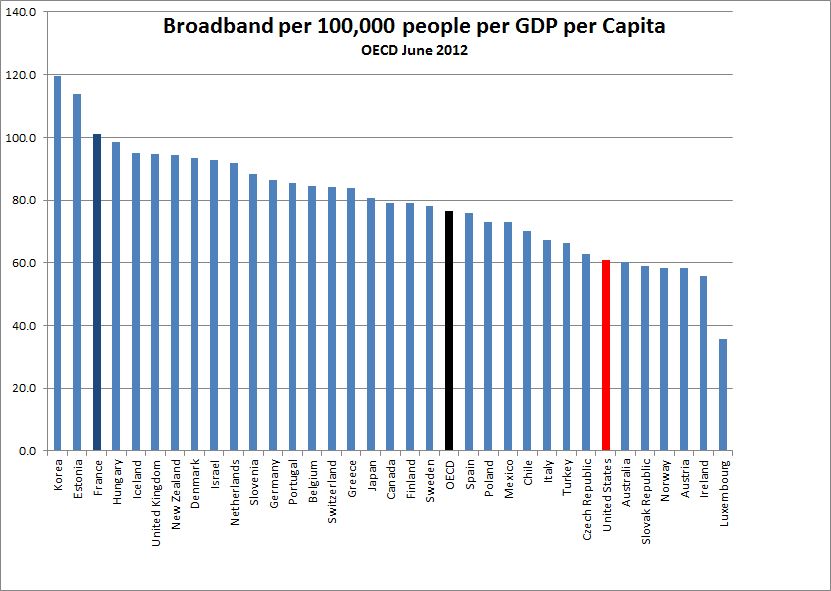
There’s nothing wrong with getting what you can afford, and it occurred to me that U.S. broadband is the best because we can afford more.  Onerous regulations or no, most other countries are not as rich as the U.S.  What if you looked at broadband and per capita GDP?

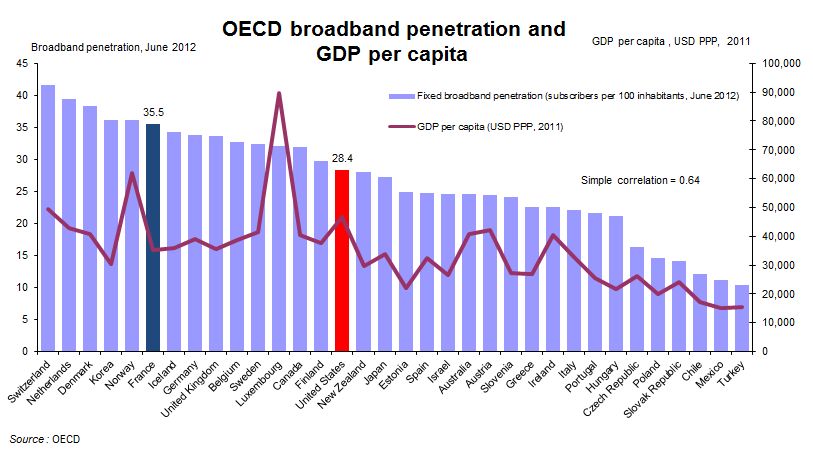
The OECD did just that with data from June 2012 (their several spreadsheets on this are here). The purple bars are broadband penetration and the bumpy red line is GDP per capita. Do you see a correlation?

1

Consider France: As of a year ago, the country had greater broadband penetration despite a lower per capita GDP than the U.S. ($35,133 vs. $46,588); that’s 25% more broadband on 33% less income and at half the cost to consumers.

If you re-rank the OECD countries factoring in per capita GDP, the line-up changes.  Notably, the U.S. and Luxembourg drop well below the OECD average, despite being among the wealthiest countries.

2

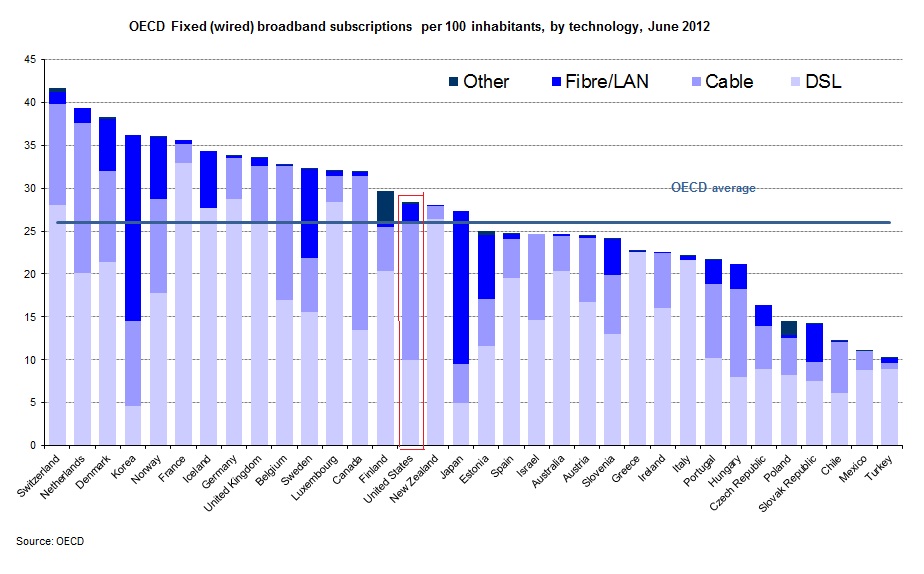
Of course, not all broadbands are equally broad.  Verizon sold me on fiber-optic with their assurance that it was dazzlingly faster than their DSL that I had been clunking along on. This graph breaks down broadband into its various incarnations.

3

The U.S. is slightly above average on all broadband, but when it comes to a high fibre diet, we are ahead of several other countries that have greater total penetration.  On the other hand, the Scandinavian countries are ahead of us, as are, impressively, the Asian countries.

This is not to deny U.S. advances.  TechCrunch summarizes more recent data from Akamai on these changes:

the U.S. is currently second in the price of broadband for entry-level users. The nation is also third in network-based competition, second in the fiber-optic installation rate, first in the adoption of next-generation LTE, ahead of Europe in broadband adoption, and doing quite well in Internet-based services.

Still, the U.S. lags behind other, less wealthy countries.  InnovationFiles, using Akamai data for different variables, has a less congratulatory view.

  • The U. S. has picked up one place in the “Average Peak Connection Speed” that’s the best measurement of network capacity, rising from 14th to 13th as the measured peak connection speed increased from 29.6 Mbps to 31.5 Mbps.
  • In terms of the “Average Connection Speed,” widely cited by analysts who don’t know what it means, the U. S. remains in 8th place world-wide. but we’re no longer tied for it as we were in the previous quarter; Sweden is right behind us on this one.
  • In terms of “High Speed Broadband Adoption”, the proportion of IP addresses with an Average Connection Speed greater than 10 Mbps, we remain in 7th place, but now we’re tied with  Sweden.

The title of CEO McAdam’s op-ed is “How the US Got Broadband Right.”  Given the content, I  guess “We’re Number 13!” wouldn’t have been appropriate.  Even “We’re Number Seven (Tied With Socialist Sweden)!” doesn’t quite have that affirmative zing.

Jay Livingston is the chair of the Sociology Department at Montclair State University. You can follow him at Montclair SocioBlog or on Twitter.

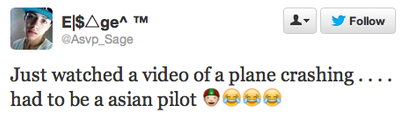
In case you were wondering if the racist “Asians can’t drive” stereotype was alive and well, here are some select tweets from the collection at Public Shaming (h/t to @Kevin_Stainback):

Screenshot_1 Screenshot_2 Screenshot_3Screenshot_5

And some couldn’t stop themselves from making fun of how some Asian people look:

Screenshot_1 Screenshot_2More, including accusations of North Korean terrorism, at Public Shaming, one of the most deeply disappointing sites on the web.

Lisa Wade, PhD is an Associate Professor at Tulane University. She is the author of American Hookup, a book about college sexual culture; a textbook about gender; and a forthcoming introductory text: Terrible Magnificent Sociology. You can follow her on Twitter and Instagram.
Cross-posted at Reports from the Economic Front.

Media and policy-makers seem anxious to convince us that the economy is in strong recovery mode, therefore, no further significant policy interventions are needed.

Their optimism appears to rest heavily on the recent acceleration in consumer spending.  After all, there are strong reasons for concern with the other major sources of growth:  government spending on all levels is being cut, exports face a weakening world economy, and business investment remains largely stagnate.

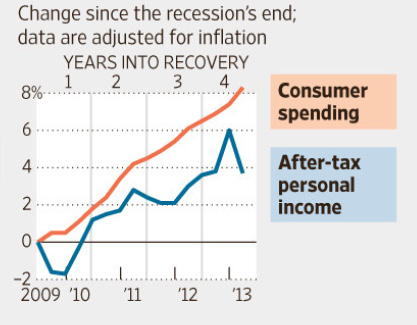
But there are also strong reasons to challenge this optimistic view of consumer spending as a growth engine.  The charts below, from a Wall Street Journal article, highlight some of the most important.

As we see below, while consumption spending is indeed accelerating, after tax personal income is falling.  In other words, there appears little reason to believe that there is a solid foundation for sustaining this trend.

1

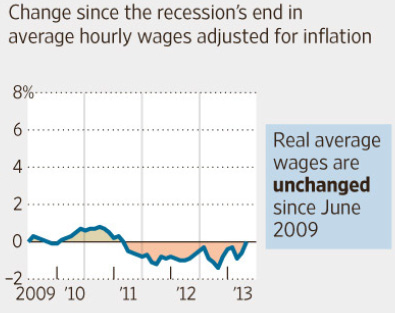
Additionally, after four years of recovery we still have 2.4 million fewer jobs than we had at the start of the recession.  Moreover, as we see below, there has been no real wage growth.  In fact, real average wages have fallen for most of the so-called expansionary period.

2

Yes, housing values are finally starting to rise and household debt payments as a share of after-tax income are declining.  But to a large extent the new burst in consumption spending has more to do with renewed borrowing than solid gains in job creation and income.

Unfortunately, there is little reason for us to have confidence that the economy is gathering strength in ways that will be sustainable or benefit the great majority of working people.

Martin Hart-Landsberg is a professor of economics at Lewis and Clark College. You can follow him at Reports from the Economic Front.

In May we featured a block of cheese that inspired quite the response.  Riffing off the name “Monterey Jack,” a company was selling “Monterey Jill”: the same old cheese, but reduced fat.  It was an excellent example of the way dieting is feminized.

People — myself included — were pretty stunned to see gendered cheese; who knew this was going to be a thing.  In fact, Liam sent us an example of gendered string cheese with the exact same theme: there’s string cheese animated by a male character and reduced-fat string cheese animated by a female character.  Also, they’re surfing; aaaaaand I have no analysis of that.

Screenshot_1Thanks for reminding the ladies to be worried about their waistlines cheese people!  It’s not as if we don’t get that message absolutely every time we turn around!

Lisa Wade, PhD is an Associate Professor at Tulane University. She is the author of American Hookup, a book about college sexual culture; a textbook about gender; and a forthcoming introductory text: Terrible Magnificent Sociology. You can follow her on Twitter and Instagram.
We celebrate education as the answer to almost all our economic problems.  At the same time we largely ignore the enormous debt students are forced to acquire gaining a college degree and the great difficulties they face in landing a job that makes it possible for them to pay off that debt.

The Student Debt Problem

Student debt, as the Bloomberg Businessweek figure below highlights, is big and fast growing.

BW27_correlations_605a

As the figure shows, the share of Americans that have graduated college has steadily grown to a current high of 32%.  And, student debt has exploded.  It now stands at approximately $1 trillion, significantly higher than credit card debt and home equity loans (which are loans secured by a second mortgage).  Student debt is now second only to housing debt.

And, as Businessweek also points out, the share of young graduates suffering from debt is also on the rise.  In 2003, only 25% of 25 year old graduates had student loans.  In 2012, it was 43%.  Moreover, “Over half of all student debt is held by households whose net worth is under $8500.”

The Employment Problem

Of course, debt is only one side of the problem.  Lack of good employment is the other.  As an Economic Policy Institute (EPI) report explains:

The Great Recession that began in December 2007 was so long and severe, and the government response so inadequate, that the crater it left in the labor market continues to be devastating for workers of all ages. . . . The weak labor market has been, and continues to be, very tough on young workers: At 16.2%, the March 2013 unemployment rate of workers under age 25 was slightly over twice as high as the national average. Though the labor market is now headed in the right direction, it is improving very slowly, and the prospects for young high school and college graduates remain dim.

The figure below, taken from the EPI report, highlights just how bad the labor market is for recent college graduates.  It shows that the underemployment rate for college graduates that are 21-24 years old and not pursuing additional education is still over 18%.

employment

The underemployment measure used includes those officially listed as unemployed as well as those “that either have a job but cannot attain the hours they need, or want a job but have given up looking for work.” This measure does not “include ‘skills/education–based’ underemployment (e.g., the young college graduate working as a barista).”  The report cites one study that estimates that in 2000, 40% of employed college graduates under the age of 25 worked at jobs that did not require a college degree.  That rose to 47% in 2007 and 53% in 2012.

earnings

The table above, also from the EPI report, gives some sense of the wage pressure that young college graduates face.  It shows that their real hourly wages have significantly declined since 2000.

The Economic Consequences

If you think rising debt and poor employment opportunities cannot end well for graduates and the economy, you are right.  A post from the Naked Capitalism blog makes that clear:

Now that student loans are undeniably in bubble territory, the officialdom is starting to wake up and take notice. Evidence that students were taking on so much debt as a group that it was undermining their ability to be Good American Consumers wasn’t enough. . . .Student debt is senior to all other consumer debt; unlike, say, credit card balances, Social Security payments can be garnished to pay delinquencies. As a result, it has contributed to the fall in the home ownership rate, since many young people who want to buy a house can’t because their level of student debt prevents them from getting a mortgage.

Student loan delinquencies are getting into nosebleed territory. The Wall Street Journal, citing New York Fed data, tells us that student debt outstanding increased 4.6% in the last quarter [third quarter 2012]. Repeat: in the last quarter. Annualized, that’s a 19.7% rate of increase during a period when other consumer borrowings were on the decline. And this growth is taking place while borrower distress is becoming acute. 11% of the loans were 90+ days delinquent, up from 8.9% at the close of last quarter. The underlying credit picture is certain to be worse, since many borrowers aren’t even required to service loans (as in they are still in school or have gotten a postponement, which is available to the unemployed for a short period). And it was the only type of consumer debt to show rising delinquency rates.

This is the new subprime: escalating borrowing taking place as loan quality is lousy and getting worse.

The following chart, from the Wall Street Journal, illustrates the trends noted above.

Falling Behind

If the situation wasn’t serious enough, because of a lack of Congressional action, the interest rate on new, subsidized Stafford loans—the loans that the federal government gives to college and university students with financial need—doubled on July 1, from 3.4% to 6.8%.  These loans account for more than a quarter of all new federal student loans.

It sure seems like we need to stop stressing individualistic solutions to our economic problems and start talking about making broader structural changes to our economic system.


Martin Hart-Landsberg is a professor of economics at Lewis and Clark College. You can follow him at Reports from the Economic Front.

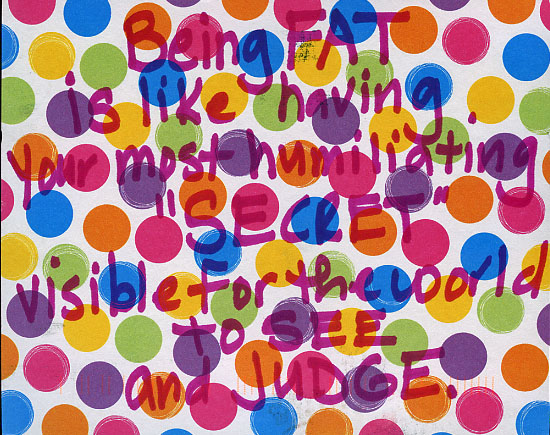
If this PostSecret confession doesn’t break your heart, you are a bad person.

fatjudge

Last week I chatted with the Canadian Broadcasting Company for a segment they’re doing on humor and power.  I used hateful jokes about fat people as an example of how patterns in comedy reveal our biases: who it is okay to revile, whose feelings we can dismiss, who we see as less-than-human.

I was surprised when the host said that some argue that pointing out people’s weight isn’t offensive because it’s “just a fact.”  I responded, “Sociologists don’t believe in that kind of fact.”  Two hundreds years ago being called fat would have been a compliment: it represented power, success, wealth, and (yes) health.  Today the meaning of fat has changed.  The word is now a weapon.  For the person who wrote this secret, fatness is not a fact; it’s a “humiliat[ion].”  This is what dehumanization feels like.

Whoever you are, I wish I could give your warm, comfy body a big giant hug.

Lisa Wade, PhD is an Associate Professor at Tulane University. She is the author of American Hookup, a book about college sexual culture; a textbook about gender; and a forthcoming introductory text: Terrible Magnificent Sociology. You can follow her on Twitter and Instagram.