Search results for The

Sociology represent!  Watch Kjerstin Gruys, UCLA sociology Ph.D. student, on The Colbert Report.  Her new book is called Mirror, Mirror Off the Wall: How I Learned to Love My Body By Not Looking at It.

See also a previous guest post where she answered the question, Can a Feminist Diet?

Lisa Wade, PhD is an Associate Professor at Tulane University. She is the author of American Hookup, a book about college sexual culture; a textbook about gender; and a forthcoming introductory text: Terrible Magnificent Sociology. You can follow her on Twitter and Instagram.

Paraphrasing Donald Rumsfeld, there are things we know and things we don’t know, and things we know we don’t know, and things we don’t know we don’t know.

One thing many working people in American don’t know that they don’t know is how poor our social benefits are compare with those enjoyed by workers in other countries.  No doubt one reason is the general media blackout about worker experiences in other countries.  A case in point: vacation benefits.

The Center for Economic and Policy Research recently completed a study of vacation benefits in advanced capitalist economies.  Here is what the authors found:

The United States is the only advanced economy in the world that does not guarantee its workers paid vacation. European countries establish legal rights to at least 20 days of paid vacation per year, with legal requirements of 25 and even 30 or more days in some countries. Australia and New Zealand both require employers to grant at least 20 vacation days per year; Canada and Japan mandate at least 10 paid days off. The gap between paid time off in the United States and the rest of the world is even larger if we include legally mandated paid holidays, where the United States offers none, but most of the rest of the world’s rich countries offer at least six paid holidays per year.

vacations

Even though paid vacations and holidays are not legally required in the United States, some employers do provide them to their workers. The table below shows the paid vacations and paid holidays offered in the U.S. private sector based on data from the 2012 National Compensation Survey.  The first two columns show the percentage of private sector workers that receive paid leave, vacation and holidays.  The next two columns show the average number of paid vacation and paid holidays provided to those employees that receive the relevant benefit.  The last two columns show the average number of paid vacation and paid holidays for all private sector workers, meaning those that receive and those that do not receive the relevant benefits.

US data

Thus, on average, private-sector workers in the United States receive ten days of paid vacation per year and six paid holidays.  This total still leaves U.S. workers last in the rankings even when compared with the legal minimums highlighted above.  And many employers in these other countries also offer more paid leave than legally required.

Moreover, several countries require additional paid leave for younger and older workers, additions that are also not included in the legal minimums highlighted above.  For example, “in Switzerland, workers under the age of 30 who do volunteer work with young people are entitled to an additional five days of annual leave. Norway offers an additional week of vacation to workers over the age of 60.”

And some countries provide additional leave for workers with difficult schedules.  For example, “Australia offers some shift workers an additional work week of leave. Austria offers workers with ‘heavy night work’ two to three extra days of leave, depending on how frequently they do this shift work, and an additional four days of leave after five years of shift work.”

Several countries offer additional paid leave for jury service, moving, getting married, or community or union work.  For example, “French law guarantees unpaid leave for community work, including nine work days for representing an association and six months for projects of ‘international solidarity’ abroad and leave with partial salary for ‘individual training’ that is less than one year. Sweden requires employers to provide paid leave for workers fulfilling union duties.”

Austria, Belgium, Denmark, Greece, and Sweden even require employers to pay workers at a premium rate while they are on vacation.

There is more to say, but the point should be clear.  Ignorance of experiences elsewhere has narrowed our own sense of possibilities.

Martin Hart-Landsberg is a professor of economics at Lewis and Clark College. You can follow him at Reports from the Economic Front.

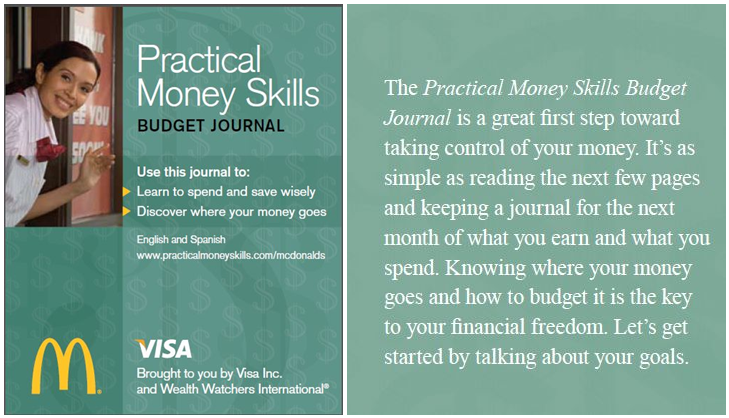
McDonald’s has distributed a pamphlet showing employees how to make a budget and stick to it.  As you can see, the pamphlet is a joint effort by McDonald’s, VISA, and (apparently said with a straight face), Wealth Watchers International.  The “key to your financial freedom,” they say, is keeping a budget journal.

Screenshot_1

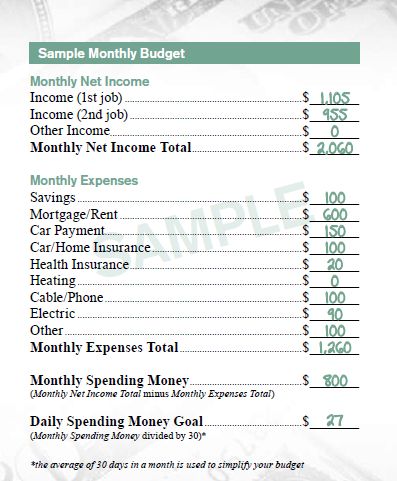
Here’s the sample budget McDonald’s uses:

Budget 1 pg

The budget is encouraging, to say the least.  With an income of $2060 a month, a 2-earner family can save $100 each month.

But do you notice anything missing?  Food, for example. Presumably, that comes out of the $27 a day in spending money.  Transportation costs? Car payments are included, but not gasoline or upkeep. On an income of $24,000 a year, will this family have a car that needs no maintenance?  And if the two earners have only one car, it’s likely someone will have to take public transportation to work.  Oh, wait  – maybe they both work at the same McDonald’s. And they never buy clothes.

I’m not sure how McDonald’s employees get health insurance for $20.  Or home heating for free.

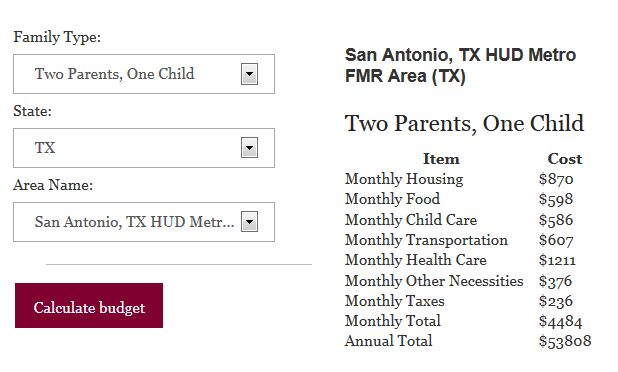
I compared this budget with those found at the The Economic Policy Institute, which has a “Family Budget Calculator.”  You enter the location and the number of adults and children, and it shows the budget for “a secure yet modest living standard.”  Since McDonald’s used a 2-earner family, I imagined a family with two adults and one child.  Here’s what they would need in San Antonio.

Budget SanAntonio

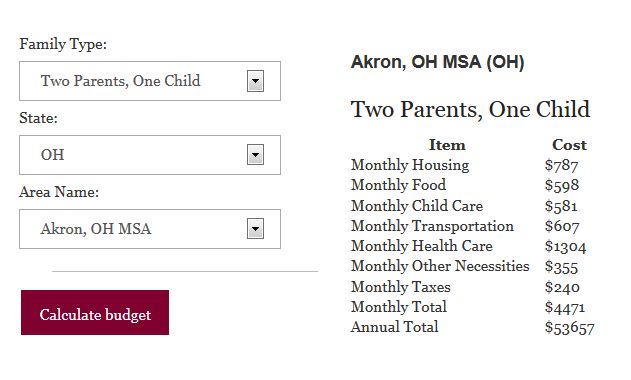
Here’s a northern city, Akron.

Budget Akron

Both cities require a monthly income of $4400 for a modest living, more than double what McDonald’s envisions for its employees.  The big difference is health care – $1200 a month is a lot more than $20.  Then comes transportation ($600 vs. $0).  Then there’s the $580 for childcare, an item that is also absent from the McDonald’s budget.  (Apparently, workers at Golden Arches are part of that low-fertility problem that some observers in the Wall Street Journal worry about – here for example).

As for daily spending, food alone, at $600, more than wipes out what the McDonald’s budget suggests. Perhaps McDonald’s assumes that the family eats most of their meals on site, taking advantage of the 50% employee discount.

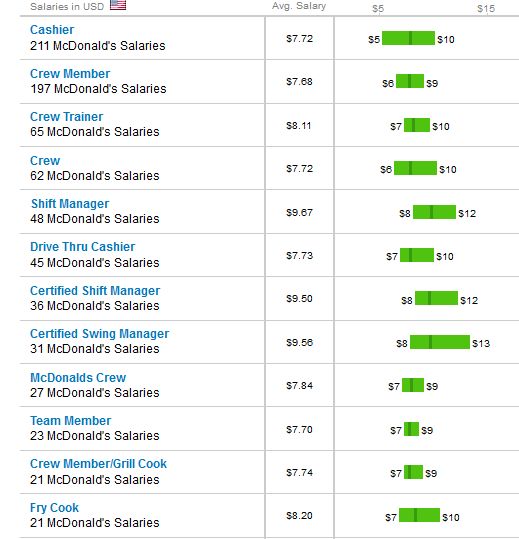
So much for the spending part of the McDonald’s budget.  What about the income part?  The Glass Door  posted these pay ranges for various positions.

Budget wages

Workers might get as little as $6 or even $5 per hour.  The average seems closer to $7.  Fast food is not covered by federal minimum wage, but let’s use that $7.25 as a default estimate.  A forty-hour week, four weeks a month, comes in at $1160 – very close to the $1105 in the McDonald’s sample budget. So that side of the balance sheet is fairly realistic.

That annual income of just under $24,720 is above the official poverty line – $19,530 – but not by all that much.  Given the omissions in the expense column, I would think that a family would find it very hard to live on that little.  And I doubt they could sock away $100 in savings, no matter how much “journaling” they did.

Cross-posted at Montclair SocioBlog.

Jay Livingston is the chair of the Sociology Department at Montclair State University. You can follow him at Montclair SocioBlog or on Twitter.

The world’s first flight attendant was a man. He was a German named Heinrich Kubis and he was a steward on LZ-10 Schwaben zeppelin, a rigid blimp like aircraft that began ferrying passengers in 1912.  Here’s Kubis at work:

1

The first flight attendant to serve on an airplane was a 14-year-old boy named Jack Sanderson. It was 1922 and he was hired by The Daimler Airway (later part of British Airways):

1

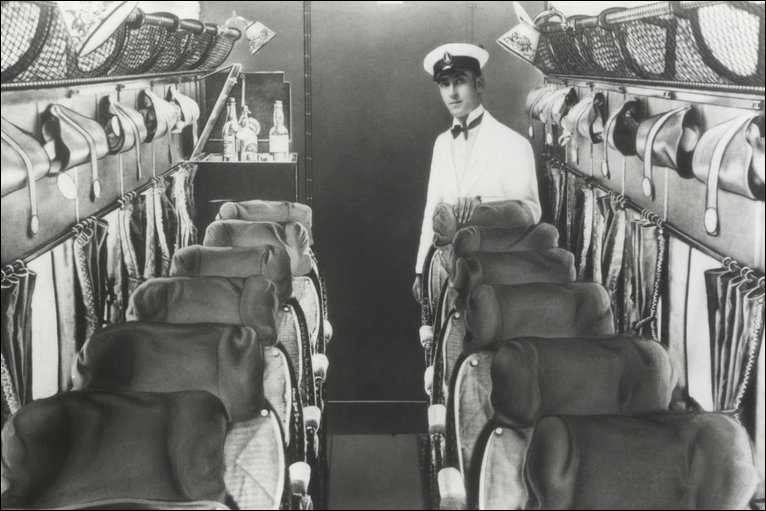
When commercial airlines took to the sky in the U.S., it was with an all-male staff.  A 19-year-old Cuban American named Amaury Sanchez was the steward for Pan American’s inaugural flight in 1928.  Pan Am maintained an all-male steward workforce for 16 years.

Unnamed steward, 1920s (source):

2

Like Kubis’ suit and bow tie, Sanderson’s military-style jacket, and our anonymous steward’s white coat reveal, the steward role was taken very seriously: they played an important role in an elite world.  This would change with the democratization of air travel and the introduction of the female flight attendant during World War II.  By the ’50s, many airlines would only hire women and the occupation would become increasingly feminized and trivialized, just like the once all-male activity of cheerleading.

Lisa Wade, PhD is an Associate Professor at Tulane University. She is the author of American Hookup, a book about college sexual culture; a textbook about gender; and a forthcoming introductory text: Terrible Magnificent Sociology. You can follow her on Twitter and Instagram.

New research is discovering that the “ambient environment,” the passive context in which activities and decisions occur, can have a big impact.  In a paper by psychologist Sapna Cheryan and three colleagues, they recount how the ambient environment affected men’s and women’s interest in majoring in computer science and their sense that they were capable of doing so.

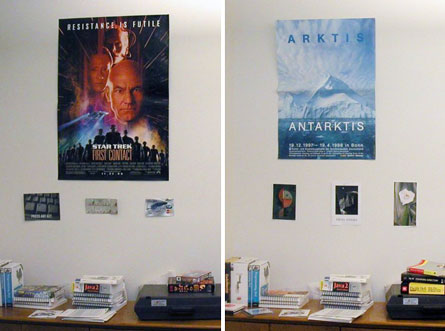
To test this, they invited some of the respondents into a neutral room, while others entered a room covered in “computer geeky” things: a Star Trek poster, comic books, video game boxes, empty soda cans and junk food, technical magazines, and computer software and hardware.   (Don’t kill the messenger; these were items that other college students had agreed were typical of a “computer science geek.”)

1
Photo credit: Sapna Cheryan, via Lisa Grossman at Like a Radio Telescope.

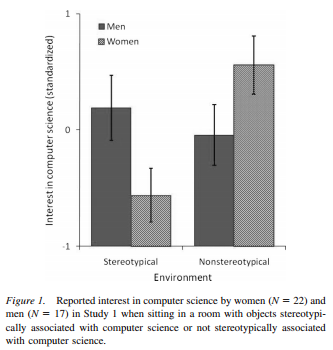
Cheryan and colleagues found that men (the dark bars in the graph below) were unfazed by the geekery (they were slightly more likely to be interested if the environment was stereotypical, but the difference is within the margin of error). Women who encountered the geeked up room, however, were much less likely to say that they were considering a computer science major (the light bars).

Screenshot_1

This research is a great example of the ubiquitousness of the cues that tell us what types of interests, careers, hobbies, and activities are appropriate to us.  Our ambient environment is rich with information about whether we belong.  And that stuff matters.

Source: Cheryan, Sapna, Victoria Plaut, Paul Davies, and Claude Steele. 2009. Ambient Belonging: How Stereotypical Cues Impact Gender Participation in Computer Science. Journal of Personality and Social Psychology 97, 6: 1045-1060.

Lisa Wade, PhD is an Associate Professor at Tulane University. She is the author of American Hookup, a book about college sexual culture; a textbook about gender; and a forthcoming introductory text: Terrible Magnificent Sociology. You can follow her on Twitter and Instagram.
Cross-posted at Reports from the Economic Front.

Wealth data is not easy to get.  Still for three years now, Credit Suisse Research Institute has published an annual Global Wealth Databook which attempts to estimate global wealth holdings.  The most recent issue includes data covering 2012.  According to Credit Suisse, the goal “is to provide the best available estimates of the wealth holdings of households around the world for the period since the year 2000.”

According to the publication, global household wealth was $222.7 trillion in mid-2012, equal to $48,500 for each of the 4.6 billion adults in the world.  Wealth is defined as “the marketable value of financial assets plus non-financial assets (principally housing and land) less debts.”

Not surprisingly, as the figure below shows, average global wealth varies considerably across countries and regions.

picture wealth

Also significant are the values of the mean vs the median wealth in each of the countries.  Mean or average wealth is calculated by dividing the total wealth of a country by its adult population.   Median wealth is the wealth holdings of the adult in the middle of the wealth distribution. The median is generally considered a far more reliable indicator of wealth because it is less sensitive to extremes at the top or bottom of the distribution.  The greater the divergence of mean and median wealth, the greater is the wealth inequality.

The table below provides mean and median wealth estimates for those countries with generally reliable data. As you can see, the U.S. ranks high in terms of mean wealth, trailing only 5 countries.  Things are quite different when it comes to median wealth; the U.S. trails 26 countries!  Not surprisingly, then, the U.S. is No. 1 when it comes to the mean/median wealth ratio, or wealth inequality.

global wealth

We clearly dominate in the number of millionaires and the upper global wealth categories.  Are we a wealthy country? Definitely.  Is that wealth concentrated in relatively few hands?  Definitely.

Martin Hart-Landsberg is a professor of economics at Lewis and Clark College. You can follow him at Reports from the Economic Front.

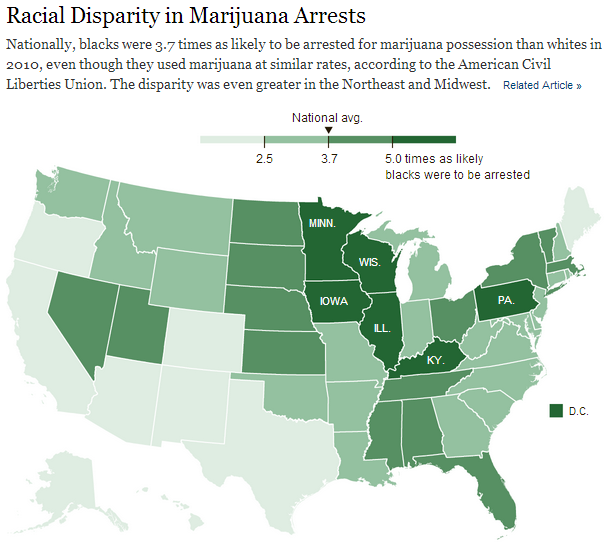
Black Americans are 3.7 times more likely than Whites to be arrested for marijuana possession, despite having equivalent use rates.  It’s a war on what again?

Screenshot_2New York Times, via Gin and Tacos, one of my favorite blogs.

Cross-posted at Racialicious.

Lisa Wade, PhD is an Associate Professor at Tulane University. She is the author of American Hookup, a book about college sexual culture; a textbook about gender; and a forthcoming introductory text: Terrible Magnificent Sociology. You can follow her on Twitter and Instagram.
Screenshot_1When white Americans are in trouble, they rarely hesitate to call the police. That’s because most of them trust the police. They rarely realize the significance during encounters with the police of their own protective “white” skin.

Many white folks also have trouble understanding the deep distrust of the police in other racialized communities. That’s because they fail to realize how quick many police officers are to harass non-white people, and how much less they tend to value non-white lives.

White Americans should listen, with sincerity and respect, to the reported experiences of others with the entrenched racist attitudes among the police, and the rampant abuse such attitudes inspire. They should also listen to the corrosive effects on non-white communities of the relative impunity with which police repeatedly harass, and murder, non-white people.

In the following short film, Stacey Muhammad’s “I AM SEAN BELL, black boys speak,” black Americans effectively explain their reasoned fear, distrust, and dismay regarding the police. I think that for starters, this film is perfect discussion material for all American classrooms. And any other gatherings that include white eyes and ears.

See a complementary post, featuring a great clip from Michael Moore, at Stuff White People Do here.

[h/t: Kai @ Zuky]

Originally posted in 2009. Re-posted in solidarity with the African American community; regardless of the truth of the Martin/Zimmerman confrontation, it’s hard not to interpret the finding of not-guilty as anything but a continuance of the criminal justice system’s failure to ensure justice for young Black men.

—————————

About himself, Macon writes, “I’m a white guy, trying to find out what that means. Especially the ‘white’ part. I live in that heart of the heart of American whiteness, the ever-amorphous ‘Midwest.'”  Macon’s blog, Stuff White People Do, is an excellent source of insights about race and racism.