Search results for The

Today students across the country are walking out of school to protest violence and demand gun control reform. Where do Americans stand on this issue, and have their views changed over time? Government policy makes it difficult to research gun violence in the United States, but we do have some trend data from the General Social Survey that offers important context about how Americans view this issue.

For over forty years, the GSS has been asking its respondents whether they “favor or oppose a law which would require a person to obtain a police permit before he or she could buy a gun”—a simple measure to take the temperature on basic support for gun control. Compared to other controversial social policies, there is actually widespread and consistent support for this kind of gun control.

(Click to Enlarge)

In light of the Second Amendment, however, the U.S. has a reputation for having a strong pro-gun culture. Is this true? It turns out there has been a dramatic shift in the proportion of respondents who report even having a gun in their homes. Despite this trend, gun sales are still high, suggesting that those sales are concentrated among people who already own a gun.
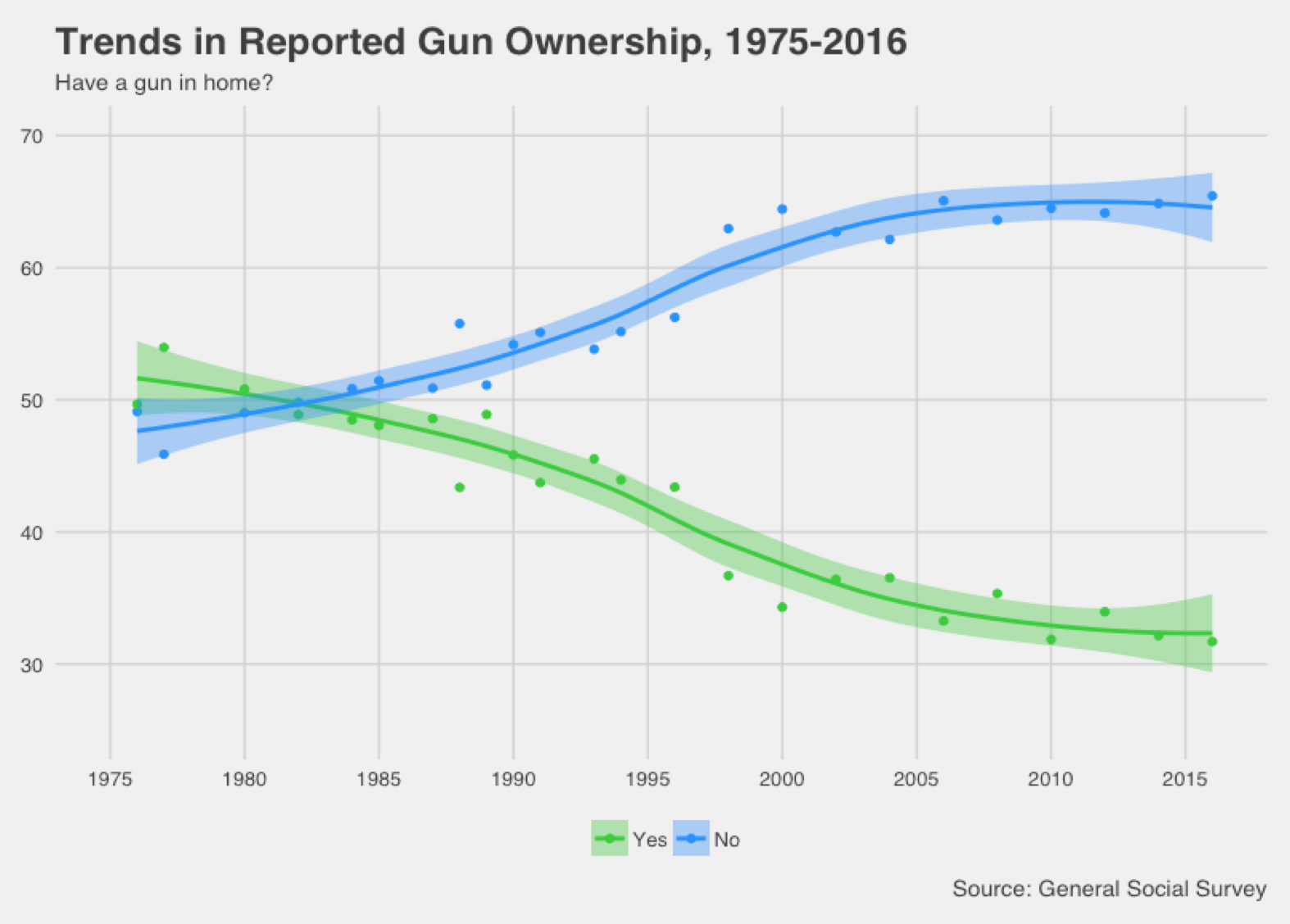
(Click to Enlarge)

Recent controversies over gun control can make it seem like the nation is deeply and evenly divided. These data provide an important reminder that gun control is actually pretty popular, even though views on the issue have become more politically polarized over time.

Inspired by demographic facts you should know cold, “What’s Trending?” is a post series at Sociological Images featuring quick looks at what’s up, what’s down, and what sociologists have to say about it.

Ryan Larson is a graduate student from the Department of Sociology, University of Minnesota – Twin Cities. He studies crime, punishment, and quantitative methodology. He is a member of the Graduate Editorial Board of The Society Pages, and his work has appeared in Poetics, Contexts, and Sociological Perspectives.

Evan Stewart is a Ph.D. candidate in sociology at the University of Minnesota. You can follow him on Twitter.
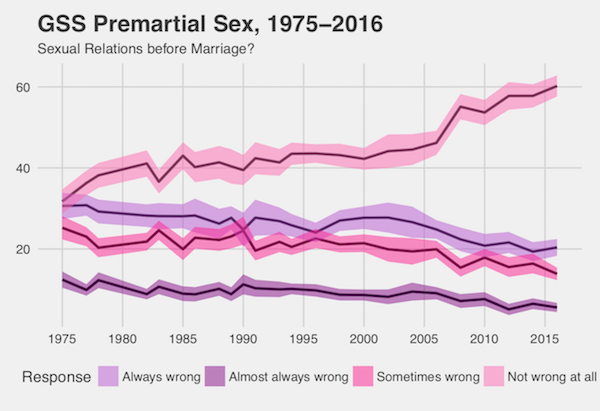
Valentine’s Day is upon us, but in a world of hookups and breakups many people are concerned about the state of romance. Where do Americans actually stand on sex and relationships? We took a look at some trends from the General Social Survey. They highlight an important point: while Americans are more accepting of things like divorce and premarital sex, that doesn’t necessarily mean that both are running rampant in society.

For example, since the mid 1970s, Americans have become much more accepting of sex before marriage. Today more than half of respondents say it isn’t wrong at all.

However, these attitudes don’t necessarily mean people are having more sex. Younger Americans today actually report having no sexual partners more frequently than people of the same age in earlier surveys.

And what about marriage? Americans are more accepting of divorce now, with more saying a divorce should be easier to obtain.

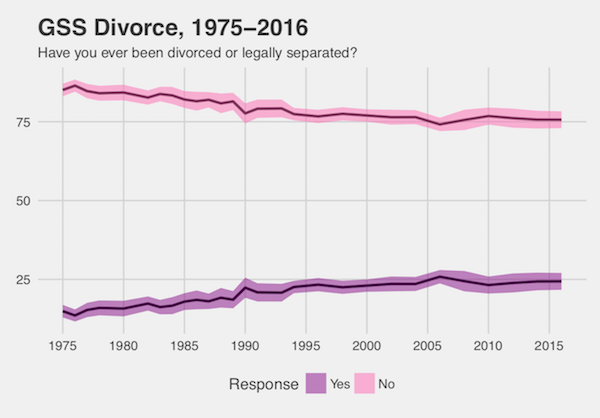
But again, this doesn’t necessarily mean everyone is flying the coop. While self-reported divorce rates had been on the rise since the mid 1970s, they have largely leveled off in recent years.

It is important to remember that for core social practices like love and marriage, we are extra susceptible to moral panics when faced with social change. These trends show how changes in attitudes don’t always line up with changes in behavior, and they remind us that sometimes we can save the drama for the rom-coms.

Inspired by demographic facts you should know cold, “What’s Trending?” is a post series at Sociological Images featuring quick looks at what’s up, what’s down, and what sociologists have to say about it.

Ryan Larson is a graduate student from the Department of Sociology, University of Minnesota – Twin Cities. He studies crime, punishment, and quantitative methodology. He is a member of the Graduate Editorial Board of The Society Pages, and his work has appeared in Poetics, Contexts, and Sociological Perspectives.

Evan Stewart is a Ph.D. candidate in sociology at the University of Minnesota. You can follow him on Twitter.

That large (and largely trademarked) sporting event is this weekend. In honor of its reputation for massive advertising, Lisa Wade tipped me off about this interesting content analysis of last year’s event by the Media Education Foundation.

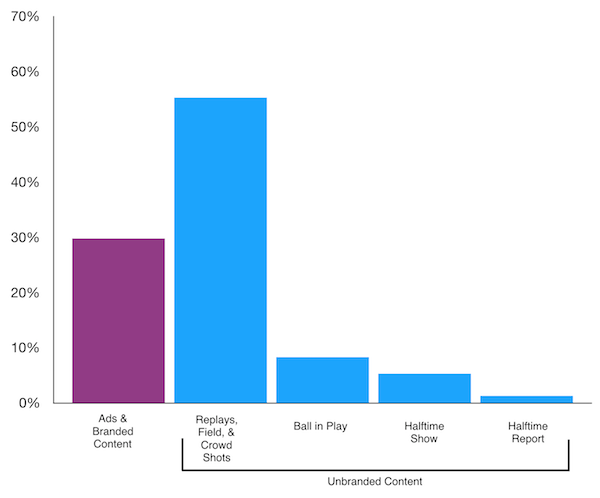
MEF watched last year’s big game and tallied just how much time was devoted to playing and how much was devoted to ads and other branded content during the game. According to their data, the ball was only in play “for a mere 18 minutes and 43 seconds, or roughly 8% of the entire broadcast.”

MEF used a pie chart to illustrate their findings, but readers can get better information from comparing different heights instead of different angles. Using their data, I quickly made this chart to more easily compare branded and non-branded content.

Data Source: Media Education Foundation, 2018

One surprising thing that jumps out of this data is that, for all the hubbub about commercials, far and away the most time is devoted to replays, shots of the crowd, and shots of the field without the ball in play. We know “the big game” is a big sell, but it is interesting to see how the thing it sells the most is the spectacle of the event itself.

Evan Stewart is an assistant professor of sociology at University of Massachusetts Boston. You can follow his work at his website, or on BlueSky.

During a year marked by social and political turmoil, the media has found itself under scrutiny from politicians, academics, the general public, and increasingly self-reflexive journalists and editors. Fake news has entered our lexicon both as a form of political meddling from foreign powers and a dismissive insult directed towards any less-than-complimentary news coverage of the current administration.

Paying attention to where people are getting their news and what that news is telling them is an important step to understanding our increasingly polarized society and our seeming inability to talk across political divides. The insight can also help us get at those important and oh-too common questions of “how could they think that?!?” or “how could they support that politician?!?”

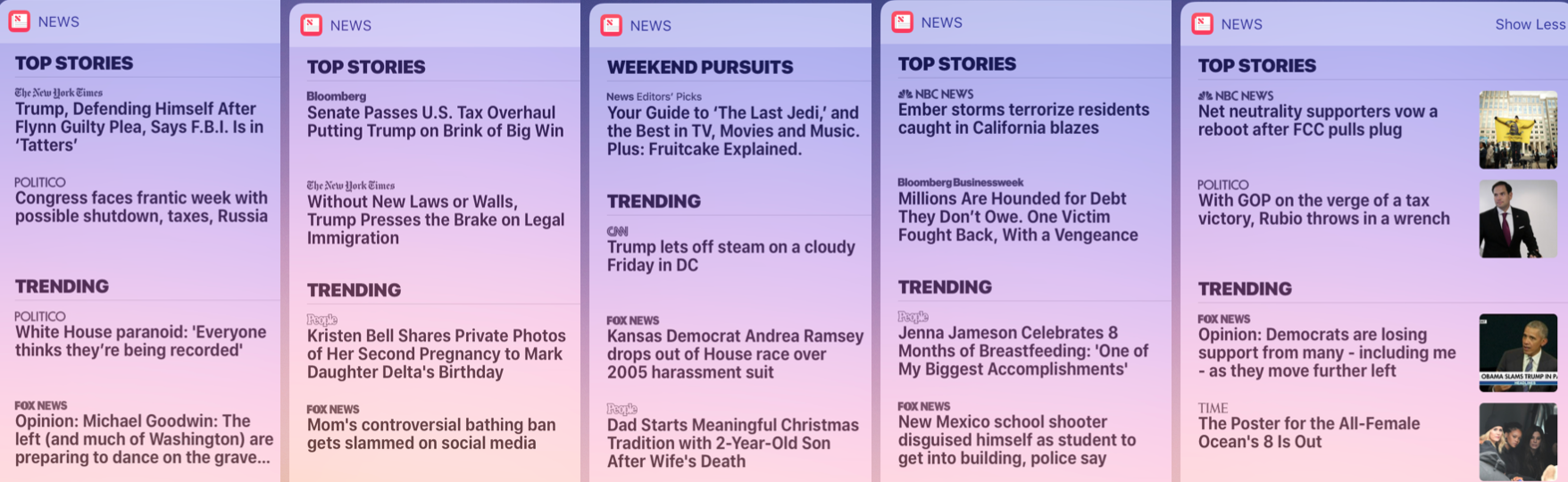
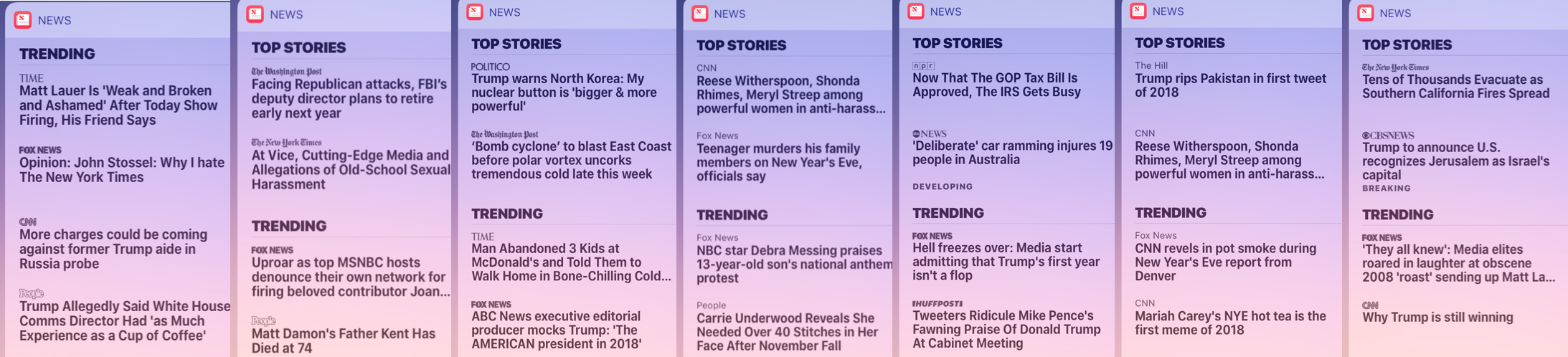
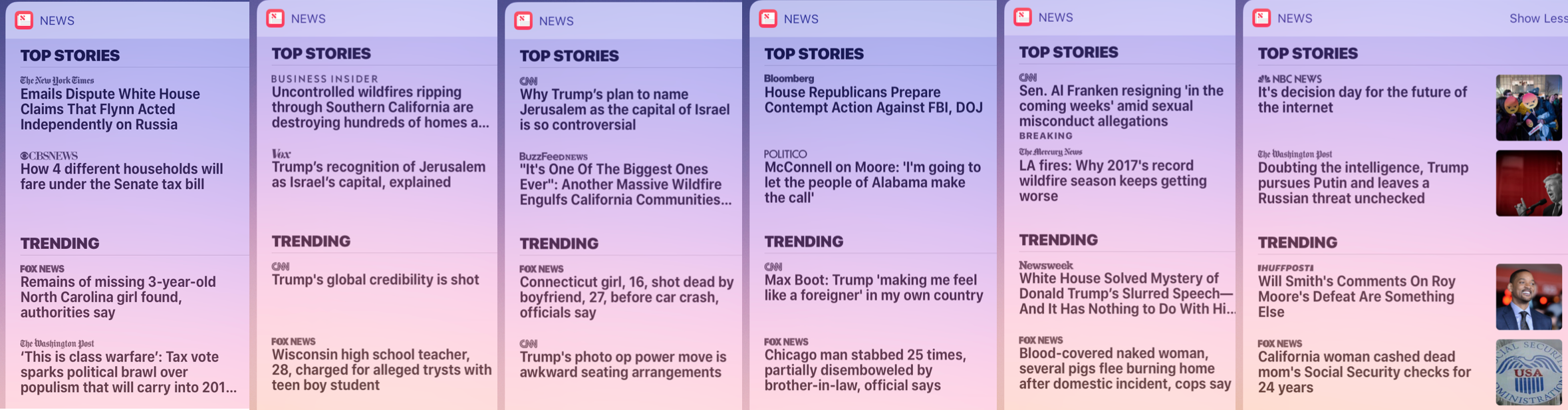
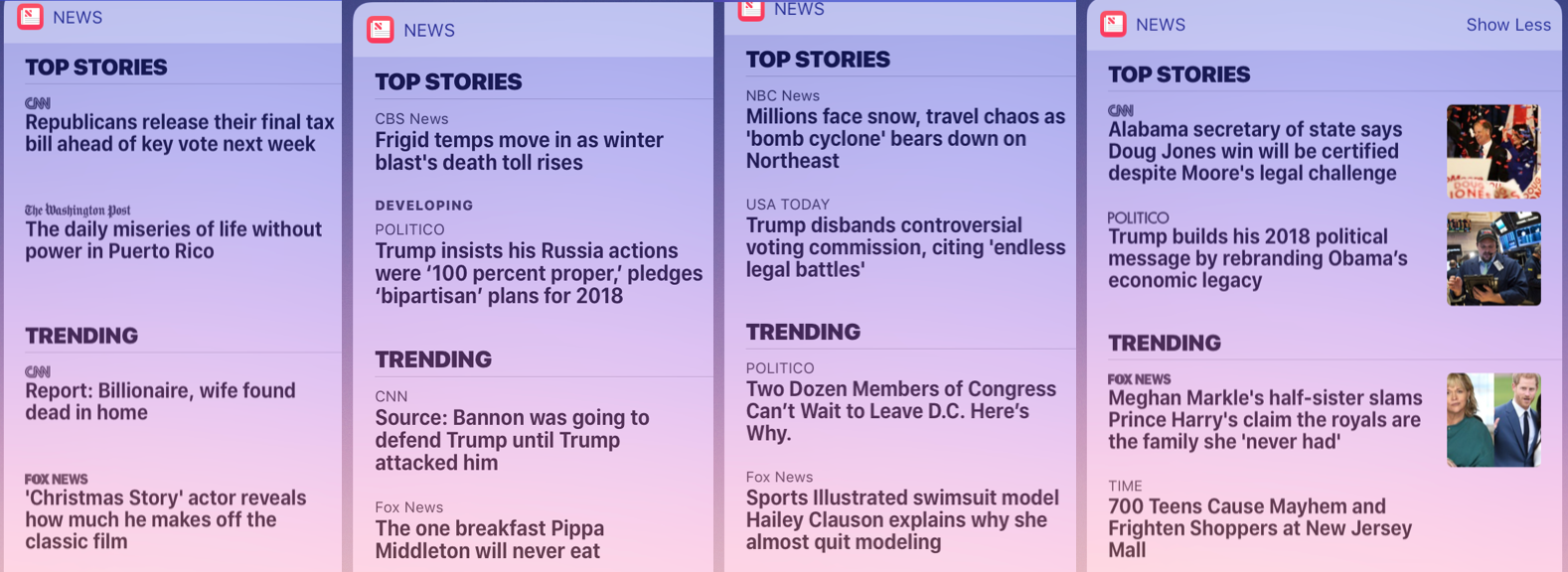
My interest in this topic was sparked a few months ago when I began paying attention to the top four stories and single video that magically appear whenever I swipe left on my iPhone. The stories compiled by the Apple News App provide a snapshot of what the dominant media sources consider the newsworthy happenings of the day. After paying an almost obsessive attention to my newsfeed for a few weeks—and increasingly annoying my friends and colleagues by telling them about the compelling patterns I was seeing—I started to take screenshots of the suggested news stories on a daily or twice daily basis. The images below were gathered over the past two months.

It is worth noting that the Apple News App adapts to a user’s interests to ensure that it provides “the stories you really care about.” To minimize this complicating factor I avoided clicking on any of the suggested stories and would occasionally verify that my news feed had remained neutral through comparing the stories with other iPhone users whenever possible.

Some of the differences were to be expected—People simply cannot get enough of celebrity pregnancies and royal weddings. The Washington Post, The New York Times, and CNN frequently feature stories that are critical of the current administration, and Fox News is generally supportive of President Trump and antagonistic towards enemies of the Republican Party.

(Click to Enlarge)

However, there are two trends that I would like to highlight:

1) A significant number of Fox News headlines offer direct critiques of other media sites and their coverage of key news stories. Rather than offering an alternative reading of an event or counter-coverage, the feature story undercuts the journalistic work of other news sources through highlighting errors and making accusations of partisanship motivations. In some cases, this even takes the form of attacking left-leaning celebrities as proxy to a larger movement or idea. Neither of these tactics were employed by any of the other news sources during my observation period.

(Click to Enlarge)

2) Fox News often featured coverage of vile, treacherous, or criminal acts committed by individuals as well as horrifying accidents. This type of story stood out both due to the high frequency and the juxtaposition to coverage of important political events of the time—murderous pigs next to Senate resignations and sexually predatory high school teachers next to massively destructive California wildfires. In a sense, Fox News is effectively cultivating an “asociological” imagination by shifting attention to the individual rather than larger political processes and structural changes. In addition, the repetitious coverage of the evil and devious certainly contributes to a fear-based society and confirms the general loss of morality and decline of conservative values.

(Click to Enlarge)

It is worth noting that this move away from the big stories of the day also occurs through a surprising amount of celebrity coverage.

(Click to Enlarge)

From the screen captures I have gathered over the past two months, it seems apparent that we are not just consuming different interpretations of the same event, but rather we are hearing different stories altogether. This effectively makes the conversation across political affiliation (or more importantly, news source affiliation) that much more difficult if not impossible.

I recommend taking time to look through the images that I have provided on your own. There are a number of patterns I did not discuss in this piece for the sake of brevity and even more to be discovered. And, for those of us who spend our time in the front of the classroom, the screenshot approach could provide the basis for a great teaching activity where the class collectively takes part in both the gathering of data and conducting the analysis. 

Kyle Green is an Assistant Professor of Sociology at The College at Brockport, State University of New York. He is a proud TSP alumnus and the co-author /co-host of Give Methods a Chance.

Over the last few weeks, commentary about alleged sexual predator Roy Moore’s failure to secure a seat in the U.S. Senate has flooded our news and social media feeds, shining a spotlight on the critical role of Black women in the election. About 98% of Black women, comprising 17% of total voters, cast their ballots for Moore’s opponent Doug Jones, ensuring Jones’s victory. At the same time, commentators questioned the role of White women in supporting Moore. Sources estimate that 63% of White women voted for Moore, including the majority of college-educated White women.

Vogue proclaimed, “Doug Jones Won, but White Women Lost.” U.S. News and World Reports asked, “Why do so many White women vote for misogynists?” Feminist blog Jezebel announced succinctly: “White women keep fucking us over.” Fair enough. But we have to ask, “What about Black and White men?” The fact that 48% of Alabama’s voting population is absent from these conversations is not accidental. It’s part of an incomplete narrative that focuses solely on the impact of women voters and continues the false narrative that fixing inequality is solely their burden.

Let’s focus first on Black men. Exit poll data indicate that 93% of Black men voted for Jones, and they accounted for 11% of the total vote. Bluntly put, Jones could not have secured his razor-thin victory without their votes. Yet, media commentary about their specific role in the election is typically obscured. Several articles note the general turnout of Black voters without explicitly highlighting the contribution of Black men. Other articles focus on the role of Black women exclusively. In a Newsweek article proclaiming Black women “Saved America,” Black men receive not a single mention. In addition to erasing a key contribution, this incomplete account of Jones’s victory masks concerns about minority voter suppression and the Democratic party taking Black votes for granted.

White men comprised 35% of total voters in this election, and 72% of them voted for Moore. But detailed commentary on their overwhelming support for Moore – a man who said that Muslims shouldn’t serve in Congress, that America was “great” during the time of slavery, and was accused of harassing and/or assaulting at least nine women in their teens while in his thirties – is frankly rare. The scant mentions in popular media may best be summed up as: “We expect nothing more from White men.”

As social scientists, we know that expectations matter. A large body of work indicates that negative stereotypes of Black boys and men are linked to deleterious outcomes in education, crime, and health. Within our academic communities we sagely nod our heads and agree we should change our expectations of Black boys and men to ensure better outcomes. But this logic of high expectations is rarely applied to White men. The work of Jackson Katz is an important exception. He, and a handful of others have, for years, pointed out that gender-blind conversations about violence perpetrated by men, primarily against women – in families, in romantic relationships, and on college campuses – serve only to perpetuate this violence by making its prevention a woman’s problem.

The parallels to politics in this case are too great to ignore. It’s not enough for the media to note that voting trends for the Alabama senate election were inherently racist and sexist. Pointing out that Black women were critically important in determining election outcomes, and that most White women continued to engage in the “patriarchal bargain” by voting for Moore is a good start, but not sufficient. Accurate coverage would offer thorough examinations of the responsibility of all key players – in this case the positive contributions of Black men, and the negative contributions of White men. Otherwise, coverage risks downplaying White men’s role in supporting public officials who are openly or covertly racist or sexist. This perpetuates a social structure that privileges White men above all others and then consistently fails to hold them responsible for their actions. We can, and must, do better.

Mairead Eastin Moloney is an Assistant Professor of Sociology at the University of Kentucky. 

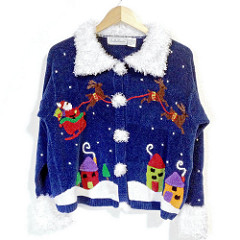
National Ugly Christmas Sweater Day is this Friday, December 15th. Perhaps you’ve noticed the recent ascent of the Ugly Christmas Sweater or even been invited to an Ugly Christmas Sweater Party. How do we account for this trend and its call to “don we now our tacky apparel”?

Total search of term “ugly Christmas sweater” relative to other searches over time (c/o Google Trends):

Ugly Christmas Sweater parties purportedly originated in Vancouver, Canada, in 2001. Their appeal might seem to stem from their role as a vehicle for ironic nostalgia, an opportunity to revel in all that is festively cheesy. It also might provide an opportunity to express the collective effervescence of the well-intentioned (but hopelessly tacky) holiday apparel from moms and grandmas.

However, The Atlantic points to a more complex reason why we might enjoy the cheesy simplicity offered by Ugly Christmas Sweaters: “If there is a war on Christmas, then the Ugly Christmas Sweater, awesome in its terribleness, is a blissfully demilitarized zone.” This observation pokes fun at the Fox News-style hysterics regarding the “War on Christmas”; despite being commonly called Ugly Christmas Sweaters, the notion seems to persist that their celebration is an inclusive and “safe” one.

Photo Credit: TheUglySweaterShop, Flickr CC

We might also consider the generally fraught nature of the holidays (which are financially and emotionally taxing for many), suggesting that the Ugly Sweater could offer an escape from individual holiday stress. There is no shortage of sociologists who can speak to the strain of family, consumerism, and mental health issues that plague the holidays, to say nothing of the particular gendered burdens they produce. Perhaps these parties represent an opportunity to shelve those tensions.

But how do we explain the fervent communal desire for simultaneous festive celebration and escape? Fred Davis notes that nostalgia is invoked during periods of discontinuity. This can occur at the individual level when we use nostalgia to “reassure ourselves of past happiness.” It may also function as a collective response – a “nostalgia orgy”- whereby we collaboratively reassure ourselves of shared past happiness through cultural symbols. The Ugly Christmas Sweater becomes a freighted symbol of past misguided, but genuine, familial affection and unselfconscious enthusiasm for the holidays – it doesn’t matter that we have not all really had the actual experience of receiving such a garment.

Jean Baudrillard might call the process of mythologizing the Ugly Christmas Sweater a simulation, a collapsing between reality and representation. And, as George Ritzer points out, simulation can become a ripe target for corporatization as it can be made more spectacular than its authentic counterparts. We need only look at the shift from the “authentic” prerogative to root through one’s closet for an ugly sweater bestowed by grandma (or even to retrieve from the thrift store a sweater imparted by someone else’s grandma) to the cottage-industry that has sprung up to provide ugly sweaters to the masses. There appears to be a need for collective nostalgia that is outstripped by the supply of “actual” Ugly Christmas Sweaters that we have at our disposal.

Colin Campbell states that consumption involves not just purchasing or using a good or service, but also selecting and enhancing it. Accordingly, our consumptive obligation to the Ugly Christmas Sweater becomes more demanding, individualized and, as Ritzer predicts, spectacular. For examples, we can view this intensive guide for DIY ugly sweaters. If DIY isn’t your style, you can indulge your individual (but mass-produced) tastes in NBA-inspired or cultural mash-up Ugly Christmas Sweaters, or these Ugly Christmas Sweaters that aren’t even sweaters at all.

The ironic appeal of the Ugly Christmas Sweater Party is that one can be deemed festive for partaking, while simultaneously ensuring that one is participating in a “safe” celebration – or even a gentle mockery – of holiday saturation and demands. The ascent of the Ugly Christmas Sweater has involved a transition from ironic nostalgia vehicle to a corporatized form of escapism, one that we are induced to participate in as a “safe” form of  festive simulation that becomes increasingly individualized and demanding in expression.

Re-posted at Pacific Standard.

Kerri Scheer is a PhD Student working in law and regulation in the Department of Sociology at the University of Toronto. She thanks her colleague Allison Meads for insights and edits on this post. You can follow Kerri on Twitter.

From Pizzagate to more plausible stories of palace intrigue, U.S. politics has more than a whiff of conspiracy in the air these days. In sorting fact from fiction, why do some people end up believing conspiracy theories? Social science research shows that we shouldn’t think about these beliefs like delusions, because the choice to buy in stems from real structural and psychological conditions that can affect us all.

For example, research in political science shows that people who know a lot about politics, but also show low levels of generalized trust, are more likely to believe conspiracy theories. It isn’t just partisan, either, both liberals and conservatives are equally likely to believe conspiracy theories—just different ones.

In sociology, research also shows how bigger structural factors elevate conspiracy concern. In an article published in Socius earlier this year, Joseph DiGrazia examined Google search trends for two major conspiracy theories between 2007 and 2014: inquiries about the Illuminati and concern about President Obama’s birth and citizenship.

DiGrazia looked at the state-level factors that had the strongest and most consistent relationships with search frequency: partisanship and employment. States with higher unemployment rates had higher search rates about the Illuminati, and more Republican states had higher searches for both conspiracies throughout the Obama administration.

These studies show it isn’t correct to treat conspiracy beliefs as simply absurd or irrational—they flare up among reasonably informed people who have lower trust in institutions, often when they feel powerless in the face of structural changes across politics and the economy.

Evan Stewart is an assistant professor of sociology at University of Massachusetts Boston. You can follow his work at his website, or on BlueSky.

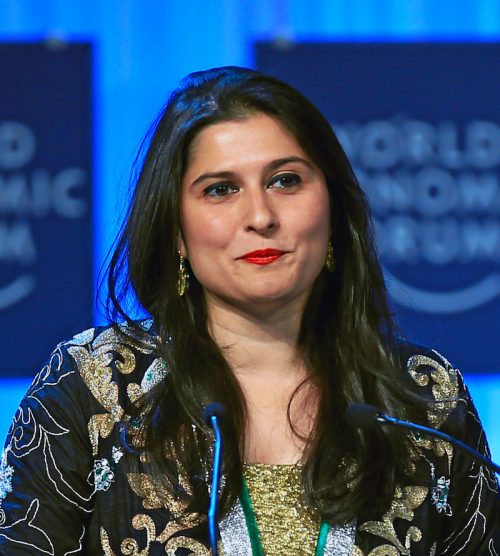
All hell broke loose online in Pakistan this winter after their first Oscar winner, Sharmeen Obaid, tweeted a complaint against a doctor who sent an unsolicited friendship request on Facebook to her sister following an E.R. visit. Sharmeen’s tweet provoked a firestorm of debate amongst Pakistani social media users, who shared a picture of Sharmeen posing with American film producer Harvey Weinstein “as proof” of Sharmeen’s double standards on sexual harassment.

Sharmeen Obaid, World Economic Forum (via Wikimedia Commons)

Sharmeen is not the first Pakistani to incite calls to violence by going public about abuse. Member of Parliament Ayesha Gulalai received severe and terrifying censure from social media trolls for her public accusations of sexual harassment against former-cricketer-turned-politician Imran Khan. Similar critiques have also been used against Malala Yusufzai, Pakistan’s only woman Nobel laureate, when social media users suggested that photographs of her at Oxford University wearing a bomber jacket and jeans, under a modest headscarf, looked just like porn actress Mia Khalifa.

These issues are not limited to Pakistan alone, of course. Digital harassment has been a prominent issue in the United States as well, and the tactics trolls use to challenge women who speak out about harassment are strikingly similar in both countries. Trolls in both contexts deploy words like “feminazi,” or “man-hater,” accusing women of “exaggerating,” “attention-seeking,” or of “trivializing” “real” cases of abuse to further their own taste for drama. They create fake Facebook or Twitter accounts in the name of a woman (or other abused person) going public, using these accounts to post humiliating status updates or embarrassing personal details about the survivor. Women in both cases are quickly accused of being traitors, airing their dirty laundry on a global stage with implications for the reputation of their social groups or organizations.

Comparing American and Pakistani harassment cases highlights how geographically distant and culturally different locations draw on similar vocabularies of silencing, giving rise to global patterns of sex-based subjection. They also show how assumptions about gender and power work to screen men perpetrating abuse against women and others.

Malala Yousafzai (via Claude Truong-Ngoc/Wikimedia Commons)

In the Pakistani setting, social media backlash against women who speak out about abuse taps into longer-running anxieties around women, publicity and the West. Seeing women who go public about abuse as excessively westernized, these anxieties suggest such women are exaggerating local problems before foreign audiences in order to win accolades from an unspecified “west” willing to pay “traitorous” women in visas, prizes, and scholarships for help in defaming Pakistan and Islam. While a cultural logic of purdah, (literally “screen,” a logic of gendered segregation) technically separates men who abuse women; these same logics don’t protect women against men’s invasion of their privacy once women have entered public domains. Wearing jeans, studying at Oxford, going to a hospital, or having a Facebook account or a cell phone all become avenues for men to take non-intimate, public interactions into the private zone, seeking an unsolicited and unwelcome intimacy, or hiding behind the cloak of online anonymity to create humiliating memes about these women.

While gender arrangements in the US don’t operate according to purdah norms, the Harvey Weinstein case, including the doubt and shaming of women who participated in the #metoo campaign afterwards, highlights the repertoires men can use to screen their abuse of vulnerable colleagues. Bullying, browbeating, pay offs, and threats of job loss or legal action act as a kind of purdah to silence women. Similarly, American women complain about receiving unsolicited “dick pics” over various digital formats from men they barely know. Indeed, the prevalence of digital forms of harassment across both geographical settings renders online anger against people who come out about abuse inexplicable.

If there is any virtue at all to the recent firestorm, it is that Pakistanis and Americans have begun to ask: what constitutes abuse? How should people respond? Are micro-harassments, such as pictures and friendship requests still inconsequential if they are widespread and relentless? These cases invite us to dwell more deeply on connections between geographically distant cases of sex-based oppression. Mobile feminists, moving back and forth between different contexts, can reflect more deeply on the ways that various binaries, West/Islam, Public/Private, and offline/online complicate discussions about sexual identity, abuse and power in both locations. Highlighting how different geographic locations and cultural contexts share these problems in common can developing a common vocabulary for talking about sex-based subjection.

Fauzia Husain is an AAUW International Doctoral Fellow and a PhD candidate at the University of Virginia, Department of Sociology. Her current research examines how Pakistani women security workers experience their work, contend with the stigma of breaching purdah (gender segregation), and enact agency at the interstices of state, gender, work and globalization.