Search results for The

Originally posted at Gender & Society

Last summer, Donald Trump shared how he hoped his daughter Ivanka might respond should she be sexually harassed at work. He said“I would like to think she would find another career or find another company if that was the case.” President Trump’s advice reflects what many American women feel forced to do when they’re harassed at work: quit their jobs. In our recent Gender & Society article, we examine how sexual harassment, and the job disruption that often accompanies it, affects women’s careers.

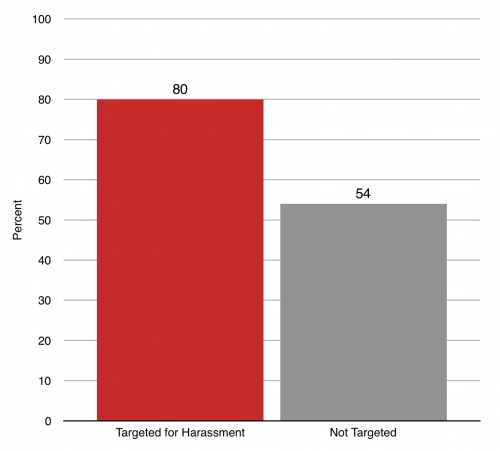
How many women quit and why?  Our study shows how sexual harassment affects women at the early stages of their careers. Eighty percent of the women in our survey sample who reported either unwanted touching or a combination of other forms of harassment changed jobs within two years. Among women who were not harassed, only about half changed jobs over the same period. In our statistical models, women who were harassed were 6.5 times more likely than those who were not to change jobs. This was true after accounting for other factors – such as the birth of a child – that sometimes lead to job change. In addition to job change, industry change and reduced work hours were common after harassing experiences.

Percent of Working Women Who Change Jobs (2003–2005)
In interviews with some of these survey participants, we learned more about how sexual harassment affects employees. While some women quit work to avoid their harassers, others quit because of dissatisfaction with how employers responded to their reports of harassment.

Rachel, who worked at a fast food restaurant, told us that she was “just totally disgusted and I quit” after her employer failed to take action until they found out she had consulted an attorney. Many women who were harassed told us that leaving their positions felt like the only way to escape a toxic workplace climate. As advertising agency employee Hannah explained, “It wouldn’t be worth me trying to spend all my energy to change that culture.”

The Implications of Sexual Harassment for Women’s Careers  Critics of Donald Trump’s remarks point out that many women who are harassed cannot afford to quit their jobs. Yet some feel they have no other option. Lisa, a project manager who was harassed at work, told us she decided, “That’s it, I’m outta here. I’ll eat rice and live in the dark if I have to.

Our survey data show that women who were harassed at work report significantly greater financial stress two years later. The effect of sexual harassment was comparable to the strain caused by other negative life events, such as a serious injury or illness, incarceration, or assault. About 35 percent of this effect could be attributed to the job change that occurred after harassment.

For some of the women we interviewed, sexual harassment had other lasting effects that knocked them off-course during the formative early years of their career. Pam, for example, was less trusting after her harassment, and began a new job, for less pay, where she “wasn’t out in the public eye.” Other women were pushed toward less lucrative careers in fields where they believed sexual harassment and other sexist or discriminatory practices would be less likely to occur.

For those who stayed, challenging toxic workplace cultures also had costs. Even for women who were not harassed directly, standing up against harmful work environments resulted in ostracism, and career stagnation. By ignoring women’s concerns and pushing them out, organizational cultures that give rise to harassment remain unchallenged.

Rather than expecting women who are harassed to leave work, employers should consider the costs of maintaining workplace cultures that allow harassment to continue. Retaining good employees will reduce the high cost of turnover and allow all workers to thrive—which benefits employers and workers alike.

Heather McLaughlin is an assistant professor in Sociology at Oklahoma State University. Her research examines how gender norms are constructed and policed within various institutional contexts, including work, sport, and law, with a particular emphasis on adolescence and young adulthood. Christopher Uggen is Regents Professor and Martindale chair in Sociology and Law at the University of Minnesota. He studies crime, law, and social inequality, firm in the belief that good science can light the way to a more just and peaceful world. Amy Blackstone is a professor in Sociology and the Margaret Chase Smith Policy Center at the University of Maine. She studies childlessness and the childfree choice, workplace harassment, and civic engagement. 
Originally posted at Gender & Society.

Photo by JCDecaux Creative Solutions flickr creative commons.

I recently took in a poignant guest lecture on hookup culture by Lisa Wade. During the talk, Wade detailed the link between rape culture and hookup culture. While hooking up encourages women to behave “like men,” it simultaneously creates an environment that rejects feminine traits (kindness, care, empathy). Since then I’ve continuously noticed how we celebrate women who display traditionally masculine characteristics (be aggressive! lean in!). But, we often do so in ways that devalue feminine attributes. It is with this framework in mind that I went to see Wonder Woman.

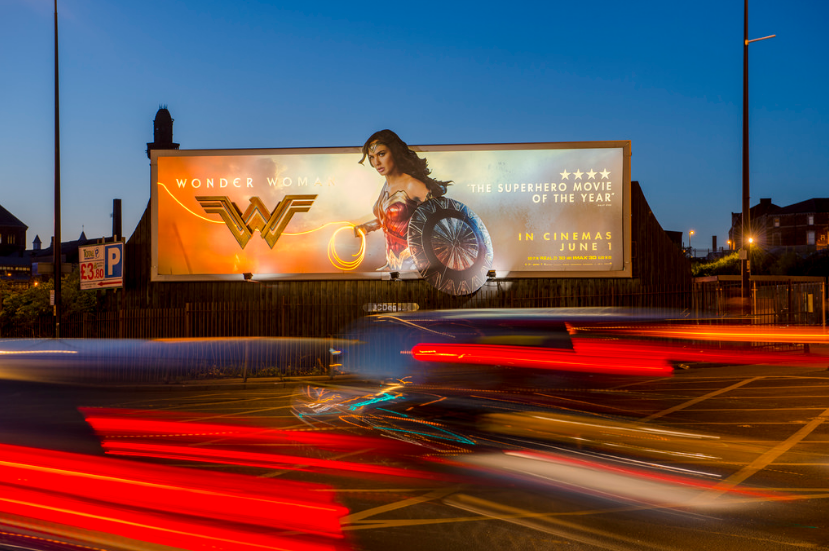
Donning my “feminist mama” sweatshirt, I expected to be underwhelmed given the mediocre reviews describing the film as just another boilerplate superhero movie. With my critical 3D glasses on, I understood why many were frustrated. Steven Trevor always has a protecting arm over Diana, even after she demonstrates that she’s indestructible. The persistence of the male gaze was also disappointing. I recognize the need to reflect Marston’s 1940’s creation, but expecting Diana to run through forests, scale mountains, and beat down villains in a sensible wedge was as laughable as Steven Trevor’s ridiculous assurance to the audience that his genitalia was “above average.” It is no coincidence that Wonder Woman’s strong but “sexy” image was the one chosen by Douglas to represent her concept of enlightened sexism nearly a decade ago.

At the same time, I think it is important to recognize the film’s strengths. The women cast as Amazonians are athletes in real life with muscular bodies that challenge anglocentric beauty ideals. Diana is a unique combination of sex appeal, acumen, and wit. She is fierce but nurturing, emboldened to take down Ares but driven by her desire to protect children. Her outfit choices are elegant but practical and she even managed to stash a sword in her stolen evening gown. Diana asserted confidence and ability while her male sidekicks over-promised and under-delivered. In short, Wonder Woman seems to encapsulate the kind of feminism Wade described as lost: embracing aggression and kindness, strength and beauty.

Given Diana’s character complexity, I find language lauding the film for its ability to break the “curse of Catwoman” particularly offensive. Perhaps if Hollywood had chosen to produce Joss Whedon’s version of Wonder Woman, where Diana’s uses a “sexy dance” to thwart the villain, it might warrant a film comparison. After all, the Catwoman “plot” was a lurid focus on Halle Berry in a tight-fitting costume, a hypersexualized (de)evolution of a female protagonist. It tanked in the box office because, like most female characters in superhero films, Patience Phillips was a two-dimensional stereotype of femininity – meek, fickle, a tease. She had to “overcome” her feminine traits to succeed and used sex appeal as a weapon. Comparing the films conflates the presence of a female lead with the notion that both films were made for women. It’s like those who questioned if Clinton supporters might vote for McCain in 2008 because he put Palin on the ticket. Having a woman lead doesn’t mean women’s interests are being considered.

Despite these attempts at male wish fulfillment, Wonder Woman’s success was not due to men aged 15-25. Unlike other superhero flicks, Wonder Woman’s audience was roughly 52% women, and women and older audience viewers continue to build its momentum. When the Alamo Drafthouse risked litigation to host an all-female screening it sold out so quickly it added more women-only events to respond to the demand. Nevertheless, the comparison to Catwoman persists as does the dominant narrative that films outside of the Captain America framework are a “gamble.”  Ignoring the success of films like Wonder Woman (Arrival or Get Out or Moonlight) allows executives to deflect the fact that most “flops” were made with an exclusively white, heterosexual, male audience in mind (I’m looking at you Cowboys & Aliens).  Yet celebrating Wonder Woman as a “triumph,” allows us to pretend that similar female protagonists dominate the screen instead of calling more attention to the fact that women still only accounted for 32% of all speaking roles in 2015 or that non-white actors are continuously overlooked at the Oscars.

Diana showcases a physical resilience seldom credited to women – let’s celebrate that. She encapsulates a kind of feminism that Wade rightfully notes is nearly nonexistent. Diana is a warrior who is agentic, driven, nurturing, protective, and merciful. She exhibits masculine strength without having to cast aside her feminine traits.  She voices concern for those who cannot protect themselves but she is a trained killer. By labeling Wonder Woman not feminist enough we overlook the crux of the problem: Wonder Woman’s empowerment narrative was likely tempered because Hollywood doesn’t really care about appealing to women. Highlighting the importance of Diana’s feminist dichotomy challenges Hollywood to build on that momentum and make a sequel without pandering to young, heterosexual, male audiences. In doing so, my hope is that in the future we have so many superheroes like Diana (strong because of their femininity, not strong despite it) that critics will have ample — and equivalent — characters for comparison.

Francesca Tripodi, PhD is a sociologist who studies how participatory media perpetuates systems of inequality. This year she is researching how partisan groups interact with media and the role community plays in legitimating what constitutes news and information as a postdoctoral scholar at Data & Society. Francesca would like to thank Caroline Jack and Tristan Bridges for their helpful feedback on this piece.

Originally posted at Montclair Socioblog.

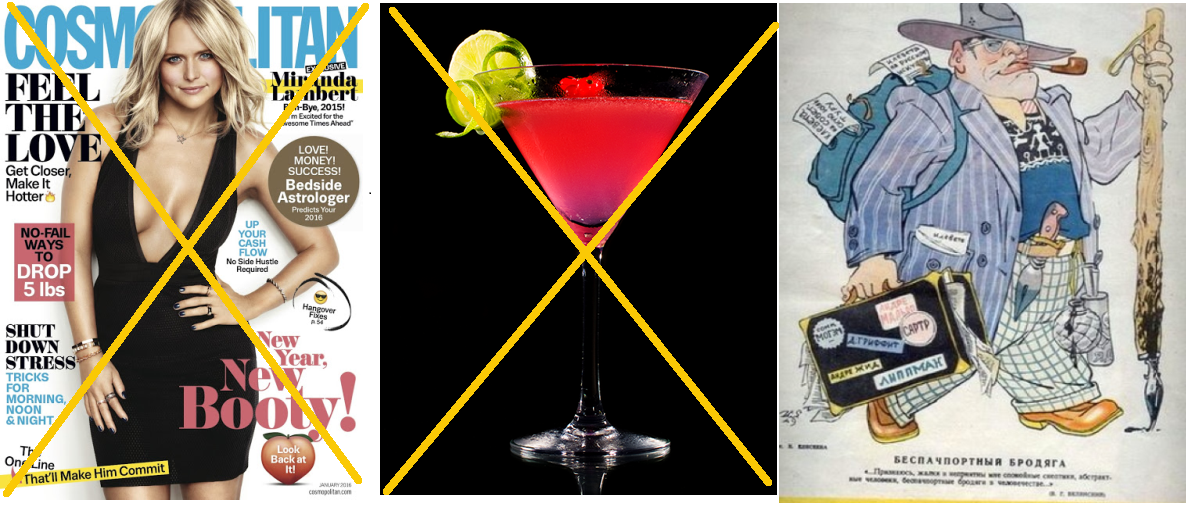
Why did White House advisor Stephen Miller call CNN reporter Jake Acosta “cosmopolitan”?

At the end of last week’s press briefing, Acosta asked about the Trump administration’s new proposals on immigration – reducing the total number of green cards by half and giving preference to people who are more skilled and people who speak English well.

ACOSTA:   The Statue of Liberty has always been a beacon of hope to the world for people to send their people to this country. They’re not always going to speak English.. . . Are we just going to bring in people from Great Britain and Australia?

MILLER: I have to say, I am shocked at your statement that you think that only people from Great Britain and Australia would know English. It reveals your cosmopolitan bias to a shocking degree.

Cosmopolitan? Acosta’s question suggests the exact opposite – provinicialism. A worldly and sophisticated person would know that countries in Asia and Africa have English as their national or dominant language and that people all over the world learn English as a second language. Only a rube would think that English proficiency was limited to Great Britain and Australia.

What did Miller mean by cosmopolitan? The question sent me back to the article that put “cosmopolitan” into the sociological lexicon – Alvin Gouldner’s 1957 “Cosmopolitans and Locals.”

 Cosmopolitans:

  • low on loyalty to the employing organization
  • high on commitment to specialized role skills
  • likely to use an outer reference group orientation

Locals: 

  • high on loyalty to the employing organization
  • low on commitment to specialized role skills
  • likely to use an inner reference group orientation.

Gouldner was writing about people in organizations. Miller is concerned with politics. The common element here is loyalty. Miller, along with Steve Bannon, engineered Trump’s “America first” doctrine, and by “cosmopolitans” he seems to mean people who are not putting America first. On immigration, people like Acosta are thinking about what might be good for an uneducated but hard-working Guatemalan, when instead they should be thinking only about what’s good for the US.

Jeff Greenfield put it this way at Politico: “It’s a way of branding people or movements that are unmoored to the traditions and beliefs of a nation, and identify more with like-minded people regardless of their nationality.”

The alt-Right has been using cosmopolitan for a while now, and perhaps it was Miller’s familiarity with White nationalist discourse that made the word so available as a put-down of Acosta even though Acosta’s question seemed based on the kind of ignorance about the world that is much respected over on the right.

Like “America first,” “cosmopolitan” has a history of holding hands with anti-Semitism. In Stalin’s Russia, the phrase “rootless cosmopolitan” was a synonym for Jew, and he murdered quite a few of them. In the US today, the antipathy to “cosmopolitan” embodies this same fear of rootlessness and the same dislike of Jews. Here is one website’s take on yesterday’s press briefing:

The twist here is that Acosta, the alleged cosmopolitan, is not Jewish, but Miller is. (The alt-Right uses the triple parentheses around a name to designate a Jew.) I don’t know how Miller resolves the dissonance other than to claim that he has never had anything to do with White nationalists (a claim that is probably false).  For the anti-Semites, the website has this:

While not a Jew himself, Acosta is the end result of the education and programming pushed by the Rootless Cosmopolitans wherever they dwell – even Stalin grew wise to them near the end of his life.

So Acosta cosmopolitanism came from being educated by Jews.

Miller and other Jews must surely understand the overtones of the term. And finally, let’s throw in a good word for Stalin: an anti-Semitic Russian autocrat – what’s not to like?

The rootless cosmopolitan on the right is from a Soviet humor magazine 1949.

Jay Livingston is the chair of the Sociology Department at Montclair State University. You can follow him at Montclair SocioBlog or on Twitter.

I work with one of the most heartbroken groups of people in the world: fathers whose adult children want nothing to do with them. While every day has its challenges, Father’s Day—with its parade of families and feel-good ads—makes it especially difficult for these Dads to avoid the feelings of shame, guilt and regret always lurking just beyond the reach of that well-practiced compartmentalization. Like birthdays, and other holidays, Father’s Day creates the wish, hope, or prayer that maybe today, please today, let me hear something, anything from my kid.

Many of these men are not only fathers but grandfathers who were once an intimate part of their grandchildren’s lives. Or, more tragically, they discovered they were grandfathers through a Facebook page, if they hadn’t yet been blocked. Or, they learn from an unwitting relative bearing excited congratulations, now surprised by the look of grief and shock that greets the newly announced grandfather. Hmm, what did I do with those cigars I put aside for this occasion?

And it’s not just being involved as a grandfather that gets denied. The estrangement may foreclose the opportunity to celebrate other developmental milestones he always assumed he’d attend, such as college graduations, engagement parties, or weddings. Maybe he was invited to the wedding but told he wouldn’t get to walk his daughter down the aisle because that privilege was being reserved for her father-in-law whom she’s decided is a much better father than he ever was.

Most people assume that a Dad would have to do something pretty terrible to make an adult child not want to have contact. My clinical experience working with estranged parents doesn’t bear this out. While those cases clearly exist, many parents get cut out as a result of the child needing to feel more independent and less enmeshed with the parent or parents. A not insignificant number of estrangements are influenced by a troubled or compelling son-in-law or daughter-in-law. Sometimes a parent’s divorce creates the opportunity for one parent to negatively influence the child against the other parent, or introduce people who compete for the parent’s love, attention or resources. In a highly individualistic culture such as ours, divorce may cause the child to view a parent more as an individual with relative strengths and weaknesses rather than a family unit of which they’re a part.

Little binds adult children to their parents today beyond whether or not the adult child wants that relationship. And a not insignificant number decide that they don’t.

While my clinical work hasn’t shown fathers to be more vulnerable to estrangement than mothers, they do seem to be more at risk of a lower level of investment from their adult children. A recent Pew survey found that women more commonly say their grown children turn to them for emotional support while men more commonly say this “hardly ever” or “never” occurs. This same study reported that half of adults say they are closer with their mothers, while only 15 percent say they are closer with their fathers.

So, yes, let’s take a moment to celebrate fathers everywhere. And another to feel empathy for those Dads who won’t have any contact with their child on Father’s Day.

Or any other day.

Josh Coleman is Co-Chair, Council on Contemporary Families, and author most recently of When Parents Hurt. Originally posted at Families as They Really Are.

I discovered a nice gem of an insight this week in an article called The 11 Ways That Consumers Are Hopeless at Math: the symbolism of the number 9.

We’re all familiar with the convention of pricing items one penny below a round number: $1.99 instead of $2.00, $39.99 instead of $40.00, etc. Psychologically, marketers know that this works. We’re more likely to buy something at $89.99 than we are at $90.00.

It’s not, though, because we are tricked by that extra penny for our pockets. It’s because, so argues Derek Thompson, the .99 symbolizes “discount.” It is more than just a number, it has a meaning. It now says to us not just 9, but also You are getting a deal. It doesn’t matter if it’s a carton of eggs for $2.99 or a dishwasher for $299.99. In both cases, putting two 9s at the end makes us feel like smart shoppers.

To bring this point home, in those moments when we’re not looking for a deal, the number 9 has the opposite effect. When marketers want to sell a “luxury” item, they generally don’t use the 9s. They simply state the round number price. The whole point of buying a luxury item is to spend a lot of money because you have the money to spend. It shouldn’t feel like a deal; it should feel like an indulgence. Thompson uses the example of lobster at a high-end restaurant. They don’t sell it to you for $99.99. That looks cheap. They ask you for the $100. And, if you’ve got the money and you’re in the mood, it feels good exactly in part because there are no 9s.

Definitely no 9s:

Photo by artjour street art flickr creative commons.

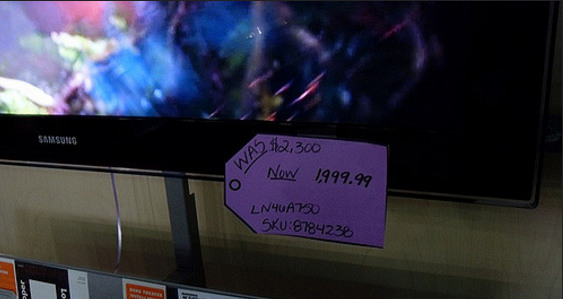
Not yet convinced? Consider as an example this price tag for a flat screen television. Originally priced at $2,300.00, but discounted at $1,999.99. Suddenly on sale and a whole lot of 9s:

Photo by Paul Swansen flickr creative commons; cropped.

Lisa Wade, PhD is an Associate Professor at Tulane University. She is the author of American Hookup, a book about college sexual culture; a textbook about gender; and a forthcoming introductory text: Terrible Magnificent Sociology. You can follow her on Twitter and Instagram.

Both men and women face a lot of pressure to perform masculinity and femininity respectively. But, ironically, people who rigidly conform to rules about gender, those who enact perfect performances of masculinity or femininity, are often the butt of jokes. Many of us, for example, think the male body builder is kind of gross; we suspect that he may be compensating for something, dumb like a rock, or even narcissistic. Likewise, when we see a bleach blond teetering in stilettos and pulling up her strapless mini, many of us think she must be stupid and shallow, with nothing between her ears but fashion tips.

The fact that we live in a world where there are different expectations for men’s and women’s behavior, in other words, doesn’t mean that we’re just robots acting out those expectations. We actually tend to mock slavish adherence to those rules, even as we carefully negotiate them (breaking some rules, but not too many, and not the really important ones).

In any case, I thought of this when I saw this ad. The woman at the other end of the table is doing (at least some version of) femininity flawlessly.  The hair is perfect, her lips exactly the right shade of pink, her shoulders are bare. But… it isn’t enough.  The man behind the menu has “lost interest.”

It’s unfortunate that we spend so much time telling women that the most important thing about them is that they conform to expectations of feminine beauty when, in reality, living up to those expectations means performing an identity that we disdain.

We do it to men, too.  We expect guys to be strictly masculine, and when they turn out to be jocks and frat boys, we wonder why they can’t be nicer or more well-rounded.

Lisa Wade, PhD is an Associate Professor at Tulane University. She is the author of American Hookup, a book about college sexual culture; a textbook about gender; and a forthcoming introductory text: Terrible Magnificent Sociology. You can follow her on Twitter and Instagram.

Originally posted at There’s Research on That!

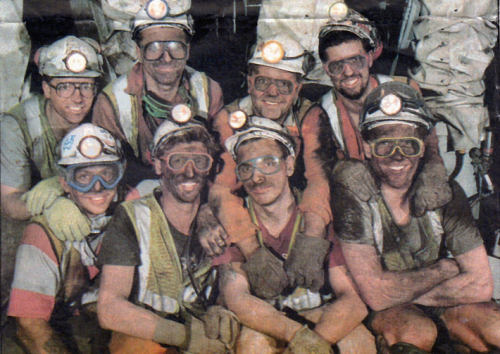
With a group of coal miners standing behind him, President Donald Trump signed an executive order in his first 100 days reversing Obama-era climate change policies, claiming that he would bring back coal while putting miners to work. Yet, can or will coal mining jobs come back, and will this lead to economic and social development in places like Appalachia?

Probably not.

Much research has shown that the loss of mining jobs in the U.S. is largely due to mechanization and labor-cutting management practices — not environmental protections. Thus, placing the blame on climate change policies is unfounded. Instead, it’s used to scapegoat environmentalists and draw our attention away from corporations and changes in the global economy.

Even if Trump’s executive order could bring back the jobs, it might not have the effects coal miners are hoping for. Researchers find that mining does not always lead to economic growth and well-being. Thus, keeping coal mines open does not guarantee economic prosperity and well-being. A study found that in West Virginia the counties with coal mines have some of the highest poverty and unemployment rates compared to surrounding counties without active mines.

Moreover, sociologist William Freudenberg argues that economies based solely around mining are prone to booms and busts, subject to the whims of the industry. Towns in Appalachian coal country and the Bakken oil fields of North Dakota become “addicted” to extraction. But dependence on fossil fuel industries is economically precarious.

Why don’t these facts change miners’ deep ties to mining as a way of life? Because many have strong cultural connections to mining, often coming from multiple generations of miners. Through her experiences working in a coal mine, anthropologist Jessica Smith Roylston saw how the miner identity connects with masculine ideals of hard work and providing for one’s family.

Photo by nottsexminer; flickr creative commons.

Industry has tapped into these sentiments to generate public support and weave the industry into the fabric of community life. Mining companies, particularly in Appalachia, have actively worked to create a positive image through public relations and other cultural and political tactics, such as sponsoring high school football tournaments and billboard ads.

These corporate strategies place the blame on outsiders and environmentalists, provide a cover for environmentally destructive and job-cutting industry practices, and keep coal politically relevant.

Erik Kojola is a PhD student in the Department of Sociology at the University of Minnesota interested in the environment, labor, social movements and political economy.

The average man thinks he’s smarter than the average woman. And women generally agree.

It starts early. At the age of five, most girls and boys think that their own sex is the smartest, a finding consistent with the idea that people tend to think more highly of people like themselves. Around age six, though, right when gender stereotypes tend to take hold among children, girls start reporting that they think boys are smarter, while boys continue to favor themselves and their male peers.

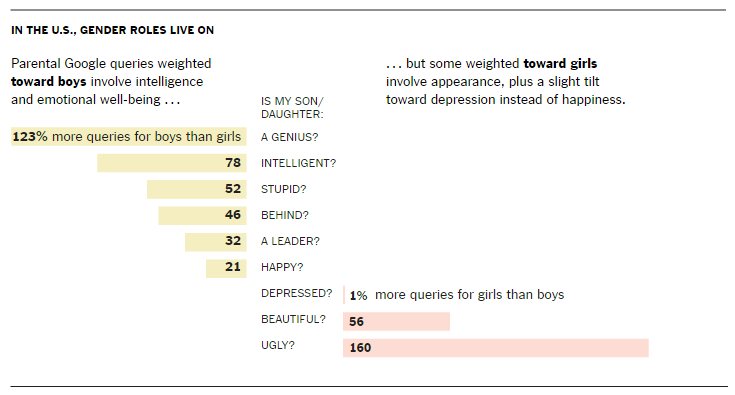
They may have learned this from their parents. Both mothers and fathers tend to think that their sons are smarter than their daughters. They’re more likely to ask Google if their son is a “genius” (though also whether they’re “stupid”). Regarding their daughters, they’re more likely to inquire about attractiveness.

Image via New York Times.

Once in college, the trend continues. Male students overestimate the extent to which their males peers have “mastered” biology, for example, and underestimate their female peers’ mastery, even when grades and outspokenness were accounted for.  To put a number on it, male students with a 3.00 G.P.A. were evaluated as equally smart as female students with a 3.75 G.P.A.

When young scholars go professional, the bias persists. More so than women, men go into and succeed in fields that are believed to require raw, innate brilliance, while women more so than men go into and succeed in fields that are believed to require only hard work.

Once in a field, if brilliance can be attributed to a man instead of a woman, it often will be. Within the field of economics, for example, solo-authored work increases a woman’s likelihood of getting tenure, a paper co-authored with a woman has an effect as well, but a paper co-authored with a man has zero effect. Male authors are given credit in all cases.

In negotiations over raises and promotions at work, women are more likely to be lied to, on the assumption that they’re not smart enough to figure out that they’re being given false information.

——————————

Overall, and across countries, men rate themselves as higher in analytical intelligence than women, and often women agree. Women are often rated as more verbally and emotionally intelligent, but the analytical types of intelligence (such as mathematical and spatial) are more strongly valued. When intelligence is not socially constructed as male, it’s constructed as masculine. Hypothetical figures presented as intelligent are judged as more masculine than less intelligent ones.

All this matters.

By age 6, some girls have already started opting out of playing games that they’re told are for “really, really smart” children. The same internalized sexism may lead young women to avoid academic disciplines that are believed to require raw intelligence. And, over the life course, women may be less likely than men to take advantage of career opportunities that they believe demand analytical thinking.

Lisa Wade, PhD is an Associate Professor at Tulane University. She is the author of American Hookup, a book about college sexual culture; a textbook about gender; and a forthcoming introductory text: Terrible Magnificent Sociology. You can follow her on Twitter and Instagram.