Search results for The

Originally Posted at Marx in Drag

I have been interested in and reading about the creators of the comic book super hero Wonder Woman for a few years now. My interest began in 2014.

I was half-heartedly listening to Fresh Air with Terry Gross, and Gross was interviewing historian Jill LePore, the author of The Secret History of Wonder Woman. At the time, I hadn’t read LePore’s book or the Wonder Woman comics, and so I was mildly but not wildly interested in their conversation. When Gross asked LePore to talk about William Marston’s family life, LePore began to describe the relationship between Marston, Elizabeth Holloway, Marston’s wife, and Olive Byrne, the woman who lived with them and was, in Terry Gross’s words, Marston’s “mistress.”

Holy shit!, I said to myself. These people were polyamorous! Of course, I knew that they couldn’t have seen themselves as “polyamorous” in the contemporary sense of the word, for the word would not be invented for another fifty years or so after Marston and Holloway invited Byrne into their relationship. However, it sounded to me like they were doing something akin to a poly relationship—as in they had chosen to forge an intimate relationship that included more than two people, and they had built a life together.

In a word, I was hailed. I felt a sense of connection to Holloway, Byrne, and Marston—dare I say queer kinship. I am poly and so were these people from almost a century ago. These are my people! And here were Terri Gross and Jill Lepore talking about it on the usually rather conventional National Public Radio. This doesn’t happen often, so I stopped what I was doing and turned up my radio.

After LePore described the relationship between Holloway, Byrne, and Marston, Terri Gross said, “That’s just so bizarre.” And LePore agreed, “Yeah. It’s so bizarre…hilariously bizarre.”

My bubble burst. Instead of being hailed, I felt slapped in the face. I don’t know what Gross’s or LePore’s relationship history looks like, but they certainly sounded like monogamists looking in at us poly freaks from the outside, and they were calling us bizarre and laughing at us. A much too common experience.

That is why Angela Robinson’s film, Professor Marston and The Wonder Woman, is the real breath of Fresh Air.

I’ll be honest, I went to this film with some trepidation. I wanted to believe I wouldn’t be mocked or depicted as a bizarre spectacle given Angela Robinson’s resume, but polyamory? Between a man and two women? With kink? It would be very easy for Robinson to spill this very tall order.

I was worried that it wouldn’t do justice to just how unconventional the Marstons were. I was concerned it would perpetuate stereotypes about polygamy–dominant, selfish, and exploitive yet lucky (wink wink) men have multiple and suffering wives. I read LePore’s book, and as I write in my forthcoming book, The Poly Gaze, she often interprets the Marston family through this lens. I also didn’t want to see yet another film about a man with a wife and mistress and the bitter, catty, and destructive rivalry between the women.

Though understandable given the lack of feminist and/or queer representations of threesomes or poly triads in mainstream media, my fears and worries turned out to be completely unfounded. Rather than make a spectacle out of the perverts or freaks, Robinson adeptly turns the tables and asks the viewer to question their own assumptions about what is normal. It renders polyamory possible and highlights the dire social sanctions that often come with not living within the boundaries of monogamy. The film also offers a truly rare representation of sexual threesomes as a loving and sexy way to forge intimate bonds, and presents BDSM as a component of healthy relationships rather than a result of psycho-pathology or sexual trauma (think Fifty Shades of Gray).

All of this is rather groundbreaking, and I was, quite literally, in tears as I watched. Tears of joy and relief for being hailed as polyamorous, an enthusiastic participant in threesomes, and a dabbler in kink and not getting slapped in the face with mocking laughter or the pointing fingers of shame.

But these things were not, for me personally, the most unique and striking aspect of this film—though, to be perfectly clear, I do not want to diminish just how significant this film is in its bravery and beauty around polyamory, bisexuality, and kink. The most astonishingly wonderful thing about Angela Robinson’s film version of this story, as seen from my theatre seat, was being hailed as a feminist. Gazing at Elizabeth and Olive admire, fall in love with, and express desire for each other as lovers, not rivals. And even more significant was to witness them consciously and deliberatively (not deliberately, though that works too) choose to forge an unconventional and poly life together with Marston.

Unlike narratives about polygamy where women are passive objects of men’s brutality or desire, this film shows Elizabeth and Olive actively creating a life together and with a man who is an equal partner. Refusing to reproduce tropes about women’s competition with each other for the attention of a man, Angela Robinson situates the women’s admiration and desire for each other at the center of the story. Both women are brilliant feminists. And both women are, as Olive says about Elizabeth, ‘magnificent” and desirous of an unconventional life.

In other words, Angela Robinson has succeeded in transforming a story about a man with a wife and a mistress (as told by Gross and LePore) into two women and a man who bravely forge an unconventional, poly and feminist life.

Whether or not it is an accurate portrayal of the lived experience of Holloway, Byrne, and Marston is impossible to know, and to be perfectly frank, completely uninteresting to me. I am interested in the stories we tell—as historians and as filmmakers and what those stories say about people who live unconventional lives.

I cherish the story told in this film by Angela Robinson because of what it says about those of us who live unconventional, poly lives. Yes, we are freaks, but only in the eyes of those who live conventional lives and want everyone else to follow the rules. Yes, we are sometimes ridiculed and shunned, and yet, because of it, we are brave, strong, and resilient. And some of us, like Elizabeth Holloway, Olive Byrne, and William Marston, and the character Wonder Woman, for that matter, are capable of changing the world. Thank you, Angela Robinson, for telling this part of the story.

Mimi Schippers is an Associate Professor of Sociology and Gender and Sexuality Studies at Tulane University. She is the author of Beyond Monogamy: Polamory and the Future of Polyqueer Sexualities  (New York University Press, 2016) and Rockin’ Out of the Box: Gender Maneuvering in Alternative Hard Rock (Rutgers University Press, 2002).  
Where is your nearest garbage dump? Where does the local factory go when it needs to get rid of some particularly toxic chemicals? If there was a disaster, would you have to move? Could you?

Sociologists use shorthand terms like “environmental racism” to draw attention to the fact that poor communities and communities of color are often more likely to be exposed to hazardous materials, and cases like the Flint water crisis drive this point home.

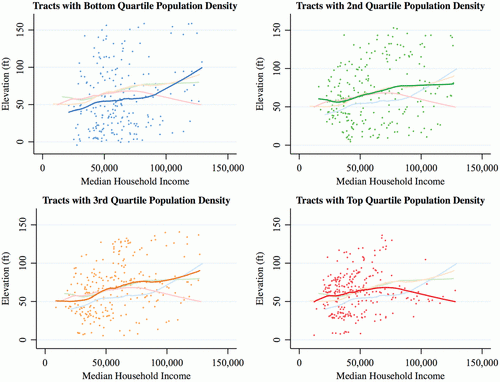
Of course, housing inequality also means that nobody has to dump anything to put poor communities in hazardous positions. One recent example of this is the flooding in Houston after Hurricane Harvey. Over at Socius, Yuqi Lu gathered data on the median household income in neighborhoods across the Houston area from the American Community Survey and matched it with land elevation data from Google Maps.

In general, poorer neighborhoods in Houston sit at lower elevations, and thus are more susceptible to flood risks. This relationship is strongest in less-densely-populated areas, such as rural and suburban neighborhoods, but additional analysis in Lu’s article shows the relationship is robust.

The latest reports are in on human caused climate change. Regardless of whether we can act to turn it around in time, we’ll also have to recognize the fact that not everyone faces the same fallout from environmental hazards and natural disasters.

Evan Stewart is an assistant professor of sociology at University of Massachusetts Boston. You can follow his work at his website, or on BlueSky.

Content Note: Some slurs in historical context below the break. 

Since the white nationalist march on Charlottesville, VA, in August, many cities in the South are grappling with what to do about Confederate monuments in their public spaces. The argument, which I agree with fully, is that Confederate monuments celebrate people who dedicated their lives to the oppression of people of color and should be removed. While there is support for removing Confederate statues among many Northern liberals, treating Confederate generals as the only obvious indicators of state-sanctioned racism perpetuates the notion of Southern exceptionalism. 

The truth is that you do not need a white hood or the Stars and Bars to be a white supremacist. In Philadelphia, the debate over a monument is not about the statue of a general from 1865 but about a 1972 Democrat Mayor.

Source: Wikimedia Commons

Across the street from City Hall, right in the entrance of the Municipal Service Building, a statue of Frank Rizzo towers nine feet high. Frank “The General” Rizzo served as Philadelphia’s Police Commissioner in the late 1960s and early 1970s and as the Mayor of Philadelphia from 1972 to 1980. Rizzo was known as a pull no punches kind of guy. During his reelection campaign of 1975 he famously told his adversaries, “Just wait after November, you’ll have a front row seat because I’m going to make Attila the Hun look like a faggot.” His brutal, and racially motivated, legacy on the Philadelphia Police department is still felt to this day.

Rizzo was born and raised in South Philadelphia in a home with a beat cop father. After dropping out of high school and briefly joining the navy, Rizzo joined the Philadelphia police, making a name for himself as “a no-nonsense cop who swung first and asked questions later.” In 1967, Rizzo become police commissioner. A year after he led police officers to a school administration building where black students were protesting for black history in their school curriculum. Rizzo told the cops, “get their black asses.”

The image that best captures Rizzo’s tenure as police chief is from 1970. A week before a Black Panther convention that was intended to take place at Temple University, police officers raided a group of Panthers and conducted strip searchers on the activists in the streets. The picture (content warning) was printed on the front page of the Philadelphia Daily News the day after.

In 1972, after a campaign in which he was endorsed by a KKK spinoff organization in Pennsylvania and in which his slogan was “vote white,” Frank Rizzo assumed the office of the Mayor of Philadelphia. The tenure of Rizzo as mayor could be thought of a series of civil right lawsuits. In 1975, the court issued a consent decree after a suit against Rizzo and the city for the failure to hire black fire fighters. In 1976, Rizzo was sued for violating the Fair Housing Act. In 1979, the Department of Justice filed what was called “an unprecedented civil suit” against Rizzo and the city for “condoning systematic police brutality.” These are just a few examples.

In 1978, the KKK awarded Rizzo the “Racist Hero of the Month award.”

After a long and failed campaign to seek a change in the City’s charter that would allow him to run for a third term, Rizzo left office in 1980. He continued his career as a “guardian of white rights.”

In the aftermath of Charlottesville, Philadelphia Councilwoman Helen Gym tweeted: “All around the country, we’re fighting to remove the monuments to slavery & racism. Philly, we have work to do. Take the Rizzo Statue down.” This wasn’t the first time that a call was made to remove the Rizzo statue in Philly. Groups of activists have been protesting the statue every Thursday for the past year.

Southern exceptionalism is the notion that the group of Southern states of the United States, the former Confederacy, is an exceptionally racist entity that America battles with every few generations. By blaming the South for racism while ignoring the way the establishment, law-enforcement, and large parts of white America in the North treated people of color, Northern liberals absolve themselves of any moral wrongdoing. Historian Clarence Lang writes that Southern exceptionalism “celebrates the inevitable triumph of U.S. democratic values, and ignores the structural role of inequality in building and maintaining the U.S. nation-state.”

We cannot allow the conversation around confederate monuments to ignore the racism of America as a whole and scapegoat racism on the south. 

We must expand our political and sociological imagination about racism and white supremacy beyond the South and the Confederacy. Philadelphia is doing exactly that. Recently, the Office of the Mayor of Philadelphia published a call for ideas on what should be done with the problematic statue. The call received hundreds of ideas and now Philadelphians wait for a decision on the statue’s future.

At the end of the day, changes in law, policies, practice and wealth distribution will dismantle the legacy and presence of racism and oppression in the United States. Taking down monuments is a way to publicly  affirm a commitment to that goal.

There is no Confederate statue in Philadelphia, at least none that I know of. Taking down the Rizzo statue in the city of brotherly love will be a victory for progressives everywhere. Just as white progressives from the North support struggles to remove monuments in the South, they must identify the “Rizzo statue” in their towns and remove it.

Abraham Gutman is an Israeli writer and economist currently based in Philadelphia. His writing focuses on Israel/Palestine, race in America, policing, and housing. Abraham currently works at the Center for Public Health Law Research at Temple University where he conducts research on housing policy. All opinions are his own. Follow him on Twitter @abgutman.

This weekend I was at the annual conference for the Society for the Scientific Study of Religion, where they held a memorial for sociologist Peter Berger. I thought of Berger and Luckmann’s classic The Social Construction of Reality in the airport on the way home. Whenever people say ritual is dying out, or socially constructed things “aren’t real,” I think of airport lines.

There are always two lines, but rarely any separation other than a sign like this. If you’re lucky, you can catch the gate agent making a big show of opening the “general boarding” lane, but everyone ends up at the same scanner right past the sign (usually only a minute or two after the “elite” passengers). From Berger and Luckmann (the Anchor Books paperback edition):

The developing human being not only interrelates with a particular natural environment, but with a specific cultural and social order which is mediated to him by the significant others who have charge of him (p. 48).

The symbolic universe orders and thereby legitimates everyday roles, priorities, and operating procedures…even the most trivial transactions of everyday life may come to be imbued with profound significance (p. 99).

Evan Stewart is an assistant professor of sociology at University of Massachusetts Boston. You can follow his work at his website, or on BlueSky.

The Washington Post recently covered a leaked email exchange from the University of Maryland in which the school’s Mock Trial team assistant coach lamented the “mediocre” to “poor” performance of Latinx students and asked if any of them had to be included to satisfy diversity requirements for the makeup of the team. While an embarrassing situation for both the students and the authors of the e-mail exchange, this event reflects recent research in law and society that addresses questions of race, gender, immigrant background, and inequality in the legal profession and among law school students.

While law firms put a high value on American law school training, not everyone gets the same benefits from a legal education. Students of color who are the children of immigrants earn less after graduating from law school. Implicit biases can also determine who gets hired at elite jobs and exert pressure on these students while they are in school. This recent incident at Maryland shows how these patterns affect minority students’ everyday experiences in law school.

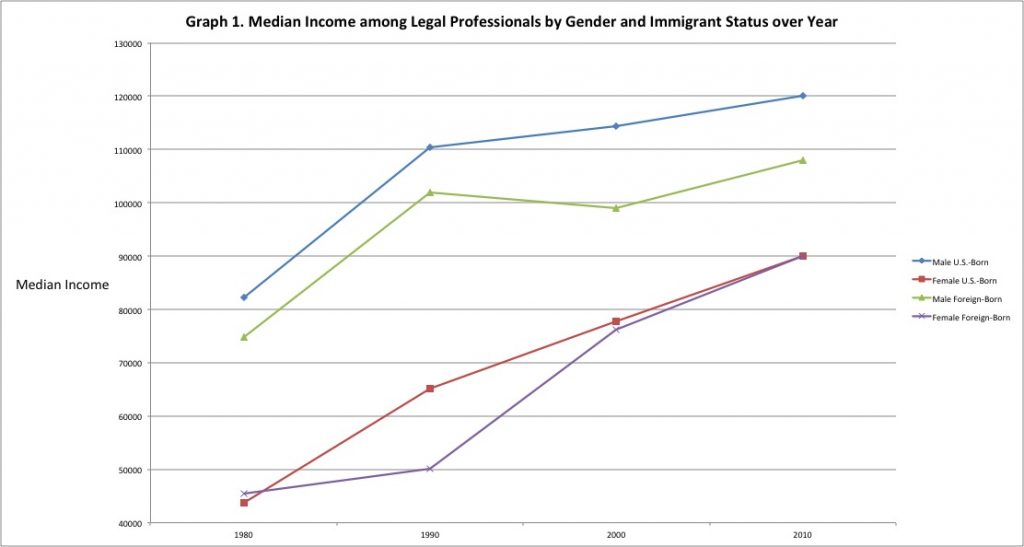
Our analysis emphasizes the persistent inequality in the median income level among lawyers in the United States. There are sizable differences in earnings across race and gender. We have found that, while immigrant status alone is not always negatively associated with income, it does compound the income disadvantage of immigrants when combined with race and gender.

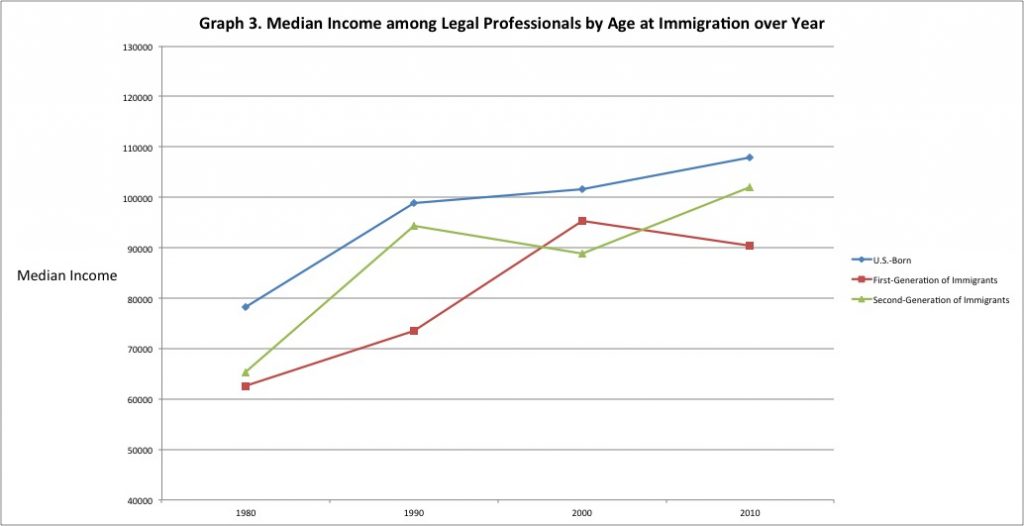
Prepared by the authors. Source: U.S. Census and American Community Survey 1970-2010. All values are in 2010 U.S. dollars. These charts refer to individuals who were in the labor force, employed in the legal profession, and worked in the legal services industry.

One issue that has come up in the course of our study is the question of whether law school matters. We considered that the first generation of immigrants is likely educated abroad, whereas the second generation is potentially educated in the U.S. Although we do not have a direct measure of whether the immigrants in our sample have received their law degree from an American or a foreign law school, previous research has found that age at immigration is a valid proxy measure for place of education.

We do find a slight income advantage for those educated in the United States. However, as the incident in Maryland might suggest, education alone may not determine future professional success as a lawyer. Because the law school environment emphasizes network building and socialization through extra-curricular activities, such as moot court or mock trial, students who are not selected for these opportunities (especially on the basis of race!), may be additionally disadvantaged when looking for a job as well as in the marketplace.

Alisha Kirchoff is a PhD student and Associate Instructor of sociology at Indiana University. Her research is in law and society, political sociology and comparative sociology. She is also currently working as a digital content producer for Contexts Magazine.

Vitor Martins Dias is a graduate student in the Department of Sociology at Indiana University-Bloomington. Prior to leaving Brazil to pursue his LL.M. at Indiana University Maurer School of Law, he received his LL.B. and LL.M., respectively, from Centro Universitário do Pará and São Paulo Law School of Fundação Getúlio Vargas. He is broadly interested in the areas of development, the legal profession, law and society, political economy, political sociology, and inequality.

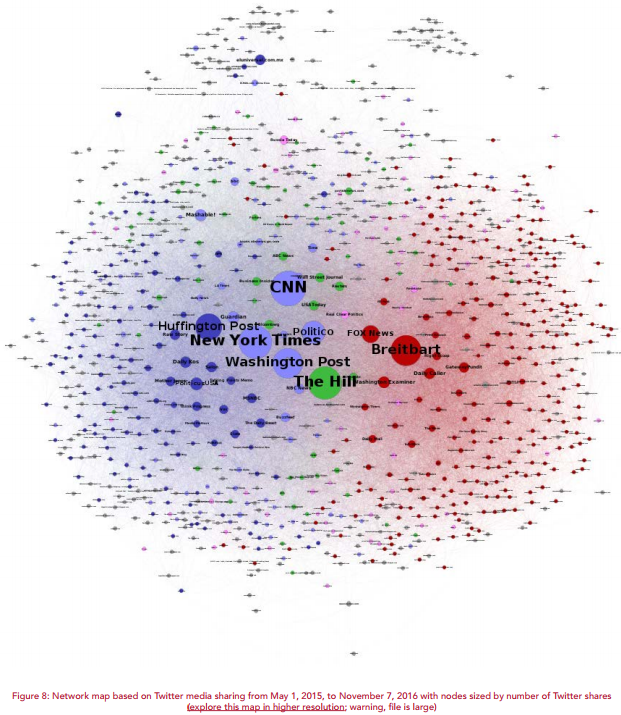
A new study tackles the media landscape building up to the election. The lead investigator, Rob Faris, runs a center at Harvard that specializes in the internet and society. He and his co-authors asked what role partisanship and disinformation might have played in the 2016 U.S. election. The study looked at links between internet news sites and also the behavior of Twitter and Facebook users, so it paints a picture of how news and opinion is being produced by media conglomerates and also how individuals are using and sharing this information.

They found severe ideological polarization, something we’ve known for some time, but also asymmetry in how media production and consumption works on either side. That is, journalists and readers on the left are behaving differently from those on the right.

The right is more insular and more partisan than the left: conservatives consume less neutral and “other side” news than liberals do and their outlets are more aggressively partisan. Breitbart News now sits neatly at the center. Measured by inlinks, it’s as influential as FOX News and, on social media, substantially more. Here’s the  network map for Twitter:

Breitbart’s centrality on the right is a symptom of how extreme the Republican base has become. Breitbart’s Executive Chairman, Steve Bannon — former White House Chief Strategist — calls it “home of the alt-right,” a group that shows “extreme” bias against racial minorities and other out-groups. 

The insularity and lack of interest in balanced reporting made right-leaning readers susceptible to fake stories. Faris and his colleagues write:

The more insulated right-wing media ecosystem was susceptible to sustained network propaganda and disinformation, particularly misleading negative claims about Hillary Clinton. Traditional media accountability mechanisms — for example, fact-checking sites, media watchdog groups, and cross-media criticism — appear to have wielded little influence on the insular conservative media sphere.

There is insularity and partisanship on the left as well, but it is mediated by commitments to traditional journalistic norms — e.g., covering “both sides” — and so, on the whole, the left got more balance in their media diet and less “fake news” because they were more friendly to fact checkers.

The interest in balance, however, perhaps wasn’t entirely good. Faris and his co-authors found that the right exploited the left’s journalistic principles, pushing left-leaning and neutral media outlets to cover negative stories about Clinton by claiming that not doing so was biased. Centrist media outlets responded with coverage, but didn’t ask the same of the right (it is possible this shaming tactic wouldn’t have worked the other way).

The take home message is: During the 2016 election season, right-leaning media consumers got rabid, un-fact checked, and sometimes false anti-Clinton and pro-Trump material and little else, while left-leaning media consumers got relatively balanced coverage of Clinton: both good stories and bad ones, but more bad ones than they would have gotten (for better or worse) if the right hadn’t been yanking their chain about being “fair.”

We should be worried about how polarization, “fake news,” horse-race journalism, and infotainment are influencing the ability of voters to gather meaningful information with which to make voting decisions, but the asymmetry between the left and the right media sphere — particularly how it makes the right vulnerable to propagandists and the left vulnerable to ideological bullying by the right — should leave us even more worried. These are powerful forces, held up both by the institutions and the individuals, that are dramatically skewing election coverage, undermining democracy, and throwing elections, and governance itself, to the right.

Lisa Wade, PhD is an Associate Professor at Tulane University. She is the author of American Hookup, a book about college sexual culture; a textbook about gender; and a forthcoming introductory text: Terrible Magnificent Sociology. You can follow her on Twitter and Instagram.

Over at Family Inequality, Phil Cohen has a list of demographic facts you should know cold. They include basic figures like the US population (326 million), and how many Americans have a BA or higher (30%). These got me thinking—if we want to have smarter conversations and fight fake news, it is also helpful to know which way things are moving. “What’s Trending?” is a post series at Sociological Images with quick looks at what’s up, what’s down, and what sociologists have to say about it.

The Crime Drop

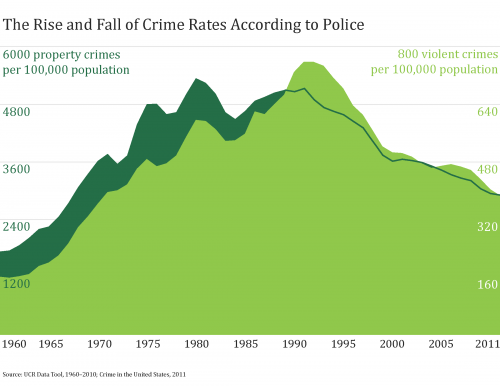
You may have heard about a recent spike in the murder rate across major U.S. cities last year. It was a key talking point for the Trump campaign on policing policy, but it also may be leveling off. Social scientists can also help put this bounce into context, because violent and property crimes in the U.S. have been going down for the past twenty years.

You can read more on the social sources of this drop in a feature post at The Society Pages. Neighborhood safety is a serious issue, but the data on crime rates doesn’t always support the drama.

Evan Stewart is an assistant professor of sociology at University of Massachusetts Boston. You can follow his work at his website, or on BlueSky.

In an era of body positivity, more people are noting the way American culture stigmatizes obesity and discriminates by weight. One challenge for studying this inequality is that a common measure for obesity—Body Mass Index (BMI), a ratio of height to weight—has been criticized for ignoring important variation in healthy bodies. Plus, the basis for weight discrimination is what other people see as “too fat,” and that’s a standard with a lot of variation.

Recent research in Sociological Science from Vida Maralani and Douglas McKee gives us a picture of how the relationship between obesity and inequality changes with social context. Using data from the National Longitudinal Surveys of Youth (NLSY), Maralani and McKee measure BMI in two cohorts, one in 1981 and one in 2003. They then look at social outcomes seven years later, including wages, the probability of a person being married, and total family income.

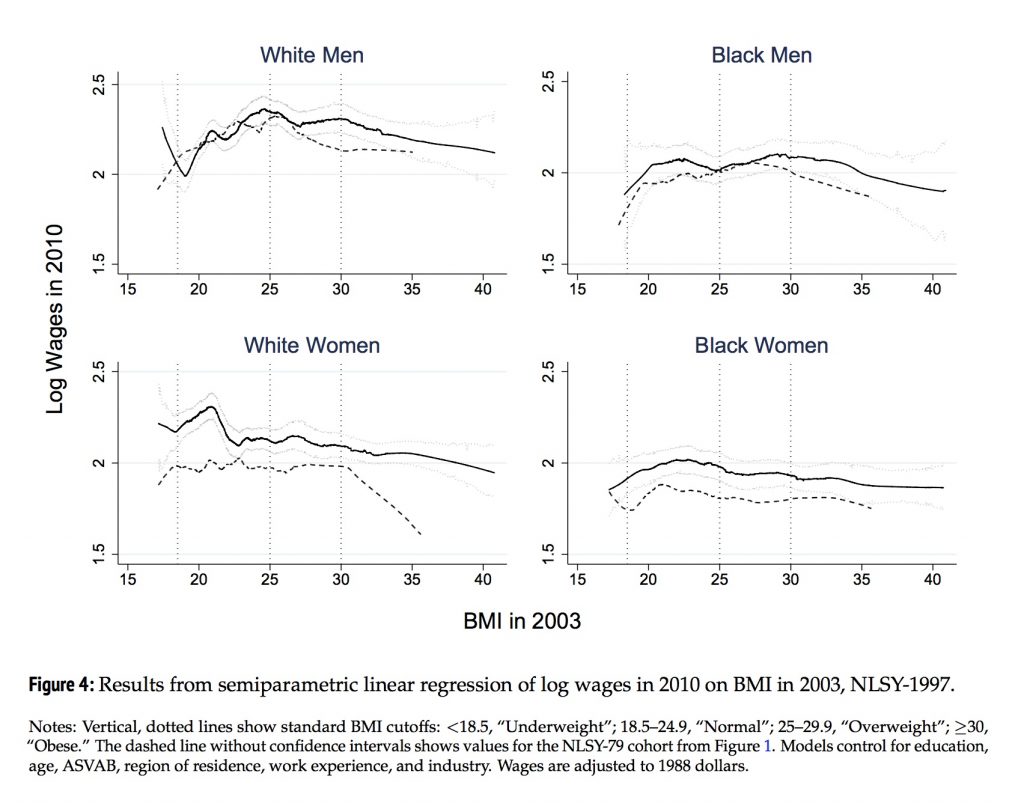
The figure below shows their findings for BMI and 2010 wages for each group in the study. The dotted lines show the same relationships from 1988 for comparison.

For White and Black men, wages actually go up as their BMI increases from the “Underweight” to “Normal” ranges, then levels off and slowly decline as they cross into the “Obese” range. This pattern is fairly similar to 1988, but check out the “White Women” graph in the lower left quadrant. In 1988, the authors find a sharp “obesity penalty” in which women over a BMI of 30 reported a steady decline in wages. By 2010, this has largely leveled off, but wage inequality didn’t go away. Instead, that spike near the beginning of the graph suggests people perceived as skinny started earning more. The authors write:

The results suggest that perceptions of body size may have changed across cohorts differently by race and gender in ways that are consistent with a normalizing of corpulence for black men and women, a reinforcement of thin beauty ideals for white women, and a status quo of a midrange body size that is neither too thin nor too large for white men (pgs. 305-306).

This research brings back an important lesson about what sociologists mean when they say something is “socially constructed”—patterns in inequality can change and adapt over time as people change the way they interpret the world around them.

Evan Stewart is an assistant professor of sociology at University of Massachusetts Boston. You can follow his work at his website, or on BlueSky.