Search results for The

Happy Valentine’s Day! A sociological look at love is always a little awkward, because it means coming to terms with just how much our most personal, intimate, and individual relationships are conditioned by the cultures we live in. Dating preferences reflect broader patterns in social inequality, external strains like job insecurity can shape the way we think about romantic commitment, and even the way people orgasm can be culturally conditioned.

Classic sociological research finds that love follows cultural scripts and repertoires. While every relationship is unique, we learn fundamental patterns about how to love from the world around us. Breaking those scripts can be uncomfortable, but also hilarious and genuine. This year the internet has gifted us two amazing examples where romantic scripts and comedy collide.

One comes from research scientist Janelle Shane. Shane recently trained a machine learning algorithm using a collection of phrases from those candy hearts that always pop up this time of year. After detecting patterns in the real messages, the program generated its own. You can see a full set of hearts on her blog. These hearts get so very close to our familiar valentine scripts, but they miss hilariously because the program can only ever approximate the romantic gesture.

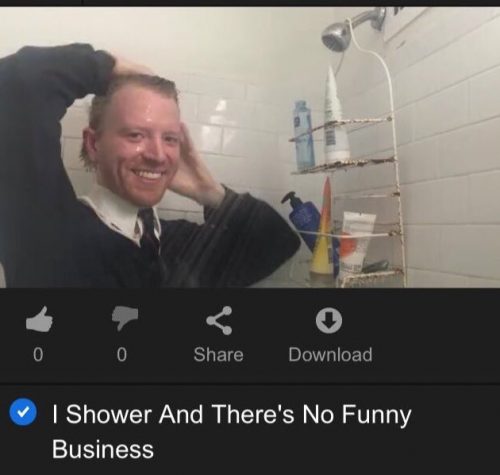
The other comes from comedy writer Ryan Creamer, who has uploaded an entire series of simple, earnest, and distinctly not pornographic videos to PornHub. Hit titles include, “I Hug You and Say I Had a Really Good Time Tonight and Then I Go Home,” and “I Ride in a Taxi and Don’t Have Sex With the Driver.” Check out Joana Ramiro’s analysis of Creamer’s work, capitalism, and intimacy at Jacobin. 
This Valentine’s Day, take a moment and see if you’re just following the typical social script. Breaking up the romantic routine can lead to a genuine laugh or two, and you might even learn something new about your relationship.

Evan Stewart is an assistant professor of sociology at University of Massachusetts Boston. You can follow his work at his website, or on BlueSky.

Over the past few years, Chris Pratt has been more public about his faith in interviews, award speeches, and social media. A few days ago, Ellen Page raised questions about Pratt’s church advancing anti-LGBT views. Pratt has ties to both Zoe Church and Hillsong, evangelical churches that are well-known and influential in contemporary Christianity.

My work doesn’t usually dovetail with celebrity gossip, but this case caught my interest because it raises questions about whether we can or should ask people to justify the political work of their religious groups. Thanks to research in the sociology of religion, we know how political attitudes spread through faith groups, and this can help us make better sense of the conversation.

Photo Credit: Mor, Flickr CC

There is good reason to expect people to have their own beliefs that might differ from their church leadership. Research across the social sciences shows that people generally aren’t consistent in the way they express their religious beliefs in everyday life. Also, churches are not often clear about where they stand on these issues. According to reporting in The Huffington Post,

Zoe’s official stance on LGBTQ issues is unclear, according to Church Clarity, a crowd-sourced database that scores churches based on how clearly they communicate their policies on LGBTQ people and on women in leadership. George Mekhail, one of Church Clarity’s founders, told HuffPost he suspects that the ambiguity some conservative Christian churches have around their LGBTQ policies could be intentional.

That last part of the quote gets at the most important sociological point. In these church contexts, people don’t usually get their politics straight from the pulpit. Research on evangelical congregations shows how most of the political socialization in church life comes from lay leaders and fellow members who model their political views for new members. If church leaders want to advocate for a pro-life, anti-LGBT, or other policy agenda, they often don’t have to do it explicitly. The laity has already taught newcomers that this is how “people like us” vote.

Want to learn more about the new politics of evangelicals? There’s research on that!

We also have to consider Pratt’s status as a celebrity congregant. Regardless of his personal views, religious organizations have long taken an interest in cultural influence and worked to foster connections with important social networks in politics, business, and the entertainment industry to legitimize and advance their social agendas.

It might seem unfair to call out a single person for the agenda of an entire church organization. On the other hand, as a sociologist, I come to this debate less interested in what’s in any single person’s head or heart. I’m more interested in where they are in relation to everyone else and what those relationships do. The conversation from Page reminds us that It’s not necessarily about what a person believes, but about what they legitimate with their platform and presence.

Evan Stewart is an assistant professor of sociology at University of Massachusetts Boston. You can follow his work at his website, or on BlueSky.

The pictures, of course, went viral. Donald Trump serving fast food, still in the box, to the college champion Clemson University football team. The cardboard containers and paper wrappers were artfully stacked on silver platters alongside ornate candelabras and embossed napkins and served on a formal table beneath a gold-framed portrait of Abraham Lincoln.

Sure the juxtaposition was glaring, and the media, the twitterverse, and the late night talk shows had a field day poking fun at the President’s seeming lack of class. The Washington Post headline quoted Patrick Guaschino, who accused the president of turning the “white house into a White Castle.” Comedian W. Kamau Bell joked that a white house staffer, “choking through tears [would say] ‘I guess we could use the Lincoln gravy boats for the McNugget sauces.’” My personal favorite meme photoshopped Ronald McDonald in place of the president.

These reactions also teach us something important about social class and “good taste.” Pierre Bourdieu famously wrote that “taste classifies the classifier (1984, 6),” and this insight has become essential to understanding contemporary American food cultures. In Discriminating Taste (2017), S. Margo Finn argues that the increasing fascination with “good food,” including trends toward the local, organic and artisanal, and the condemnation of fast and processed foods, are way for people to perform elite status. In a similar take on Foodies, Joseé Johnston and Shylo Baumann write that many foodies enjoy everything from high brow cuisine to street food, but often only enjoy fast food ironically (2010, 2012). And Julie Guthman (2011) and Charlotte Biltekoff (2013) offer contemporary and historical accounts of the ways that more affluent Americans have looked down on the food cultures and (always constrained) food choices of working class and immigrant groups as a way to boost their own cultural status and displace their own cultural anxieties.

Trump isn’t the only person who highlights our assumptions about food and social class. In an article that was just published in American Studies, media scholar Emily J. H. Contois examines Guy Fieri’s take on American food culture, arguing that he uses “unpretentious” foods, as well as his own bleach-tipped, tattooed presentation of self, to create a populist image that “speaks directly to eaters who oppose culinary elites and who experience a sense of disenfranchisement regarding their own sociocultural status.” Examining Fieri’s work offers a “method for considering the most recent rise of populist sentiment in the United States” (2018, 156). Her analysis aligns nicely with comedian Seth Meyers’ Late Night joke, which, playing on the fact that Trump said Burger Kings (plural) that, “had he lost the election, The Burger Kings would have been the name of the food show he would have co-hosted with Guy Fieri.”

Despite his own elite background, Trump has something of a masterful ability to appeal to white working class tastes, and to mobilize that group in opposition to political progressives who might actually work to improve their lives and livelihoods. Working class foods like burgers are part of the habitus through which these sort of Trump voters define themselves. To those who love fast food, serving it to football players might read like an embrace of their ways of being over the so-called cultural elites who (they believe) look down on them. Mocking Trump for this lends credence to this belief.

There is no shortage of reasons to object to fast food— land use and environmental degradation, worker exploitation, low pay, and the concentration of wealth in fewer and fewer hands—and, of course, there are no shortage of reasons to object to Trump’s behavior. But when we mock fast food culture out of context, we ignore the fact that many people have cultural attachments to these foods, and through them, tell themselves stories about who they are and what they believe in. As sociologists, I hope we can hear and empathize with those stories, rather than dismiss them.

Recommended Readings:

Baumann, Shyon and Joseé Johnston. 2012. “Democracy vs. Distinction in Omnivorous Food Culture. Sociologica. 2: 1-12.

Biltekoff, Charlotte. 2013. Eating Right in America. Chapel Hill, NC: Duke.

Bordieu, Pierre. 1987. Distinction: A Social Critique of the Judgement of Taste. Cambridge: Harvard University Press.

Contois, Emily J. H. 2018. “Welcome to Flavortown: Guy Fieri’s Populist American Food Culture.” American Studies. 57(3): 143-157.

Guthman, Julie. 2011. Weighing In. Berkeley: UC Press.

Johnston, Josee and Shyon Baumann. Foodies. NY: Routledge.

Alison Hope Alkon is associate professor of sociology and food studies at University of the Pacific. Check out her Ted talk, Food as Radical Empathy

As a feminist sociologist, I couldn’t help but notice how reality competition shows like Dwayne “The Rock” Johnson’s  The Titan Games and American Ninja Warrior can teach us a lot about how society understands physical strength in relation to gender. 

Each of these shows takes a different approach to including women in strength competitions. On The Titan Games, women compete against women, while men compete against men. For each round, there is a man and woman winner. Given this format, men and women get equal screen time throughout the show. We see pairs of women and men compete in the same competitions like the Herculean Pull—the most intense one-on-one game of tug-of-war you have ever seen. This same-gender competition can actually minimize gender differences to the audience. Even if the pairs of women are slower than the pairs of men on some events, competition times are not shown to the television audience, so this difference is not highlighted.

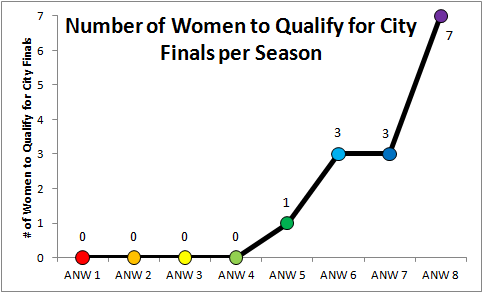
In contrast, in the original rules of Ninja Warrior, everyone competed and the highest ranked individuals moved on to the next round. This quickly resulted in few women being represented beyond the first round (although some women were advanced as “wildcards” at the producers’ discretion). On Ninja Warrior, the audience sees the ranks of all the competitors, so it is very clear how the women do in comparison to the men (not so well, for the most part).

Source: “Numbers of Ninja Warrior: Ladies Night in Philadelphia”

In 2017 (Season 9), the rules were modified to secure slots for women in later rounds. Interestingly, the rule change was in response to fan interest in seeing more women compete. Under the new rules, the top five women in qualifying rounds would advance and the top two women in the city finals would move on to national finals. This format results in some women moving forward based on performance in relation to all competitors and other women moving on based on their performance in relation to other women. For example, in Philadelphia qualifiers in Season 10, three women earned a spot in the city finals based on their overall rank in the competition and the next two highest-ranking women (although lower ranking than some men) also advanced to the City finals to attain the minimum of five women advancing.

From a feminist perspective, which approach is best for showing women’s strength in competition? Do you prioritize representation and visibility for women, giving equal time to men and women throughout the competition as in The Titan Games? Or do you prioritize eliminating gender as an organizing category, providing the opportunity for (some) women to be ranked higher than (some) men, and including the potential for participation of folks outside the gender binary as in the original Ninja Warrior rules? Or do you try to do both?

Five women moving on from American Ninja Warrior Philadelphia qualifiers to city finals in Season 10. (Click for Source)

This question matters because there are real stakes to the way we see strength in pop culture. The way we consider gender and physical strength affects many women, even those who are not elite athletes. For example, in my own research on the construction trades, many tradeswomen face assumptions and stereotypes about women’s physical ability that disadvantage them throughout their careers. It’s important to disrupt discourses about strength when they are leveraged to unnecessarily disadvantage women. Not all women (or men) have the physical ability to do construction work. But many do. 

Strength competitions like these might seem to support stereotypes, but our scientific understanding of strength raises some troubling ideas about perceived “natural” differences of the body. Biological differences between men and women are not a clear as some would like to believe, this had led to problems with determining athletes’ genders for competition. In the US, large and muscular bodies are seen as desirable for men and problematic for women; this shapes who trains to complete in these types of competitions. If more women trained for strength-based competitions, we can assume the gap between men and women in these competitions would shrink, but not fully disappear. Similar trends have occurred in long distance running.

It’s difficult to imagine that anyone who has seen the women competitors on these shows could believe that women are not strong enough to do construction. Especially if you watched the first episode of The Titan Games and saw Tina Rivas, a sheet metal installer. And as she said about her work, “I am the only woman. So obviously that’s a little bit hard. But I can handle it.” Indeed.

Maura Kelly is an Associate Professor of Sociology at Portland State University. Her research and teaching interests include gender, sexualities, social inequality, work and occupations, and popular culture. Her current research is primarily focused on the experiences of women and people of color in the construction trades as well as policy and programs intended to increase the diversity of the construction trades workforce. She is the co-editor of the forthcoming book Feminist Research in Practice (Rowman & Littlefield 2019).

The rise of online shopping at the holiday season highlights some pretty Grinchy behavior. Local news and home security companies have been trumpeting market research about so-called “porch pirates” swiping deliveries before people can get home from work or school to bring them inside.

Most of the current solutions for package security aren’t that great. If you don’t feel comfortable trusting Amazon or some other company to remotely run your door locks for deliveries (or if you live in an apartment building without a fancy mailroom), getting packages can be a gamble unless you can route them to a secure delivery site. If someone wants to send you a gift with all the warm intentions of a classic Christmas tradition, their surprise could end up costing everyone a lot more time, money, and stress.

That friction between the idea of the gift and the gift itself is a great example of sociological theory at work. Pierre Bourdieu wrote about gift exchanges throughout his work, especially the idea that giving a gift has a “double truth.” People want to show kindness and generosity, expecting nothing in return, but gifts are still exchanged in relationships. That exchange implicitly demands some things: your thanks, your continued commitment to the relationship, and often a different gift at a different time. This seems like a contradiction, but both things can be true because there are different styles of gift-giving tied to time and place. Exchange too quickly and you look like you’re trying to tie up a relationship and move on. Respond too slowly, and it looks like you have forgotten your loved ones.

To betray one’s haste to be free of an obligation one has incurred, and thus to reveal too overtly one’s desire to pay off services rendered or gifts received, so as to be quits, is to denounce the initial gift…It is all a question of style, which means in this case timing and choice of occasion, for the same act-giving, giving in return, offering one’s services, paying a visit, etc. – can have completely different meanings at different times, coming as it may at the right or the wrong moment… (Outline of a Theory of Practice, 1977, Pp. 5-6)

Package pirates put a whole new strain on our relationships at special occasions. Now, if someone mails you a gift, accepting it gracefully might also mean being responsible for its security. What happens if your apartment has said they will not be liable for packages delivered, or your work schedule may not get you home in time to receive them? Do you sound ungrateful if you complain about these things or ask not to receive gifts?

On the other hand, it might also become much more rude to send someone a holiday surprise without a heads up first. It is also important to ask ourselves whether we are putting the idea of sending a gift ahead of the actual experience of our loved ones receiving it.

This time of year, we often say “it’s the thought that counts.” If that’s true, we might have to think carefully about some of the social norms for sending gifts until the shipping industry can catch up.

Evan Stewart is an assistant professor of sociology at University of Massachusetts Boston. You can follow his work at his website, or on BlueSky.

For better or worse, pop culture models some of our deepest assumptions about social relationships. One classic example is the Hollywood double standard when it comes to gender and aging—leading men get to age while the media expects most leading women to stay forever young. This can lead to age gaps on screen that mirror uncomfortable patterns of gendered power in society.

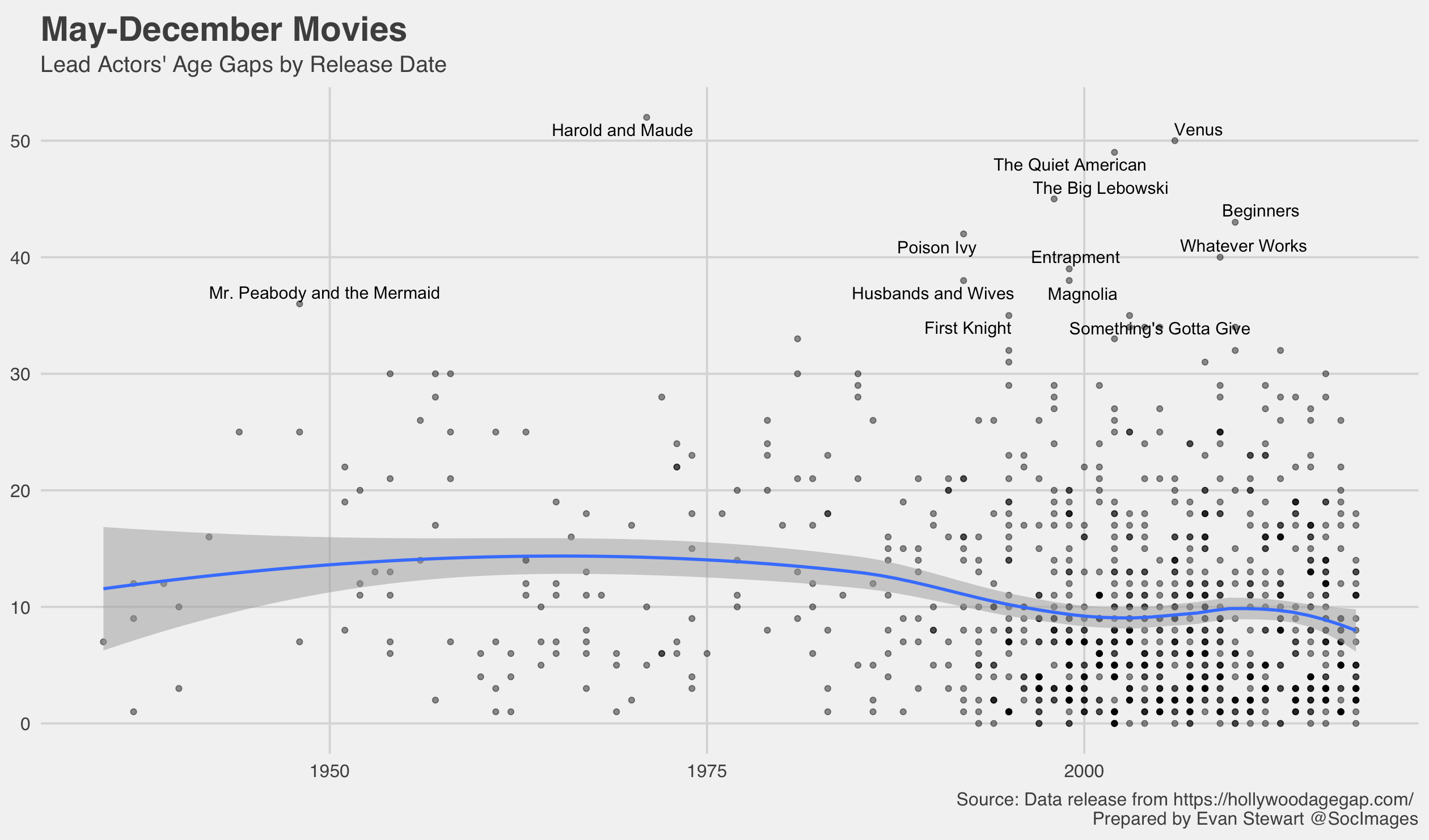
Has this trend gotten better or worse over time? I recently came across some great open data from the Hollywood Age Gap project, where Lynn Fisher has collected the ages of actors playing the romantic leads in over 600 films to calculate the actual age gaps behind the on-screen relationships. The website does an excellent job showing the gaps for each movie individually, but we can also look at them in the aggregate. It turns out that as more movies are produced, more also tend to have smaller age gaps between the leads. The average age gap for films in this data set sits just below 10 years since 2000, down from average gaps of about 15 years through the 1970s.

(Click to Enlarge)

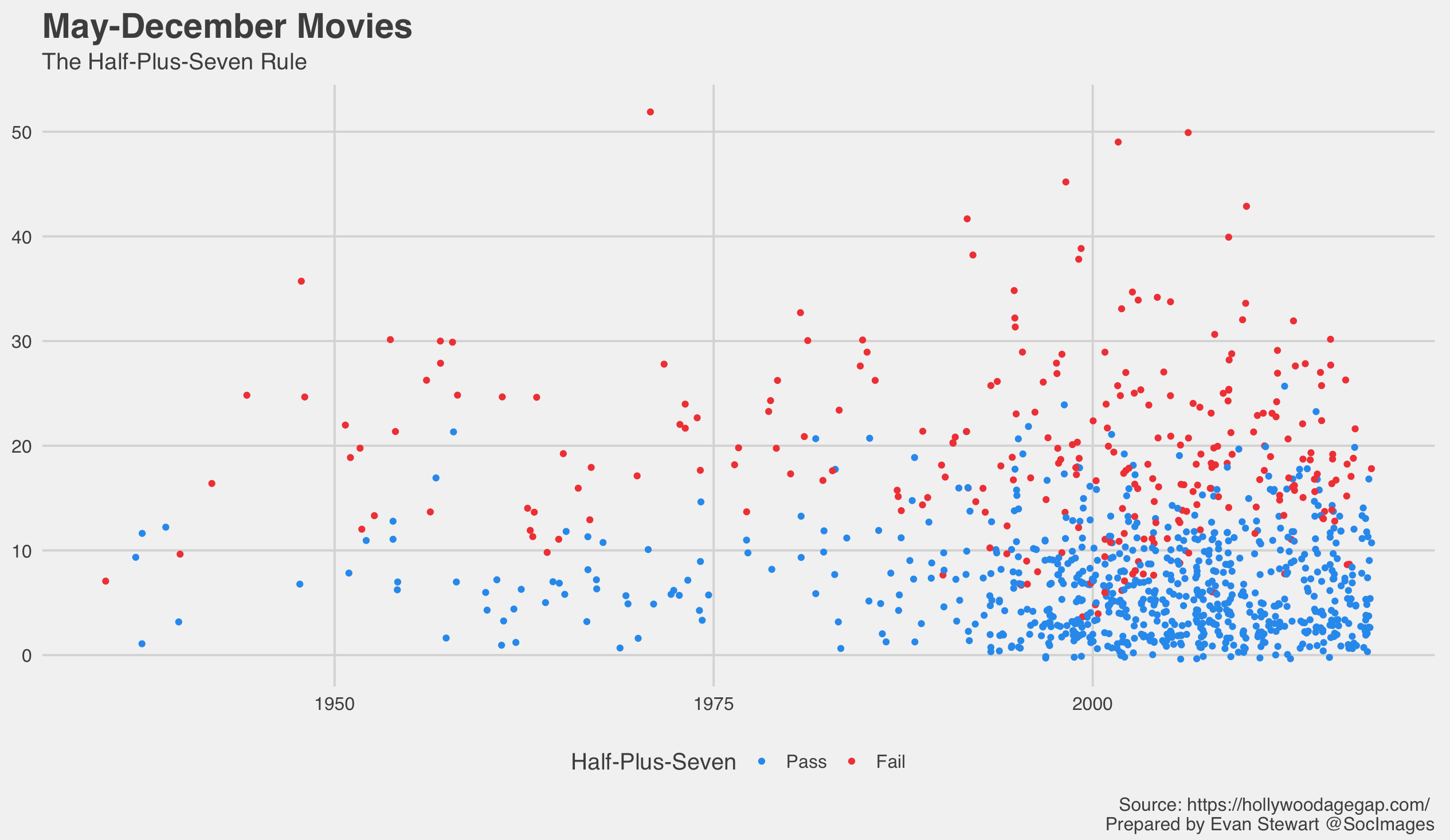
We also know that social context matters for relationships. If both people are older, for example, smaller age gaps aren’t as big a deal. The classic “half-your-age-plus-seven” shortcut is one example of the kind of informal rules cultures can develop to figure these things out. After a little math, I color coded the age gaps using this common shortcut. About 27% of the movies in this data set fail the test. Notice how the rule cuts both ways—some larger age gaps pass the test because both actors are older. Other smaller age gaps fail the test.

(Click to Enlarge)

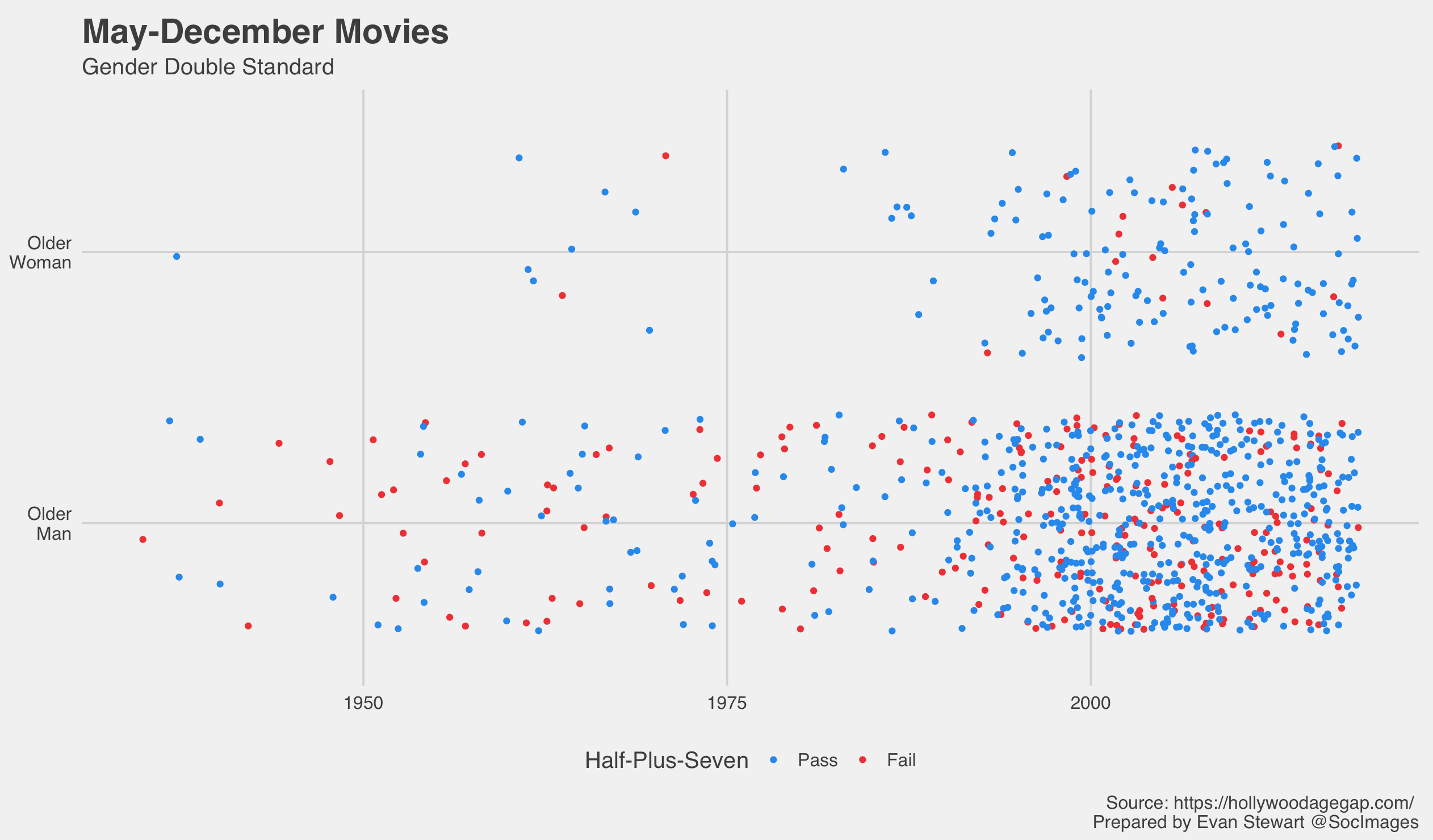
However, there is still a massive gendered double standard in these movies. Once we remove the 20 instances of same-sex relationships in the data set, 83% of the cases have an older man and only 17% of cases have an older woman. The older men cases are also more likely to violate the half-plus-seven rule (based on a quick chi-square test for gender of older actor x half plus seven status – p<.001).

(Click to Enlarge)

The news here is a mixed bag. While average age gaps as a whole are on the decline, these data show how Hollywood still has a gendered double standard for who has to act in a potentially “creepy” scenario on screen.

Evan Stewart is an assistant professor of sociology at University of Massachusetts Boston. You can follow his work at his website, or on BlueSky.
Political drama over the past few years has driven us to take a new look at bridging social division. Pundits worry about filter bubbles, cultural enclaves, and the way “identity politics” might be driving us apart into groups that understand each other less and less. The theory assumes we do a lot of identity policing—we figure out who we are, anchor that on who we are not, and spend a lot of time and effort policing that boundary to keep other people out. If everyone self-sorts into similar identity communities, it can be harder to connect in a diverse society.

But is that really what’s happening? Sociologists know that identities are a key part of cultural membership, but we often complain about “identity politics” for certain groups and ignore it for others. Now, new research shows how focusing on one kind of identity can bring people together, rather than pushing them apart.

Photo Credit: Ted Eytan, Flickr CC

In a new study published in Sociological Science, Adam Horowitz and Charles Gomez look at “identity override”—a process where a shared identity can lead people to bridge other social divides. Using data from the National Longitudinal Survey of Adolescent to Adult Health, they find evidence for an interesting case of identity override: people who identify as lesbian, gay, or bisexual (GLB) have more friendships and relationships with people from different racial groups.

Identity was the key factor here; people who reported same-sex relationships but didn’t identify as LGB didn’t show the same patterns. Rates of interracial relationships also held after the authors controlled for other demographics and whether respondents lived in urban areas. Racial segregation still persists in the United States, but it looks like coming out and coming together encourages interracial social ties that can overcome some of these barriers. Horowitz and Gomez write,

the cross-racial nature of GLB membership allows it to override the otherwise high borders between people without such a second salient identity.

This research provides a little bit of good news for a world that seems full of conflict. In this case, there’s some evidence that investing in an identity doesn’t always mean cutting other people off.

Evan Stewart is an assistant professor of sociology at University of Massachusetts Boston. You can follow his work at his website, or on BlueSky.

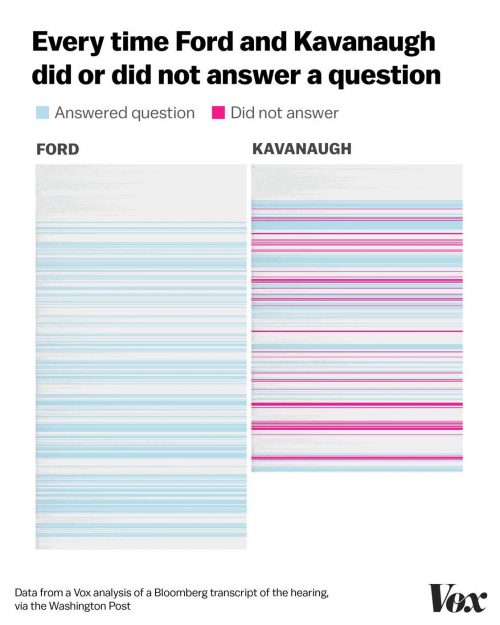
Everyone has been talking about last week’s Senate testimony from Christine Blasey Ford and Supreme Court nominee Brett Kavanaugh. Amid the social media chatter, I was struck by this infographic from an article at Vox:

Commentators have noted the emotional contrast between Ford and Kavanaugh’s testimony and observed that Kavanaugh’s anger is a strategic move in a culture that is used to discouraging emotional expression from men and judging it harshly from women. Alongside the anger, this chart also shows us a gendered pattern in who gets to change the topic of conversation—or disregard it altogether.

Sociologists use conversation analysis to study how social forces shape our small, everyday interactions. One example is “uptalk,” a gendered pattern of pitched-up speech that conveys different meanings when men and women use it. Are men more likely to change the subject or ignore the topic of conversation? Two experimental conversation studies from American Sociological Review shed light on what could be happening here and show a way forward.

In a 1994 study that put men and women into different leadership roles, Cathryn Johnson found that participants’ status had a stronger effect on their speech patterns, while gender was more closely associated with nonverbal interactions. In a second study from 2001, Dina G. Okamoto and Lynn Smith-Lovin looked directly at changing the topic of conversation and did not find strong differences across the gender of participants. However, they did find an effect where men following male speakers were less likely to change the topic, concluding “men, as high-status actors, can more legitimately evaluate the contributions of others and, in particular, can more readily dismiss the contributions of women” (Pp. 867).

Photo Credit: Sharon Mollerus, Flickr CC

The important takeaway here is not that gender “doesn’t matter” in everyday conversation. It is that gender can have indirect influences on who carries social status into a conversation, and we can balance that influence by paying attention to who has the authority to speak and when. By consciously changing status dynamics —possibly by changing who is in the room or by calling out rule-breaking behavior—we can work to fix imbalances in who has to have the tough conversations.

Evan Stewart is an assistant professor of sociology at University of Massachusetts Boston. You can follow his work at his website, or on BlueSky.