Search results for The

Edward L. sent in a link to Ultra Culture’s post about trailers for the new Will Smith movie “Seven Pounds” market the movie differently depending on whether the target audience is men or women. Ultra Culture’s analysis is funnier than anything I’d say, so I’m just going to quote it.

Here’s one trailer:

[youtube]https://www.youtube.com/watch?v=7kpK1fKzoDs[/youtube]

Ultra Culture says:

WOMEN!
This is the film for you! Its got that sexy Will Smith in it (from Hitch!) and just look at all the emotional turmoil he’s going through with Rosario Dawson. And did you see that? It’s directed by the guy who did Pursuit of Happyness! What a lovely, life-affirming film that was.

Another trailer:

Again from Ultra Culture:

MEN!
This is the film for you! Its got that cool Will Smith in it (from Hancock!) and just look at all that fast paced action he’s going through with that gruff-voiced man. And those fast cuts, whooshing noises and gradually fading words remind me of Enemy of the State! What a heart-pounding thrill-ride that was.

You might pair this with a discussion of how other products are marketed differently to men and women, such as cars or food.

Thanks, Edward!

Gwen Sharp is an associate professor of sociology at Nevada State College. You can follow her on Twitter at @gwensharpnv.
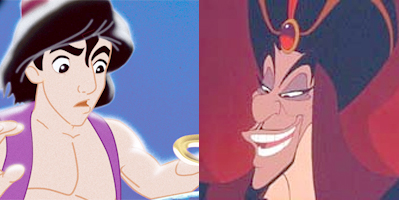
A Cracked article compiled their candidates for the Nine Most Racist Disney Characters. Select stolen clips and liberal quoting below:

American Indians in Peter Pan:

Why do Native Americans ask you “how?” According to the song, it’s because the Native American always thirsts for knowledge. OK, that’s not so bad, we guess. What gives the Native Americans their distinctive coloring? The song says a long time ago, a Native American blushed red when he kissed a girl, and, as science dictates, it’s been part of their race’s genetic make up since. You see, there had to be some kind of event to change their skin from the normal, human color of “white.”

The bad guys in Alladin:

“Where they cut off your ear if they don’t like your face” is the offending line, which was changed on the DVD to the much less provocative “Where it’s flat and immense and the heat is intense.”

In a city full of Arabic men and women, where the hell does a midwestern-accented, white piece of cornbread like Aladdin come from? Here he is next to the more, um, ethnic looking villain, Jafar.

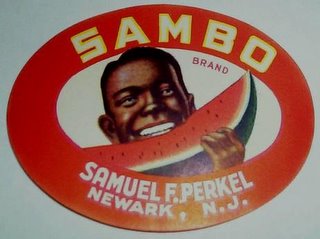
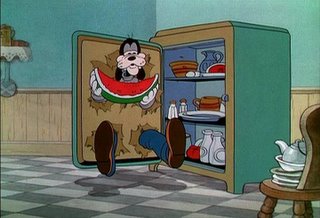
NEW: Miguel (of El Forastero) sent in a post from El Blog Ausente that compares an image of Goofy, a character generally portrayed as sort of dumb and lazy, to a traditional Sambo-type image:

sandia_goofy

sambo_watermelon

The post suggests that Goofy is a racial archetype, built on stereotypical African American caricatures. I can’t remember ever seeing anything that suggested this, but that doesn’t mean much, and I certainly don’t put it past Disney to do so. Does anyone know of any other examples of Goofy supposedly being based on African American stereotypes? On the other hand, is it possible to depict a character eating watermelon in an exuberant manner without drawing on those racist images? When I look at the image of Goofy above, I have to say…that’s pretty much what it looks like when my (mostly White) family cuts a watermelon open out on the picnic table in the summer and everybody gets a piece and they all have ridiculous looks on their faces as they dribble juice all down themselves eating big chunks (I say “they” because I’m a weirdo who doesn’t really care for watermelon, so I rarely eat any, and even then only if I can put salt on it). I’m fairly certain that I couldn’t put up a photo of my family eating watermelon like that without it seeming, to many people, to draw on the Sambo-type imagery. It brings up some interesting thoughts about cultural and historical contexts, and how and in what circumstances you can (or can’t) escape them, regardless of your intent.

Lisa Wade, PhD is an Associate Professor at Tulane University. She is the author of American Hookup, a book about college sexual culture; a textbook about gender; and a forthcoming introductory text: Terrible Magnificent Sociology. You can follow her on Twitter and Instagram.

My friend Steve sells Cessnas (single engine propeller planes, usually with between two and four seats).  A four-seater basic single-engine Cessna will cost you about $200,000, plus insurance, hanger fees, regular maintenance, and check-ups.   They aren’t particularly fast (not jets): the $200,000 one will get you somewhere about twice as fast as a car.  The gas will cost you about twice as much.   And there’s a much bigger carbon footprint.

Last summer, Steve sold a six-seater single-engine Cessna to France.  Since someone had to fly it (and the trip was paid for), we decided to take it there ourselves.  (Okay, Steve decided to take it there himself; I decided to sit in the passenger seat.)  Among other things, the adventure was a fascinating look at how the other half, eh em, top one percent lives.  In this post, I’m going to talk about the terminals serving private planes (also posted about here).   If you fly by private plane, you don’t go to the main terminal.  There is a separate private terminal.  We went through a lot of those terminals as we flew from Omaha, Nebraska; to Bangor, Maine; to Goose Bay-Happy Valley, Canada (Newfoundland-Labrador border); to Narsarsuaq, Greenland; to Reykjavik, Iceland; to Aarhus, Denmark; and, finally, to Nice, France.

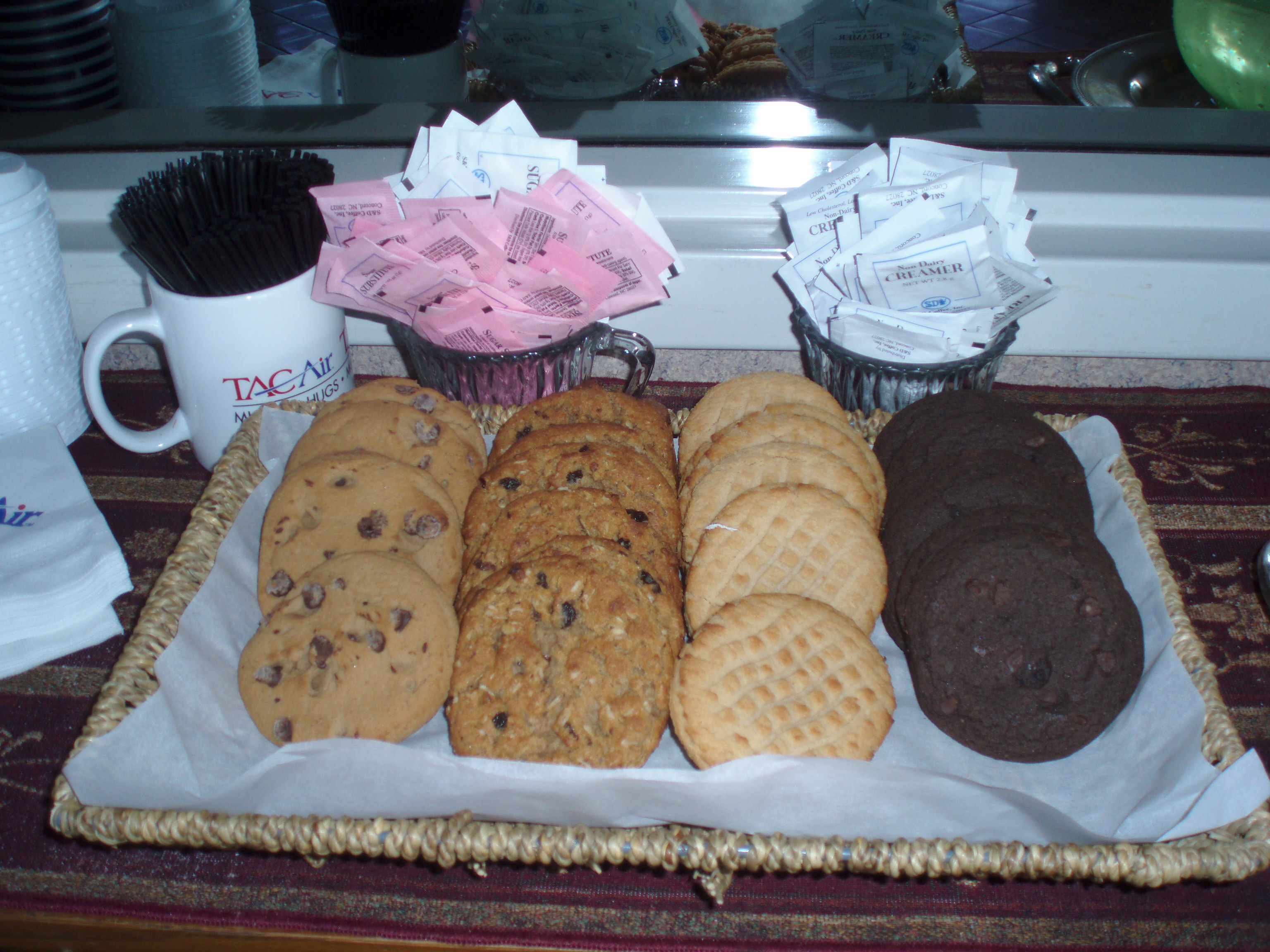
Because I have my priorities straight, the first thing I noticed about these terminals is that they all have free treats: muffins, candy, or cookies:


There was also always free coffee and soda and bottled water. (This, I gotta tell you, was torture because I was off caffeine for the trip and, on top of that, couldn’t drink anything before taking off because of the whole no-bathroom-on-the-plane-thing and living below the poverty line until you’re 32 really instills a desire to pilfer anything that’s not nailed down.)

Private plane travel is figuratively as well as literally delicious.  There is no “long-term parking.”  You park your car right up front in the complimentary parking lot.  Honestly, going to the grocery store is more challenging.  In the private terminal, you can wander about as you please; your things will not be confiscated if you leave them unattended. There are no announcements.  You will not wait in line.  There is no security, except that which is designed to make your life more comfortable. You will not be asked to walk through an x-ray machine or show anyone any paperwork. There are computers available if you would like to use them and free wireless if you brought your own. You will leave whenever you like and stay as long as you please.  And how nice, since the facilities are incredibly comfortable.

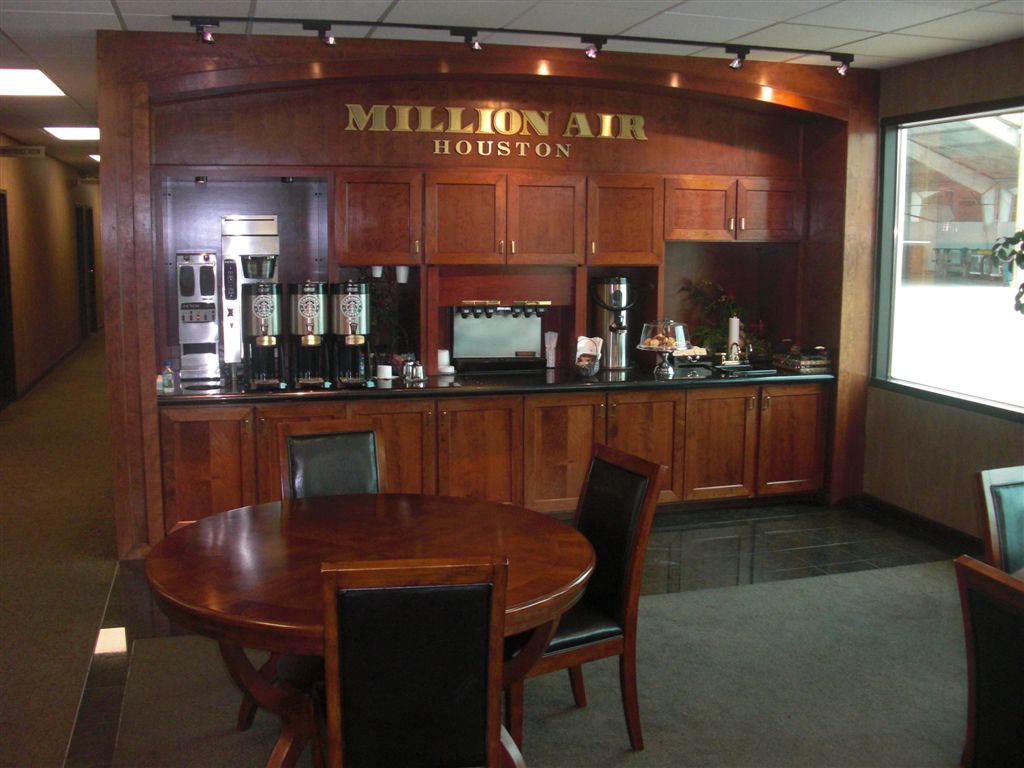
Steve let me borrow these photos from the Houston Million Air.  The main desk:

CIMG3372

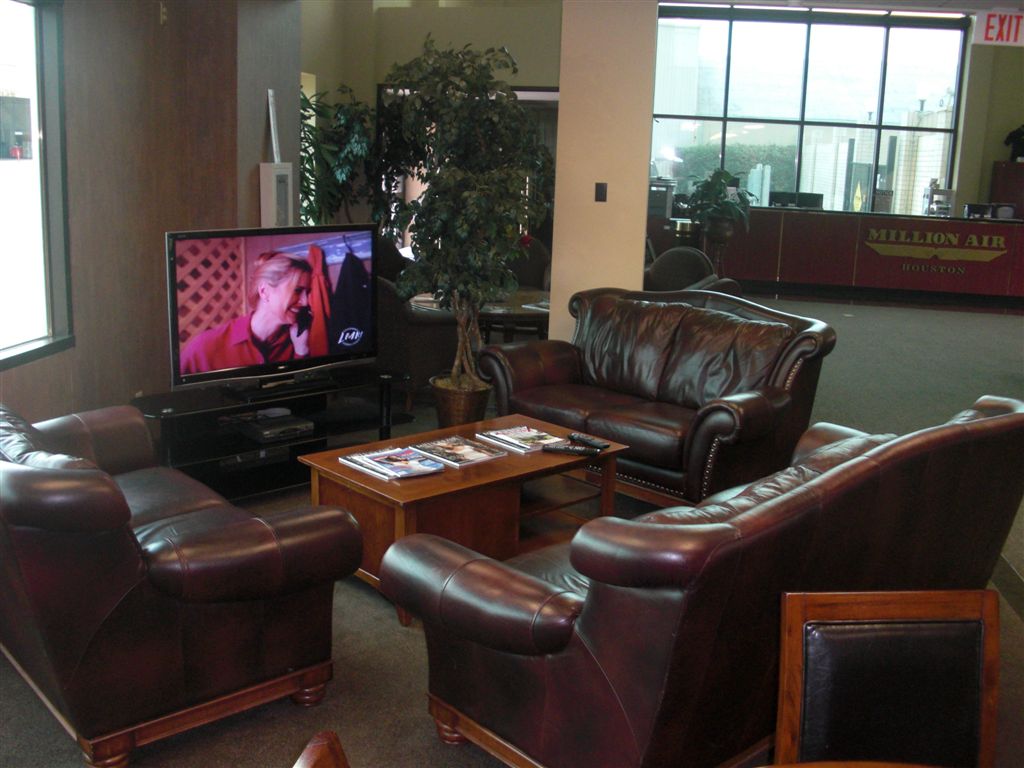
A lovely place to sit and watch TV comfortably:

CIMG3373

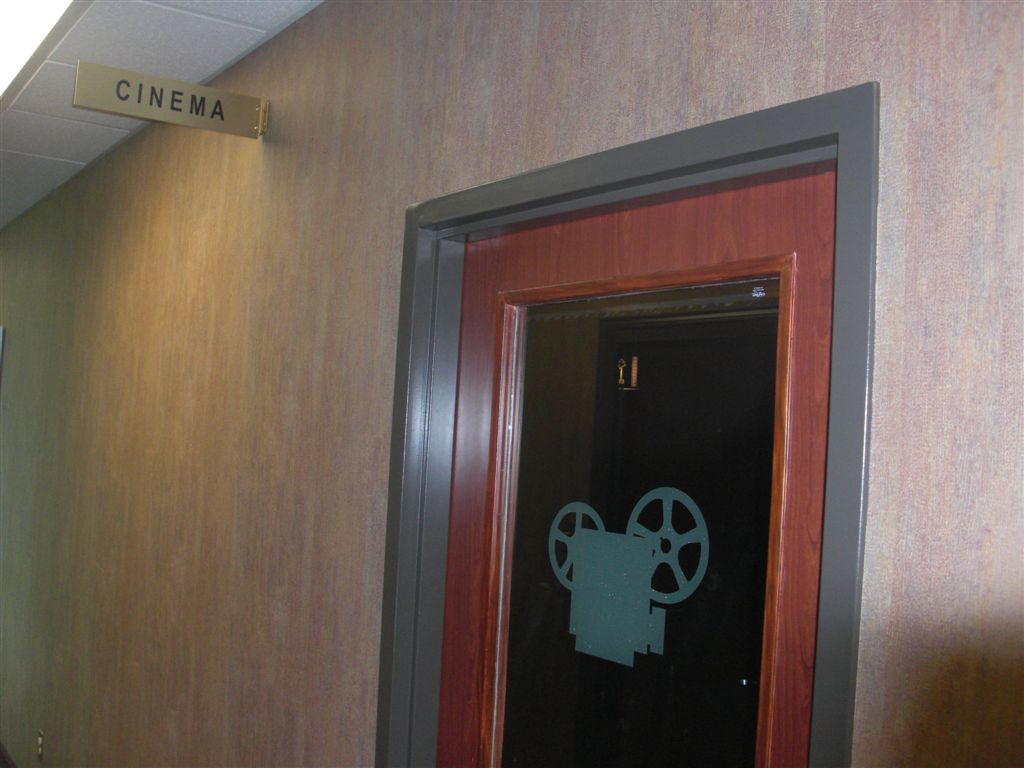
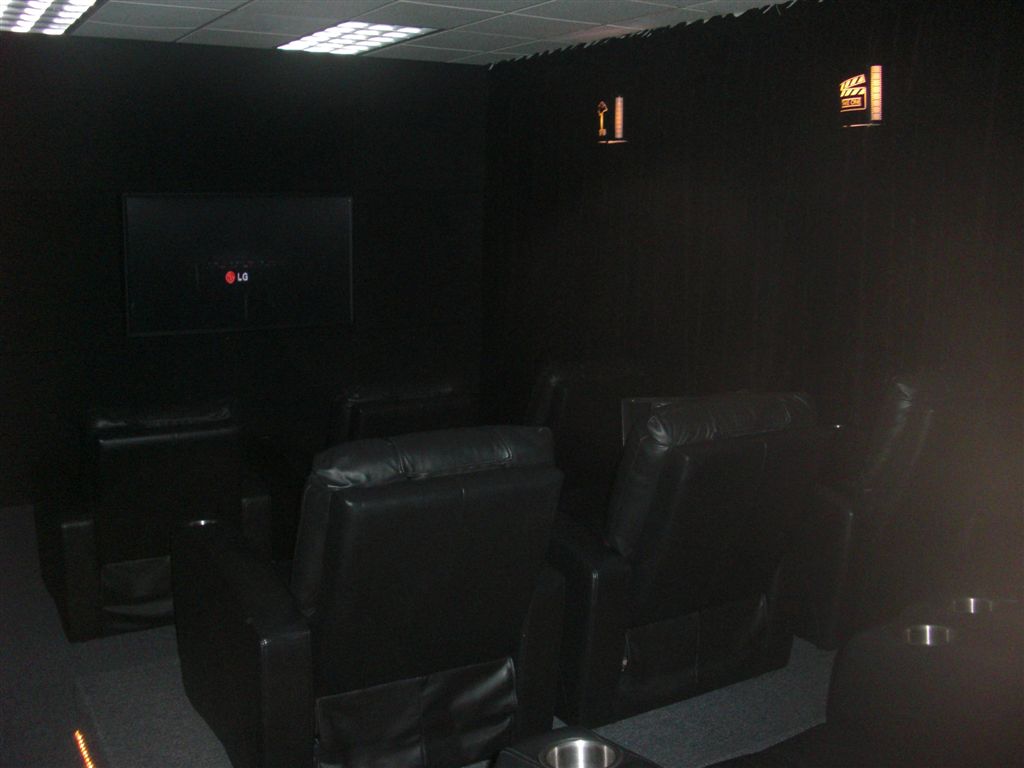
And if that isn’t good enough for you, a free, private cinema:

CIMG3371

CIMG3367

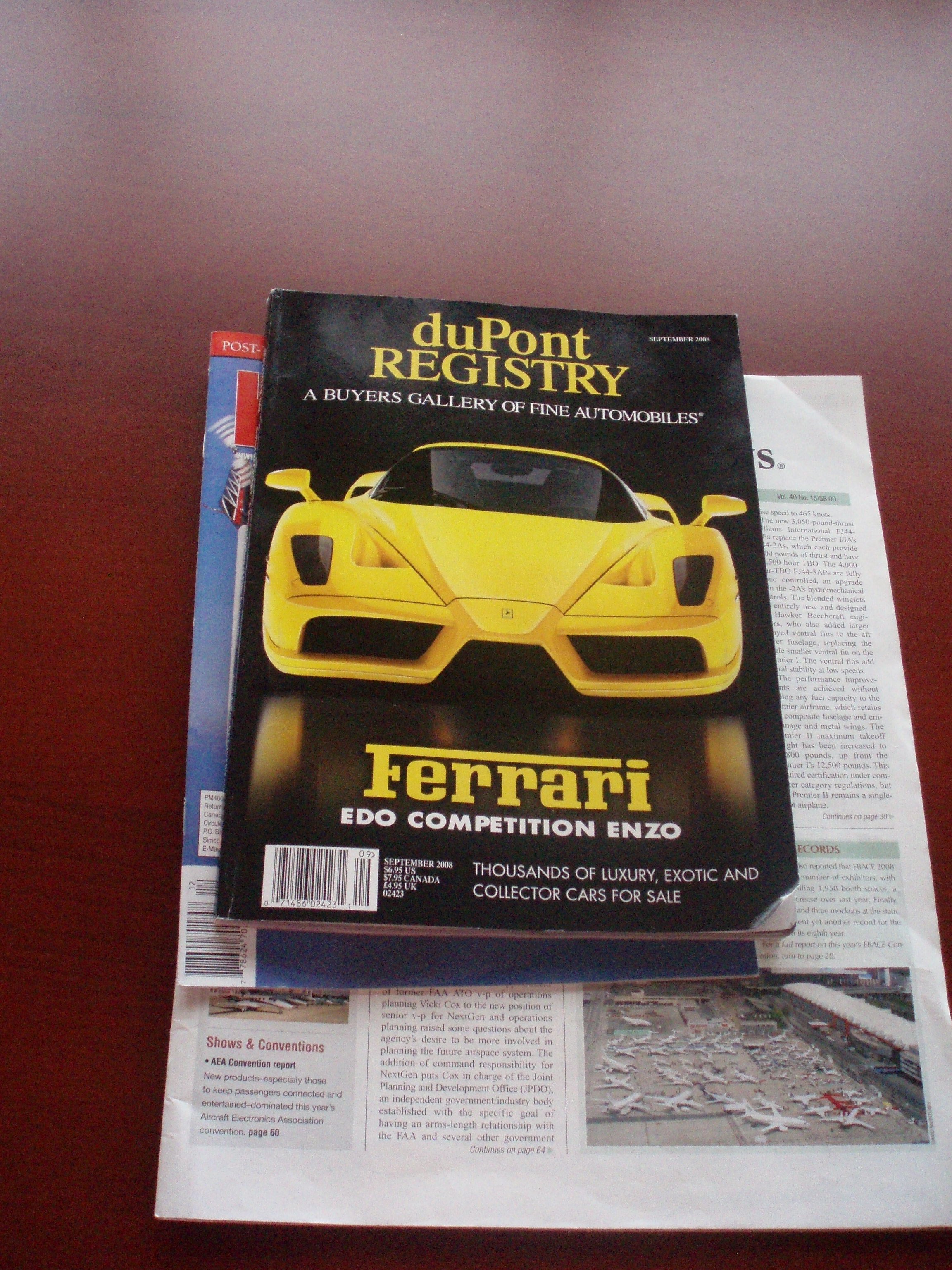
There were also free magazines about things like investments, yachts, and other expensive things:


This is where I got the ads and articles aimed at exeedingly rich people that I have been posting recently (see here, here and here).

When we decide to leave, we just waltz out to our plane, jump in and taxi to the runway.  We would call ground control, say “we’re ready,” and they’d say “go ahead.”   We never waited more than three or four minutes to get clearance to take off.

When we landed, we’d taxi over to the terminal, jump out of the plane and wander in.  The interaction would go something like this:

THEM: Welcome Sir and Miss. Can we get your bags?

STEVE: Please.

[They go out and start unloading the plane.]

THEM: Can we arrange for a hotel?

STEVE: Why yes.

THEM: Will do. Would you prefer downtown or on the water?

STEVE: The water will be lovely.

THEM: One moment, please. [The hotel is called.] Your room is booked. Would you like us to arrange a rental car for you or would you like a ride to the hotel?

STEVE: We will take a rental car, please.

THEM: It will be just a few minutes. Please enjoy our complimentary beverages, delightful morsels, overstuffed chairs, and free wireless while you wait.

STEVE: We certainly will.

I am totally not kidding.

You could also call ahead and request a rental car.  In this case, they would drive it right up to your plane, unload your bags for you, and you’d just scoot across the tarmac and be off!

One final tidbit:

Steve and I left the U.S. and entered five different countries over the course of our trip.  We got through Canada and Greenland without being asked for our passports.  Iceland would be both the first and the last place we were required to show I.D.  Denmark and France welcomed us with wide arms and trust.  We were the special people.

UPDATE: Several commenters pointed out that once Steve and I were through Iceland, the law grants us entry to Denmark and France without I.D. Thanks for the correction!

I saw this bumper sticker yesterday:

Text:

If you can read this, thank a teacher. If you’re reading it in English, thank a soldier.

It reminded me of when Lisa and I visited the Atomic Testing Museum here in Vegas last year (inspired posts here and here). There was a video about atomic testing in Nevada with a lot of scientists who took part talking about it. Several of them said things to the effect of, “Yeah, ok, so it turns out testing nuclear bombs had some negative effects for people, and we’re sorry about that. But we had to do it, and if we didn’t, you’d be living in the Soviet Union right now!”

I understand that the point of the bumper sticker is that speaking English means we haven’t been taken over by some other country that doesn’t speak English (apparently we don’t have to worry about Britain, Canada, or the many former colonies where at least a large minority speak English or where it is the language used for official government matters) and haven’t been forced to adopt their culture. But I have to say, when I think of things that would worry me if some other country took over the U.S., whether we’d continue to speak English wouldn’t be my top concern.

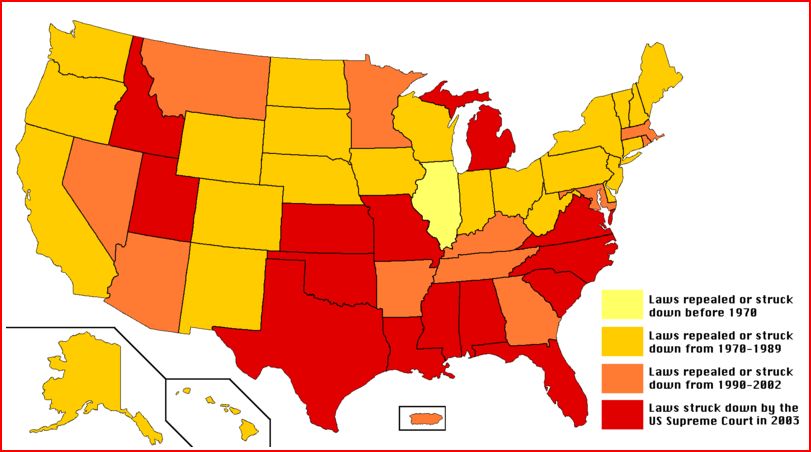
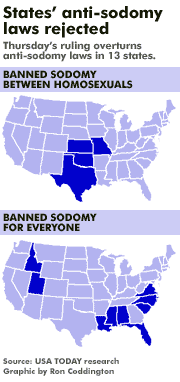
At one point in U.S. history, sodomy was illegal in every state. In the penal codes (no pun intended), sodomy was sometimes defined as anal sex, sometimes as oral sex, and sometimes both. In some cases, the laws applied only to same sex partners, in other cases to any two partners (even husband and wife).

This map (found here) shows when each state repealed its law:

In 2003, the Supreme Court made all such laws unconstitutional. This image (found here) shows which states had sodomy laws that applied to same sex couples and those that had laws that applied to all couples:

Velanie W. sent me this video (found at here), in which the parents clearly think it’s funny that when their toddler daughter says “sparkling wiggles,” it sounds like she’s saying something very different:

(after the jump b/c it automatically plays and that gets annoying)…
more...

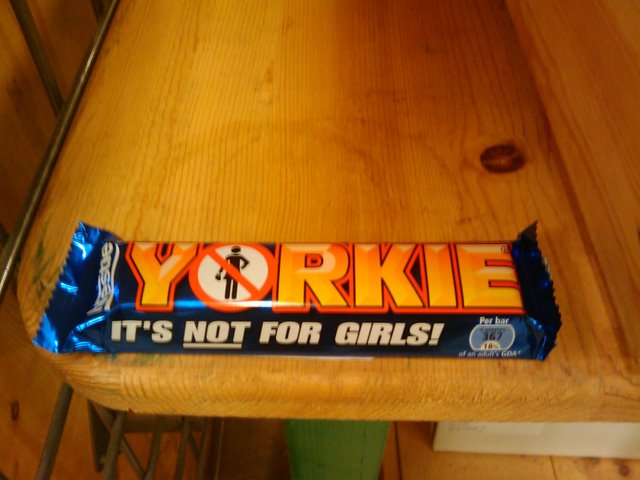
Both Cole S. and Toban B. found this Nestle’s candy bar (Cole saw it at World Market):


The Yorkie website was down (the error message said for routine maintenance) when I tried it, but Toban managed to snag some quotes from it earlier that indicate how the bar is being marketed to men. The bar is described as “a big, solid, chunky eat, uniquely for men,” and the site goes on:

Yorkie is positioning itself as a chocolate bar for men who need a satisfying hunger buster. With five solid chunks of chocolate, it’s a man sized eat…

[Earlier] advertising reflected this with macho imagery – lorry drivers who take it one chunk at a time…
Yorkie still holds these values today but was relaunched in 1994 as a hunger satisfying bar.

It’s similar to the way that Hungry Man frozen dinners are marketed: the association with working-class male appetites, which presumably require big, “solid” meals to satisfy them after their hard days of work. Clearly any candy bar this serious isn’t appropriate for women. Oh, excuse me…not a candy bar, a hunger-satisfying bar. Women eat chocolate for emotional reasons or to bask in the luxury of the taste; men eat chocolate just to fill their stomachs. Notice that the advertising doesn’t focus on the types of things we generally see in Dove or Hershey’s ads for chocolate bars: the chocolate being rich, smooth, delicious, etc., which imply that eating chocolate is an indulgence rather than just a practical way to satisfy your hunger.

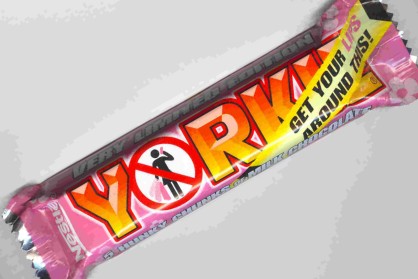
Also, in our comments Trevor pointed us to a conversation about a pink version of the Yorkie.  I am completely perplexed.  Along the top it says “VERY LIMITED EDITION.”  Along the bottom is says “5 HUNKY CHUNKS OF MILK CHOCOLATE.”  Along the top, diagnolly, it reads: “GET YOUR LIPS AROUND THIS!” 

So is it a girl version?  I can’t tell.  The female figure is still crossed-out with the “no” symbol.  I don’t know what pink thing she is holding.  I am perplexed.

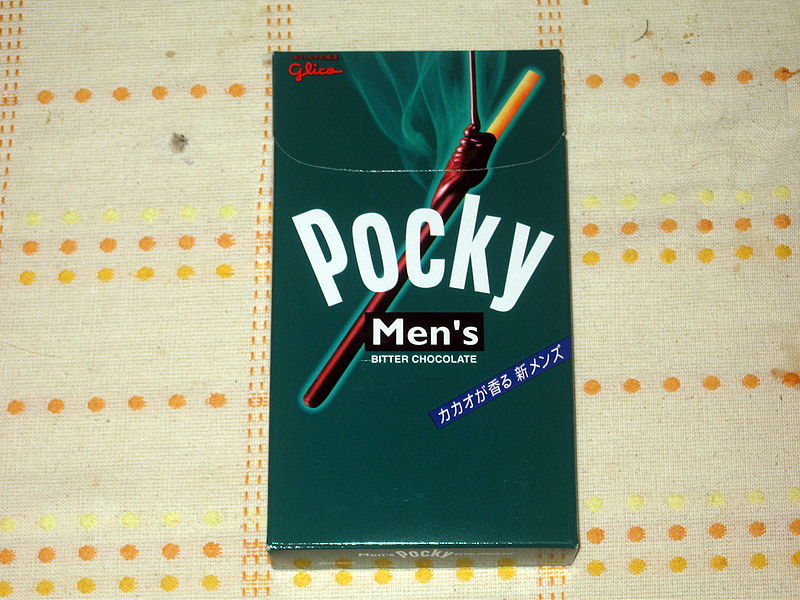
Also note, Men’s Pocky (thanks Lis Riba): 

Candy, like other high-sugar products, are often gendered female.  Perhaps that’s why this candy marketing is making such a big point of making candy manly?  Notice that the Men’s Pocky is “bitter,” i.e., not too sweet.  That seems to be happening a lot these days, as in the new Snickers and Twix marketing, see here, herehere, and here.

NEW! Keely W. sent in a commercial for Mars’ new candy bar aimed at women, Fling (found here).  The message: You shouldn’t (sexually) indulge a lot, but you can (sexually) indulge just a little… with the help of Mars Co., of course.


First, thanks to all of you for making 2008 a great year for Sociological Images!  Our list of 152 blogs that link to us is one tiny way that we try to show our appreciation.  Browse through our list, if you like, and if you link to us in your blogroll and aren’t on there, please send us a note at socimages@thesocietypages.org to let us know.

Second, as usual, we have been up to some stuff behind your back!  Here it is:

Remember how the swastika didn’t used to connote total evil?  Neither did we. We added several more examples of pre-Nazi uses of the swastika to this post.

The Canadian Centre for Diversity put out an interesting PSA along the lines of the U.S. “I am African” campaign (so brilliantly parodied).  Find the link here.  Thanks to Julie C. for sending it in!

Our post about rape as hyperconformity to masculine norms sparked a ton of comments, many of them negative.  Maybe these screenshots of a whole series of recipes for a drink called the “Liquid Panty Remover” will influence you one way or the other.   Enjoy!  (Thanks to an anonymous commenter and Vidya for pointed us to a hoax billboard that led us to discover these.)

We added another example of an image of sexualized dominance, this time women’s dominance over men, to our post on the theme.  Thanks to Stumblng Tumblr for the submission!

Still on the topic of sex:  Laura at The F Word posted a video of a commercial that just begged to be added to our post on ejaculation imagery.

You wine drinkers are all sissies!  We added another set of ads to this post on messages about masculinity in Jim Beam ads.  Also on the theme of masculinity, we added a Gillette shampoo ad that tells men to “take charge” of their hair to this post about masculinizing beauty products.  And a reader sent us a link to more antics from Dmitri the Lover (I feel gross just writing his name).

We added a series of furnishings shaped like female bodies–mostly tits and asses really–to a post on in-no-way-theoretical objectification. Click here for the post.  Here’s a teaser just for fun:

Relatedly, we added an image of a pole-dancer alarm clock from a catalog to this post featuring the “Bitchcruiser.”  Yeah, you gotta take a look at that one.

On the theme of using women’s bodies to “sell” stuff, here’s another image showing how PETA sexualizes women as a way to advocate vegetarianism.

On gender and socialization, we added a screen shot of an Amazon webpage showing what to buy “for her” and “for him” to our post about gendered holiday gift marketing (sent in by Sofia A.) and we added an image of the video game Imagine: Babies to this post about how Miss Bimbo socializes girls into traditional gender roles.

Speaking of banal stereotypes, Jasmine sent us some more examples of truly boring uses of stereotypes.  This time they are used to promote eye care.  Find them here.

We added an image comparing a Brazilian brand of rum to Brazilian waxes (you know, those kinds of waxes) to make the claim that the brand is authentic to this post.  Because there’s nothing more authentic than a woman waxed to look like a child.  What!?

Finally, what better way to end our list than with a post about animals, “love,” and babies!  A bonded pair of male penguins at a zoo were replacing the eggs of male-female couples with rocks and sneaking off with their eggs.  The zoo keepers helped them legitimately adopt and now everyone’s happy.  We added a picture of this couple to our post about actual “homosexual” pairings among animals.