Search results for The

With technological innovation and the introduction of me-centric online worlds (e.g., blogs, youtube channels, and social networking sites), more than ever before, we have the opportunity to carefully craft a public personality and hope for a measure of celebrity. Many have commented on how this might affect kids who grow up enveloped in these technologies and learn to value, or take-for-granted, the kind of life that they facilitate.

In addition to the fact that mistakes, easily chocked up to immaturity, are now often irrevocable, even viral… some are concerned with rising rates of narcissism, which is correlated with high rates of depression when an unrealistic sense of self comes face-to-face with reality.

Jay Smooth, reflecting on Michael Jackson’s life, beautifully articulates pretty damn profound concerns:

If you don’t follow Jay Smooth, I can’t recommend him enough.

More Jay on SocImages here, here, here, and here.

And here’s his website, Ill Doctrine.

—————————

Lisa Wade is a professor of sociology at Occidental College. You can follow her on Twitter and Facebook.
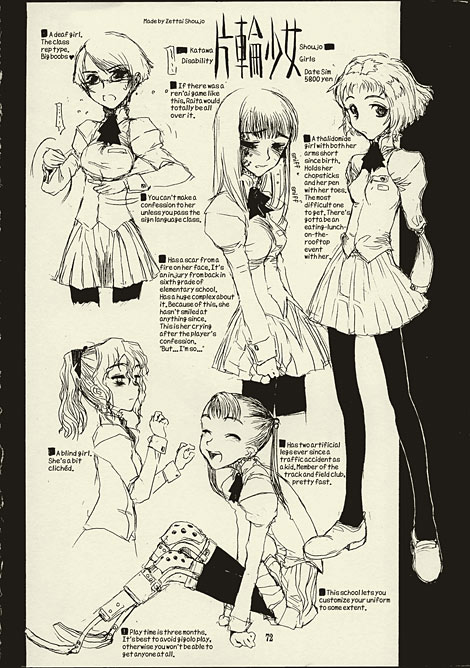
Months ago Ryan emailed us about a video game called Katawa Shouju (sometimes translated as Disabled Girls or Crippled Heart). From the website:

Hisao Nakai, a normal boy living a normal life, has his life turned upside down when a congenital heart defect forces him to move to a new school after a long hospitalization. Despite his difficulties, Hisao is able to find friends—and perhaps love, if he plays his cards right.

A design sketch of the girls:

090430-kawata-shoujo-2

An article at GameSetWatch refers to the game having a “perverse and contemptible premise.”

Ryan says,

A lot of the discussion about this game seems to be about the disabilities of the girls and how disgusting it is. I don’t really share that opinion personally…I don’t really see what’s wrong with casting a girl with burn scars on her face as a love interest within a game. Or for that matter , what’s wrong with casting a girl with no legs or deformed arms as a love interest? I mean, it’s one thing to fetishize…but on the other hand it might be good for someone who has similar disabilities to feel like they can be desirable.

It’s an interesting point. I suspect there are things about the video game I would find disturbing, and if the girls are portrayed in a ridiculing way, that’s problematic. But some of the reactions to it seem to assume that having a person with a disability as a potential love interest is automatically ridiculing them. But why would that be? Why would it be more “contemptible” to portray these women as romantic/sexual interests any more than other women in similar games? Some of the objections to the game are based on the idea that you must be laughing at people with disabilities if you show them as sexy or romantically interesting. But that’s based on the idea that of course they can’t really be sexy, so it’s mean to portray them that way…which points out some interesting assumptions about people with disabilities and their romantic and sexual lives.

Thoughts?

UPDATE: Reader Magnetic Crow says,

I think what bothers me about this is the premise of a “school for disabled kids only”, the fact that the girls are ‘othered’ from the get-go by this isolation, and the fact that this is probably being made to play to an exploitative fetish. Were it any other dating sim, and one of the girls available for dating just happened to have been born with no arms, or had lost her legs in a traffic accident, I would feel a lot more comfortable.

Other posts about video games: Evony’s boob ads, gender and race in RuneScape, Border Patrol game, Miss Bimbo and Sexy Beach 3, Rape Simulator, My Life, Medal of Honor’s all-White military, a game called Battle Raper that is exactly what it sounds like, blaming moms for video game addiction, sales of Grand Theft Auto, and “military entertainment.”

We also have a posts of a girl with a limp as an ugly friend, Goodyear ad featuring a sad kid in a wheelchair, nude calendar of Paralympic athletes, dolls with Down’s Syndrome, models with disabilities in a British Top Model show, representing people with disabilities, what is an “alt model”?, and amputee model Viktoria.

Eugene Robinson:

Republicans’ outrage, both real and feigned, at Sotomayor’s musings about how her identity as a “wise Latina” might affect her judicial decisions is based on a flawed assumption: that whiteness and maleness are not themselves facets of a distinct identity. Being white and male is seen instead as a neutral condition, the natural order of things. Any “identity” — black, brown, female, gay, whatever — has to be judged against this supposedly “objective” standard.

Thus it is irrelevant if Justice Samuel A. Alito Jr. talks about the impact of his background as the son of Italian immigrants on his rulings — as he did at his confirmation hearings — but unforgivable for Sotomayor to mention that her Puerto Rican family history might be relevant to her work. Thus it is possible for Sen. Jeff Sessions (R-Ala.) to say with a straight face that heritage and experience can have no bearing on a judge’s work, as he posited in his opening remarks yesterday, apparently believing that the white male justices he has voted to confirm were somehow devoid of heritage and bereft of experience.

Stephen Colbert:

The Colbert Report Mon – Thurs 11:30pm / 10:30c
The Word – Neutral Man’s Burden
www.colbertnation.com

If you can’t view the video, there’s a transcript after the jump, thanks to Macon D at Stuff White People Do.

Jay Livingston:

In the Sotomayor confirmation hearings, Republicans have swarmed on Ricci v. DeStefano, the New Haven firefighters case. To hear them tell it, Sotomayor flung the law aside in upholding the lower court decision. She, the majority of the Second Circuit Court, the Federal judge who wrote the original opinion, and the four dissenting Supreme Court justices all based their opinions entirely on a preference for blacks and Hispanics and an animus towards whites. They didn’t consider the law.

By contrast, the five males (four of them white) on the Supreme Court who sided with the white male plaintiffs based their decision wholly and impartially on the law. Their race had nothing to do with it.

The Republican strategy depends on the tendency for privilege to remain invisible.

The transcript after the jump:

more...

Michelle Braun allegedly runs a very large prostitution ring and may be making a deal with the authorities in which she reveals her clients.  The clip from KTLA news below reveals our bizarre, confused relationship with sexuality.  In the clip, reporters suggest that her celebrity clients are likely “shaking in their boots” and “sweating bullets,” have a sort of gleeful disapproval of the whole thing, and yet can’t stop making suggestive remarks: it’s a “juicy” story, Braun is “cozying up to feds,” has a “naughty list” that may be “exposed,” she’s going to tell “all of her dirty little secrets” (that one is used twice).  Of course, you could also just measure the hypocrisy by the on-site reporter’s self-satisfied laugh.

Most of the good stuff is in the first 40 seconds, the remainder is just embarrassingly bad reporting:

—————————

Lisa Wade is a professor of sociology at Occidental College. You can follow her on Twitter and Facebook.
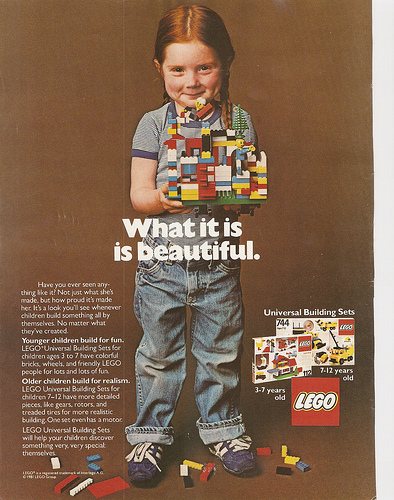
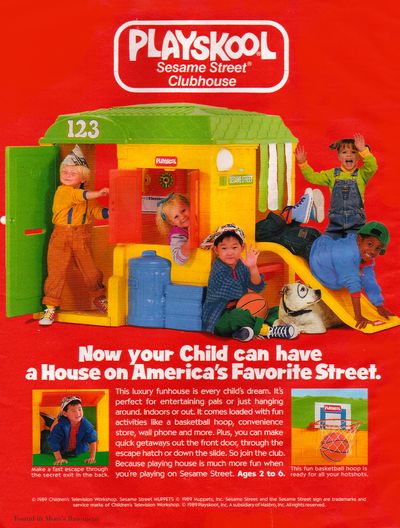
I love this 1981 Lego ad, sent in by Nora R. (found at Flikr):

3717671129_64985bd5c6

This is what I looked like as a kid. Except that I have naturally curly hair that my mom couldn’t control, so add a halo of frizz sticking out everywhere. And it’s been a while since I’ve seen an ad that shows a girl like this–wearing clothes and playing with a toy that aren’t meant to be specifically “feminine” in our current version of that. She’s playing with regular Legos–not some special version for girls that makes a shopping mall or purse or tube of lipstick! And she’s beautiful!

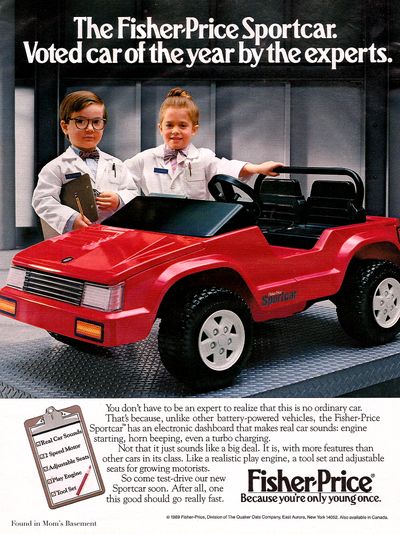
I’ve seen other ads from the ’70s and ’80s, particularly for Tonka trucks, that show girls like this–in clothes that look like they’re actually made for playing instead of making a fashion statement, and playing with toys in the same way boys would, even if it means getting dirty (gasp!). When we see ads that always show girls in pink, playing with “girl” versions of toys, or engaged in passive activities, that’s a particular marketing choice, not some inevitable, obvious way girls need to be depicted to sell products.

[Note: In the comments, we’re getting a lot of love for the Legos. That’s fine and all, but I must speak up for Lincoln Logs, which were way more awesome if you wanted to build corrals to hold your Breyer horses.]

[Note 2: Holy crap! Someone remade the “Thriller” video with Lego people! I have to admit, Legos probably work better for this purpose than Lincoln Logs would.]

NEW! Nov ’09 I found three more examples of ads that seem devoid of gender differentiation (here, here, and here):

6a00d83451ccbc69e20120a68a339e970c-400wi

6a00d83451ccbc69e20120a633a285970b-400wi

6a00d83451ccbc69e20120a6339839970b-400wi

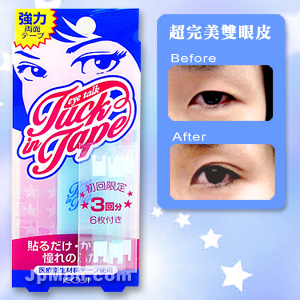
I’ve posted in the past about surgical procedures used to give “Asian” eyes a more “Caucasian” or “Western” look. As Alexia R. showed us, though, there are temporary means of getting a similar effect, particularly gluing a fold into eyelids. A quick google of “eyelid glue” came up with products such as this for sale on ebay:

WLM01-007305-LL

I don’t have many thoughts to to add that I didn’t say in the earlier post, except that watching that video has made my eyelids really itch and I can’t imagine what it must feel like to have them glued together. And also I’m kind of horrified by what apparently counts as not wearing much makeup; I had no idea I could conceivably be putting three different products on my eyelashes as part of my daily beauty regimen.

NOTE: Some commenters have made a good point about my post title and the implication that people who try to get an eyelid crease are trying to look more “Caucasian,” given that about half of people living on the Asian continent have an eyelid fold. I put “Caucasian” and “Western” in quotes to acknowledge the fact that I know these categories are socially created. But I think they have a good point about making assumptions as to why someone might use a product like this. The websites for eyelid surgery often DO very explicitly advertise their procedures as producing a “Caucasian” eye, so I think there often is that understanding or motivation, but people may use products like these for a variety of motivations, and I shouldn’t automatically imply that it is to approximate U.S. standards of (White) beauty. Thanks for the comments, everyone!

Gwen Sharp is an associate professor of sociology at Nevada State College. You can follow her on Twitter at @gwensharpnv.

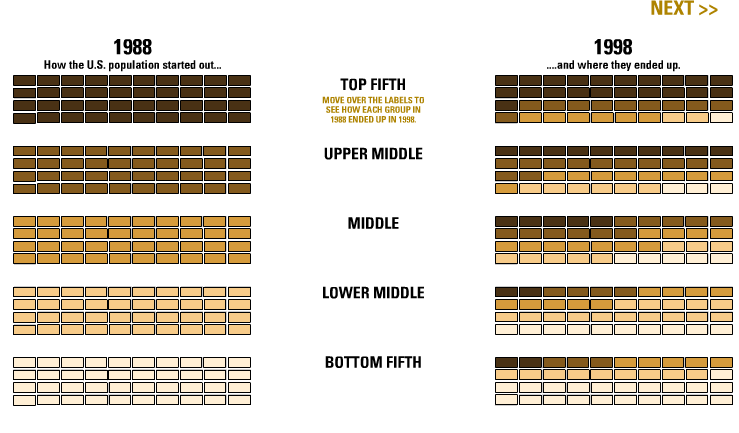
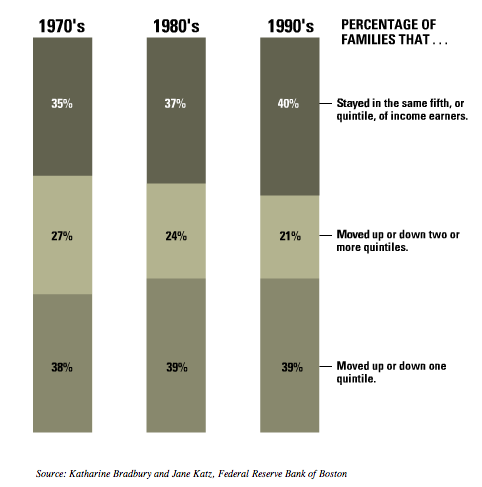
The New York Times has some interactive graphics showing various types of data about social class and class mobility. You can see where you fall in terms of four characteristics often used to measure class status, see the overall class breakdown for various occupations, and so on. This graph shows social class mobility by depicting which social class (divided into quintiles) the U.S. population fell into in 1998 based on the social class they started out in from 1988:

Picture 1

You can hover over a particular group, such as “lower middle,” to see the outcome just for them.

Another graph of social mobility:

Picture 2

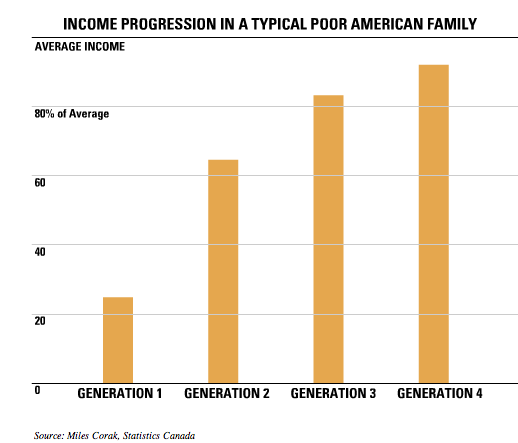
This next graph counters the idea that poor families remain poor forever (often explained by some version of the “culture of poverty” thesis) by showing that if you track a poor family over multiple generations, there is a general trend toward upward mobility:

Picture 3

That isn’t to ignore the fact that being poor leads to circumstances (poor schools, etc.) that make upward mobility difficult. But the idea that poor families stay poor for generation after generation, passing on poverty almost like a genetic characteristic, simplifies a more complex story about how families become poor, how long they remain poor, and the importance of looking at structural factors as opposed to a “cycle of poverty” explanation.

Since Lisa shared an embarrassing story today, I’ll share one too: for some reason, I think because he had the album Purple Rain and was famous for wearing purple a lot, for the longest time I thought the book The Color Purple must be a biography about Prince.

Readers’ minds think alike, sometimes, and the changing advertising campaign for the “empire building” video game Evony caught the attention of fds, torenc, Assaf N., Elisabeth R., Sabriel, Nicole O., and Liz B. (images found at Gawker and Coding Horror, and hope I didn’t miss anyone who sent it in). Online ads for the game started out like this:

504x_evony-ad-1-thumb

Then they added a woman with a little boob showing:

504x_evony-ad-2-alt-thumb

In case people weren’t noticing the cleavage, the ad evolved into one where the boobs are pointed out a bit more explicitly:

504x_evony-ad-4-thumb

Moving on to a slightly more realistic look:

504x_evony-ad-5-thumb

Christina W. sent us one with a woman actively disrobing and saying “Come play, my Lord”:

shot one

Mick H. found a close-up version similar to the one above:

Evony

D.R.S. sent us another:

-1

And then they realized they could just dispense with all subtlety and get to the important part:

504x_evony-ad-6-thumb

If that didn’t work, why not straight up near-nudity.  Dan J. found this one here:

evony_ad

This ad submitted by both Alex B. and Kim H. seems to be taking the advertising to a whole new level.  No longer content with boobs, they seem to be moving towards implied female masturbation:

evony

Wtfcats sent this one in:

Picture1

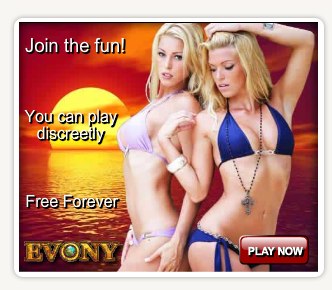
NEW (Dec. ’09)! Tom R. sent in this next one with a nice “we’re lesbian, but just for you” flair.  Using the term “discreetly”  to imply porn, it reads “join the fun”:

20091210-ec2qeabe8kppejcqyukc7wk3wk

NEW (Jan. ’10)! Thanks to Chris M., Tinpantithesis, and Ryan, we now know that there is an Evony ad that doesn’t say anything about the game at all.  You simply see this image and are invited to click on her boobs, butt, or lips to turn her into the “ideal woman”:

Evony_Ad_Jan_2010

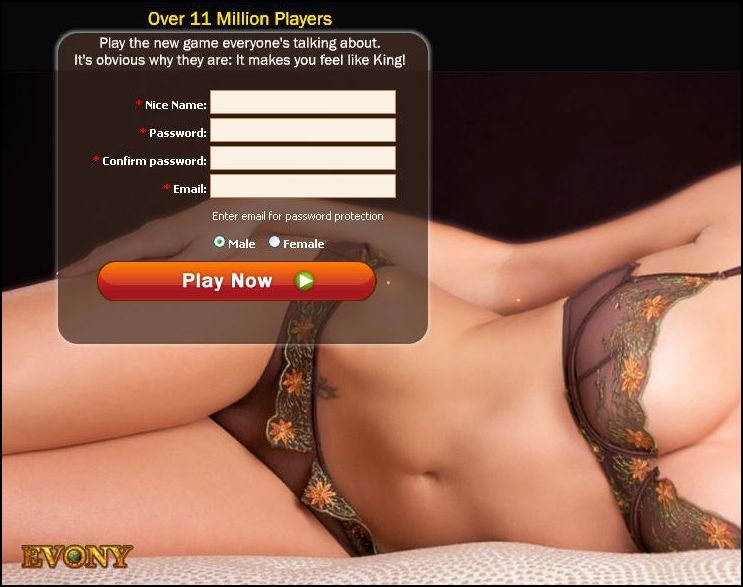
When you click, you are taken to this site, which asks you to sign up for the game because “obvious[ly],” “it makes you feel like King!”

Evony_Ad_Jan_2010_2

Or sometimes apparently you get this view:

Presumably some players will be disappointed that there isn’t a female “queen” to be saved or oogled in the game at all–the women were invented only for the purpose of adding boobs to the ads. Jeff A. from Coding Horror says,

Evony, thanks for showing us what it means to take advertising on the internet to the absolute rock bottom … then dig a sub-basement under that, and keep on digging until you reach the white-hot molten core of the Earth. I’ve always wondered what that would be like. I guess now I know.

ALSO NEW (Dec. ’09)! Apparently the Evony ads have become such a thing that other games are referencing them to advertise themselves.  Timm F. sent along the ad below making fun of the Evony ads.  It reads, “She is actually in our game, my lord”:

gview