Search results for The

Last night some friends and I were on the Strip here in Vegas and wandered over to look at City Center, the new casino/very high-end shopping center/”walkable city within a city” that was such a big deal when it opened recently that national news outlets, including NPR, talked about it. Anyway, we were wandering around and came upon a lingerie store with this mannequin in the window:
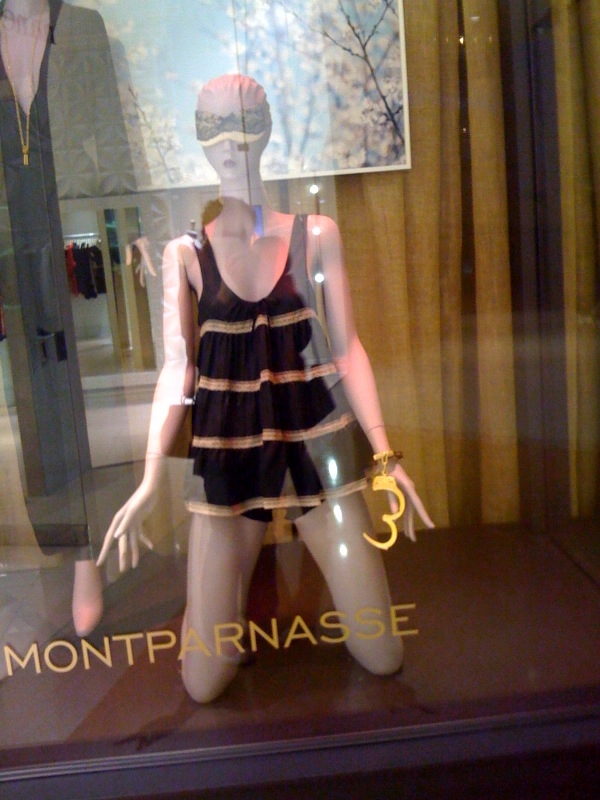
She’s blindfolded, handcuffed, on her knees. Another mannequin was also blindfolded, with ties around her ankles, and a third had a long pearl necklace wrapped around her neck and then tied around each wrist.

Our reaction was, basically, “Agh! Agh! WTF? Why?!?” We all, men and women alike, interpreted it as an icky depiction of sexual domination of women, perhaps even violence.

But of course, there’s another way to interpret it, particularly given that it’s a lingerie store: as consensual participation in S&M/bondage or sexual role-playing.

I still can’t shake off my initial feeling. We often see implied, or obvious, violence toward or sexual harassment of women as marketing or entertainment (see the trailer for the movie Bounty Hunter, vintage Betty Crocker ad, PSA for labeling cleaning products, violence against women in prime time, ad for CSI, t-shirt to show team spirit, ad for shoelaces, Lanvin ads, trailer for Dead Girl, Barney’s window display showing splattered blood and mannequins under attack, is stalking romantic?, trailer for Observe and Report, Rene Russo photo shoot, ha ha! She wasn’t being beaten!, “going in for the kill has never been so satisfying”, oops, I strangled a woman, and…oh, there are many more, but I don’t have time to link to them all). It seems naive to think that people can see mannequins posed like this and completely disconnect them from other portrayals of women bound, gagged, dead, sexually assaulted, etc., that are meant to be funny or sexy.

But it also seems problematic to dismiss the idea that in at some situations, such as this one, the situation could be consensual S&M. Allusions to at least light bondage has become more common in pop culture, particularly handcuffs as a sexy prop (sometimes used for laughs if one partner ends up handcuffing the other to something and then robbing them, stealing their clothes, etc.). Yet those who participate in S&M are also often stigmatized as sexual deviants.

But then, how do we think about S&M/bondage given that the sexual norms common in the U.S. include the idea of female sexual passivity and submission? Is this mannequin problematic in any way even if the store meant to invoke the idea of sexual role-playing?

I am confounded by this. The mannequin creeps me out. I don’t like it. But I’m sure many people can make eloquent arguments against my reaction, or how we approach the various issues involved. So what to make of this mannequin, readers? Help me out.

NEW! (Mar. ’10): SOM sent in this photo of the display in the window of the shoe store Sole Experience in Edmonton, Alberta, that shows a woman in high heels with her feet bound. This image, to me, seems to more clearly imply violence than the one above, possibly because of the use of rope rather than handcuffs, which are associated with sex role-playing:


Photobucket

Gwen M. sent in a story about a performance by Oksana Domnina and Maxim Shabalin at the Russian National Figure Skating Championships:

The pair won first place and plan to use the routine at the Vancouver Olympics next month. They explained that the routine (video below) was inspired by clips of Australian Aboriginal dance on the internet. About the idea, Domnina wrote: “I thought it was just crazy, but once we have tried it, we immediately fell in love with it.”

Bev Manton, the chair of the New South Wales Land Council thinks it’s less “crazy” and more offensive. She says:

I am offended by the performance and so our other councillors… Aboriginal people for very good reason are sensitive about their cultural objects and icons being co-opted by non-Aboriginal people – whether they are from Australia or Russia.

It’s important for people to tread carefully and respectfully when they are depicting somebody else’s culture and I don’t think this performance does.

The routine:

Sources (text; image).  Via Racilicious.

Lisa Wade, PhD is an Associate Professor at Tulane University. She is the author of American Hookup, a book about college sexual culture; a textbook about gender; and a forthcoming introductory text: Terrible Magnificent Sociology. You can follow her on Twitter and Instagram.

We at Sociological Images are having fun with forms lately (see here and here). This time the fun is thanks to Bri A. who sent us some screen shots from the website Trillian.

Against heteronormativity, you can choose your sexual orientation.  If you choose female and gay, you are represented by two side-by-side female symbols (on the right):


However, if you choose straight, you aren’t represented by a male and female symbol, you’re just represented by a female symbol:


This reveals that straight is the default (without  a male by her side, everyone assumes she’s straight), and gay is the different, odd, marked category.

Bri then added “in a relationship” and noticed that, despite choosing gay and female, the “in a relationship” icon featured a man and a woman:

Oops.  Heteronormatity is back!

And, if she clicked “single,” the icon simply represented her as a man:

Presumably all people are represented by a male figure.  And we can’t even pretend that it’s neutral and supposed to represent “person,” because the “in a relationship icon” clearly includes a male and a female figure.

What’s funny is that these seem like really easy problems to fix, but either no has noticed or no one cares.

For  more posts on default and marked figures, see our posts on traffic lights with female figures, stick figures and stick figures who parent, and default avatars.

Lisa Wade, PhD is an Associate Professor at Tulane University. She is the author of American Hookup, a book about college sexual culture; a textbook about gender; and a forthcoming introductory text: Terrible Magnificent Sociology. You can follow her on Twitter and Instagram.

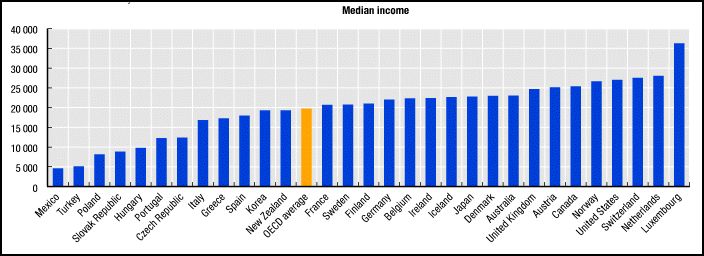
Dan S. forwarded a post by Matthew Yglesias in which he presents recent data from the OECD Factbook (larger version at the link).  It is another interesting way to think about income inequality.

First, we can look at a comparison of how much median income earners in the U.S. make compared to other countries (in U.S. dollars).  Luxembourg is the standout at the far right, with the U.S. not far behind, showing the fourth highest median income alongside some Scandinavian countries.  Mexico, Turkey and some Eastern European countries have the lowest median incomes.

A story starts to emerge, however, if we look at the median income of the bottom 10% of earners.  Suddenly the relative position of the U.S. shifts way to the left; the bottom 10% of earners in the U.S. make less than the OECD average.  Notice that the relative placements of the other high income and low income states don’t shift very much.  This means that while people in the U.S. are doing relatively well overall, the poorest people in the U.S. are doing worse than the poorest in about 2/3rds of the other countries:

Then, if you look at the median income of the top 10%, the relative position of the U.S. moves all the way to the right; that is, the top 10% of U.S. earners make more than the top 10% of earners in any other OECD country.  We even beat out Luxembourg:

Most other countries retain their relative position, more or less, with the exception of Sweden, which drops way down.  So the richest Swedes are, relatively speaking, not that rich.

The lesson is that income inequality–the difference between the incomes of the high earners and low earners–is significantly more severe in the U.S. than it is in other OECD countries (and that may be an understatement).

See this post for another graphic showing that income inequality is larger in the U.S. than in most other industrialized countries.  Also, the top 1/100th of a percent in the U.S. brings home a larger proportion of the total earned income in 2007 than they have since 1913.  And here is the percent of total U.S. income that went to the top 1% of earners (23% as of 2006).  Also see our posts breaking down CEO compensation, on the disproportionate tax burden by social class, and on class inequality across U.S. states.

Lisa Wade, PhD is an Associate Professor at Tulane University. She is the author of American Hookup, a book about college sexual culture; a textbook about gender; and a forthcoming introductory text: Terrible Magnificent Sociology. You can follow her on Twitter and Instagram.

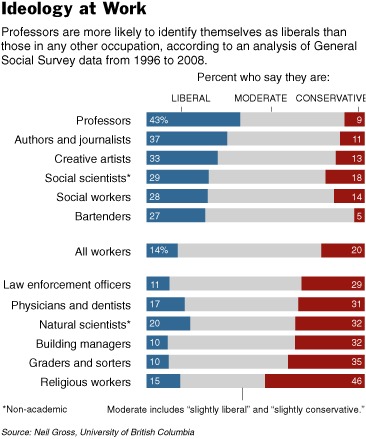
The stereotype that professors are more likely to be liberal than people in other occupations was confirmed by a recent study by sociologists Neil Gross and Ethan Fosse:

The study measured a number of reasons why college professors may be more liberal.  Among others, they argued that already liberal people may be drawn to academia because they perceive that academics are liberal.  That is, just as women are drawn to teaching and men to construction work because these jobs are gendered, academia is a politically-typed job that draws people who identify as liberal already.

They also speculate that the relative low pay, given the high educational attainment that the profession requires and high status that it brings, may lead professors to lean towards democratic principles of economic redistribution.  They write:

Deprived of economic success relative to those in the world of commerce, intellectuals are less likely to be invested in preserving the socioeconomic order, may turn toward redistributionist policies in hopes of reducing perceived status inconsistency, and may embrace unconventional social or political views in order to distinguish themselves culturally from the business classes (quoted here).

I think this is a fascinating and provocative question, even given Gross and Fosse’s excellent work, and one that I’ve wondered about many times.  Thoughts?

Lisa Wade, PhD is an Associate Professor at Tulane University. She is the author of American Hookup, a book about college sexual culture; a textbook about gender; and a forthcoming introductory text: Terrible Magnificent Sociology. You can follow her on Twitter and Instagram.

p.j. sent in a link to the trailer for the movie “Demographic Winter,” which apparently educates us about the coming downfall of humanity, or at least humanity in developed nations:

Thus, gay rights, women’s rights, and non-marital sexuality are not just immoral, they’re literally threatening the very survival of the human species.

Well, maybe not the human species. Certain members of the human species, those that live mainly in Europe and the U.S. Of course, what we’re really getting at here, ultimately, is the fear that Whites in developed nations are not reproducing sufficiently. For another example of this, see our post on the Louisiana Senator who proposed paying “these people” and “illegal aliens” $1,000 to be sterilized.

In both cases, women’s reproductive capacity would ultimately be targeted as a means to a social goal–one group of women will need to give up their silly concerns about women’s equality and start having more babies (and gay men gotta start impregnating women!), while other women must be discouraged from having them. It’s a story we’ve heard many, many times before.

Gwen Sharp is an associate professor of sociology at Nevada State College. You can follow her on Twitter at @gwensharpnv.

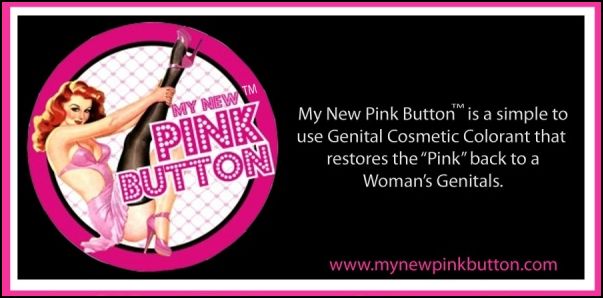
The uproar in the blogosphere pales only in comparison to the uproar in our email inbox about My New Pink Button.

Penny R., Eden H., Alicia T., Shannon H., Nils G., Shiquanda S., Mickey C., and Bob C. have all sent in links to a new product designed to bring back the “fresh” to your lady parts. For 30 bucks you can get 3 days of pretty-in-pink. That’s right, genital dye to pinkify your private parts. In case you weren’t worried about this particular repulsivity, now you know. (It apparently works on men as well as women, and nipples too).

As they say at Jezebel: “Anti-aging mania and marketing: Not just for your face anymore!”

Capture

Shiquanda and Mickey brought our attention to this particular Q&A in the FAQ section:

Q. “Help! I’ve noticed I am turning a more brown color down there on my inside lips, is this normal”?

A. Yes, it’s perfectly normal and there are many factors that can contribute to this.  Ethnicity is a big factor, also age, hormone change, surgeries, childbirth, sickness, health, diet and medications can all contribute to a change from “Pink” to “Brown” in a woman’s genital area.

So this is kind of fascinating: browner coloring is “normal,” but you should change it anyway.  The message is that normal is not ideal.  We are normal (or at least white people are), and we still need fixing.

The FAQ makes plain the two ways in which marketing tries to convince us to change our bodies: both by telling us that our bodies are abnormal and by telling us that they are normal.  Normal bodies are icky, we’re told, your body should appear, as much as possible, as if it is not a body at all.  I mean, isn’t that part of what shaving our legs, chests, and genitals (both male and female) are about?

I think the ubiquitousness of breast implants in the media also sends the message that beautiful breasts have the look of breast implants (in terms of shape, size, and the position of the nipple).  I recently saw mannequins in a store window who were built to look as if they had breast implants.  Do you get how crazy that is?  If a mannequin is supposed to represent the ideal body, then the ideal body isn’t one with naturally large breasts, it’s one with fake breasts!  Nuts.  This world is nuts. (Kristi reminds me that this is insensitive to those with mental illness… and she’s right.)   Weird!  This world is weird!

(I looked this up on Snopes, but no word yet as to whether it’s a hoax. I have no idea whether this product is for real or whether it’s a big-enough-seller to get my panties in a bunch over.  Though it appears that you can order it, but it is of questionable efficacy.  Scam-status and efficacy aside, I think it still reveals something interesting about how we are told that our bodies aren’t good enough.)

Lisa Wade, PhD is an Associate Professor at Tulane University. She is the author of American Hookup, a book about college sexual culture; a textbook about gender; and a forthcoming introductory text: Terrible Magnificent Sociology. You can follow her on Twitter and Instagram.

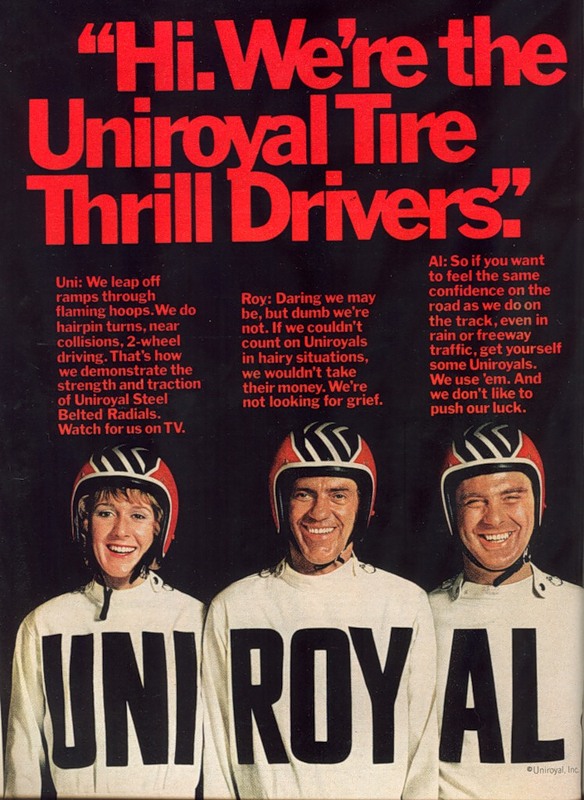
Readers responded so positively to our post featuring the lego ad from the 1980s that was just so… human.  The girl in the ad reminded us how hypergendered advertising has become.  I offer the ad below in the same spirit (from Vintage Ads).  Three people, who look like people, saying stuff about tires:

Lisa Wade, PhD is an Associate Professor at Tulane University. She is the author of American Hookup, a book about college sexual culture; a textbook about gender; and a forthcoming introductory text: Terrible Magnificent Sociology. You can follow her on Twitter and Instagram.