Search results for The

American school children learn all about the U.S. gold rush in the Western part of the country. Goldmining was a speculative, but potentially highly rewarding endeavor and attracted, almost exclusively, adult men. But the entrepreneurship of gold mining (though not mining as wage work) is long gone in the U.S.  Still, gold is in high demand:  “The price of gold, which stood at $271 an ounce on September 10, 2001, hit $1,023 in March 2008, and it may surpass that threshold again” (source).  Who are the gold entrepreneurs today?  Where?  Under what economic conditions do they work?  And with what environmental impact?

I found hints to answers in a recent Boston.com slide show and a National Geographic article (thanks to Allison for her tip in the comments).  While there is still some gold mining in the U.S., there is gold mining, also, in developing countries and all kinds of people participate:

According to the United Nations Industrial Development Organization (UNIDO), there are between 10 million and 15 million so-called artisanal miners around the world, from Mongolia to Brazil. Employing crude methods that have hardly changed in centuries, they produce about 25 percent of the world’s gold and support a total of 100 million people…

Environmentally, gold is especially destructive.  The ratio of gold to earth moved is larger than in any other mining endeavor.

It makes me rethink whether I really want to buy gold (because, you know, I do that constantly, darling, constantly).  In fact, jewelry accounts for two-thirds of the demand.  In the comments, HP reminds me:

Gold (along with even more problematic metals) is found in pretty much all consumer electronics. It’s in your computer, your cellphone, your .mp3 player, your TV/stereo, etc. You’re buying gold all the time already, whether you know it or not.

UPDATE! A reader, Heather Leila, linked to a picture she took of gold prospecting in Suriname (at her own blog).  She writes:

The gold mines aren’t what you are thinking. They aren’t underground, you don’t carry a pick axe and a helmet. The garimpos are where the miners have dammed a creek and created large mud pits. The mud is pumped through a long pipe lined with mercury. The mercury attaches itself to the specks of gold and gets filtered out as the mud is poured into a different pit. The mercury is then burned off, while the gold remains. This is how it was explained to me. From the plane, they are exposed patches of yellow earth dotting the endless forest.

See also our posts on post-oil boom life and gorgeous photos of resource extraction by Edward Burtynsky.

Lisa Wade, PhD is an Associate Professor at Tulane University. She is the author of American Hookup, a book about college sexual culture; a textbook about gender; and a forthcoming introductory text: Terrible Magnificent Sociology. You can follow her on Twitter and Instagram.

We talk about a lot on this blog about how things that having nothing to do with genitals are, nonetheless, gendered. Some sociologists are noting that a cluster of ideas related to intellectualism–liking school, studying hard, being smart, reading, and even caring about ideas–have become feminized. As a result, boys and men express less interest in and invest less in school, and girls and women are kicking their asses, scholastically speaking.

We previously featured an advertising campaign for Wrangler that told men to “stop thinking.” And this week Monika P. and Kat B. sent in an ad campaign for Deisel with the slogan: “be stupid.”

There’s a whole commerical (embedded below), but the general thrust is that smart people are doin’ smart stuff, but Diesel is “with stupid.” Because “stupid is the relentless pursuit of a regret free life.”  And while smart people may have “the brains,” stupid people have “the balls.” Besides, they say, “if we didn’t have stupid thoughts, we’d have no interesting thoughts at all.” Which doesn’t make the slightest bit of sense, but whatever.

And in case that doesn’t convince you, they concede that “smart has the authority,” but stupid has “one hell of a hangover.” Sign me up.

Ultimately the message is that smart people are repressed and confined, they have no fun, and nothing exciting ever happens to them.  So being smart is framed as (but isn’t) the opposite of all these things.   They leave you with the thought: “You can’t outsmart stupid.”


UPDATE! That said, Reader Kyle Munkittrick offers a compelling rebuttal at his blog, Pop Transhumanism.

Lisa Wade, PhD is an Associate Professor at Tulane University. She is the author of American Hookup, a book about college sexual culture; a textbook about gender; and a forthcoming introductory text: Terrible Magnificent Sociology. You can follow her on Twitter and Instagram.

Jersey Shore has come to end, we’re (genuinely) sad to say. We know we had fun. But is it possible we also saw something, dare I say it, subversive about beauty, gender and sexuality? I think so.

A panel discussion on the show and “Guido culture” at Queens College yesterday (you read that right), included New York State Senator and Jezebel heroine Diane Savino, who knows from stinging cultural analysis.

[Savino] explained, “‘guido’ was never a pejorative.” It grew out of the greaser look and became a way for Italian-Americans who did not fit the standard of beauty to take pride in their own heritage and define cool for themselves.

When she was growing up, everybody listened to rock; girls were supposed to be skinny with straight blonde hair (like Marcia Brady on “The Brady Bunch”); guys wore ripped jeans, sneakers and straggly hair.

The 1977 film “Saturday Night Fever” marked a turning point. “It changed the image for all of us,” Ms. Savino said. As Tony Manero, John Travolta wore a white suit, had slicked short hair, liked disco music and was hot. “It was a way we could develop our own standard of beauty,” she added.

In the same way, Virginia Heffernan writes in this weekend’s New York Times Magazine, Italian-Americans in the Northeast originally disdained their own accents until movies like “Mean Streets, Saturday Night Fever, Working Girl and, of course, Taxi Driver.” Those representations, she says, led to a “hammy” reclamation of an identity that had been mirrored back to them through Hollywood. These were second and third generation immigrants, who had mostly reached the middle class but maybe didn’t feel wholly a part of the mainstream, who telegraphed their identity through stylized symbols like Italian flags and red sauce that felt potent but no longer limited their social mobility.

That goes for the ladies too. Female beauty that took on a showily “ethnic cast” was distinct from what was already being sold. As Regina Nigro recently put it on The Awl:

We (I) laugh at bon mots like “You don’t even look Italian!” (the insult that Sammi “Sweetheart” flings at the blonde blue-eyed “grenade” …) but, ridiculous as it is, that assessment betrays a value system: Skinny blonde pale WASP princesses are deemed not attractive when measured by the JS aesthetic. And this seems curious and laughable to us.

“You don’t even look Italian!” is crazy funny but is the underlying judgment (dark hair/olive skin/Italian-looking = pretty; the inverse = not pretty) any worse than any other standard of beauty? It’s an alternative perspective, one that I suspect is so funny partly because it is so unfamiliar.

Of course, there is plenty about the Jersey Shore sexual aesthetic that is broadly familiar. The worst insult is to call a woman fat (or a “hippo”); big, exposed boobs are a baseline requirement, and the men are judged by the attractiveness of the women they acquire. (The other guys repeatedly mock The Situation about the looks of the women he brings home; Ronnie taunts him that he hasn’t brought home a girl anywhere near as pretty as Sammi).

And yet it’s oddly refreshing how much artifice itself is celebrated, with everyone participating mightily, and openly, in becoming the ideal Guido. No one is just born one, or supposed to make it look effortless. There are communal visits to tanning salons and unblinking references to fake breasts, and everyone takes hours to get ready. Vinny describes a girl admiringly: “Fake boobs, nice butt, said she was a model.”

Heffernan, writing about regional accents being reinforced by the show, uses Sammi as an example: “Every part of Sweetheart’s identity – including her skin color, which on the show is not an inborn marker of ethnicity but a badge of achievement (in the tanning bed) – is the product of intense calculation.” And Heffernan didn’t even get to Sammi’s hair extensions, which are brandished for emphasis.

No character more desperately self-produces than The Situation and his third-person pronouncements. Men are not inscluded [sic] from all this ritual artifice. In the last episode, J-Woww practically goes into heat when she sees some “juicehead gorillas” on the beach, and she lists “Human Growth Hormone” among the attractions. This, by the way, leads The Situation to mumble defensively, “Big is out and lean is in.”

That’s because on The Jersey Shore, men’s bodies are just as scrutinized as women’s, and their beauty rituals are as elaborate, expensive, and time-consuming as those of the women. Maybe even more so — in addition to blowouts, tanning sessions, and agonizing over which appliqued shirt will set them apart from the gelled masses, they spend hours at the gym, something we never see the girls do.

As much as the cast performed all this around the clock during the show’s taping, the audition tapes seen here and in the video below are even more extreme, mixing ethnic calculation with the general famewhoring savviness reality producers have become accustomed to.

Looking at this through what we know now: Sammi calls herself a “hookup slut” but aside from a few flirtations, turned out to be conventionally monogamous on the show. Vinny, in straight-up costume, claims he has to take off his pants “to really show you the magic,” but turned out to be the mildest-mannered cast member, one who unashamedly adores his doting mother. Underneath playing to the producers, though, is a more personal kind of construction, and a more particular one. And ironically, although the cast members’ self-creation was one of the most entertaining parts of the show, some underlying sense of unembarrassed authenticity, even wholesomeness, made it most worth watching.

——————————

Irin Carmon is a reporter at Jezebel.com, from where we’re super pleased to have borrowed the post below. Her work has also appeared in the New York Times, Boston Globe, The Village Voice, and others; more information is at www.irincarmon.com.

If you would like to write a post for Sociological Images, please see our Guidelines for Guest Bloggers.

Gwen mentioned recently that the real purpose of television wasn’t to entertain you, but to collect a predictable audience that networks could then sell to companies.  Commercials.  Commercials are the reason that programming exists.

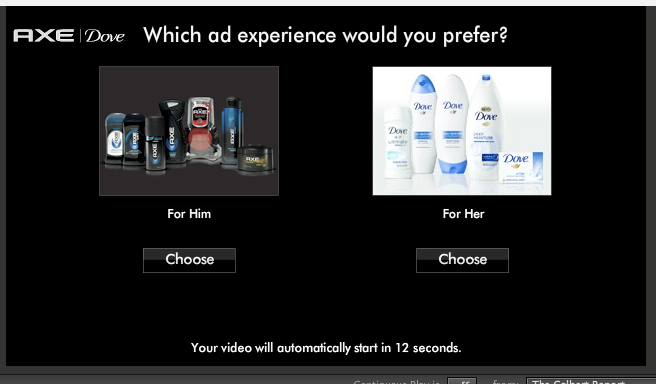
In that light, it’s interesting to see what’s happening on Hulu, a website devoted to watching television programs.  Jody and Karyn G. sent in this screen shot of a prompt at the beginning of a show asking, nicely, what kind of “ad experience” she would “prefer”:

First, I think the question is hilarious.  “Ad experience” is an awesome euphemism for “effort at manipulation.”  And, of course, the real question that is being asked is “Who are you?”  Like with Facebook, they need to know.

Second, asking the question is a new tool for marketers made possible by a this new way of delivering programming to one person at a time.  Presumably, I am only one person and either a “him” or a “her.”  If the marketers can ascertain this, they can target their commercials even more effectively than when they were advertising on Spike TV and during Oprah (because they are only guessing who is watching in those cases, but I’m straight up telling them in this one).

Of course, this all depends on us being predictable and obedient consumers… and I bet some of us very much aren’t.

Lisa Wade, PhD is an Associate Professor at Tulane University. She is the author of American Hookup, a book about college sexual culture; a textbook about gender; and a forthcoming introductory text: Terrible Magnificent Sociology. You can follow her on Twitter and Instagram.

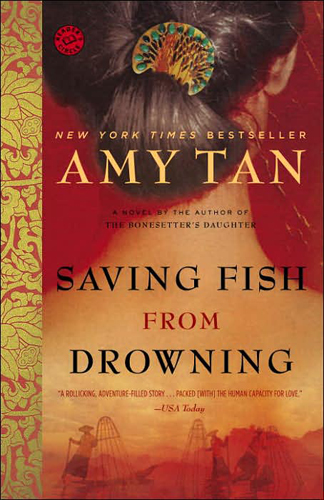
If you’re designing a cover for a book by a Chinese or Japanese writer, or with a Chinese or Japanese setting, it seems that there are some compulsory elements which must be included. For variety’s sake, there are four elements, but you MUST use at least one of them. Advanced designers, of course, may use two or more.

Element 1: Blossoms (preferably cherry, but anything red or pink will do)

Element 2: Fans (preferably held so as to partly obscure a woman’s face (or genitals), and if you can get blossoms on the fan, you get bonus points)

Element 3: Dragons (for use only on crime novels, or other exciting tales)

Element 4: Female Necks (preferably that of a geisha, but any female neck will do in a pinch)

You’ll notice that only women are allowed on the cover of Chinese and Japanese literature. Ideally, they will be either expressionless (some might say demure or inscrutable), or at most vaguely melancholy.

For more on this trend, see this article from Hyphen Magazine, which features a brief interview with ace designer Henry Sene Yee. It was that article which also drew my attention to two covers featured above, those for On a Bed of Rice and The Street of a Thousand Blossoms.

(To be fair, I ought to note that several of these covers are actually very nice–it’s just that they lose rather a lot of their impact because of the familiarity of the elements used.)

James Morrison (jrsmorrison@yahoo.com.au) is a writer, editor and graphic designer who lives in Adelaide, Australia. He writes about book covers and book design at causticcovercritic.blogspot.com, and used to write about novellas at Book Slut.  He blogs at Caustic Cover Critic. Thanks to Lisabee for the hat tip.

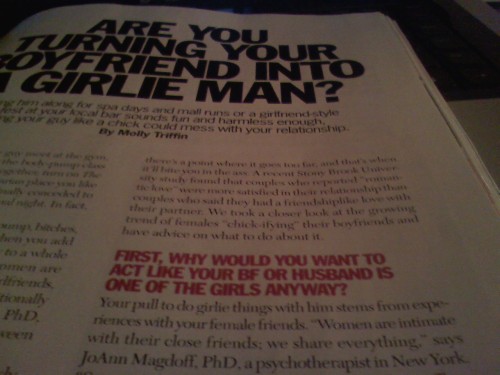
Nikki L. sent in images of an article titled “Are You Turning Your Boyfriend into a Girlie Man?” from the February 2010 issues of Cosmo. Nikki says,

The article discusses how many women are treating their boyfriends like their girlfriends, making them go shopping, do yoga, and eat vegan food. It says the gender roles are being blurred, and that’s a good thing up to a point. The article says that eventually your man will push you away and resent you for making him girlie. It gives a list of things your man shouldnt be doing, as it might damage his masculinity…

The first page:

Notice the subtitle in red and the text below it:

First, why would you want to act like your BF or husband is one of the girls anyway? Your pull to do girlie things with him stems from experiences with your female friends. “Women are intimate with their close friends, we share everything,” says JoAnn Magdoff, PhD…

Yes. Why on earth would you want to recreate that type of relationship with a guy? Who wants to be intimate, emotionally close, and share everything with their partner? Yuck!

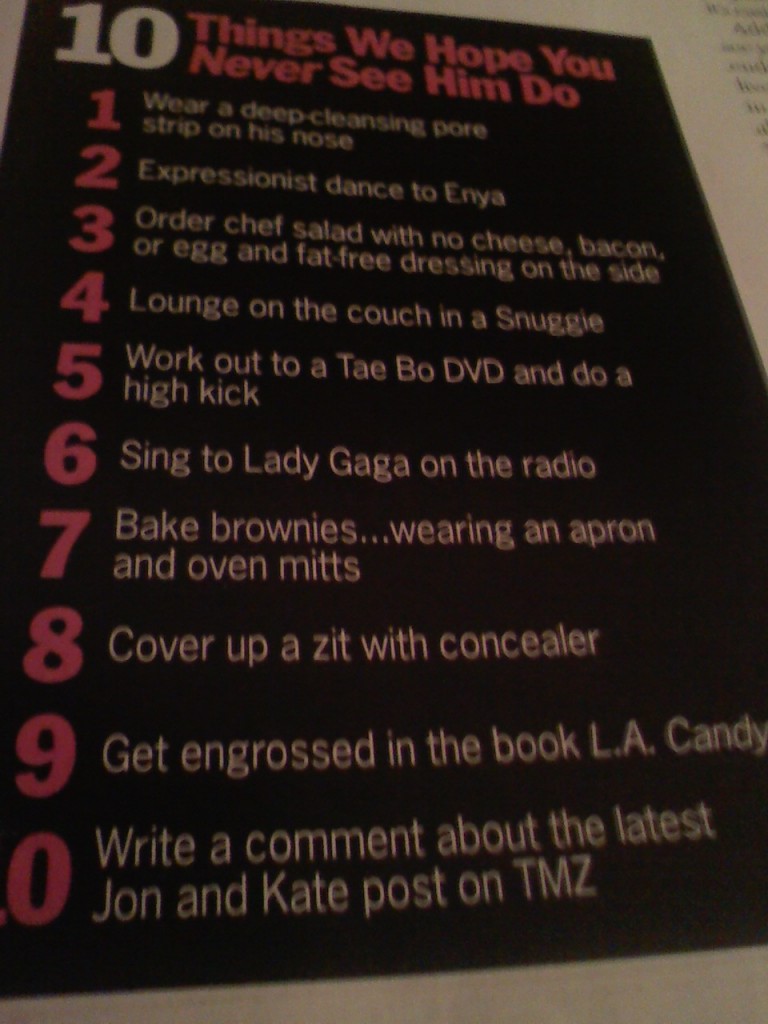
Here are some things you do not want your boyfriend/husband to do:

Just to reiterate: men cannot care too much about their personal appearance. They cannot try to eat healthily, or be vegetarian/vegan. If they’re gonna cook, they better not try to keep from burning their hands by wearing items specifically designed for that task. Sissies!

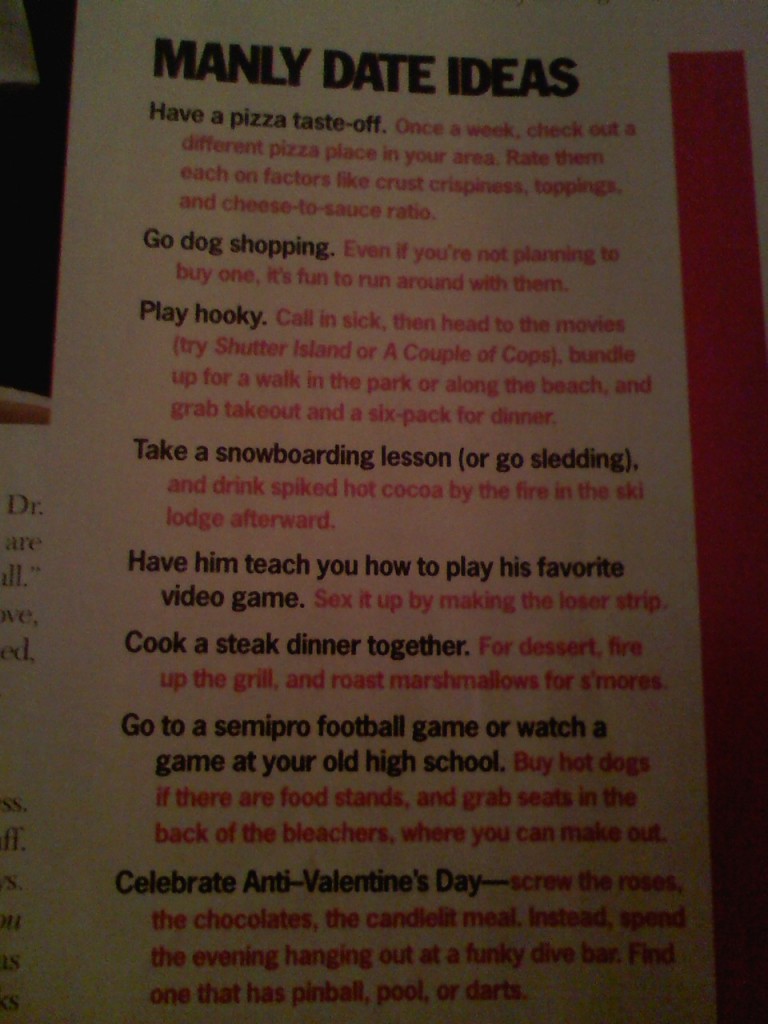
The article also provides a list of “manly date ideas” you can do with your guy to avoid turning him into one of the girls:

That’s just…stupid! It’s stupid! Gah! It’s such a ridiculous division of the world into the stereotypically masculine and the stereotypically feminine with policing to remind us that men must never be feminine. Ever! And women, stop emasculating men!

Men like meat! And pizza! Girls like chef salads without eggs, bacon, or cheese in them. Men like dogs! Women like cats. Have you ever known a woman who liked dogs? As if! Men like walking in the park and the beach. Except in movies where walking on the beach is portrayed as all annoyingly mushy and romantic, something men do because women like that sort of thing.

I’m also pretty sure if his favorite video game turns out to be Bejeweled, that goes up on the list of things you never wanna see.

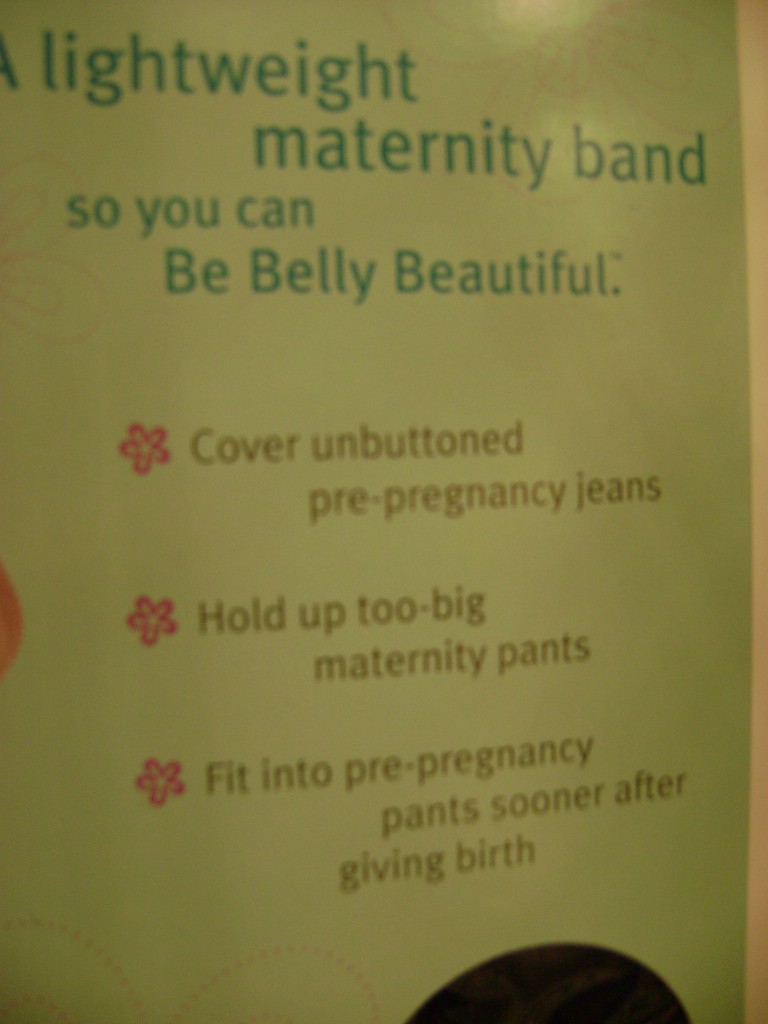
Z at It’s The Thought That Counts asked us to submit for commentary a product called the BeBand on sale at Target.  The Band is designed for pregnant women and women who’ve recently given birth:

(Note the carefully placed rings!  This model is no unwed mother!)

The box says that it will “cover unbuttoned pre-pregnancy jeans,” “hold up too-big maternity pants,” and allow you to “fit into pre-pregnancy pants sooner after giving birth”:

But it’s interesting that that’s the fine print.  The large print emphasizes beauty (“Be Belly Beautiful”) and the product is also sold under the name BellaBand.

Questions:

I’ve never been pregnant, is this a new product?  If so, is it a useful product or an invented need?

Even if this is a useful product, what do you think of the emphasis on beauty on the part of the marketers?

Is this not just another part of a demand for women to be freakin’ gorgeous at every part of their lifecycle?

NEW! (Mar. ’10): Along the same lines, R. Walker told us about a product called Shrinkx Hips:

For the low price of $54.99, “Shrinkx Hips provides constant, even pressure to gently guide hips back to their pre-pregnancy position” (if you wear it for 8 weeks). R.W. said it seems like a torture device, and I rather agree. But hey, apparently it makes you look like that model afterward, so what’s a little pain?

Lisa Wade, PhD is an Associate Professor at Tulane University. She is the author of American Hookup, a book about college sexual culture; a textbook about gender; and a forthcoming introductory text: Terrible Magnificent Sociology. You can follow her on Twitter and Instagram.

Christina S. sent along a link to the British commercial below for Twingo. There’s a twist ending, so I’ll let you watch it:

Notice that, at the very end, the narrator refers to how “we live in modern times,” meaning that we drive socially responsible cars and tolerate cross-dressing.

The idea embedded in that commercial is: now that we’re “modern,” there is no more prejudice and intolerance. Or, “modern” people are tolerant of social differences. Things like bias, hate, and discrimination are “in the past,” confined to those who are “traditional” or otherwise somehow regressive.

This makes sense to us (and the commercial, therefore, works) because many of us have a model of history that assumes that everything will, inevitably, always get better… or at least not get worse. This is a linear model where the line for “progress” keeps going higher and higher over time.  However things are today, we assume, things must have been worse before.  Thinking like this makes invisible the possibility that people were more tolerant in the past as well as the possibility that we could become increasingly intolerant in the future.  As I wrote in a previous post about cavemen:

There are serious problems with this idea:  (a)  We may stop working to make society better because we assume it will get better anyway (and certainly never get worse) with or without us.  (b) Instead of thinking about what things like gender equality and subordination might look like, we just assume that equality is, well, what we have now and subordination is what they had then.  This makes it less possible to fight against the subordination that exists now by making it difficult to recognize.

History doesn’t move along in a linear or predictable way.  And it certainly doesn’t produce equality just by plodding along.  We need to do the hard work of figuring out what an egalitarian society looks like and how to get there.  Conflating “modernity” with social tolerance makes it seem as though the work is already finished.

UPDATE! Ashleigh V. sent in another Twingo commercial.  This one conflates modernity with sexual permissiveness:

Lisa Wade, PhD is an Associate Professor at Tulane University. She is the author of American Hookup, a book about college sexual culture; a textbook about gender; and a forthcoming introductory text: Terrible Magnificent Sociology. You can follow her on Twitter and Instagram.