Search results for The

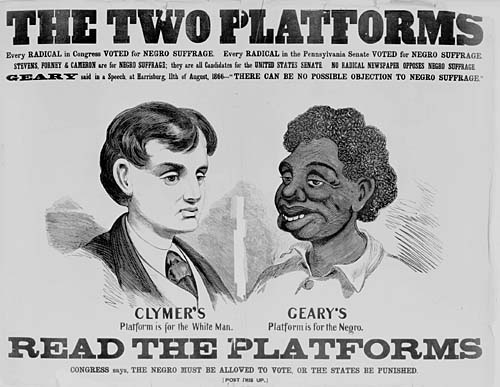
This Clymer for Pennsylvania governor poster attacks his opponent, Geary, and the Republican exponents of black suffrage, with a familiar caricature of blackness  (Jim Crow History):
a_3a33025v

Text:

Every RADICAL in Congress VOTED for NEGRO SUFFRAGE.  Every RADICAL in the Pennsylvania Senate VOTED for NEGRO SUFFRAGE.  STEVENS, FURNEY, & CAMERON are for NEGRO SUFFRAGE; they are all Candidate for the UNITED STATES SENATE.  NO RADICAL NEWSPAPER OPPOSES NEGRO SUFFRAGE.  GEARY said in a Speech at Harrisburg, 11th of August, 1866 — “THERE CAN BE NO POSSIBLE OBJECTION TO NEGRO SUFFRAGE.”

For more caricatures of black people in U.S. history, see these posts: one, twp, three, four, five, six, seven, eight, nine, ten, eleven, thirteen, fourteen, fifteen, sixteen, seventeen, eighteen, and nineteen.

And for examples of modern reproductions of these stereotypes (literally), see these: one, two, three, four, and five.

Lisa Wade, PhD is an Associate Professor at Tulane University. She is the author of American Hookup, a book about college sexual culture; a textbook about gender; and a forthcoming introductory text: Terrible Magnificent Sociology. You can follow her on Twitter and Instagram.

Paul S. sent in a link to a cell phone for five-year-olds (plus or minus).  The fact that it has a button for dialing a female and a male person (presumably mom and dad) is a nice illustration of how having two parents of opposite sexes is normative.  Many children have two caregivers of the same sex (e.g., a mom and a grandmother or gay parents) or only one caregiver (or, for that matter, more than two).  But it is expected that a child will have a mother and a father involved in their life.  That this is “normal” will be reflected back at that child again and again, whether or not it reflects their reality.

For more examples of heteronormativity see this post (featuring sea monkeys!) and also see our post full of cute photos of same-sex animal couples.

Lisa Wade, PhD is an Associate Professor at Tulane University. She is the author of American Hookup, a book about college sexual culture; a textbook about gender; and a forthcoming introductory text: Terrible Magnificent Sociology. You can follow her on Twitter and Instagram.

Greg Mankiw, a big shot economist (he was the chairman of President Bush’s Council of Economic Advisors) had a brief blog post on Monday comparing European countries and the US. It’s part of a long-standing debate about the relative merits of European-style social democracy. The left wants the US goverment to do more to reduce inequalities (ensuring universal health care, for example, or providing benefits for the unemployed, and the poor, requiring employers to offer paid maternity leave, etc.). Those on the right argue that these policies would stifle the economy. They offer an economic picture of America the dynamic, Europe the stagnant.

The volume on that debate got turned up by an article by Jim Manzi in National Affairs. He refers to “government policies — to reduce inequality or ensure access to jobs, education, housing, or health care — that can in turn undercut growth and prosperity.”

Paul Krugman, in his column on Monday, rejected this idea:

The real lesson from Europe is actually the opposite of what conservatives claim: Europe is an economic success, and that success shows that social democracy works.

Greg Mankiw gives some data on GDP per capita, adding with a sly grin, “Readers of today’s column by Paul Krugman might find these figures useful to keep in mind.” He gives the data for “the United States and the five most populous countries in Western Europe.”

We’re number one. We’re way ahead – 30% higher than the UK next in line. Mankiw wins; Krugman loses. Case closed. Or is it?

I’m sure there’s a good economic reason for this cherry-picking choosing only the five largest cherries. But if you were curious about some of the insignificant countries in Europe and elsewhere, you might want to take a look at the entire list. Here’s an expanded chart:

It turns out that among the non-Asian industrial democracies, there are a few countries that fall in that $11,000 gap between the US and UK. And when you include all those countries, the US is no longer number one.

Tara C. sent in this video about why big blockbuster video games haven’t tended to appeal to women, and what might need to change to make the (non-casual?) gaming world more interesting to women in general:

Apparently the creators of this trailer for Record of Agarest War, sent in by Goku S., hadn’t seen the video (NSFW):

Nor, presumably, did the creator of the Pocket Girlfriend iPhone app, sent in by Suzanne B.:

You’ll be excited to know that she’s real!

Pocket Girlfriend moves, she’s interactive, and most importantly she’s real. YES SHE’S REAL!!!! She’s not some 3D rendered mannequin. Seriously, why would you want to buy an application of a dancing mannequin?

Looks like Yahoo didn’t get the message either when it hired lap dancers to attend an event to recruit developers to build things for Yahoo.com, and then posted images of the dancers on the Yahoo Developer Network blog:

Yahoo later apologized.

[And for the record, yes, I realize these are just some examples and don’t represent the entire gaming community, especially the Yahoo thing. That’s true of anything we post–they’re specific examples that we try to fit into a larger context.]

On a related tech-and-gender note, Brigid told us that Wired magazine recently described a study that suggested the stereotype of computer scientists as “unwashed nerds” may be off-putting to women and discourage them from going into computer programming:

Cheryan and colleagues tested this idea by alternately decorating a computer science classroom with objects that earlier surveys pegged as stereotypically geeky—Star Trek posters, videogames and comic books — or with objects that the surveys found to be neutral— coffee mugs, plants and art posters. Thirty-nine college students spent a few minutes in the room, then filled out a questionnaire on their attitudes toward computer science.

Women who spent time in the geeky room reported less interest in computer science than women who saw the neutral room. For male students, however, the room’s décor made no difference.

UPDATE: Comments closed. Sorry, but it was turning into a big fight that wasn’t constructive.

UPDATE 2: Upon request that I rethink closing comments, I’ve cleaned out some problematic ones and am reopening the comment thread. Please remember–no personal attacks or insult wars. Play relatively nice.

Dan Ariely, in this great talk, describes some of his surprising research on cheating.

He finds that almost everyone will cheat, but only a little bit.  People are less likely to steal money, than other things (e.g., office supplies).  “Priming” works, too: If people are reminded to be moral, they are less likely to cheat.

If we see people we think are like us cheat, we are more likely to cheat than we would have otherwise (but we have the opposite reaction to cheaters that we see as not like us).  Ariely then applies his findings to the Enron scandal.

A fun and fascinating 16 and a half minutes:

Lisa Wade, PhD is an Associate Professor at Tulane University. She is the author of American Hookup, a book about college sexual culture; a textbook about gender; and a forthcoming introductory text: Terrible Magnificent Sociology. You can follow her on Twitter and Instagram.

Anna sent us links to this 1967 British health awareness film, “A Cruel Kindness,” about children and obesity:

I was really struck by how little mention fresh fruits and vegetables get in the discussion of a balanced diet at the end of the first segment (about 3:45)–you just need a little of them to get the vitamins you need. Today, of course, much more emphasis would be placed on them, and fats would get much less.

Anna points out that the fault for childhood obesity is placed squarely on mothers, either for overindulging their children out of love or being too busy or lazy to get their kids enough exercise and healthy meals.

And oh, poor Valerie! She’s from a broken home. Destined to be handicapped for life, a social outcast who will grow up to be like Mrs. Brown, abandoned by her husband.

Of course, while our attitudes toward foods have changed to focus on more fruits and vegetables and fewer fats, other elements of the film would fit in with anti-obesity campaigns today with a little updating. We still often focus on individualistic causes of obesity over structural ones (what types of foods governments subsidize, for instance), implicitly blame mothers for not taking the time to cook wholesome meals at home, and treat fatness as a social death sentence. We usually try to sound nicer when doing it, though.

Gwen Sharp is an associate professor of sociology at Nevada State College. You can follow her on Twitter at @gwensharpnv.

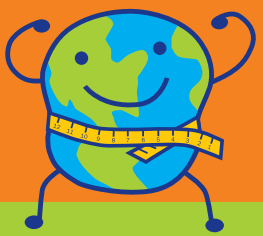
I was stuck by this image, which is being used by Environmental Defense as part of a “how you can stop global warming”-type promotion:

slimEarth

We see a cartoon anthropomorphized earth flexing its muscles happily while a tape measure is cinched around its quite unnaturally narrow waist. It’s an interesting collision between the longstanding metaphor of environmentalism as seeking the “health” of the environment, with the modern idea of obesity as iconic of poor health.

Unpacking the idea of ecological “health” as the goal of environmentalism is something I’ll mostly set aside here, except to note that it is a non-inevitable conceptualization (contrast the alternate framing of conservation/sustainability). The important thing to keep in mind is that the idea of ecological health involves conceptualizing the ecosystem, or even the entire planet, as a mega-organism — and in particular, a mega-human-body — for which health consists of an approximation to a particular ideal state. For a human body, health by this conception involves having all the normal parts (2 legs, both eyes, smooth skin, etc) functioning in the normal way.

What caught my eye about the ED ad was the change in the representation of what constitutes “health.” A quick Google image search on “sick earth” brings up lots of examples of the old way of representing health. We get lots of earths suffering from common cold and flu type symptoms — flushed, sweating, excreting mucus, and making use of thermometers and hot water pads.

The archetype of ill health here is infectious disease, an invasion by microbes that upsets the system’s functioning. The metaphorical parallels between viruses and pollution (including, in some cases, human beings) have been powerful for environmentalism.

But over the past few decades, we’ve acquired a new archetype for poor health: obesity. Being fat has become synonymous with being sick, and vice-versa. What I’m interested in here is not the scientific/medical question of how bad for you being fat really is (though I’ll admit to skepticism of the obesity panic on these grounds), but rather the sociological question of how obesity became the key trope in our discourse about health. Thus, a healthy earth can be easily represented as one that has slimmed down, because we all know that getting skinnier equals getting healthier. The metaphor is extended in the “Low Carbon Diet Guide” that the ad encourages you to download, which talks about how “counting carbs” should apply to carbon dioxide as well as carbohydrates. Interestingly, the guide sticks to energy conservation tips, thus both continuing environmentalists’ reluctance to address food habits as a contributor to climate change while mercifully avoiding blaming fat people for causing global warming by stuffing their faces.

An important element to the conceptualization of obestity as the archetype of ill health is the way it’s tied to ideas of personal responsibility. While genetics and social conditions play a huge role in determining who gets fat, our discourse about obesity promotes the idea that on the one hand you can control your own weight, and on the other fat people can be blamed for their condition. This is reflected in the content of ED’s Low Carbon Diet brochure, which is is a fairly standard compendium of personal behavioral changes that will make you a better, less-carbon-emitting, metaphorically slimmer person. Obviously this sort of thinking long predates the ecological-health-as-thinness metaphor, but there’s a synergy between them in terms of the emphasis on the small scope of personal control within a larger issue.

This is not the first, or most extreme, time environmentalists have tried to link up with the concern over obesity. But it was striking to me that the thin = healthy idea is so engrained that it can be used as a metaphor by causes outside of the public health field.

Stentor Danielson is a professor of Geography at Slippery Rock University in Pennsylvania. His research focuses on the relationship between humans and their environment. Specifically, he’s interested in how people understand the risk of wildfires. You can read more from Stentor at his blog, Debitage.

Like the segregation laws characteristic of Jim Crow, soon after Hitler came to power in the U.S. Germany (oops) he began establishing legal segregation of Jews from Aryan Germans.  The writing on the bench in this photo, taken in 1934, reads: “For Jews Only”:

slo-02

The source explains that benches were segregated, with others reading “For Germans Only.”

See our other posts on Nazi Germany: comparing German remembrance of the Holocaust and U.S. remembrance of slavery, Nazi symbolism, Nazi celebration of motherhood, the racialization of the Jews, and this sympathetic memorabilia website.

Lisa Wade, PhD is an Associate Professor at Tulane University. She is the author of American Hookup, a book about college sexual culture; a textbook about gender; and a forthcoming introductory text: Terrible Magnificent Sociology. You can follow her on Twitter and Instagram.