Search results for The

The Modern Language Association has all kinds of awesome language-related data available that you can customize depending on your interests. Most basically, you can get an interactive map showing the percent or number of speakers of various languages spoken at home by county (or number by zip code). Here is English:
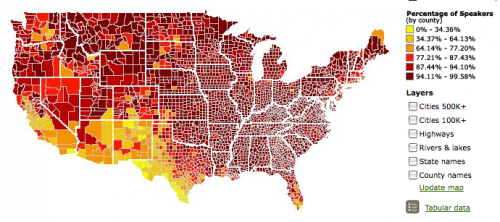
English

Spanish:

Spanish

Navajo:

Navajo

Notice that the scale of the maps changes, so the same color doesn’t indicate the same percent of speakers for each language. For some languages the darkest red only indicates 1 or 2 percent.

There was one odd category I noticed. This is the map for “African languages”:
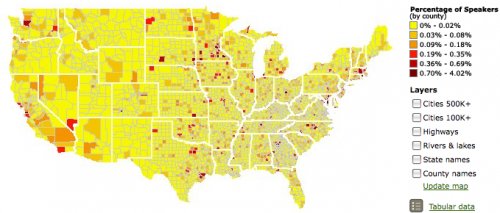
African languages

I can understand why you might lump some languages from an area together if they are so rare in the U.S. that they’d barely show up. But what, exactly, is an “African” language? It doesn’t appear to include Arabic, though it is spoken in much of northern Africa. Many people in Africa speak European languages (particularly French and English) due to colonialism. Presumably this category includes “native,” non-Arabic languages. It’s a strange category.

For those of you wondering about the little pockets of African language speakers in, say, Iowa and Nebraska, I could be wrong, but I would suspect in some of those counties it might have something to do with slaughterhouses. In the last decade or so some packing houses have recruited African immigrants, particularly Somalis, to move to rural areas and work in the plants. Again, that’s just a guess, but some of the locations fit.

UPDATE: Commenter mordant.espier says,

I think you’re wrong about African languages and meatpacking in the midwest. I know that Omaha has a significant Sudanese community, about 7,000, many of whom are refugees and asylum seekers.  In Minneapolis, there are a number of Somali. They are there because of the US government, and even more because religious and charitable organizations, especially the Episcopal Church and Catholic Charities, have provided support through all stages of the immigration process.  The existance of a group of refugees who are able to enlist the support of locals has created such pockets.

Anyway, moving on.You can also get side-by-side comparisons of two states. This shows the percentage of the population speaking Arabic in California and Michigan:
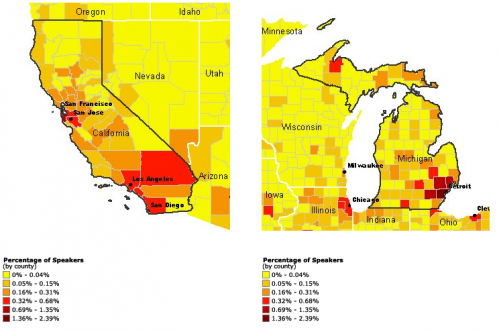
Arabic comparison

Number and percent of speakers of various languages:
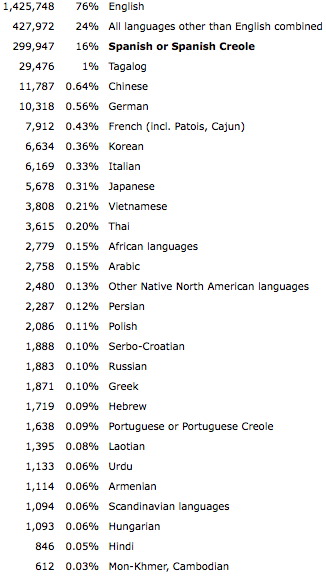
Picture 1

You can compare the number of speakers in 2000 and 2005:
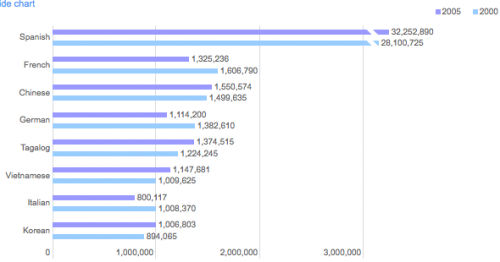
Picture 3

If you go to “Language by State” in that last link and select a language, you can then look at “ability to speak English”. Annoyingly, it only shows raw numbers, not percentages, so you have to do the calculations yourself. But here’s the breakdown for German in Michigan; clearly the vast majority of people who speak German also say they speak English “very well”:
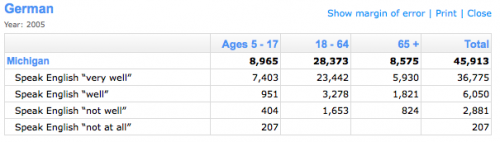
Picture 4

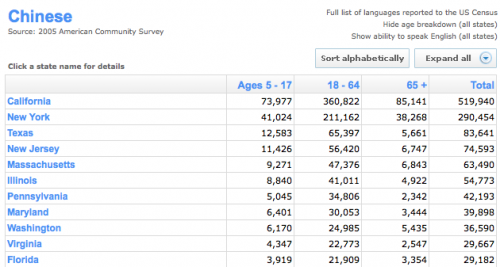
You can also get an age breakdown (again, just raw numbers) for each language, by state. Here’s a partial list for Chinese:
Picture 1

I’m warning you now, the site can turn into an enormous time-suck. You think you’ll just look up the state you live in, say, and then you get started comparing things, and the next thing you know, it’s a half hour later.

UPDATE 2: Commenters have also pointed out that a) “Chinese” is as much of a thrown-together category as “African” (does it mean Cantonese? Mandarin?) and b) the site doesn’t have any information about use of American Sign Language, both great points.
Capture

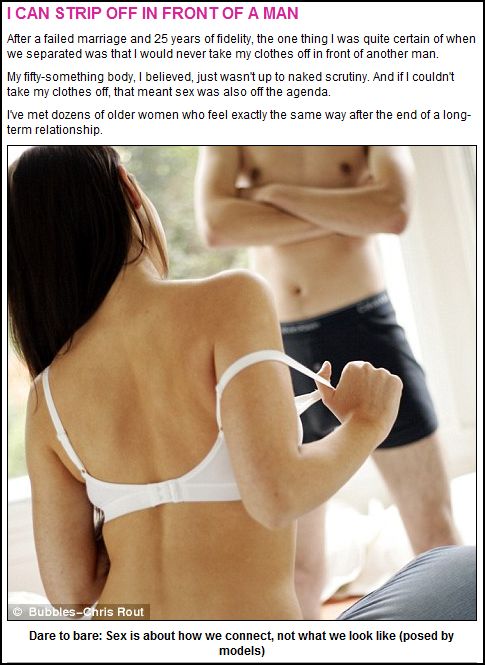
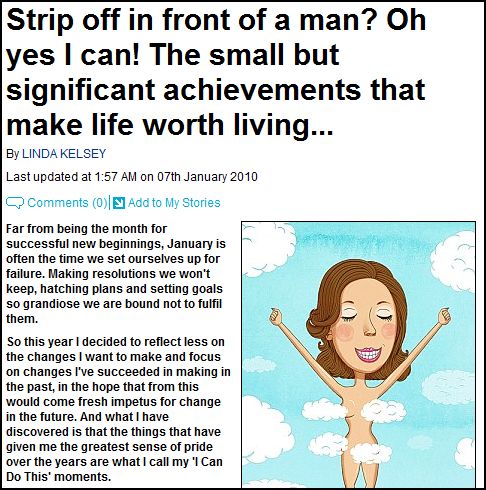
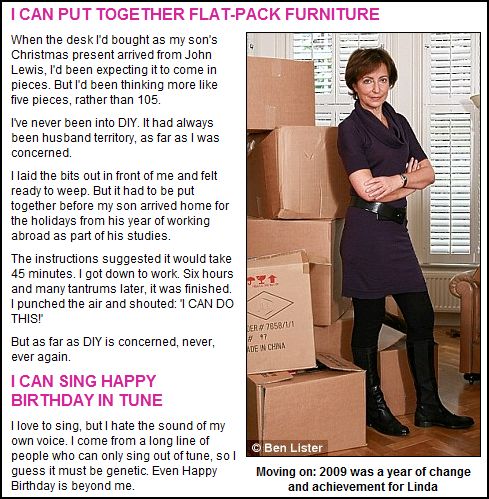
This is the lead to an article in the Daily Mail, sent in by Chris W., about the small victories accomplished in 2009 by one “fifty-something” Linda Kelsey.  In addition to letting a man see her naked, she lists putting together home-assembly furniture and singing happy birthday in tune:

Capture2

But back to the stripping.  The message she is trying to send is that she feels happy that she’s become more comfortable with her body.  She writes:

My fifty-something body, I believed, just wasn’t up to naked scrutiny. And if I couldn’t take my clothes off, that meant sex was also off the agenda.

But then she met someone she liked and yadda yadda yadda.

This is all fine and good, but the image they used to illustrate this particular victory is this:

Capture1

So the image they used to illustrate her comfort with her body and the fact that “sex is about how we connect, not what we look like” suggests just the opposite.  The picture includes two mostly naked models (who are models because they have ideal bodies already); there’s no bodily connection at all and the man’s pose doesn’t suggest emotional connection either.

So women are being told how liberating it is to take their clothes off for men (how convenient for the dudes) and that they should feel comfortable with their bodies, like those young, thin, white, properly-gendered, able-bodied models do.

Now, if good ol’ “fifty-something” Linda Kelsey had posed displaying her newfound body comfort, like she does with her cardboard boxes, it would have sent the message she intended.  Instead, it makes us feel bad for feeling icky about our bodies AND reminds us that they are (probably) icky indeed.

P.S.: I just have to say, do you see that picture of her?!  She looks fine!  What fifty-something woman wouldn’t be pleased with that body?!  What woman of any age shouldn’t be pleased with that body? What kind of message does it send when she trashes herbody.  She must think most of the population is hideous.  We all need to stop trashing our bodies in front of one another, there’s just-about-always someone who ends up feeling worse because they compare their own body to the self-trasher and feel like they don’t measure up even to the body being disparaged.  Enough.

Lisa Wade, PhD is an Associate Professor at Tulane University. She is the author of American Hookup, a book about college sexual culture; a textbook about gender; and a forthcoming introductory text: Terrible Magnificent Sociology. You can follow her on Twitter and Instagram.

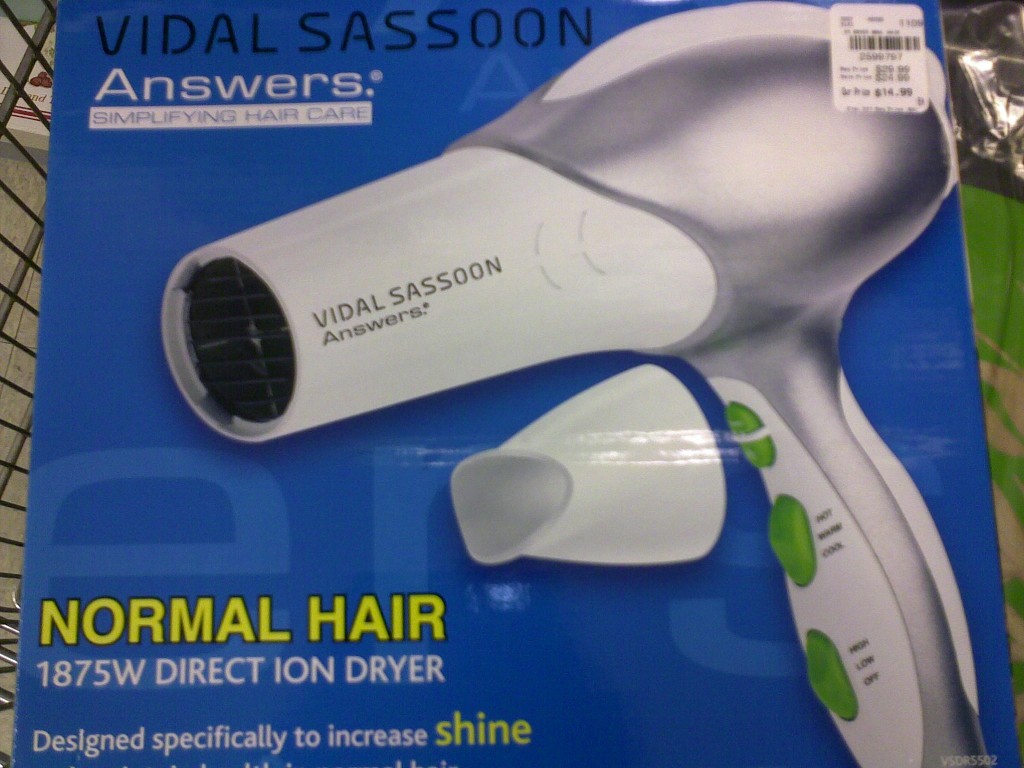
Rudo M. sent us a great example of how “normal” is socially constructed. The photos below are of the box containing a Vidal Sassoon hair dryer for “normal” hair:

1

It’s also, “good” hair, as is said, in so many words, the blurb on the box said so:

Not too fine or coarse,  normal hair is the most manageable hair type with the largest range of possible styles.  Though it’s fun to experiment, even the easiest-to-care-for hair requires a regimen of regular maintenance.  Proper styling tools with varying heats are crucial for keeping a healthy-looking shine, maintaining balance, and adding…

Yeah, so just in case it wasn’t clear already, “normal” hair is the bestest!  It’s “not too fine or too coarse,” has the “largest range of possible styles,” is “fun,” and is totally the “easiest-to-care-for”!

Rudo is an African woman who wears her hair natural, so she knew right away that Vidal Sassoon didn’t count her hair as “normal.”  So, what were the other options?  If you’re not normal, what are you? Well, according to Vidal Sassoon, you are, of course, “fine” or “coarse.”

But a lot of good this does Rudo, since even the models on the “coarse” box are white with essentially straight hair!  So much for a range of hair types!  Well, at least we know that even white women with straight hair can be abnormal!

And, just in case you didn’t know already that being abnormal means being WRONG, coarse hair is “hard-to-style,” fine hair is limp, and both tend to “frizz.”   What a difference from Vidal Sassoon practically falling over itself praising normal hair.

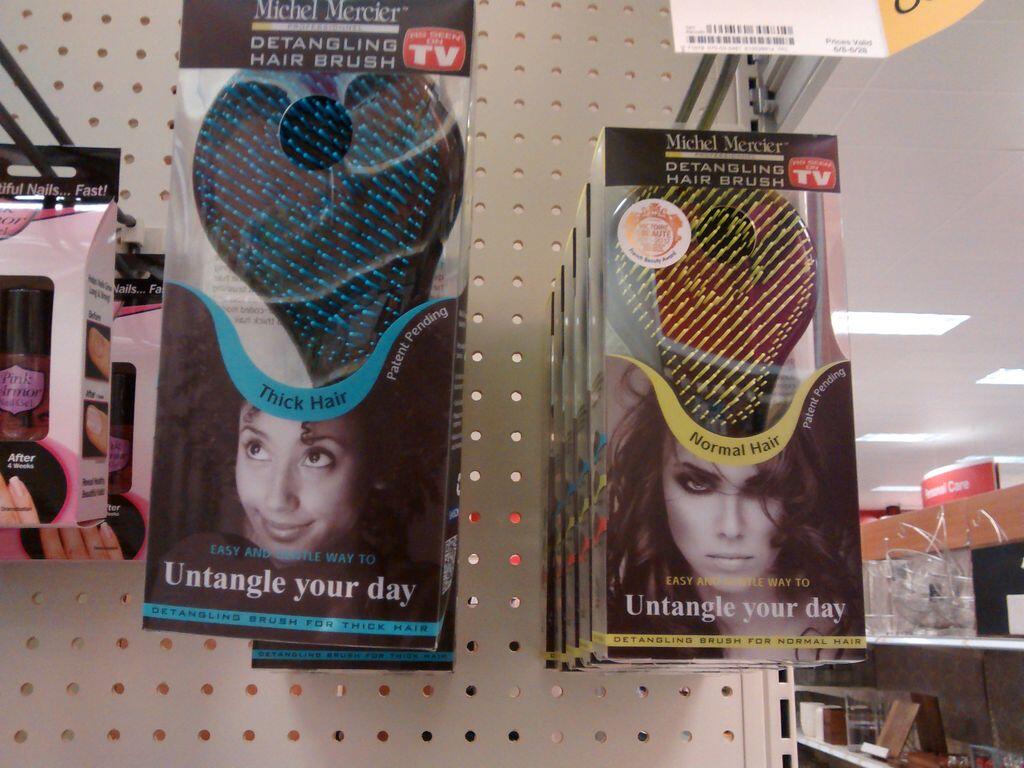
Here’s another example, sent in by @adentweets.  There’s “normal” and there’s “thick” hair.

1

Cara McC. sent us a Covergirl commercial selling foundation for “normal,” “oily,” and “sensitive” skin. Again, they include a range of skin types (and probably include women who represent three different races) in order to point to the diversity of skin types, but nonetheless label one “normal” (the one represented by the white woman).

For more examples of whiteness as normal and people of color as deviant (or, if we measure by Vidal Sassoon, non-existent), see our posts on Michelle Obama’s “flesh-colored” gown, Johnson’s lotion for “normal to darker skin,” bandaids and other “flesh-colored” things, why Sotomayor may be “biased,” families vs. ethnic families, and people of color add “spice.”

Lisa Wade, PhD is an Associate Professor at Tulane University. She is the author of American Hookup, a book about college sexual culture; a textbook about gender; and a forthcoming introductory text: Terrible Magnificent Sociology. You can follow her on Twitter and Instagram.

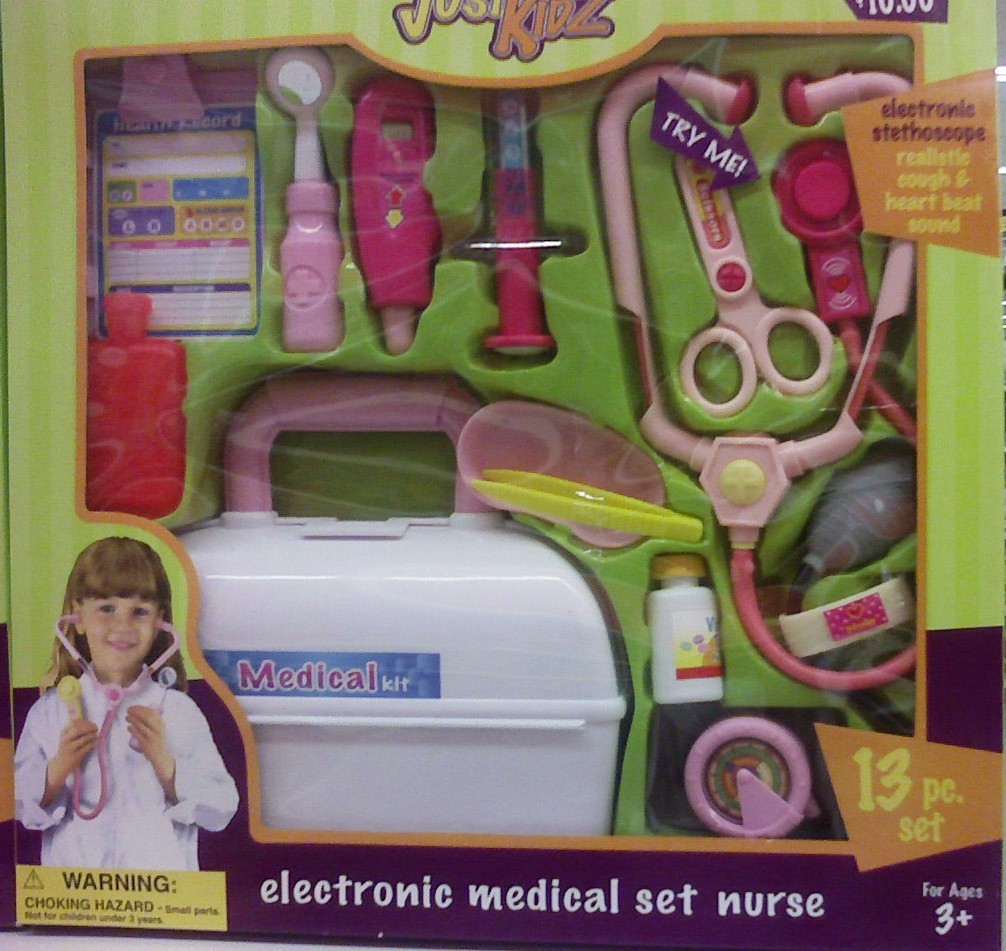
Caroline P. sent in this stunning example of gendered socialization, gendered job segregation, and the social construction of skill.  Notice that the two photos below show an “electronic medical set” for a doctor and a nurse, with a photo of a boy and a girl, respectively.

spa0269hspa0268v

Okay, so the jobs are gendered.  But more than that, notice that the sets contain essentially the same toys: a stethescope, pill bottle, syringe, thermometer, mirror, hot water bottle, clipboard, blood pressure thingy, and whatever that is in the bottom right corner.

So it’s more than just gendered jobs, it’s an acknowledgement that when boys and girls do the same job, it gets called something different and, more, better compensated when men do it.  We see this with other, real jobs that get split into gendered categories like janitor/maid.

Lisa Wade, PhD is an Associate Professor at Tulane University. She is the author of American Hookup, a book about college sexual culture; a textbook about gender; and a forthcoming introductory text: Terrible Magnificent Sociology. You can follow her on Twitter and Instagram.

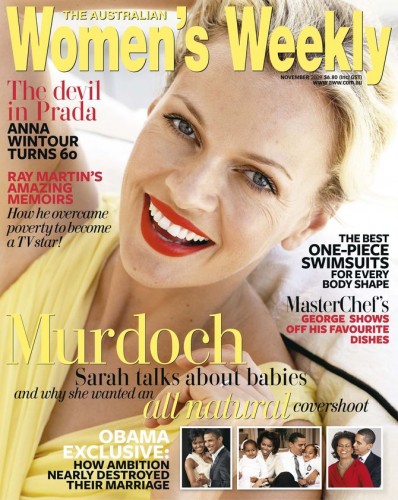
Michelle D. sent in this cover of The Australian Women’s Weekly featuring Sarah Murdoch, which includes the text “why she wanted an all natural covershoot”:

r459114_2251391

As Michelle pointed out, the woman has visible wrinkles, but she’s clearly wearing a significant amount of makeup (and teeth that are either bleached or covered with veneers), leading her to wonder what “all natural” means. As it turns out, it means that she wasn’t airbrushed or photoshopped. If you google “Australian Women’s Weekly Sarah Murdoch,” you’ll find a ton of stories about it.

Now, let me be clear: I’m not trying to minimize the courage it took for Sarah Murdoch to insist that her cover be un-touched-up or to speak in interviews about resisting the pressure to hide all signs of aging. Nor am I saying that wearing makeup is evil.

I’m just saying that, as I was reading the many stories in other news outlets about the cover, and looking at that “all natural” on the cover, and then looking at her face, I couldn’t help but think that it says something about the level of inhuman youthful perfection we currently expect of celebrities that this woman’s face, which as far as I can tell is flawless, would ever “require” touching up at all, and that showing herself looking like this is a major act of bravery and resistance because under normal circumstances, her face would be defined as unfit for a cover without technological “fixing”…and that all that makeup, teeth whitening, and eyebrow sculpting don’t undermine the claim to being “all natural” because we just take those things for granted now.

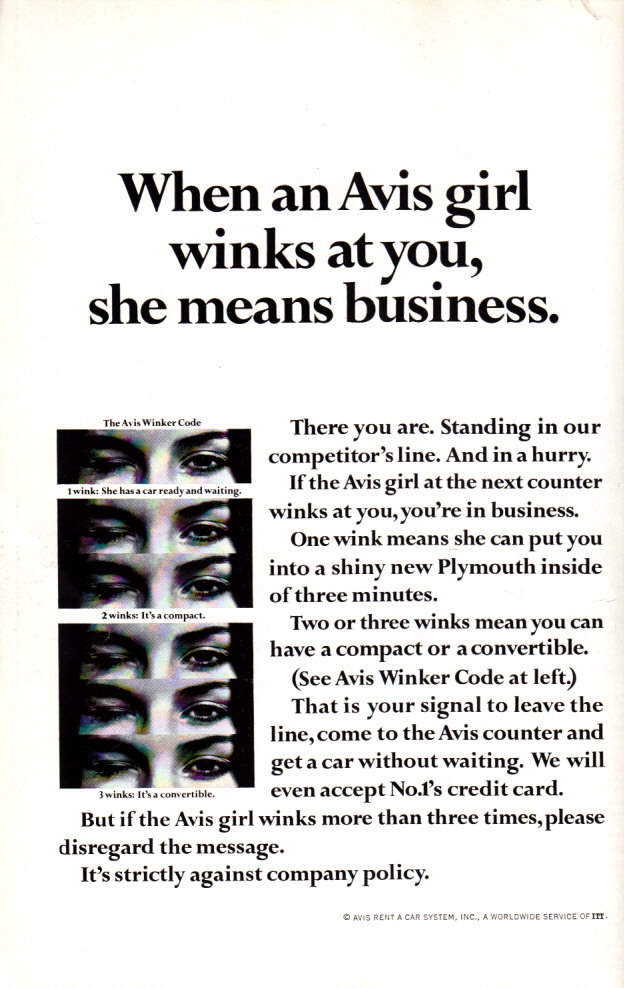
James H. (of Town Creek Poetry) sent in this vintage Avis ad:

-1

So the company marketed its cars to implicitly heterosexual male customers with the possibility of flirting, and even sexual access, to its attractive female employees (that is, “girls”). I have no idea if female employees were expected to actually wink at people.

Also see our post on Singapore Girls.

Gwen Sharp is an associate professor of sociology at Nevada State College. You can follow her on Twitter at @gwensharpnv.

Chrissy B., Dmitriy T.M., and Lindsay sent in videos regarding Brit Hume speaking on Fox News about the Tiger Woods scandal, arguing that he needs to convert to Christianity, rather than his current Buddhist beliefs, if he’s going to get back on the right moral track:

Transcript of the main point:

The extent to which he can recover seems to me depends on his faith, he’s said to be a Buddhist, I don’t think that faith offers the kind of forgiveness and redemption that is offered by the Christian faith, so.. my message to Tiger would be, “Tiger, turn your faith–turn to the Christian faith, and you can make a total recovery and be a GREAT example to the world.”

It’s an interesting example of how many Americans treat Christianity as the default, “normal,” and the best religion for everyone. Can you imagine Fox News, or any other news outlet, intentionally giving air time to a person saying that Tiger Woods needs to convert from Christianity to Buddhism (or any other religion) if he’s going to change his behavior? Can you imagine the outcry if the suggested religion was Islam?

The Daily Show aired a segment that addressed this issue, and then a day later had another segment about Brit Hume’s claims that Christianity is under attack in the U.S.:

The Daily Show With Jon Stewart Mon – Thurs 11p / 10c
The Best F**king News Team Ever – Tiger Woods’ Faith
www.thedailyshow.com
Daily Show
Full Episodes
Political Humor Health Care Crisis
The Daily Show With Jon Stewart Mon – Thurs 11p / 10c
The Temple of Hume
www.thedailyshow.com
Daily Show
Full Episodes
Political Humor Health Care Crisis

None of this, of course, even addresses the irony of suggesting that Christianity is the only religion that can help save you from infidelity, given the number of conservative Christian politicians who have been caught cheating on their wives in the past couple of years. But I don’t think irony is Hume’s strong suit.

UPDATE: Rosa S. of Newsy sent in this segment about the issue:


Binyavanga Wainaina does an excellent job, in this 3-minute video, describing ways that “Africa” tends to be written about in the West. See how many of the tropes you recognize:

To paraphrase Jose, at Thick Culture, it’s important to be engaged with the world, but our engagement shouldn’t be entirely on our terms. And, especially, not terms in which the Western world gets to construct itself as the savior of the less fortunate (e.g., Avatar).

Such ideas make it seem as if underdeveloped parts of the world are somehow inherently deficient (culturally or otherwise). When, in fact, insofar as underdeveloped parts of Africa or other continents need saving, it is partly (largely?) because of (1) a history of colonialism that stole their resources and disrupted their societies and (2) the current global economic system that continues to put them at a devastating disadvantage.

See also: The Single Story of “Africa”

Lisa Wade, PhD is an Associate Professor at Tulane University. She is the author of American Hookup, a book about college sexual culture; a textbook about gender; and a forthcoming introductory text: Terrible Magnificent Sociology. You can follow her on Twitter and Instagram.