Search results for The

The Stonewall Riots, widely described as the birth of the modern gay and transgender rights movement, occurred on this day in 1969.

Lisa Wade, PhD is an Associate Professor at Tulane University. She is the author of American Hookup, a book about college sexual culture; a textbook about gender; and a forthcoming introductory text: Terrible Magnificent Sociology. You can follow her on Twitter and Instagram.

Flashback Friday. 

How do people in the U.S. become wealthy?  According to the myth of meritocracy, they do so by hard work: blood, sweat, tears, a trace of talent, and a tad bit of luck.  This is the story told in this two-page ad for U.S. Trust in The New Yorker:

On the first page we learn she’s rich, but she’s still a home-town girl at heart. On the second page, we learn a little about how she might have gotten so wealthy:

Note the first few sentences:

Who’s to say how it happened. A big idea. A gutsy work ethic. A lucky break here and there.

Well, uh…what about, “She inherited it”? That’s a pretty common way to end up with a whole bunch of houses and in need of a wealth management team.

The notion that rich people are rich because their parents are rich, however, interrupts the American mystique, the one where we are a country of self-made immigrants who pulled ourselves up by our bootstraps.  People, even people who inherited wealth, like to think that they’re rich because they worked hard.  Hence, the romanticization of the self-made millionaire in the ad and the corresponding invisibility of the inheritance loophole.

On the flipside, this narrative also supports the converse idea that the poor are poor because of their lack of personal efforts and merits.  Perhaps they didn’t have a “big idea’ or the “gutsy work ethic” that enabled them to profit from the lucky break that they inevitably encountered, right?

This ad is just one drop in the sea of propaganda that makes it seem right and normal that a small proportion of our population is able to hoard wealth and property.

This post originally appeared in 2008.

Gwen Sharp is an associate professor of sociology at Nevada State College. You can follow her on Twitter at @gwensharpnv.

When my primary care physician, a wonderful doctor, told me he was retiring, he said, “I just can’t practice medicine anymore the way I want to.” It wasn’t the government or malpractice lawyers. It was the insurance companies.

This was long before Obamacare.  It was back when President W was telling us that “America has the best health care system in the world”; back when “the best” meant spending twice as much as other developed countries and getting health outcomes that were no better and by some measures worse. (That’s still true).

Many critics then blamed the insurance companies, whose administrative costs were so much higher than those of public health care, including our own Medicare. Some of that money went to employees whose job it was to increase insurers’ profits by not paying claims.  Back then we learned the word “rescission”  — finding a pretext for cancelling the coverage of people whose medical bills were too high.   Insurance company executives, summoned to Congressional hearings, stood their ground and offered some misleading statistics

None of the Congressional representatives on the committee asked the execs how much they were getting paid. Maybe they should have.

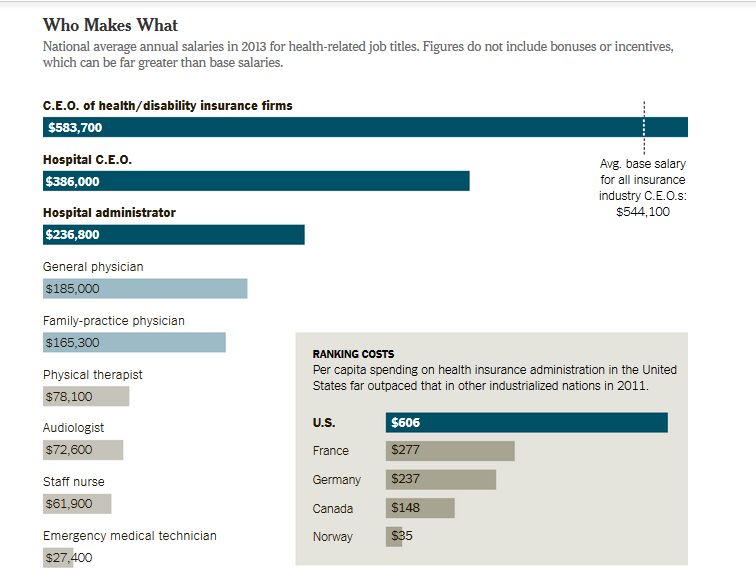
Health care in the U.S. is a $2.7 trillion dollar business, and the New York Times has an article about who’s getting the big bucks.  Not the doctors, it turns out.  And certainly not the people who have the most contact with sick people — nurses, EMTs, and those further down the chain.  Here’s the chart from the article, with an inset showing those administrative costs.

1

As fine print at the top of the chart says, these are just salaries — walking-around money an exec gets for showing up.  The real money is in the options and incentives.

In a deal that is not unusual in the industry, Mark T. Bertolini, the chief executive of Aetna, earned a salary of about $977,000 in 2012 but a total compensation package of over $36 million, the bulk of it from stocks vested and options he exercised that year.

The anti-Obamacare rhetoric has railed against a “government takeover” of medicine. It is, of course, no such thing. Obama had to remove the “public option”; Republicans prevented the government from fielding a team and getting into the game. Instead, we have had an insurance company takeover of medicine. It’s not the government that’s coming between doctor and patient, it’s the insurance companies. Those dreaded “bureaucrats” aren’t working for the government of the people, by the people, and for the people. They’ve working for Aetna and Well-Point.

Even the doctors now sense that they too are merely working for The Man.

Doctors are beginning to push back: Last month, 75 doctors in northern Wisconsin [demanded] . . . health reforms . . . requiring that 95 percent of insurance premiums be used on medical care. The movement was ignited when a surgeon, Dr. Hans Rechsteiner, discovered that a brief outpatient appendectomy he had performed for a fee of $1,700 generated over $12,000 in hospital bills, including $6,500 for operating room and recovery room charges.

That $12,000 tab, for what it’s worth, is slightly under the U.S. average.

Cross-posted at Pacific Standard.

Jay Livingston is the chair of the Sociology Department at Montclair State University. You can follow him at Montclair SocioBlog or on Twitter.

In the wake of Elliot Rodger’s misogynistic killing spree, the media’s role in male entitlement and violence against women has brought commentators to virtual blows.  One right hook came from Ann Hornaday, who argues in the Washington Post that male entitlement fantasies are part of a climate in which women are displayed as objects for the sexual fulfillment of men.  This post is about how full frontal nudity in True Blood, Hung, and Game of Thrones contributes to this climate.

True Blood.

While there are dozens of examples of full frontal female nudity in True Blood’s six-season run, from lead actors to extras, there are only two instances of full frontal male nudity.

A striking example of the exploitation of women as sex objects is in the appearance and figure of Lillith, a vampire goddess who is featured rising from a pool of blood, walking around fully nude for extended scenes. Her minions do the same and are also shown full frontal.

When a male character drinks Lillith’s blood and effectively becomes her, he too rises out of the pool of blood. But unlike the actresses associated with Lilith before, the camera cuts away before reaching his waist. In another stark example, vampires hold several dozen humans captive. While all the humans are naked, men in one cage and women in another, it is only the women who are displayed fully frontally nude. When the werewolf packs in True Blood disrobe to turn into wolves, again it is only the females who are demonstrated fully frontal.

Hung.

Hung is a program about a down-on-his-luck teacher who, because of his large penis, became a prostitute. Though the entire show is about Ray Drecker’s member, we only get one brief glimpse of it — and not even the whole — yet his clients and sexual partners are often shown fully frontal.

Even when a show is about the sexual objectification of a man and his sexual organ, it’s still women who are the default sex objects.

Game of Thrones.

Game of Thrones has come under fire for its sexism, misogyny, gratuitous nudity, and violence against women.  As usual, women are portrayed fully frontally nude in most Game of Thrones episodes, even when their male sexual partners are not. This is especially striking in the many brothel scenes (unnecessarily) scattered about the seasons; even when there are both male and female prostitutes, only the women are shown full monty.

To date there has been only one full frontal male on Game of Thrones: Theon Greyjoy. Through a horrific series of events, Theon is tortured and castrated. In episode six of season four — “The Laws of Gods and Men” — we are offered once again a gratuitous display of naked women in a bathhouse. In the same episode Theon is also offered a bath and while his full frontal, for once, would have actually been part of the plot, we do not see it.

In episode eight — “The Mountain and the Viper” — we are given another bathing scene in which members of the Unsullied, an army of castrated men, bathe in the vicinity of women in the same convoy. Surprise, surprise, the women are fully frontal and the men are not. Even sans one particular physical marker of male sexuality, these castrated men are deemed unseeable.

Neil Marshall, who directed the Blackwater Bay siege episode in Game of Thrones‘ 2nd season, recently spoke about how he was urged by a producer to include more full frontal female nudity.  The producer explained that he was “not on the drama side of things,” meaning that he didn’t care about the story. Instead, he said, he was on the “perv side of the audience.”  This is concrete evidence that orders for the systematic sexual objectification of women comes from upper management.

***

Ultimately, nudity is rarely necessary to further a storyline.  Women’s nudity isn’t about plot, it’s about treating women as objects and men as human beings.  The problem is systemic. Women’s bodies exist in many of HBO’s varied worlds to serve men, circling us back to a culture of male entitlement that, in the case of Rodgers at least, led directly to violence.

Sezin Koehler is an informal ethnographer and novelist living in Florida. You can find her on Twitter and Facebook.

Cross-posted at Pacific Standard.

In Generation Me and The Narcissism Epidemic, psychologist Jean Twenge argues that we’re all becoming more individualistic.  One measure of this is our willingness to go against the crowd.  She offers many types of evidence, but I was particularly intrigued by her discussion of the afterlife of a famous experiment in psychology.

In 1951, social psychologist Solomon Asch placed eight male Swarthmore students around a table for an experiment in conformity.  They were asked to consider two cards, one with three lines of differing lengths and another with one line.  He asked each student, one by one, which line on the card of three was the same length as the lone line on the second card. Each group looked at 18 pairs of cards like this:

1.jpg

Asch was only interested in the last student’s response.  The first seven were confederates. In six trials, Asch instructed all the confederates to give the correct answer.  In twelve, however, the other seven would all choose the same obviously wrong answer.  Asch counted how often the eighth student would go against the crowd in these cases, breaking consensus and offering up a solitary, but correct answer.

He found that conformity was surprisingly common.  Three-quarters of the study subjects incorrectly went with the majority in at least one trial and a third did so half the time or more.  This was considered a stunning example of people’s willingness to lie about what they are seeing with their own eyes in order to avoid rocking the boat.

But then there was Vietnam and anti-war protesters, hippies and free love, the women’s and gay liberation movement, and civil rights victories.  By the 1960s, it was all about rejecting the establishment, saying no, and envisioning a more authentic life.  Things changed. And so did this experiment.

By the mid-1990s, there were 133 replications of Asch’s study.  Psychologists Rod Bond and Peter Smith decided to add them all up.  They found that the tendency for individuals to conform to the group fell over time.

One of the abstract take-away points from this is that our psychologies — indeed, even our personalities — are malleable.   In fact, the results of many studies, Twenge writes, suggest that “when you were born has more influence on your personality than the family who raised you.” When encountering claims of timeless and cultureless truths about human psychology, then, it is always good to ask ourselves what scientists might find a few decades later.

Cross-posted at Pacific Standard.

Lisa Wade, PhD is an Associate Professor at Tulane University. She is the author of American Hookup, a book about college sexual culture; a textbook about gender; and a forthcoming introductory text: Terrible Magnificent Sociology. You can follow her on Twitter and Instagram.

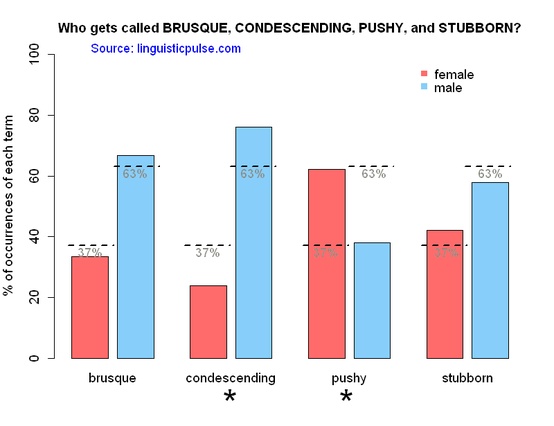
According to data gathered from the Corpus of Contemporary American English by linguistics PhD student Nic Subtirelu, women are called “pushy” twice as often as men, while men are more likely to be described as “condescending.”

1

At his blog, Linguistic Pulse, Subtirelu argues:

Condescending seems to differ from pushy and bossy in an important way, namely that it seems to acknowledge the target’s authority and power even if it does not fully accept it.

Subtirelu has also ran the numbers for “bossy” and found that it was used to described women 1.5 times more often than men.

Lisa Wade, PhD is an Associate Professor at Tulane University. She is the author of American Hookup, a book about college sexual culture; a textbook about gender; and a forthcoming introductory text: Terrible Magnificent Sociology. You can follow her on Twitter and Instagram.
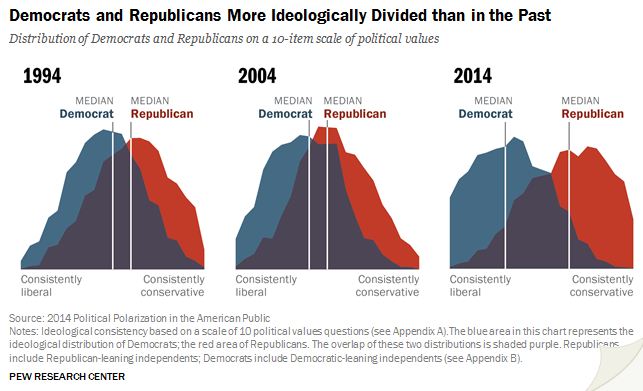
A new study of 10,000 Americans by the Pew Research Center finds that political polarization is more extreme than it’s been anytime in the last 20 years.  The median (or middle) Democrat and Republican are farther away from each other politically than in 2004 or 1994.  “Today,” reports Pew, “92% of Republicans are to the right of the median Democrat, and 94% of Democrats are to the left of the median Republican.”

1

Animosity has grown as well.  Over a quarter of Democrats and a third of Republicans see the other side as a “threat to the nation’s well being.”  In total, 38% of Democrats and 43% of Republicans judge the other side to be “very unfavorable.”

1a

Even more dramatically, it is the people at the extremes who are most likely to vote in elections and contribute to candidates.  Today’s America is highly polarized, then, but the voting booth is even more so.

1b

Pew concludes by noting that, even given this polarization, the majority of Americans are in the middle and are open to compromise between parties.  These individuals, however, are less politically active, whether out of disinterest or distaste for the rancor, leaving politics to the most extreme among us.

Cross-posted at Pacific Standard.

Lisa Wade, PhD is an Associate Professor at Tulane University. She is the author of American Hookup, a book about college sexual culture; a textbook about gender; and a forthcoming introductory text: Terrible Magnificent Sociology. You can follow her on Twitter and Instagram.

Screenshot_1Please enjoy these posts from Father’s Days past:

Stereotyping Men on Dad’s Day

Also…

Lisa Wade, PhD is an Associate Professor at Tulane University. She is the author of American Hookup, a book about college sexual culture; a textbook about gender; and a forthcoming introductory text: Terrible Magnificent Sociology. You can follow her on Twitter and Instagram.