
Search results for The

Screenshot_3Please enjoy these posts from Mother’s Days past:

Lisa Wade, PhD is an Associate Professor at Tulane University. She is the author of American Hookup, a book about college sexual culture; a textbook about gender; and a forthcoming introductory text: Terrible Magnificent Sociology. You can follow her on Twitter and Instagram.

There are more women in political office than ever, but the U.S. is not on the forefront of this change.  In 2013, the U.S. Congress was 18% female which, internationally, places us in the middle of the pack.

The Democrats can boast better numbers than the Republicans, but it wasn’t always this way.  At the Scholars Strategy Network, sociologist Danielle Thomsen observes that the Democratic party (green and blue) has increased female representation much quicker than the Republicans (red and purple), but only since the ’80s or so.

1

Thomsen argues that part of the reason for this difference has to do with increasing polarization in politics.  Both the Democratic and Republican parties have become more ideologically extreme, but this has hurt Republican recruitment of women more than Democratic ones.  This is because Republican women tend to be more moderate, on average, than Republican men.  Since there is less room for moderation in the party, the selection process favors more conservative politicians.  Among that group, there are very few women.

This hasn’t hurt the Democrats as much, since Democratic women are not more likely than Democratic men to hold moderate views.  The opposite, in fact, may be true, increasing the rate at which women may be picked up and supported by the party.

Cross-posted at Pacific Standard.

Lisa Wade, PhD is an Associate Professor at Tulane University. She is the author of American Hookup, a book about college sexual culture; a textbook about gender; and a forthcoming introductory text: Terrible Magnificent Sociology. You can follow her on Twitter and Instagram.
Visit A Whole Lot of Something.

Lisa Wade, PhD is an Associate Professor at Tulane University. She is the author of American Hookup, a book about college sexual culture; a textbook about gender; and a forthcoming introductory text: Terrible Magnificent Sociology. You can follow her on Twitter and Instagram.
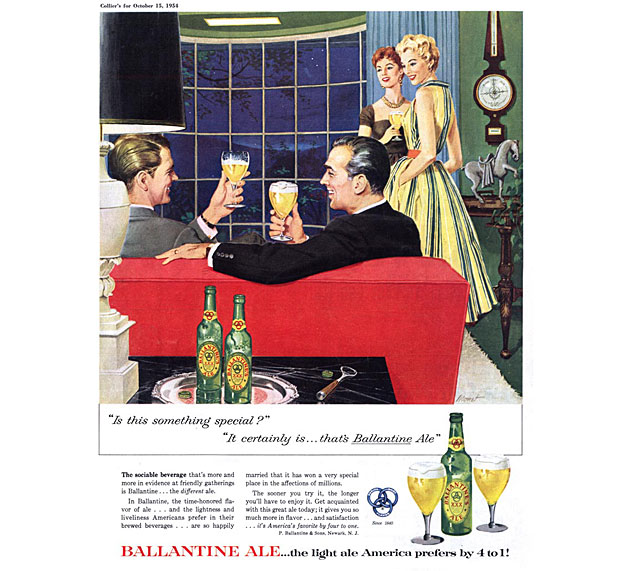
Ads are always selling more than just a product. They’re selling a fantasy.  In this case, buy Ballantine Ale and you’ll get this:

1

The this is this ad from 1954 is what interests me.  I see same-sex friendship. These are presumably two heterosexual married couples — though some would disagree — but the ad isn’t about love, marriage, or sex.  The ad is about the friendship that each spouse finds with their same-sex counterpart.  The two couples come together not for platonic cross-sex companionship, in other words, but same-sex friendship.

For much of American history, the idea that men and women could be friends made little sense.  This was not for the reason we tend to think this today (that is, sexual temptation), but because men and women were believed to be psychologically different.  Differences between the sexes were believed to make cross-sex friendship impossible and pointless.  You wouldn’t have anything in common and couldn’t understand one another.  Women needed men for marriage, domestic divisions of labor, and children — and vice versa — but true friendship was reserved for someone of the same sex.

We certainly don’t need to return to that type of thinking — even if it was adorable — but I do appreciate the way this ad is committed to the idea that simple friendship is fantastic.

Lisa Wade, PhD is an Associate Professor at Tulane University. She is the author of American Hookup, a book about college sexual culture; a textbook about gender; and a forthcoming introductory text: Terrible Magnificent Sociology. You can follow her on Twitter and Instagram.
This February, president Obama sat down for dinner with his visiting French colleague, François Hollande. In the company of the first lady, other government officials, and some celebrities, the men enjoyed an appetizer of Illinois caviar, Pennsylvania quail eggs, and 12 US varieties of potatoes. The main dish was a Colorado beef steak with mushrooms, Vermont cheese, and salad, followed by a dessert of Hawaiian chocolate cake, Florida tangerines, and Pennsylvania vanilla ice-cream. Three types of wine accompanied the meal. Not just any types of wine: they were American wines made by French-born winemakers.

Like the food, nothing in this meal was left to chance. But why was the encounter so carefully planned? Would it make a difference if, to celebrate the French-American friendship, the presidents raised a glass of Italian wine instead?

Food provides us with much more than physical sustenance: it is a symbol of relationships among individuals and groups. What was at stake at the February state dinner was not just pleasing the presidents’ palates, but nurturing ties within and between entire nations.

Imagine, first, that the diners were served tortillas or spaghetti as a main course instead of the dry-aged, family-owned-farm-raised rib eye beef steak they had. The former quickly evoke images of Mexico and Italy, while the latter tells a distinctly American story.

Serving dishes associated with particular countries is one way of fostering an imagined community – a nation state – which Benedict Anderson describes as being too great to be maintained by personal relationships, and one that must be continuously symbolized in order to persist. Especially on celebratory occasions, food takes part in producing and communicating national identities.

State dinners aren’t the only such example: another is the festive food used in New Year’s meals. The Vietnamese will eat a tet cake, the Belgians will have smoutebollen, and Slovenians will always have potica. In a melting pot nation, sending a message of a coherent community is even more important. France used banquets in it post-revolutionary times to bring together citizens in defiance of regionally specific gastronomies, writes Julia Csergo. Similarly, during the state dinner, a steak symbolizing quintessential America amidst its diversity was the star of the presidents’ meal.

And imagine, second, what would happen if president Hollande refused any part of the meal. If he skipped the cheese, we might think he is suspicious of the way the U.S. regulates its dairy industry. If he only finished half his potatoes, does that mean American produce does not taste good enough for the French? And if he rejected the dinner invitation to begin with, does this indicate the French dislike the US altogether?

Such presidential gestures would transcend his individual palate. Two political representatives sharing a meal are not only communicating their own food preferences, they are shaping a relationship between two communities. Using commensality as a political instrument is as old as the feasts of ancient Greeks and Romans, writes Richard Ascough: the banquets that took place on special occasions served to maintain connections with gods as much as to foster connections between citizens and forming a political identity. Those who partook in the meal were considered part of a tight group, while those who were not invited, or worse yet, refused the invitation, cast themselves as outsiders. The American and the French presidents enjoying a meal together, then, symbolizes the nations’ peaceful coexistence and firm diplomatic ties.

Offering a bottle of Italian wine instead of a French-American one during the state dinner would not be a disaster, but it would certainly convey a different message, one perhaps of a somewhat colder relationship. But if we are to believe Mary Douglas’ classical 1972 text, Deciphering a Meal, just the fact the presidents were sharing more than drinks is promising: we are almost never reluctant to share a drink with strangers, while sharing meals tends to be reserved for those to whom we wish to signal intimacy. The state dinner, conveniently held right before Valentine’s day, was a political sign of affection.

Teja Pristavec is a graduate student in the sociology department, and an IHHCPAR Excellence Fellow,  at Rutgers University. She blogs at A Serving of Sociology.

Cross-posted at A Serving of Sociology and Everyday Sociology

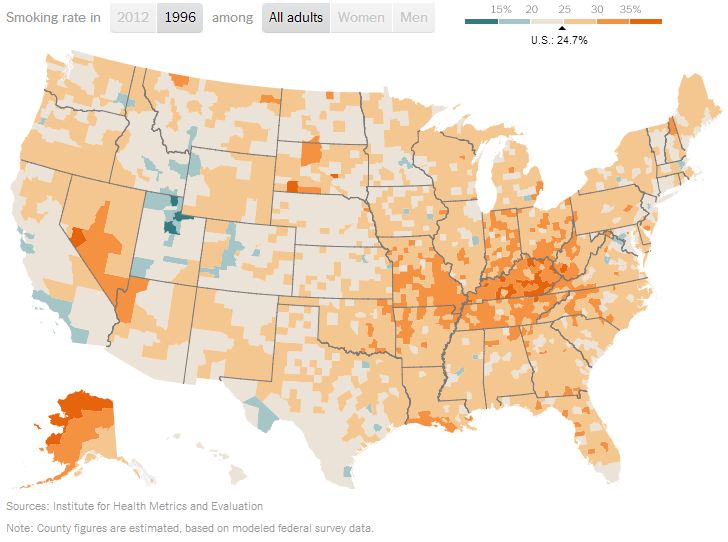
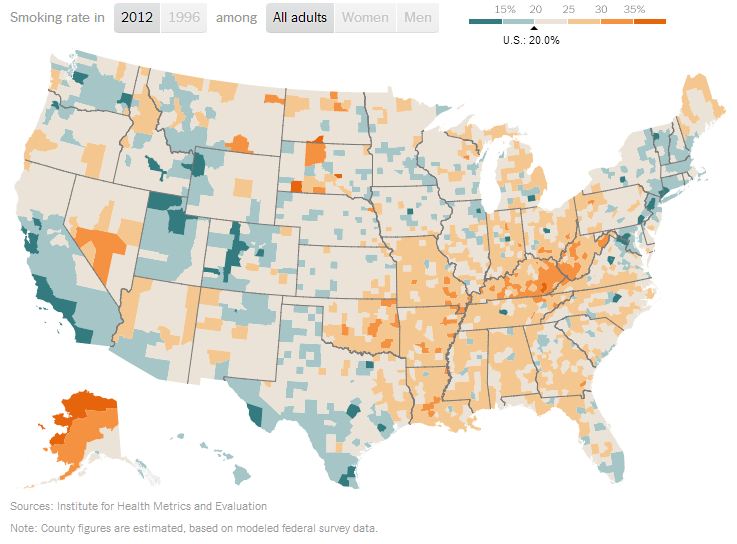
At the New York Times, Sabrina Tavernise and Robert Gebeloff discuss the tenaciousness of tobacco in low-income areas.  Smoking rates are declining, but much more slowly in some counties than others.  Local residents suggest that smoking is the least of their worries:

“Just sit and watch the parking lot for a day,” Mrs. Bowling said. “If smoking is the worst thing that’s happening, praise the Lord.”

Smoking rates, 1996:1a

Smoking rates, 2013:1

Lisa Wade, PhD is an Associate Professor at Tulane University. She is the author of American Hookup, a book about college sexual culture; a textbook about gender; and a forthcoming introductory text: Terrible Magnificent Sociology. You can follow her on Twitter and Instagram.
“For many of us, quicksand was once a real fear,” write the producers at Radio Lab:

It held a vise-grip on our imaginations, from childish sandbox games to grown-up anxieties about venturing into unknown lands. But these days, quicksand can’t even scare an 8-year-old.

Interviewing a class of fourth graders, writer Dan Engber discovered that most understood the concept, but didn’t find it particularly worrisome.  “I usually don’t think about it,” said one.  They were more afraid of things like aliens, zombies, ghosts, and dinosaurs.  But they understood that it was something that people used to be afraid of: “My dad told me that when he was little his friends always said ‘look out that could be quicksand!'”

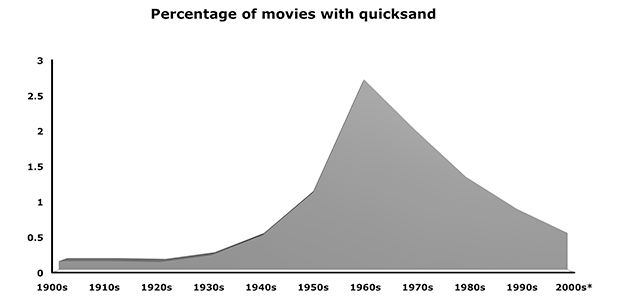
Engber became fascinated with what happened to quicksand.  He found a source of data — compiled by, of all things, quicksand sexual fetishists — that included every movie scene that involved quicksand from the 1900s to the 2000s.  Comparing this number to the total number of movies produced allowed him to show that quicksand had a lifecourse.  It rose in the ’40s, skyrocketed in the ’60s, and then fell out of favor.

1.jpg

Why?

Engber found a pattern in the data.  In quicksand’s early years, the movie scenes featured quicksand as a very serious threat.  But, after quicksand peaked, it became a  joke.  In the ’80s, quicksand even made it into My Little Pony and Perfect Strangers.  Later, in discussions about plot lines for Lost, the idea of quicksand was dismissed as ridiculous.

I guess it’s fair to say that quicksand “jumped the shark.”

In sociology, we call this the social construction of social problems: the fact that our fears don’t perfectly correlate with the hazards we face.  In this case, media is implicated. What is it making us fear today?

Lisa Wade, PhD is an Associate Professor at Tulane University. She is the author of American Hookup, a book about college sexual culture; a textbook about gender; and a forthcoming introductory text: Terrible Magnificent Sociology. You can follow her on Twitter and Instagram.
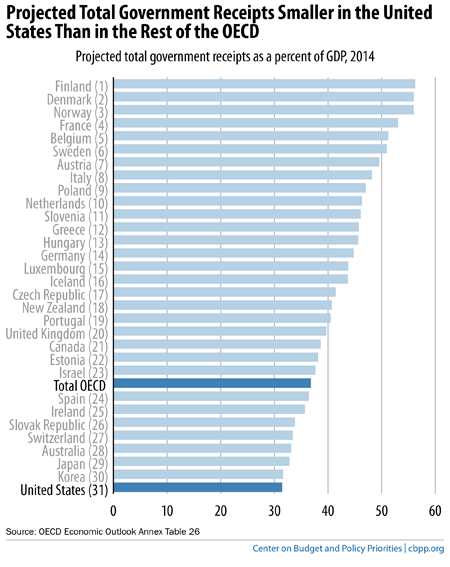
This chart comes from Chuck Marr at the Center on Budget and Policy Priorities.  As Marr explains:

The United States is a relatively low-tax country, as the chart shows.  When measured as a share of the economy, total government receipts (a broad measure of revenue) are lower in the United States than in any other member of the Organization for Economic Co-operation and Development (OECD), even after accounting for the modest revenue increases in the 2012 “fiscal cliff” deal and the taxes that fund health reform.

1 (2) - Copy

Martin Hart-Landsberg is a professor of economics at Lewis and Clark College. You can follow him at Reports from the Economic Front.