Search results for The

In New Orleans there is this magical thing where you can put your alcoholic drink in a plastic cup of any kind and leave the establishment you are patronizing — or even your own very house — and go outside!

!!!

It’s called a “go-cup” and, in its simplest form, it looks like this:

1

The bars and restaurants have them for your convenience and many residents keep a supply on hand too.

I still remember the first time I went to New Orleans, about five years ago, and realized that I could do this.  It was… okay “liberating” might be a strong word… but it did bring into sharp relief the lack of freedom that I experience in other parts of the U.S. that do not allow public consumption of alcohol.  Moreover, it revealed to me how deeply I had internalized the idea that (1) you can’t drink alcohol in public, (2) if you want to drink alcohol and you’re not at home, you have to purchase it from a vendor and, (3) if you purchase a drink, you must finish drinking it or abandon the remains if you want to go somewhere else.

None of these rules apply in New Orleans.

I had the pleasure of showing my friend Dolores around the city last month and chuckled as she kept forgetting that we could leave a bar or restaurant with a drink in hand.  I’d suggest we go and she’d remember, suddenly, that we could.  We didn’t have to sit around and finish our drinks.  Or, even crazier, we could pop into a bar as we walked by, order a drink, and keep going our merry way.  Her realization that these were possibilities happened over and over again, as she kept reverting to her non-conscious habits.

Dolores’ experience is a great example of how we internalize rules invented by humans to the point where they feel like laws of nature.  In our daily lives in Los Angeles, where we both live, we hang out together and drink alcohol under the local regulations. We rarely feel constrained by these because we forget that it could be another way.  This is the power of culture to make alternative ways of life invisible and, as a result, gain massive public conformity to arbitrary norms and laws.

Cross-posted at Pacific Standard.

Lisa Wade, PhD is an Associate Professor at Tulane University. She is the author of American Hookup, a book about college sexual culture; a textbook about gender; and a forthcoming introductory text: Terrible Magnificent Sociology. You can follow her on Twitter and Instagram.
Flashback Friday.

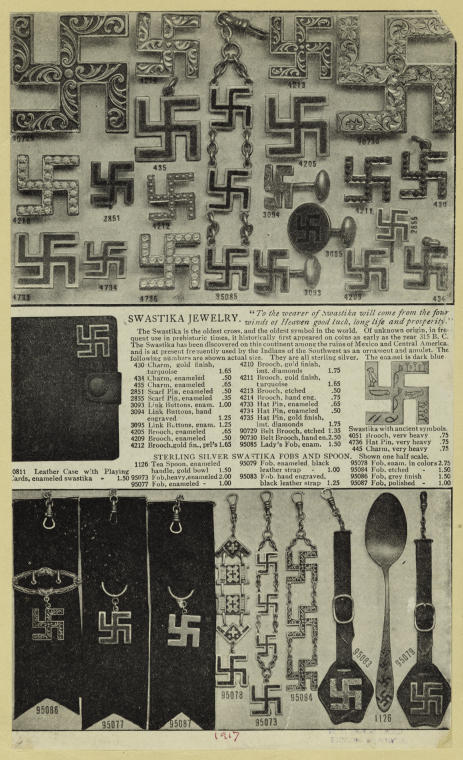
I found this 1917 advertisement for swastika jewelry while browsing through the NY Public Library Digital Gallery. The text reads in part:

To the wearer of swastika will come from the four winds of heaven good luck, long life and prosperity. The swastika is the oldest cross, and the oldest symbol in the world. Of unknown origin, in frequent use in the prehistoric items, it historically first appeared on coins as early as the year 315 B.C.

As this suggests, while the symbol of the swastika is most frequently associated with Hitler and Nazis during World War II, and is still used by neo-Nazi groups, the symbol itself has a much longer history. From wikipedia:

Archaeological evidence of swastika-shaped ornaments dates from the Neolithic period. An ancient symbol, it occurs mainly in the cultures that are in modern day India and the surrounding area, sometimes as a geometrical motif and sometimes as a religious symbol. It was long widely used in major world religions such as Hinduism, Buddhism and Jainism.

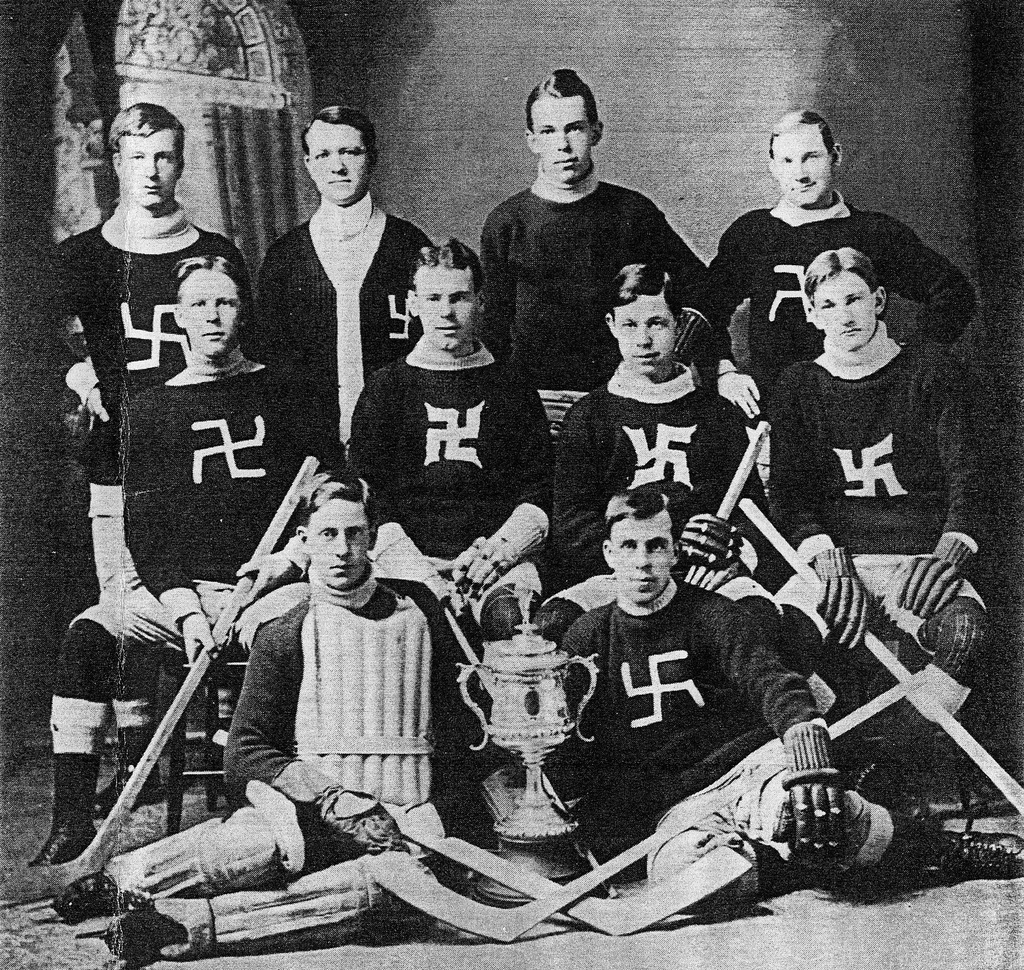
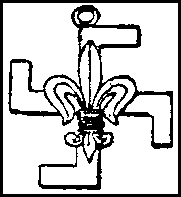
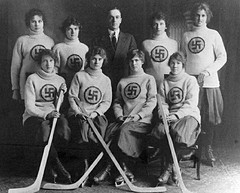
Before it was co-opted by the Nazis, the swastika decorated all kinds of things.  Uni Watch has tons of examples. Here it is on a Finnish military plane:

A Boy Scout badge:

A women’s hockey team called the Swastikas from Edmonton (from 1916):

Another hockey team:

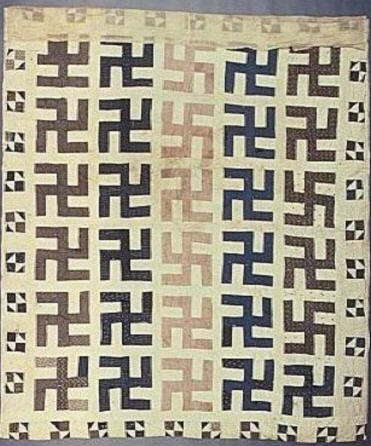
In the comments, Felicity pointed to this example:

She writes:

My mom is a quilter and collects antique quilts (when she can afford them). She says that while in general, antique quilts and quilt-tops have gone up a great deal in price over the decades, there’s still one sort you can pick up for a song — swastika quilts.

It’s kind of sad to think of somebody in 1900 putting all that time and hand-stitching into a ‘good luck’ quilt that is now reviled.

All of these examples occurred before the Nazis adopted the swastika as their symbol (and changed it slightly by tilting it on a 45-degree angle). Of course, the original meaning or usage of the swastika is beside the point now. Because it is so strongly associated with the Nazis, it’s impossible to use it now without people reading it as a Nazi symbol. And in fact it’s unimaginable that a group in the U.S. or Europe would use the swastika today without intentionally meaning to draw on the Nazi association and the ideas espoused by Hitler and his party.

Wendy Christensen is an Assistant Professor at William Paterson University whose specialty includes the intersection of gender, war, and the media.  You can follow her on Twitter.

“Stay-at-home mother” evokes black and white images of well-coiffed women in starched aprons. Rather than a vestige of a bygone era, stay-at-home moms are on the rise, according to the findings of a new Pew Research study. In 2012, 29% of women with children under the age of 18 stayed home, a number that has been on the rise since 1999 and is 3% higher than in 2008.

However, while more women are staying home with their children, the face of the stay-at-home mom has changed dramatically since the 1950s “Leave It to Beaver” days. Stay-at-home moms today are less educated and more likely to live in poverty than working moms. Younger mothers and immigrant mothers also make up a good portion of stay-at-home moms.

The story of why mothers are staying home is more complex than you may imagine and has more to do with the poor labor market, the exorbitant price of child care, and the contemporary structure of work. In a recent interview with Wisconsin Public RadioBarbara Risman, a sociologist at the University of Illinois at Chicago, spoke about how this report has been picked up by the mainstream media:

What’s surprising to me is the headlines and how it’s portrayed in the news. Although the numbers are going up, when you look at what mothers say, 6% of the mothers in this study say they are home because they can’t find a job. When you take those 6% of mothers out, the results are rather flat. Part of the real story here then is that it’s hard to find a job that allows you to work and covers your child care, particularly if you have less education and your earning potential isn’t very high.

These days stay-at-home moms, who are more likely to be less educated, are not able to make enough money for working to even be worthwhile. Many times, their pay wouldn’t actually cover the cost of child care. Beyond these important financial considerations, lower wage shift work makes it extremely difficult to coordinate child care in the midst of work schedules that change on a weekly basis.

Erin Hoekstra is pursuing a PhD in Sociology at the University of Minnesota. This post originally appeared on Citings and Sightings and you can read all of Erin’s contributions to The Society Pages here.  Cross-posted at Pacific Standard.

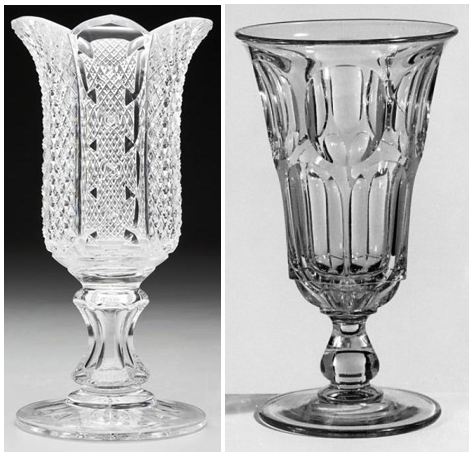
These are not fancy glasses:

1b

They’re celery vases and they’re exactly what they sound like: vases for celery.   In the late 1800s, people used these vases to ostentatiously present celery to their guests. Celery, you see, was a status food: a rare delicacy that only wealthy families could afford and, therefore, a way to demonstrate your importance to guests.

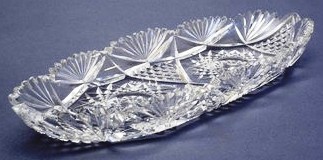
As celery began to decline in importance — cheaper varieties became available and its role for the elite declined — celery vases were replaced by celery dishes.   “Less conspicuous on the dining table,” writes decorative arts consultant Walter Richie, “the celery dish reflected the diminishing importance of celery.”

1a

Lisa Wade, PhD is an Associate Professor at Tulane University. She is the author of American Hookup, a book about college sexual culture; a textbook about gender; and a forthcoming introductory text: Terrible Magnificent Sociology. You can follow her on Twitter and Instagram.

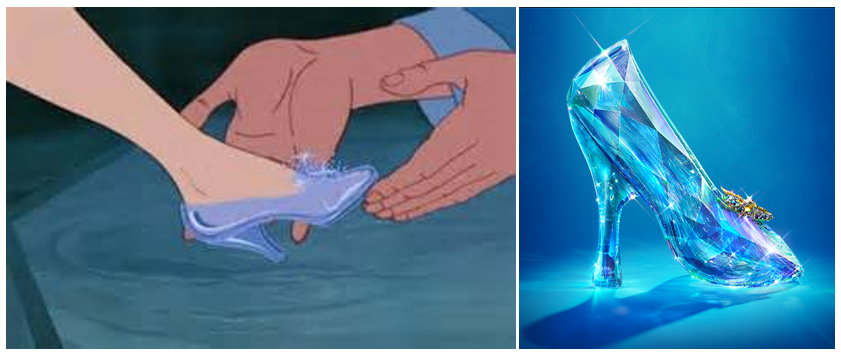
I guess I’m a little bit of a masochist, so I watched the trailer for Disney’s Cinderella re-make, due out in 2015. All they do is show a shoe, but what a shoe it is! Notice anything different?

1 (2) - Copy

Point to Gail Dines; Pamela Paul; Carmine Sarracino and Kevin Scott; and Kaarina Nikunun, Susanna Paasonen, and Laura Saarenmaa, all who argue that we’re seeing a “pornification” of everyday life.

Lisa Wade, PhD is an Associate Professor at Tulane University. She is the author of American Hookup, a book about college sexual culture; a textbook about gender; and a forthcoming introductory text: Terrible Magnificent Sociology. You can follow her on Twitter and Instagram.
Flashback Friday.

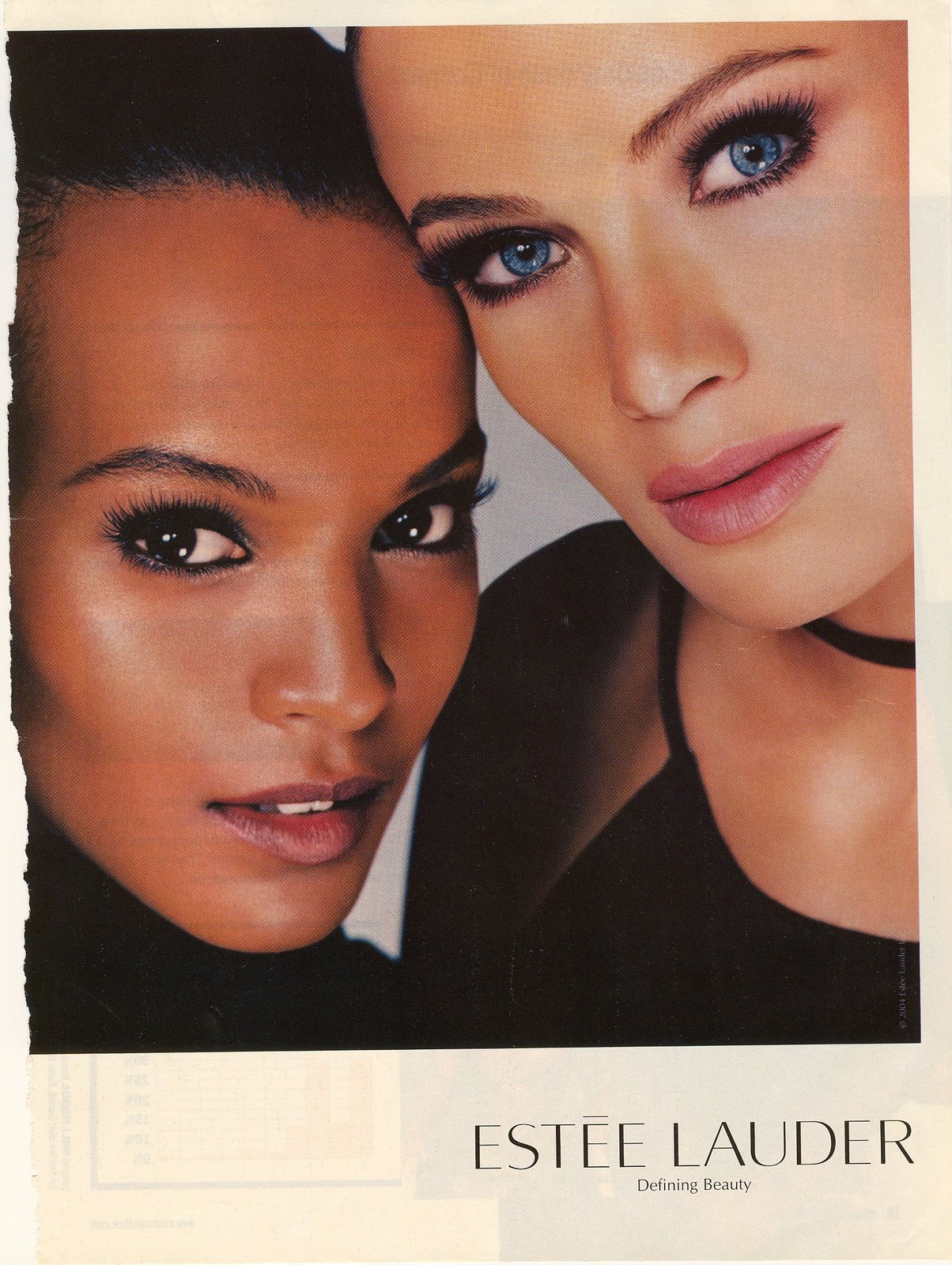
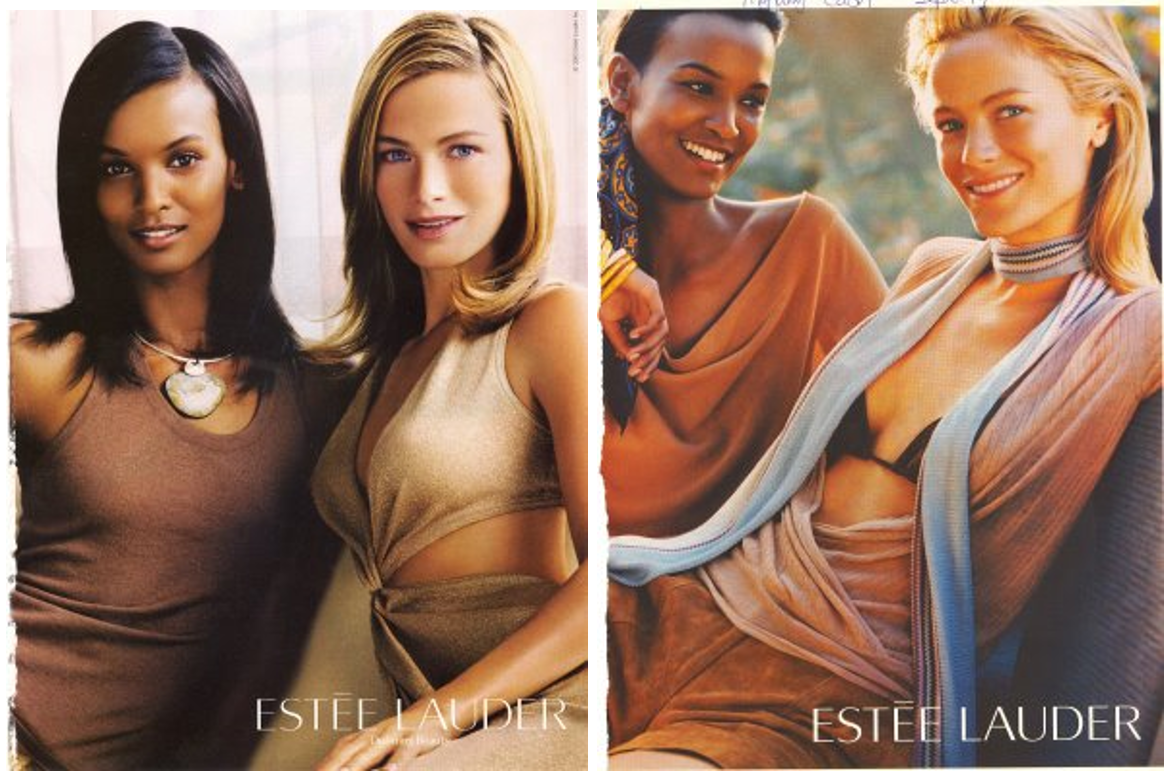
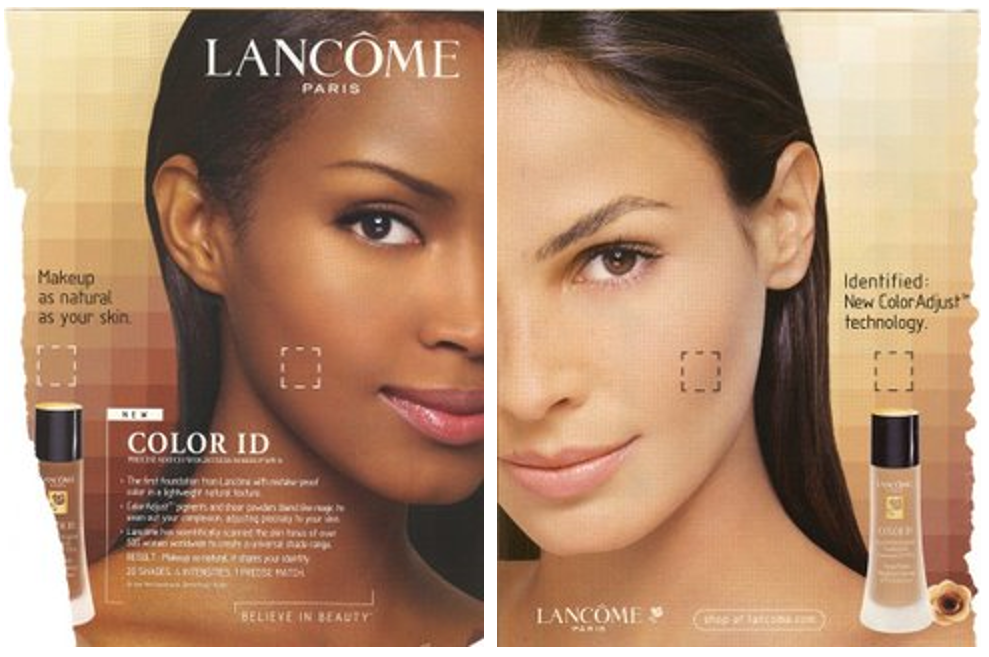
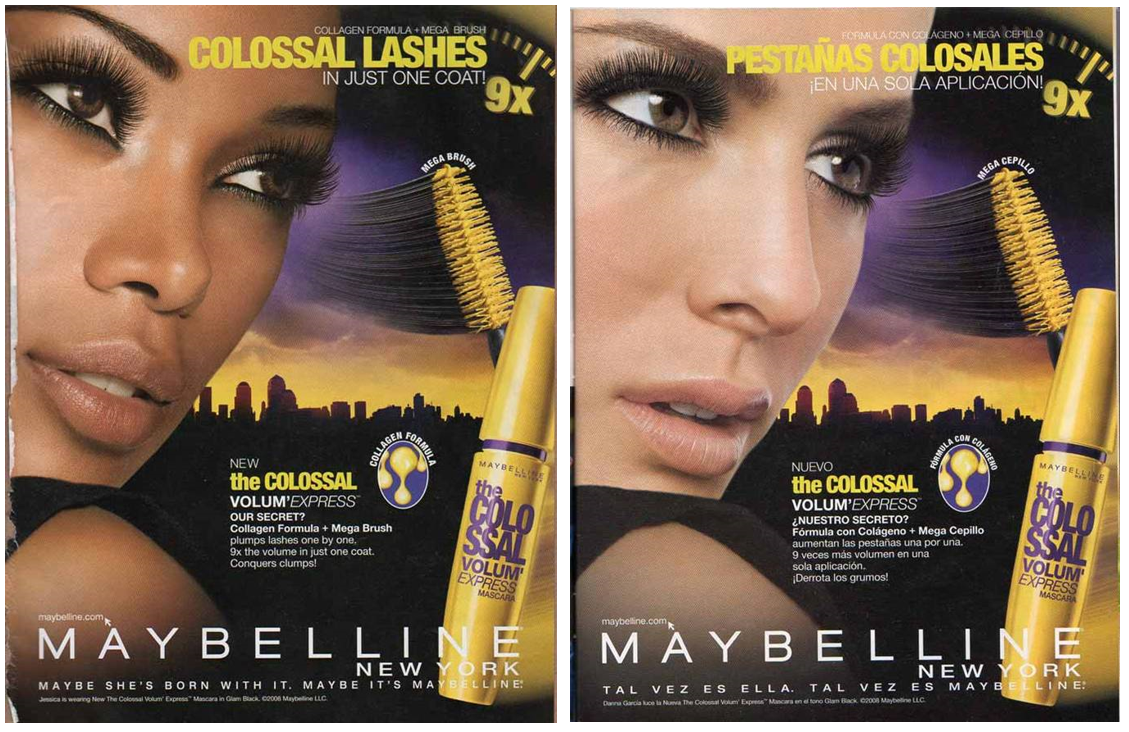
One manifestation of white supremacy is the use of whiteness as the standard of beauty.  When whiteness is considered superior, white people are considered more attractive by definition and, insofar as the appearance of people of other races deviates from that standard, they are considered ugly.

Non-white people are still allowed to be considered beautiful, of course, as long as they look like white people.

This collection of images is a nice illustration of the way in which black women, in particular, are expected to look white in order to qualify as beautiful. The images are powerful because the black models look almost identical to the white models, but also because they are ads for make-up. So the ads are literally selling beauty.

1 (3)11 (2) 1 (3)

This is Flashback Friday, so these are ads I collected and posted in 2008.  Have things changed or stayed the same? Or, am I being unfair? Most white women do not look like these women either.  And the women of color in the images are, in fact, women of color.  Who am I to say they don’t look “black”?  Is there something else going on here?  I’m happy for the conversation.

Lisa Wade, PhD is an Associate Professor at Tulane University. She is the author of American Hookup, a book about college sexual culture; a textbook about gender; and a forthcoming introductory text: Terrible Magnificent Sociology. You can follow her on Twitter and Instagram.
In case you were wondering, race is still important in the U.S., including in American sports. Deadspin put out a neat tool just in time for NFL draft weekend, allowing readers to see for themselves just how often different words are used to describe white and black athletes in draft scouting reports.  It turns out, for example, that a black prospect’s report is more likely to mention his “motor,” while the typical white player is more likely to be called a “worker.” “Freakish” shows up five times in black reports, and never in a white player’s. Black players are also more likely to be called “coachable.”

I downloaded the data to find out just what the “blackest” and “whitest’ words were. I then drew out the 50 words most likely associated with black and white athletes, respectively. The words are all vaguely football-ish, but upon reflection distinctive patterns emerge.

Some words leap out immediately. Reports on black athletes are far more likely to include the word “mother.” Conversely, white athletes’ reports mention “brothers” more often.  Black players’ reports more often include “driving”; reports on white athletes mention “drive.”

Dig a bit deeper, and some groupings appear. I created five rough categories for the most common “black” words, and another four for the most common white words:

Table 1: black word groups
Physicality upright, leaping, acceleration, pedal, driving, talented, runs, bounce, accelerates, chase, closes, tightness, track, radius, flexible, coordination, physicality
Violence jam, violent, disruptive
Positional all-purpose, cutback, touches, safety, open-field, pass-rush, cornerback, return, returner, cuts, gaps, gap, wr
Development loose, currently, support, stop, drop, interception, terms, directions
Other jones, auburn, vj, instead, wrap, disengage


 Table 2: white word groups
Quarterback delivery, accuracy, velocity, accurate, mobility, short-to-intermediate, throwing, placement, pocket, passer, release, throw, passing, arm, throws
Other positional leg, center, pressure, targets, touch, guard, under, offense, rushers, blocking, keeps, tackle
Intelligence intangibles, understands, intelligence, all-conference, smart,
experienced, sound, leader
Other onto, brother, backup, drive, 50, ends, base, ten, four-year, keeping, punch, left, timing

I was quite surprised just how pervasive the old tropes of the smart white leader athletes, and the talent and physical black athletes remain. The word “accuracy” is more than twelve times more likely to be associated with a white player than his black counterpart. Likewise, the words “understands,”(3.9 times) “intelligence” (3.0 times), and the sneaky “intangibles” (3.9 times) are all far more likely to be associated with white athletes.

Conversely, reports on black athletes are more likely to include “leaping” (6.3 times), “upright” (10.4 times), and “violent” (5.1 times). They comparatively rarely include words associated with quarterbacking, intelligence, or leadership.

What the numbers can’t tell us is how much of the difference can be ascribed to the scouts themselves allowing biases to creep in, and how much reflects ways in which athletes have been shaped to this point (i.e., coached to be violent,  encouraged to become leaders, etc). This is obviously an important question, but either way it is clear that race remains a hugely important filter affecting life chances, even in something as supposedly meritocratic as professional and near-professional sports.

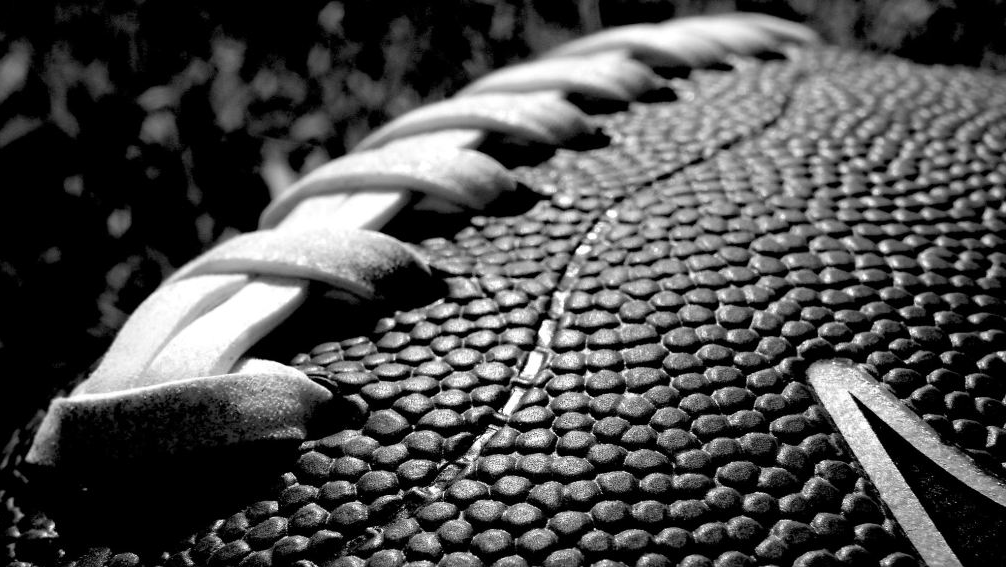
A longer version of this post, with more details on methods, can be found at Politics All the Way Down.  Photo credit: Ron Almog, via wikimedia commons.

Stewart Prest is a PhD candidate in political science at the University of British Columbia in Vancouver, Canada.  You can follow him at his blog, Politics All the Way Down, and on Twitter.  Cross-posted at Pacific Standard.

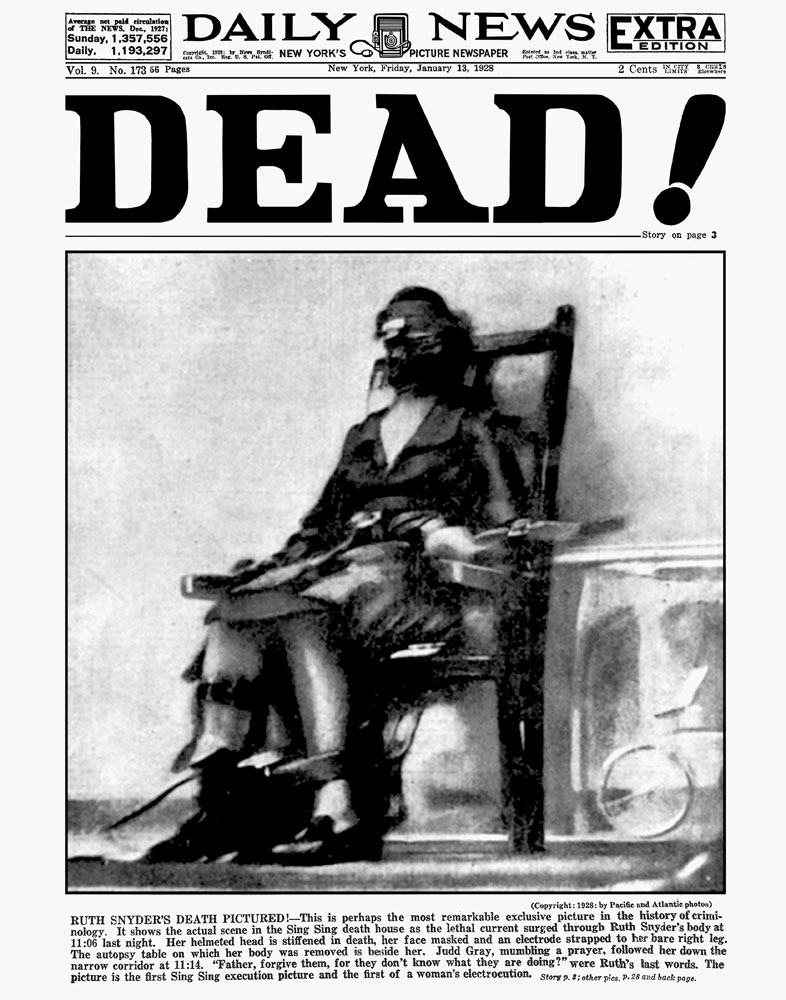
In 1928 readers of the New York Daily News were shocked by this cover.  It was the first photograph ever taken of an electrocution.

1

The executed is a woman named Ruth Snyder, convicted of murdering her husband.  The photographer was a journalist named Tom Howard.  Cameras were not allowed in the execution room, but Howard snuck a device in under his pant leg.  Prison officials weren’t  happy, but the paper was overjoyed.

The fact that the image was placed on the front page with the aggressive headline “DEAD!” suggests that editors expected the photograph to have an impact.  Summarizing at Time, Erica Fahr Campbell writes:

The black-and-white image was shocking to the U.S. and international public alike. There sat a 32-year-old wife and mother, killed for killing. Her blurred figured seemed to evoke her struggle, as one can imagine her last, strained breaths. Never before had the press been able to attain such a startling image—one not made in a faraway war, one not taken of the aftermath of a crime scene, but one capturing the very moment between life and death here at home.

It is one thing to know that executions are happening and another to see it, if mediated, with one’s own eyes.

Pictures can powerfully alter the dynamics of political debates.  Lennart Nilsson‘s famous series of photographs of fetuses, for example, humanized and romanticized the unborn.  They also erased pregnant women, making it easier to think of the fetus as an independent entity. A life, even.

Unfortunately, Campbell’s article doesn’t delve any further into the effect of this photograph on death penalty debates.  To this day, however, no prisons allow photography during executions.  What if things were different?  How might the careful documentation of this process — with all our technology for capturing and sharing images — change the debate today?  And whose interests are most protected by keeping executions invisible?

Cross-posted at Pacific Standard.

Lisa Wade, PhD is an Associate Professor at Tulane University. She is the author of American Hookup, a book about college sexual culture; a textbook about gender; and a forthcoming introductory text: Terrible Magnificent Sociology. You can follow her on Twitter and Instagram.