Search results for The

Flashback Friday.

The term “Cajun” refers to a group of people who settled in Southern Louisiana after being exiled from Acadia (now Nova Scotia, New Brunswick, and Prince Edward Island) in the mid 1700s.  For a very long time, being Cajun meant living, humbly, off the land and bayou (small-scale agriculture, hunting, fishing, and trapping).  Unique cuisine and music developed among these communities.

In Blue Collar Bayou, Jaques Henry and Carl Bankston III explain that today more than 70% live in urban areas and most work in blue collar jobs in service industries, factories, or the oil industry. “Like other working-class and middle-class Americans,’ they write, “the Southwestern Louisianan of today is much more likely to buy dinner at the Super Kmart than to trap it in the bayou” (p. 188).

But they don’t argue that young Cajuns who live urban lifestyles and work in factories are no longer authentically Cajun.  Instead, they suggest that the whole notion of ethnic authenticity is dependent on economic change.

When our economy was a production economy (that is, who you are is what you make), it made sense that Cajun-ness was linked to how one made a living.  But, today, in a consumption economy (when our identities are tied up with what we buy), it makes sense that Cajun-ness involves consumption of products like food and music.

Of course, commodifying Cajun-ness (making it something that you can buy) means that, now, anyone can purchase and consume it.  Henry and Bankston see this more as a paradox than a problem, arguing that the objectification and marketing of “Cajun” certainly makes it sellable to non-Cajuns, but does not take away from its meaningfulness to Cajuns themselves.  Tourism, they argue, “encourages Cajuns to act out their culture both for commercial gain and cultural preservation” (p. 187).

Originally posted in 2009.

Lisa Wade, PhD is an Associate Professor at Tulane University. She is the author of American Hookup, a book about college sexual culture; a textbook about gender; and a forthcoming introductory text: Terrible Magnificent Sociology. You can follow her on Twitter and Instagram.

This has been a hard week.  Another young, unarmed black man was killed by police. The Root added Michael Brown’s face to a slideshow of such incidents, started after a black man named Eric Garner died after being put in a chokehold by officers less than one month ago.  This week’s guilty verdict in the trial of the man who shot Renisha McBride left me feeling numb.  Nothing good could come of it, but at least I didn’t feel worse.

The shooting of Michael Brown, however, is still undergoing trial by media and the verdict is swayed by the choices made by producers and directors as to how to portray him. When Marc Duggan was killed by police earlier this year, they often featured pictures in which he looked menacing, including ones that had been cropped in ways that enhanced that impression.

Left: Photo of Duggan frequently used by media; right: uncropped photo in which he holds a plaque commemorating his deceased daughter.

antonio_gramsci_by_ludilozezanje-d5eqwsv

As the media coverage of Brown’s death heated up, the image that first circulated of Brown was this:

4

Reports state that this was his current Facebook profile picture, with the implication that media actors just picked the first or most prominent picture they saw.  Or, even, that somehow it’s Brown’s fault that this is the image they used.

Using the image above, though, is not neutrality.  At best, it’s laziness; they simply decided not to make a conscious, careful choice.  It’s their job to pick a photograph and I don’t know exactly what the guidelines are but “pick the first one you see” or “whatever his Facebook profile pic was on the day he died” is probably not among them.

There are consequential choices to be made.  As an example, here are two photos that have circulated since criticism of his portrayal began — the top more obviously sympathetic and the bottom more neutral:

2 3

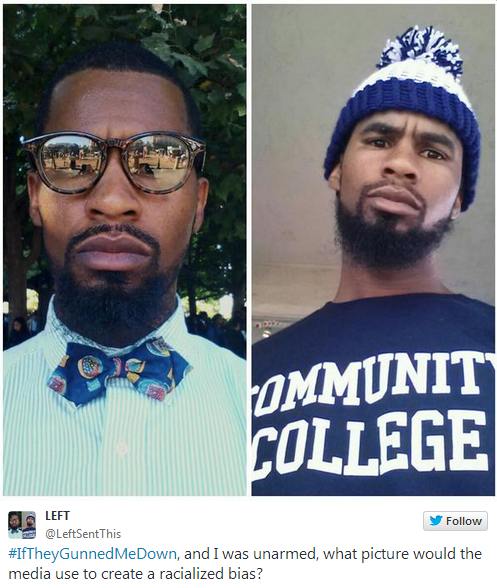
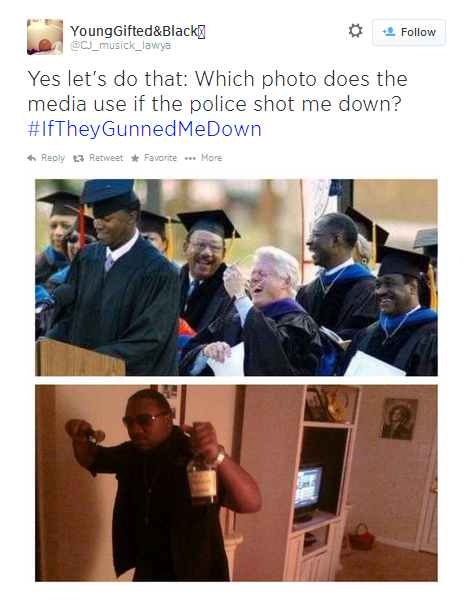
Commenting on this phenomenon, Twitter user @CJ_musick_lawya released two photos of himself, hashtagged with #iftheygunnedmedown, and asked readers which photo they thought media actors would choose.

Top: Wearing a cap and gown with former President Clinton; bottom: in sunglasses posing with a bottle and a microphone.

1

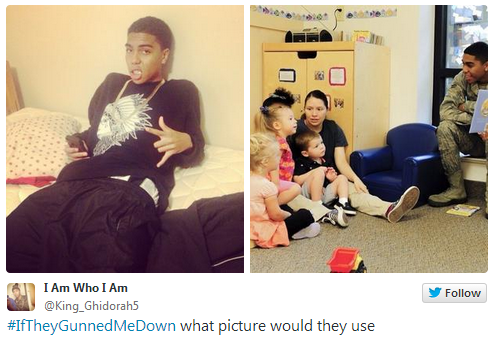
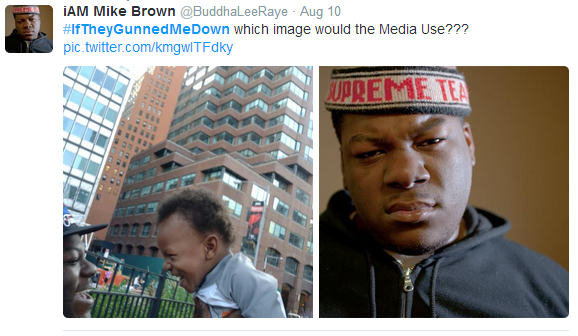
The juxtaposition brilliantly revealed how easy it is to demonize a person, especially if they are a member of a social group stereotyped as violence-prone, and how important representation is.  It caught on and the imagery was repeated to powerful effect. A summary at The Root featured examples like these:

2 3 4

The New York Times reports that the hashtag has been used more than 168,000 times as of  August 12th.  I want to believe that conversations like these will educate and put pressure on those with the power to represent black men and all marginalized peoples to make more responsible and thoughtful decisions.

Lisa Wade, PhD is an Associate Professor at Tulane University. She is the author of American Hookup, a book about college sexual culture; a textbook about gender; and a forthcoming introductory text: Terrible Magnificent Sociology. You can follow her on Twitter and Instagram.

Ross Douthat is puzzled. He seems to sense that a liberal policy might actually help, but his high conservative principles and morality keep him from taking that step. It’s a political version of Freudian repression – the conservative superego forcing tempting ideas to remain out of awareness.

In his column, Douthat recounts several anecdotes of criminal charges brought against parents whose children were unsupervised for short periods of time.  The best-known of these criminals of late is Debra Harrell, the mother in South Carolina who let her 9-year-old daughter go to a nearby playground while she (Debra) worked at her job at McDonald’s. The details of the case make it clear that this was not a bad mom – not cruel, not negligent. The playground was the best child care she could afford.

One solution should be obvious – affordable child care.  But the U.S. is rather stingy when it comes to kids. Other countries are way ahead of us on public spending for children.

1

Conservatives will argue that child care should be private not public and that local charities and churches do a better job than do state-run programs. Maybe so. The trouble is that those private programs are not accessible to everyone. If Debra Harrell had been in France or Denmark, the problem would never have arisen.

The other conservative U.S. policy that put Debra Harrell in the arms of the law is “welfare reform.”  As Douthat explains, in the U.S., thanks to changes in the welfare system much lauded by conservatives, the U.S. now has “a welfare system whose work requirements can put a single mother behind a fast-food counter while her kid is out of school.”

That’s the part that perplexes Douthat. He thinks that it’s a good thing for the government to force poor women to work, but it’s a bad thing for those women not to have the time to be good mothers. The two obvious solutions – affordable day care or support for women who stay home to take care of kids – conflict with the cherished conservative ideas: government bad, work good.

This last issue presents a distinctive challenge to conservatives like me, who believe such work requirements are essential. If we want women like Debra Harrell to take jobs instead of welfare, we have to also find a way to defend their liberty as parents, instead of expecting them to hover like helicopters and then literally arresting them if they don’t.

As he says, it’s a distinctive challenge, but only if you cling so tightly to conservative principles that you reject solutions – solutions that seem to be working quite well in other countries – just because they involve the government or allow poor parents not to work.

Conservatives love to decry “the nanny state.”  That means things like government efforts to improve kids’ health and nutrition. (Right wingers make fun of the first lady for trying to get kids to eat sensibly and get some exercise.)

A nanny is a person who is paid to look after someone else’s kids. Well-off people hire them privately (though they still prefer to call them au pairs). But for the childcare problems of low-income parents, what we need is more of a nanny state, or more accurately, state-paid nannies.

Jay Livingston is the chair of the Sociology Department at Montclair State University. You can follow him at Montclair SocioBlog or on Twitter.

“What is it that I want?”

Jane Van Galen asked herself this question after reading a gushing profile of an “island cabin” in The Seattle Times.   It begins: “Lots of folks have lots of reasons for wanting their own piece of land out of town” and quotes one of the new cabin’s owners who, when pregnant, came to realize: “I can’t raise a child just in the city … I wanted woods, salamanders and pileated woodpeckers.”

So, she and her husband “went right out,” bought nine acres on an island, and built this a stunning “cabin.” Writing at her site, Education and Class, Van Galen processed her reaction to this article. She added up the costs, figuring that the owners spent close to a million dollars.  “I knew that my unease,” she wrote, “was not just straightforward jealously.”  So, what did she want?

She knew what she did not want:

Narratives in which the wealthy are held up as model parents who upon hearing of the dangers of the modern world, “go right out” to provide acres of weekend woods for their children; narratives that invite us to admire their paint colors and beautiful windows and solid black granite bathtub without asking too many questions about how it is that relatively young parents can ensure that their child has access to acres of his own private salamanders, and especially not to ask too many questions about how all children might have room to grow and thrive...

She wanted, “for once,” to hear wealthy people just admit they’re rich — for whatever reason — instead of framing their decision to build a vacation home as simply what any good parent would do.

“I love having this for my son,” the owner is quoted.  But Van Galen wants to know: What about everyone else’s children?

Cross-posted at Global Policy TV.

Lisa Wade, PhD is an Associate Professor at Tulane University. She is the author of American Hookup, a book about college sexual culture; a textbook about gender; and a forthcoming introductory text: Terrible Magnificent Sociology. You can follow her on Twitter and Instagram.

Flashback Friday.

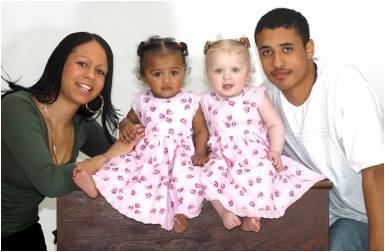
This remarkable newspaper article illustrates how skin color (which is real) gets translated into categorical racial categories (which are not).  The children in the images below — Kian and Remee Hodgson — are fraternal twins born to two bi-racial parents:

1

The story attempts to explain the biology:

Skin colour is believed to be determined by up to seven different genes working together. If a woman is of mixed race, her eggs will usually contain a mixture of genes coding for both black and white skin. Similarly, a man of mixed race will have a variety of different genes in his sperm. When these eggs and sperm come together, they will create a baby of mixed race.  But, very occasionally, the egg or sperm might contain genes coding for one skin colour. If both the egg and sperm contain all white genes, the baby will be white. And if both contain just the versions necessary for black skin, the baby will be black.

Fair enough.

But then the journalist makes a logical leap from biological determinants of skin color to racial categories. Referring now to genes for skin color as “black” and “white” genes, she writes: “Baby Kian must have inherited the black genes from both sides of the family, whilst Remee inherited the white ones.”  And, of course, while both children are, technically, mixed race*, the headline to the story, “Black and White Twins,” presents them as separate races.

We’re so committed to racial differences that the mother actually speaks about their similarities as if it is surprising that twins of different “races” could possibly have anything in common.  She says:

There are some similarities between them. They both love apples and grapes, and their favourite television programme is Teletubbies.”

This is also a nice example of a U.S.-specific racial logic. This might not have been a story in Brazil at all, where racial categories are determined more by color alone and less by who your parents are.  It is not uncommon there to have siblings of various racial designations.

The twins, by the way, are seven now.

* Of course, identifying them as mixed race also re-inscribes racial categories in that you must believe in two or more racial categories to believe that it is possible to mix them.

Originally posted in 2008.

Lisa Wade, PhD is an Associate Professor at Tulane University. She is the author of American Hookup, a book about college sexual culture; a textbook about gender; and a forthcoming introductory text: Terrible Magnificent Sociology. You can follow her on Twitter and Instagram.

Every spring, my daughter receives an invitation to participate in a local Girls on the Run (GOTR) program. Every spring, I hesitate saying, “yes.”

Girls on the Run (GOTR) is a non-profit organization with about 200 councils across the U.S. and Canada. Over 10 to 12 weeks, councils help organize teams of girls in 3rd through 8th grades to train for and complete a 5K run.

Volunteer coaches lead their team through the program’s pre-packaged curriculum, consisting of lessons that “encourage positive emotional, social, mental and physical development.” Among other things they discuss self-esteem, confidence, team work, healthy relationships, and “challenges girls face.” Boys are not allowed to participate in the program. The 5K is described by GOTR as the ending “moment in time that beautifully reflects the very essence of the program goals.”

The starting line has the atmosphere of a party. Music is played over loud speakers, pumping teen pop (with lyrics laden with sexual innuendo and “crushes” on boys) and oldies that carry an affirmative “you can do it” message like Gaynor’s, “I Will Survive.”

Vendors (local businesses and organizations) bring tables to engage the girls and their parents in products/services they have available. This is not the only form of capitalistic opportunism affiliated with GOTR. The international organization’s official sponsors include Lego Friends – a line of Legos that emphasize single-sexed socialization (not building!) and Secret’s campaign “Mean Stinks” (featuring another pop glam star, Demi Lovato) that emphasizes painting fingernails blue, among other frivolous things, to address girl-on-girl bullying.

The run is an odd scene. Though boys have been banned from participation, older male relatives, friends, and teachers are encouraged to run with girls as their sponsors. It has become a unique trademark of GOTR that these men, and many of the women and girls, dress “hyper-feminine” (e.g., in skirts, tutus, big bows, bold patterned knee-high socks, tiaras, etc.), apply make-up or face paint, and spray color their hair. The idea is to “girl it up.”

Over the years, I’ve become increasingly uncomfortable with this event for a couple of reasons.

First, encouraging girls to “girl it up”—or I prefer, “glam it up,” so that we don’t appropriate these behaviors just for girls—can be fun, an opportunity to step out and beyond what is practiced in everyday life. But there’s no corresponding encouragement to “butch it up” if they desire, or do some combination of both.  In the end, then, this simply serves to reproduce gender stereotypes and the old-fashioned and false notion that gender is binary.

Second, by bombarding girls with “positive” messages about themselves meant to counteract negative ones, the program implicitly gives credence to the idea that girls aren’t considered equal to boys. What messages are girls really getting when special programs are aimed at trying to make them feel good about themselves as girls?

Although I have always given in to my daughter’s requests, at some point I am going to say “no.” Instead of reinforcing the box she’s put into, and decorating it with a pretty bow, we’ll have to start unpacking mainstream girl culture together.

Scott Richardson is an assistant professor of educational foundations and affiliate of women’s studies at Millersville University of Pennsylvania. You can follow him on Twitter.

A blast from the past.  Fred and Barney let their wives do all the work, pull out a pack of Winston’s:

Originally posted in 2008.

Lisa Wade, PhD is an Associate Professor at Tulane University. She is the author of American Hookup, a book about college sexual culture; a textbook about gender; and a forthcoming introductory text: Terrible Magnificent Sociology. You can follow her on Twitter and Instagram.
Last month I posted data showing that, of all the things that might disqualify someone for public office, being an atheist is tops.  I wrote: “Prejudice against those who say there’s no god is stronger than ageism, homophobia, and sexism.” On average, Americans would rather vote for someone who admitted to smoking pot or had an extramarital affair.

We just don’t like atheists.

But who is “we”?

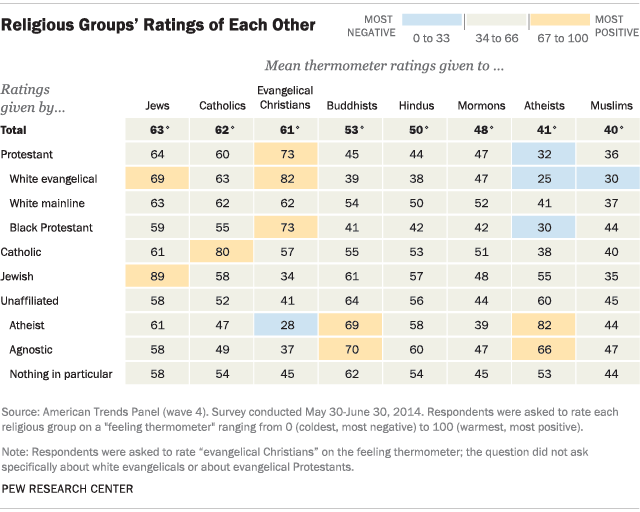
A survey by the Pew Research Center asked Americans of varying religious affiliations how they felt about each other.  atheists were most disliked by Protestants, especially White evangelicals and Black Protestants (somewhat less so White Mainline Protestants).  Atheists quite liked themselves, and agnostics thought were they were okay. Among other religiously affiliated groups, Jews gave atheists the highest rating.

1

For what it’s worth, atheists feel warmish toward Jews in return, preferring them to everyone except Buddhists, and they dislike Evangelical Christians almost as much as the Christians dislike them.

Lisa Wade, PhD is an Associate Professor at Tulane University. She is the author of American Hookup, a book about college sexual culture; a textbook about gender; and a forthcoming introductory text: Terrible Magnificent Sociology. You can follow her on Twitter and Instagram.