
Search results for The

By Stacy, who blogs at maraglen.tumblr.com.

Lisa Wade, PhD is an Associate Professor at Tulane University. She is the author of American Hookup, a book about college sexual culture; a textbook about gender; and a forthcoming introductory text: Terrible Magnificent Sociology. You can follow her on Twitter and Instagram.

Prisoners who can maintain ties to people on the outside tend to do better — both while they’re incarcerated and after they’re released. A new Crime and Delinquency article by Joshua Cochran, Daniel Mears, and William Bales, however, shows relatively low rates of visitation.

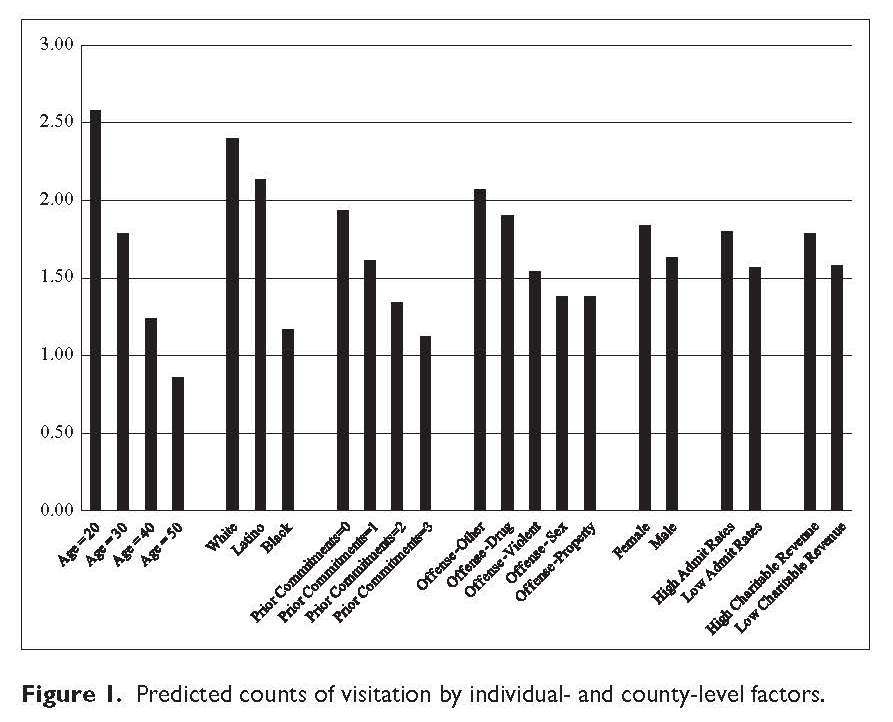
The study was based on a cohort of prisoners admitted into and released from Florida prisons from November 2000 to April 2002. On average, inmates only received 2.1 visits over the course of their entire incarceration period. Who got visitors? As the figure below shows, prisoners who are younger, white or Latino, and had been incarcerated less frequently tend to have more visits. Community factors also shaped visitation patterns: prisoners who come from high incarceration areas or communities with greater charitable activity also received more visits.  

2

There are some pretty big barriers to improving visitation rates, including: (1) distance (most inmates are housed more than 100 miles from home); (2) lack of transportation; (3) costs associated with missed work; and, (4) child care. While these are difficult obstacles to overcome, the authors conclude that corrections systems can take steps to reduce these barriers, such as housing inmates closer to their homes, making facilities and visiting hours more child-friendly, and reaching out to prisoners’ families regarding the importance of visitation, both before and during incarceration.

Cross-posted at Public Criminology.

Chris Uggen is a professor of sociology at the University of Minnesota and the author of  Locked Out: Felon Disenfranchisement and American Democracy, with Jeff Manza. You can follow him at his blog and on twitter.

Forgive me, because this is probably better left to Cyborgology, but something amazing is happening here. In the video below, nesting swallows become trapped in a building when they add doors. The birds soon learn, though, that they can get the doors to automatically open by triggering the motion sensors. This is a story, obviously, of how smart birds are, but here’s what struck me: we often think about human technology as for humans. In this case, however, birds adapted the technology for their own very similar needs (to get in and out).

If the workers had installed an older human technology — plain old doors — the birds would have been out of luck because they don’t have thumbs and the strength to manipulate an environment built for humans. But motion activated doors make both thumbs and strength irrelevant, so now birds are our functional equals.

This is fascinating, yeah? Our technology has advanced to the point where we’re potentially undermining our own evolutionary advantages. I’m not putting a moral judgment on it. I think morality is firmly on the side of non-fitness based decisions (eh em, social Darwinism). If one wants to theorize the relationship between animals, technology, and what it means to be human, however, this looks like gold to me.

Okay Cyborgology, your turn.

Thanks to Reuben S. for the tip! Cross-posted at Pacific Standard.

Lisa Wade, PhD is an Associate Professor at Tulane University. She is the author of American Hookup, a book about college sexual culture; a textbook about gender; and a forthcoming introductory text: Terrible Magnificent Sociology. You can follow her on Twitter and Instagram.
In the clip below, James Baldwin powerfully explains why he, as a black man, has no reason to assume that white people care about him and his people.

Responding to Dick Cavett, he says, “I don’t know what most white people in this country feel, but I can only conclude what they feel from the state of their institutions.”

He goes on to present a devastating list of ways in which American institutions are segregated and biased.  He concludes:

Now, this is the evidence. You want me to make an act of faith — risking myself, my wife, my woman, my sister, my children — on some idealization which you assure me exists in America, which I have never seen.

It was 1968, four years after the Civil Rights Act.  This year marks its 50th anniversary. How much have things changed?

Hat tip to Tim Wise. Cross-posted at Pacific Standard.

Lisa Wade, PhD is an Associate Professor at Tulane University. She is the author of American Hookup, a book about college sexual culture; a textbook about gender; and a forthcoming introductory text: Terrible Magnificent Sociology. You can follow her on Twitter and Instagram.
American divisions over the state of our country’s race relations were brought to the forefront in the aftermath of Mike Brown’s shooting by a Ferguson, MO police officer named Darren Wilson. Black Americans are more than twice as likely as whites or Hispanics to say that the killing was part of a broader pattern (source).  And blacks are twice as likely as whites to say that race played an important role in Wilson’s decision to shoot (source).

At The Atlantic, Robert Jones argues that these disparate opinions may be caused, in part, by the different life experiences of the typical white and black American. He shows data, from the American Values Survey, indicating that black people are much more likely than whites to report living in communities rife with problems, from a lack of jobs and inadequate school funding to crime and racial tension.

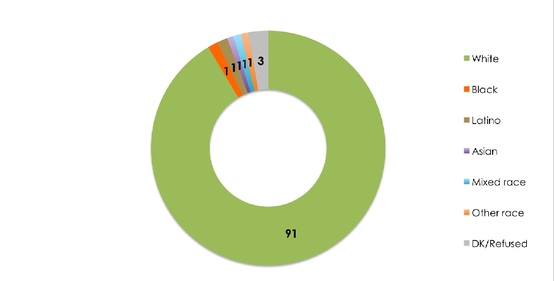
In the meantime, whites may be genuinely naive about what it’s like to be black in America because many of them don’t know any black people.  According to the survey, the average white American’s social network is only 1% black.  Three-quarters of white Americans haven’t had a meaningful conversation with a single non-white person in the last six months.

2

In contrast, the social network of the average black American is 65% black and, among Hispanic Americans, 46% Hispanic.

The average white person’s failure to engage meaningfully with people of color isn’t solely a matter of personal choice, though that is certainly part of it.  Nor is it simply a function of the country being majority white, non-Hispanic (but not for long).  White insularity is caused, too, by occupational and residential segregation which, in turn, is the result of both individual choices and institutionalized mechanisms that keep black people in poverty and prison.

If we want the people of America to embrace justice, we must make our institutions just.

Cross-posted at Pacific Standard.

Lisa Wade, PhD is an Associate Professor at Tulane University. She is the author of American Hookup, a book about college sexual culture; a textbook about gender; and a forthcoming introductory text: Terrible Magnificent Sociology. You can follow her on Twitter and Instagram.
W.E.B. DuBois (1934):

The colored people of America are coming to face the fact quite calmly that most white Americans do not like them, and are planning neither for their survival, nor for their definite future if it involves free, self-assertive modern manhood. This does not mean all Americans. A saving few are worried about the Negro problem; a still larger group are not ill-disposed, but they fear prevailing public opinion. The great mass of Americans are, however, merely representatives of average humanity. They muddle along with their own affairs and scarcely can be expected to take seriously the affairs of strangers or people whom they partly fear and partly despise.

For many years it was the theory of most Negro leaders that this attitude was the insensibility of ignorance and inexperience, that white America did not know of or realize the continuing plight of the Negro.  Accordingly, for the last two decades, we have striven by book and periodical, by speech and appeal, by various dramatic methods of agitation, to put the essential facts before the American people.  Today there can be no doubt that Americans know the facts; and yet they remain for the most part indifferent and unmoved.

– From “A Negro Nation Within a Nation.

Borrowed from an essay by Tressie McMillan Cottom. Photo from ibtimes.com.

Lisa Wade, PhD is an Associate Professor at Tulane University. She is the author of American Hookup, a book about college sexual culture; a textbook about gender; and a forthcoming introductory text: Terrible Magnificent Sociology. You can follow her on Twitter and Instagram.
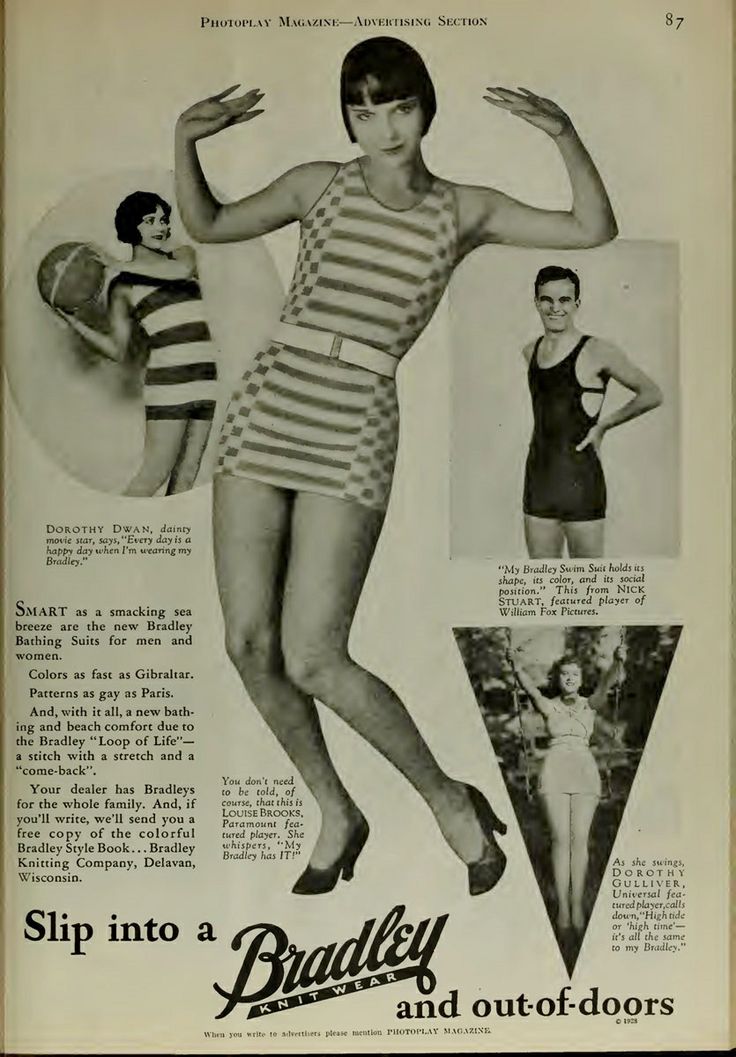
I came across this ad for bathing suits from the 1920s and was struck by how similar the men’s and women’s suits were designed.  Hers might have some extra coverage up top and feature a tight skirt over shorts instead of just shorts but, compared to what you see on beaches today, they are essentially the same bathing suit.

1

So, why are the designs for men’s and women’s bathing suits so different today? Honestly, either one could be gender-neutral. Male swimmers already wear Speedos; the fact that the man in the ad above is covering his chest is evidence that there is a possible world in which men do so. I can see men in bikinis. Likewise, women go topless on some beaches and in some countries and it can’t be any more ridiculous for them to swim in baggy knee-length shorts than it is for men to do so.

But, that’s not how it is.  Efforts to differentiate men and women through fashion have varied over time.  It can be a response to a collective desire to emphasize or minimize difference, like these unisex pants marketed in the 1960s and 70s.  It can also be, however, a backlash to those same impulses.  When differences between men and women in education, leisure, and work start to disappear – as they are right now – some might cling even tighter to the few arenas in which men and women can be made to seem very different.

Cross-posted at Pacific Standard.

Lisa Wade, PhD is an Associate Professor at Tulane University. She is the author of American Hookup, a book about college sexual culture; a textbook about gender; and a forthcoming introductory text: Terrible Magnificent Sociology. You can follow her on Twitter and Instagram.

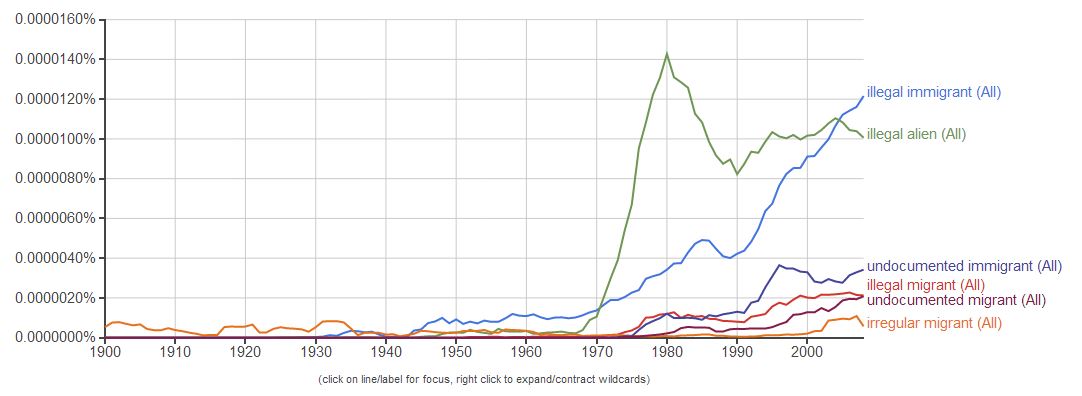
Citing the immigration scholar, Francesca Pizzutelli, Fabio Rojas explains that the phrase “illegal immigrant” wasn’t a part of the English language before the 1930s.  More often, people used the phrase “irregular immigrant.”   Instead of an evaluative term, it was a descriptive one referring to people who moved around and often crossed borders for work.

1

Rojas points out that the language began to change after anti-immigration laws were passed by Congress in the 1920s.  The graph above also reveals a steep climb in both “illegal immigrant” and “illegal alien” beginning in the ’70s.

Lisa Wade, PhD is an Associate Professor at Tulane University. She is the author of American Hookup, a book about college sexual culture; a textbook about gender; and a forthcoming introductory text: Terrible Magnificent Sociology. You can follow her on Twitter and Instagram.