Search results for The


Crossposted at Jezebel.

Simon O. sent in this Ukrainian army video meant to recruit women:

The translation (taken from YouTube, and I think it’s a somewhat rough translation; I cleaned up the punctuation and spelling a bit):

Girl 1: Would you take us for a ride in your BMW?
BMW-driver: Even to the end of the world!
Soldier: Hey, I’d like to drown [drink?] some vodka, girls!
Girl 1: Just a second!
Girl 2: Where do you live?
Soldier: Right here- daytime at work, and at night in the clubs!
Girl 1: Which work???
Soldier: Contract, of course!
Blonde girl: Contract? Marriage contract or what?
Girl 3: Army contract, stupid!
BMW driver: Hey, don’t you wanna ride in my car?
Girls: Forget it, take yourself for a ride!
Narrator: It’s about time for new heroes! With contract-based service in Ukrainian armed forces!

Apparently the Austrian army thought it was awesome and made their own version:

Translation (again from YouTube):

Audi Driver: Hey girls, wanna go for a spin in my fast ride?
Girls: Ehh not sure, there’s not even enough space for all of us.
Soldier: Wazzup girls, in the mood for a joyride?
Girls: *Yaaaaay*
Soldier: Join the army if you wanna drive a tank.
Soldier2: Jump in, starting engine.
Audi Driver: Hey, what about the spin?
Girl: Forget it, I want to drive something big.
Narrator: The Austrian Armed Forces offer unique opportunities for young people who are at least 18, everything else is just everyday life.

Both versions play on the idea of women as materialistic, looking for the guy with the best car. Vehicles become a stand-in for masculinity; the bigger/faster the ride, the more attractive you are to women. And what’s more manly than a tank, with a long, phallic-shaped barrel? Women are simply entranced and can’t help running off after the biggest, strongest, manliest vehicle they can find…and, if we take the phallic imagery seriously, presumably the guy with the largest penis, too.


NEWS:

A new intern! We are proud to introduce a new Sociological Images intern, Lauren McGuire.  Lauren is a liberal arts graduate working as an assistant to a disability activist who blogs at The Deal with Disabilty.  She lives with four boys, one bathroom, and a dog in Pasadena, CA.  She is also an enthusiastic amateur in writing, blogging, sewing, photography, and general creative buffoonery.  Look for her first Guest Post soon.

An award!  I am so pleased to have been awarded the Early Career Award for Innovation in Teaching Sociology from the Pacific Sociological Association!  If any of you would like to celebrate with me, I will be at the PSA conference in Oakland, CA, on the evening of Friday, April 9th.  Email me at socimages@thesocietypages.org for details.

A new partnership!  We are so excited to have entered into a partial syndication agreement with Jezebel!  You may see some of our posts re-posted there, and vice versa.

SocImages in the news!  This month Gwen was quoted in Adweek (on children’s toys); Gwen and Lisa were both quoted in ABC News (on the pricing of black and white barbies); and Lisa was quoted in Women’s ENews (on the sex of traffic signals), interviewed on WEOL am 930 with Les Sekely, and her top ten favorite blogs were featured at blogs.com.

Social networking!  Don’t forget: you can follow us on Twitter or friend us on Facebook, where we update with a featured post everyday .

NEWLY ENRICHED POSTS (Look for what’s NEW! Mar. ’10):

To our post about laws and taxes forbidding yellow margarine, we added another fascinating vintage ad.

Caity sent us a video than an Australian bank created to try to explain why they were increasing interest rates. We added it to our post of a cartoon that explains the credit crisis.

Race

A nice example of the way that people of color are frequently chaperoned by a plurality of white people was sent in by Caitlan V.d.W.  I added it to my post on the topic, one of a series on how people of color are included in advertising aimed primarily at white people.

Previously we posted a popsicle sold in Spain with an Asian caricature on the package. Now we’ve added ice cream that came in a container shaped like a stereotypical Asian character, also sold in Spain.

Anina H. sent us a New York State Department of Health flier encouraging breast feeding that featured women of different races, but had the white woman modeling ideal motherhood.  We added it to our post on materials that include a diverse group of people, but somehow always manage to put the white person up front or on top.

Sarah G. found another example of black dolls being sold for less than white dolls, we added it to our post on the recent Walmart scandal.

We recently posted about the objectification and fetishization of Asian women on the dating website Classy Asian Ladies. Rachel K. sent us a t-shirt that illustrates this obsession with Japanese women, in particular, so we added it.

Martha sent us a commercial for MetroPCS that featured two Indian men with strong accents. We added it to our post on two ads that ran during Super Bowl 42 that featured characters with thick accents (Indian and Chinese).

We updated our post on contemporary blackface in the fashion world with a mini-movie by Karl Lagerfeld that includes White actors made up to appear Asian.

Sex

Christina W. sent us another great contribution to our post: selling the most unlikely things with sex!  It started with organ donation, but this addition involves cheese.

Dmitriy T.M. sent in a flyer for a techno party that is a great addition to our ejaculation imagery post. And Kristyn G. found an Australian commercial in which white liquid squirts all over Pamela Anderson and another woman. Thanks, D. and Kristyn!

We updated our post on reframing the abortion debate to associate abortion with genocide by adding a Polish billboard that claims Hitler introduced abortion to Poland. Might be mildly unsafe for work — there are images of bloody aborted fetuses.

Joe told us about the video game Mass Effect, which allows heterosexual or lesbian couplings but not gay male ones. We added a link of a scene where a female character does a sexy dance for a male character to our post about the video game Sexy Beach, which is about what you’d think it is. Probably NSFW.

To our post in which we asked whether a store display seemed to imply violence or consensual bondage we added a photo SOM took of a shoe store window display showing a woman’s bound feet.

Gender

Renée Y. and Corina sent us two more examples of breast cancer research fund raising that privileges saving boobs over saving women.

We added images of chocolate Easter bunnies and pink computer cables to our ever-growing post on pointlessly gendered products.

We added a commercial, sent in by Emma H., in which a man is humiliated because he loves ice dancing to our post of ads telling men that they better eschew femininity or else.

More mocking of the Disney princesses!  Courtesy of Kristyn G.

We added three more examples of beer advertising that compares beer to a “good woman.”  See both here and here.  Thanks to John for one of the examples!

We added another image, this one a photo of Reille Hunter from GQ, to our post featuring infantilized women.  Thanks to Jeff H. for the suggestion!

Katie P. sent us a pair of gendered onesies: one said “I’m Super” and the other, “Super Cute.”  Guess which one was pink.

Halley M. and Ryan both sent in additions to our recent post showing how anatomy is gendered.  One is another educational image and one is the image of humanity attached to the Pioneer spacecraft in case any extraterrestrials ran into it and wanted to know what we’re like. We added them to the original.

We  added a product called Shrinkx Hips, a product to “guide” your hips back to their “pre-pregnancy position,” to our post on the BeBand.

Mindy sent us a video she was shown at a couples retreat that demonstrates how men and women are so different! We added it to our post on medicalizing gendered marriage.

French Elle‘s April 2010 issue has a long feature dedicated to women with larger bodies. We added it to our post on some recent images from Glamour of women’s bodies that don’t fit the size-zero model ideal.

Katrin sent us a video about a marketing campaign for Lynx (the British version of Axe). The campaign, called LynxJet, presents sexy women as sexually-available airline stewardesses, eager to please. We added it to another post on Axe/Lynx products.

We updated our post on the sexualization of female employees in an Avis ad with an ad for Ansett Airlines that shows a female flight attendant in just a towel.

Martha sent us some images from the book Who Killed Amanda Palmer? in which Palmer is posed as though she’s been murdered. We added them to our post on images that show dead-looking women.

Ryan let us know about a video of Filipina activist Sass Rogando Sasot speaking to the United Nations about the need for more recognition of transgender rights. We added the video of her speech, “Reclaiming the Lucidity of Our Hearts,” to our post of a spoken-word performance about being transgendered.

We updated a post on the sexualization/adultification of children with some images from the clothing company Zara that have similar themes.

Lisa Wade, PhD is an Associate Professor at Tulane University. She is the author of American Hookup, a book about college sexual culture; a textbook about gender; and a forthcoming introductory text: Terrible Magnificent Sociology. You can follow her on Twitter and Instagram.

Cross-posted at Jezebel.


Good Morning America interviewed Cynthia Shackelford, who won $9 million in a lawsuit against her husband’s mistress last week. When asked what she’d like to tell cheating spouses, Shackelford puts all the blame on other women:

My main message is to all those women out there who might have their eyes on some guy that is married to not come between anybody… Lay off… It’s not good to go in there. It hurts the children. My children are devastated. I’m devastated.

Hear that ladies? Stop targeting happily married men, drugging them, and forcing them to have sex with you. Think of the children!

But wait — is it possible mistress Anne Lundquist isn’t the only one to blame for Shackelford’s divorce? A jury in North Carolina, one of only seven states to allow “alienation of affection” lawsuits, certainly thinks she’s at fault, but Allan Shackelford posted a statement (in the third person, no less!) on the Greensboro News & Record website. Note the twist at the end!

Allan Shackelford and Cynthia Shackelford had significant problems in their marriage for years, including three rounds of marital counseling that failed. Allan Shackelford had been involved in numerous affairs going back to the first two years of their marriage. Cynthia Shackelford told Allan Shackelford that she wanted to divorce him at least two years before he began a relationship with Anne Lundquist. Their marriage did not break-up because of Anne Lundquist. It ended because of the problems that Allan Shackelford and Cynthia Shackelford created for themselves. But, Cynthia Shackelford was never prepared to look in the mirror and take responsibility for her own mistakes. I know, because I am Allan Shackelford.

When asked about her husband’s statement, Shackelford said she, “Had absolutely no knowledge of any of these other affairs. We had a great marriage. He was very affectionate. We have two wonderful children. I mean, this is all a shock to me.”

What happened to Shackelford is horrible, and she probably is in shock and isn’t thinking clearly. But just because she thinks the marriage was “great” doesn’t make it so — it just means her husband was a really good liar. Sleeping with a man you know is married is a shitty thing to do, but someone needs to explain to Shackelford that her husband, not his mistress, is the one who broke a vow to be faithful.

————————-

Wife’s $9M Message to Mistresses: ‘Lay Off’ [ABC News]
Spurned Spouse Gets Her Due [Greensboro News-Record]

Send an email to Margaret Hartmann, the author of this post, at margaret@jezebel.com.

Lisa Wade, PhD is an Associate Professor at Tulane University. She is the author of American Hookup, a book about college sexual culture; a textbook about gender; and a forthcoming introductory text: Terrible Magnificent Sociology. You can follow her on Twitter and Instagram.

When American figure skater Evan Lysacek won the gold medal at the 2010 Olympics, he was the only man on the podium who had not attempted a quadruple jump in either of his two skating programs. The silver medalist, 2006 Olympic Champion Evgeni Plushenko of Russia, was quick to point out that “a quad is a quad. If an Olympic champion doesn’t do a quad, well I don’t know… Now it’s not men’s figure skating, it’s dancing.” Plushenko’s website later proclaimed (though the claim was soon redacted) that his superior performance had earned him a “platinum” medal. Figure skaters and others who heard his comment understood this wasn’t just sour grapes; by questioning Lysacek’s jumping ability, Plushenko was also questioning his manhood.

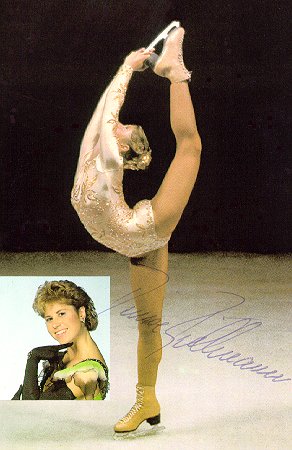
As Daniel, a former singles and pairs skater, knows from personal experience, when you look below the surface of figure skating, a coded gendering of the sport emerges. Figure skating has both athletic and artistic components, and traditionally these have been apportioned to men and women, respectively. Men are expected to be able to land enormous jumps. Women, on the other hand, are more likely to grab one of their feet and pull it up behind their heads, sometimes while spinning fast enough to set off a nose-bleed, as Mirai Nagasu did in Vancouver. Women’s programs also emphasize a great deal of emotion when they skate, while men are expected to display their athletic strength and power.

This is not to say that women are not expected to jump or that men can be soulless automata, but there are lower expectations for each in the other gender’s territory. A male skater who doesn’t emote passionately can be forgiven if he has a fantastic triple axel, and a woman can even win the Olympics with jumps that aren’t fully rotated. Artistry and flexibility are where women are expected to excel, while boys strive to jump higher and rotate more. To this day, only one woman (Japan’s Miki Ando) has landed a clean quadruple jump in competition, while it has become a mainstay of men’s event. This video shows Ando’s jump, at a 2002 competition:

In the aftermath of his silver platinum silver medal finish in Vancouver, Plushenko questioned the qualifications of Evan Lysacek to win gold without a quad. Aside from being poor sportsmanship, his approach highlighted the deep association of jumps with male figure skating. Though, in the women’s event, Mao Asada completed the technically difficult triple axel on three separate occasions, no fuss was made over her second-place finish behind the ethereal Kim Yu-Na. Kim has strong jumps, to be sure, but what sets her apart from her competitors is that she skates in a way that is graceful, balletic and undeniably feminine.

Ironically, one of the most promising things about a young Evgeni Plushenko when he arrived on the international skating scene in 1997 was his blending of artistry and athleticism. His style was avant-garde and overwrought, and his jumps were magnificent; he had, in skating parlance,”the whole package.” It might seem excessive to map gender onto his performances, but he is famous for being one of the only men to perform the Biellmann spin, in which the skater grabs the blade of one skate and pulls it up behind the top of his or her head.

This was a clear and unabashed case of gender-bending, as the spin had previously been the province of women. The figure skating world, after being sufficiently impressed by the flexibility of his hips, shrugged and moved on. No one thought any less of him for doing a “girly” spin.

Compare this to the skating world’s reaction to two-time Olympic gold medalist Katarina Witt, who was often said to skate “like a man.” Witt had big jumps (and big thighs to go with them), and skated to the soundtracks of epic movies, a practice that was usually reserved for men, while other women tended to skate to classical ballet suites. Witt’s artistic style was also not typical of women skaters: while her competitors demonstrated flowing, balletic arm movements to match their floaty chiffon skating dresses, Witt opted for stronger, cleaner arm movements and famously skated in leggings and a tunic in a program set to music from Robin Hood. She also skated with a stoic bearing that was similar to that of Canadian Elvis Stojko, who won the silver medal in Lillehammer in 1994.

Despite the popular perception of figure skating as a uniformly “girly” sport, there exists within the figure skating world a unique and nuanced code for constructing and understanding gender. In the figure skating world, as in the rest of our culture, that code changes over time, with different representations of masculinity and femininity being rewarded, marked down, or phased out entirely as the sport evolves. And as Plushenko’s comments about Lysacek demonstrated, figure skating’s coding of gender can be invoked by skaters trash-talking their rivals in subtle, but complicated, ways. As yet, Plushenko has made no comment on Lysacek’s upcoming appearance on “Dancing with the Stars,” but it’s not hard to imagine what he might have to say.

——————–

Chloe Angyal is a Contributor at Feministing.com, where she writes about gender in popular culture. She is also a failed figure skater. Daniel Eison is a former nationally-ranked pairs and singles skater who retired in 2005. He is not a failed feminist.

——————–

Gender differences in figure skating are also institutionalized in the form of costume requirements. Women are required to wear dresses, while men are not allowed to wear leggings or sleeveless outfits.

UPDATE: Reader Jeff says,

This isn’t true anymore; “this rule was repealed in 2004, allowing women to wear tights, trousers, or unitards” [1] ([1] http://www.frogsonice.com/skateweb/faq/rules.shtml)

Thanks for the correction!

Related posts: Johnny Weir and Canadian skating gets tough.

Crossposted at Jezebel.

All my life my Grandfather has used the phrase “cotton pickin'” as a slur, as in “wait a cotton pickin’ minute!” and, if he was mad at you (or the dog), “You cotton pickin’…!”

It is debated as to whether the phrase refers to the act of cotton picking, which is tedious and painful work (because the edges of cotton bolls are prickly and sharp), or the people who picked cotton (highly disadvantaged groups, especially black slaves in the American south).

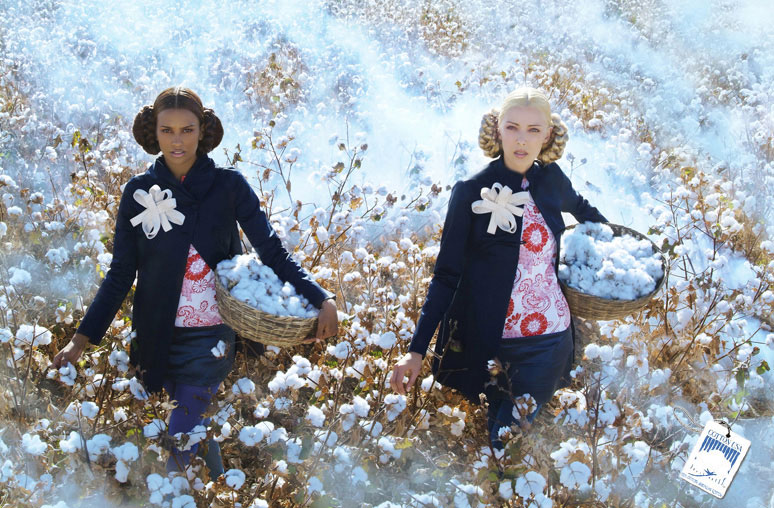
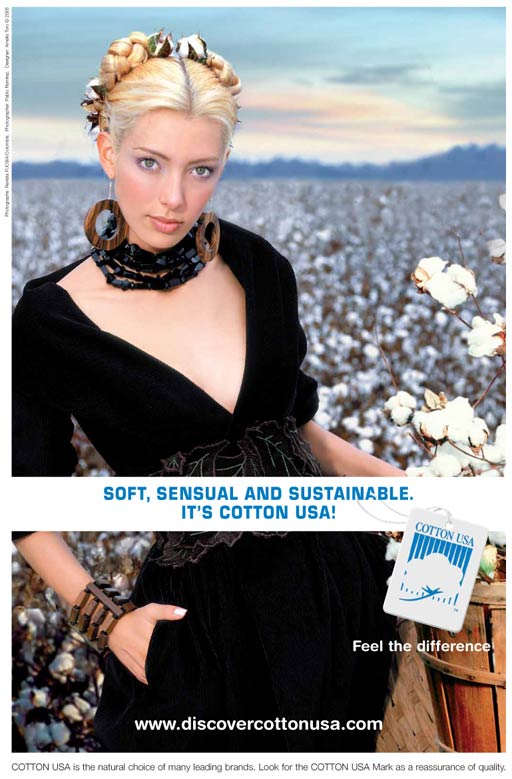
In light of this, it is fascinating that the cotton industry has decided to try and revamp its image by focusing on the act of cotton picking (as opposed to trying to make it invisible).  In this recent Cotton USA ad campaign, sent in by Katrin, cotton picking is full-on romanticized: beautiful people in beautiful clothes decorated in cotton pick cotton in cottony cotton fields:

The image suggests that cotton is beautiful, natural, relaxing, comforting, and comfortable. Indeed, the new tagline for the campaign was: “Soft, sensual, and sustainable.  It’s Cotton USA!” (source).

Interestingly, the U.K. has banned the language of this campaign, arguing that cotton is a highly destructive crop because it is both insecticide- and pesticide-intensive (i.e., not sustainable at all).

In any case, it’s interesting for me, as an American, to see a company try to romanticize an activity so closely linked with slavery.  The Great Grandmother of my co-blogger, Gwen, picked cotton and she said that it was an absolutely miserable job.  The cotton boll itself was prickly and sharp and she had to put her hand inside of the boll and pull the cotton out, such that it would leave both her hands ripped up.  The harvested cotton was carried on her back under a beating sun.  Agricultural labor is punishing, not pastoral.

Today, of course, most cotton in the U.S. is picked by machine, not beautiful 20-somethings (or Great Grandmas).  Most of us would have no knowledge with which to challenge this images so, I suppose, that’s how Cotton USA gets away with such a ludicrous campaign.

See also romanticizing colonialism and our post on how mommies and daddies are baking Goldfish crackers in their comfy kitchens just for you!

Lisa Wade, PhD is an Associate Professor at Tulane University. She is the author of American Hookup, a book about college sexual culture; a textbook about gender; and a forthcoming introductory text: Terrible Magnificent Sociology. You can follow her on Twitter and Instagram.

Rob D. sent along a commercial, made by the non-profit organization Iranians Be Counted, aimed at encouraging Iranian Americans filling out the U.S. Census to check “Other” and write in “Iranian.” It features a famous Iranian commedian doing a bunch of outrageous personalities, but in between the schtick is an argument that there is power in numbers and, therefore, a benefit to being identified as specifically Iranian:

This type of effort is really interesting and taps into a larger debate about Census categories.  How do we divide up the categories that we count?  Iranians are a much smaller group than, say, Arab American Persian (which is currently not an option on the U.S. Census).  If there is power in numbers, then wouldn’t it be better to write in “Arab American” “Persian”?  But, if you write in Arab Persian instead of Iranian, the resources to be gained from being counted may not benefit your community specifically. [As two commenters have pointed out, Iranian Americans are not Arab, except for a small minority. Iranians are Persian and most speak Farsi, not Arabic.  My mistake.]

The Asian American community in the U.S. is a good example of this conundrum.  “Asian” is a social construction; it is an umbrella label that includes very, very different groups.  There is great power in the social construction because it gives “Asians” a presence in American politics that, for example, the Hmong or the Vietnamese alone could never have.  But counting Asians as a group also means obscuring some very important differences among them.

For example, Asians outearn Whites in income surveys, suggesting that Asians should be excluded from programs trying to help groups escape poverty.  But, in reality, the groups we categorize as Asian vary tremendously in their average socioeconomic status.  Some Asian groups (e.g., the Japanese) outearn Whites; other Asian groups (e.g., the Hmong) have very high poverty rates.  When we look at the data broken out by smaller groups, we see more need, but the group itself is small enough that it can be ignored by politicians.

UPDATE: Roshan, in the comments, corrects me further:

Not all Iranians are Persians… Persians compose only 51 percent of the population. Other groups include the Azeris (24 percent), Gilaki and Mazandaranis (eight percent), Kurds (seven percent), Arabs (three percent), Lurs (two percent), Baluchs (two percent), and Turkmens (two percent) (Hakimzadeh, 2006).

Lisa Wade, PhD is an Associate Professor at Tulane University. She is the author of American Hookup, a book about college sexual culture; a textbook about gender; and a forthcoming introductory text: Terrible Magnificent Sociology. You can follow her on Twitter and Instagram.

Liz C. sent in the video for the song “A Kiss with a Fist (Is Better Than None)” by Florence and the Machine. She analyzes it nicely:

The lyrics seem to condone domestic violence, and the video seems to trivialize it, in the sense that the lead singer prances and jumps around while singing about getting punched in the face, having her leg broken, and having plates broken over her head by her partner, while she, in turn, hits and slaps him, breaks his jaw, and refers to “The Burning Bed” by setting fire to their bed.

The lyrics:

You hit me once
I hit you back
You gave a kick
I gave a slap
You smashed a plate over my head
Then I set fire to our bed

You hit me once
I hit you back
You gave a kick
I gave a slap
You smashed a plate over my head
Then I set fire to our bed

My black eye casts no shadow
Your red eye sees nothing
Your slap don’t stick
Your kicks don’t hit
So we remain the same
Love sticks
Sweat drips
Break the lock if it don’t fit

A kick to the teeth is good for some
A kiss with a fist is better then none

A kiss with a fist is better then none

I broke your jaw once before
I spilled your blood upon the floor
You broke my leg in return
So sit back and watch the bed burn
Love sticks
Sweat drips
Break the lock if it don’t fit

A kick to the teeth is good for some
A kiss with a fist is better then none

A kiss with a fist is better then none

You hit me once
I hit you back
You gave a kick
I gave a slap
You smashed a plate over my head
Then I set fire to our bed

You hit me once
I hit you back
You gave a kick
I gave a slap
You smashed a plate over my head
Then I set fire to our bed

UPDATE: Reader Kyle pointed out another example, Chester French’s video for the song “She Loves Everybody.” He asks whether we can imagine seeing this video if the gender roles were reversed:

And commenter Dave gave us a link to a recent discussion of this topic at Jezebel.
Also see our post on sexualized violence in Lady Gaga’s “Paparazzi” video.

Dmitriy T.M. sent us a report from the Nielsen company of time spent watching TV and using the internet.

We do, of course, want to take into account possible sample bias–the data are based on answers from Nielsen TV and internet panel participants and a survey of cell phone users, and there’s likely some self-selection bias there, with some groups being more likely to participate than others. I know I’ve read about concerns with Nielsen’s data within the entertainment industry.

That said, while I would be cautious about reporting the data as representative of the U.S. overall, the general trends are interesting. People 65+ watched over 47 hours of traditional (non-recorded) TV per week? Can that be possible? The only 65+-year-old whose TV-watching habits I know is my grandma, and she does tend to have the TV on at all times, even when she’s in the kitchen and is just listening, not watching.

According to these data, among those of retirement age, TV watching is basically more than a full-time job. Kids aged 2-11, on the other hand, only have a part-time job watching TV, at about 25 hours per week.

I, of course, had to sit down and calculate my own TV watching, which came out at a little over 6 hours per week when my friends and I have our Friday night TV watching get-together, 3 hours when we don’t. Less than I thought, overall. I am, however, that advertising nightmare, the person who watches 100% of TV online or DVRd, thus reducing the number of commercials I’m exposed to. You can blame me and others like me for the increasing number of product placements you see in TV shows, a way to try to incorporate sponsorship directly into the content rather than in separate commercials that people are finding more ways to skip.

Gwen Sharp is an associate professor of sociology at Nevada State College. You can follow her on Twitter at @gwensharpnv.