
Search results for The

NEWS:

Lisa was quoted in an Associated Press article that, much to her chagrin, rather uncritically celebrated the recent rash of untouched photos released by celebrities.  You can read it here and compare it to her unfiltered thoughts about it at her own post.

We added a new example of an assignment drawing on Sociological Images that instructors can use.  This one asks students to think critically about the whole project and is, thus, very interesting.  See #7 of our Sample Assignments.

This is your monthly reminder!  You can follow us on Twitter or friend us on Facebook where we update with a featured post every day.  We are, by the way, having lots of fun watching reactions to our posts on Facebook.  Thanks to all of you who have friended us and contribute to the conversations and the “like”!

NEWLY ENRICHED POSTS (Look for what’s NEW! Apr. ’10):

Neat, Cute, Ew, and Cool

In a comments thread a Reader, ckilgore, linked to her grandma’s cabinet fridge from the ’50s.  We added it, along with another example of an ad, to our vintage ad for the same.

We added a picture of pair-bonded female albatrosses to our (adorable) post on gay animals.

Tom M. sent in a billboard for Penthouse features a very suggestive… eye.  We added it to our post featuring ads with not-at-all-subtle visual sexual innuendo (NSFW).

I added an image of the Korean peninsula at night, linked in a comments thread by Brendon, to our post comparing the a map of the lights of the world at night and population density.

Race-Related Updates

We added a representation of “users” from WordPress that represented people as coming in different skin colors to our post featuring default avatars.

Jessica S. and Lucia M.M. sent in links to companies selling pretend teepees.  We added it to our post on American Indian-themed toys for kids.

Skada sent in another example in which white people are just people but black people are b-l-a-c-k, this time on Netflix.

Gender-Related Updates

We added lollipops, identical deodorants, and disposable cameras to our post on pointlessly gendered products.  We also added a new “girl talk” version of Jenga to our post on gendered versions of classic board games.  The first two were found by Sunlight Snow and the latter by Kathe H.

We also added a “drama queen” sign for girls to our post on babies’ and kids’ items that reinforce the “girls as spoiled divas” stereotype.  Thanks to Coley for sending it in!

Alex N. sent in a Fruit Loops commercial that genders doctors and nurses (in the direction that you would expect) and we added it to a post on that topic.

We updated our post on scrapbooking sticker sets of words about boys and girls with wall decals for boys and girls. In case you didn’t know, boys like hip-hop derived terms, while girls like any and all abbreviations.

Lizz Q. sent us another example of an anatomical illustration that featured a man facing straight forward and a woman posing rather sexily.  We added it to our burgeoning collection.

We added another great example of hygiene products being marketed to men by arguing that it enhances, instead of detracts from, their manliness.  In this one, sent in by Lucia M.-M., truly manly body wash is contrasted with sissy manly body wash.

Sofia R. sent us another example of Twix commercials that depict men as immature idiots.

We added a third example of shirts being sold in “unisex” and “women’s,” sent in by Mindy J.

Dmitriy T.M., Beth W., Abby D., and Jillian Y. sent in links to a video game called RapeLay.  We added it to a previous post on rape-themed video games (TRIGGER WARNING).

Lisa Wade, PhD is an Associate Professor at Tulane University. She is the author of American Hookup, a book about college sexual culture; a textbook about gender; and a forthcoming introductory text: Terrible Magnificent Sociology. You can follow her on Twitter and Instagram.


How have adults and young people weathered the worldwide economic downturn? This two-minute 12-second video shows that young people have been harder hit by joblessness in almost all OECD countries:

From the OECD Factblog.

Lisa Wade, PhD is an Associate Professor at Tulane University. She is the author of American Hookup, a book about college sexual culture; a textbook about gender; and a forthcoming introductory text: Terrible Magnificent Sociology. You can follow her on Twitter and Instagram.
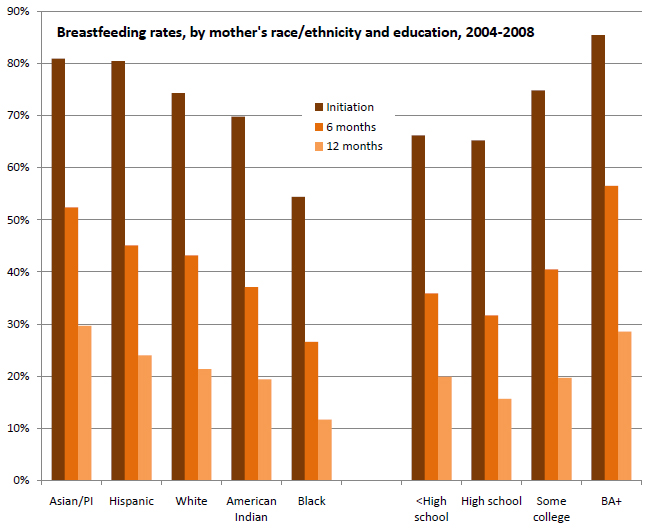
Breastfeeding is widely believed to carry significant health advantages for infants and the American Academy of Pediatrics (AAP) would like to see all mothers breastfeed their children for at least 12 months, with no supplemental food for the first six.

Breastfeeding, however, is a big job.  Even if a newborn takes to breastfeeding without any problems (some mothers struggle mightily with less-than-cooperative infants), mothers must feed their children around the clock (they now recommend every two hours, 24-hours a day for newborns).  If it takes a half hour to settle the baby down and fill it up, you’ve got an hour and a half before the next feeding time.

Mothers who have the privilege to stay home with their babies — for three, six, or even twelve months — then, are going to find it much easier to follow the AAP guidelines.  For mothers who return to work, those who work in flexible positions that award some degree of autonomy and respect will also be more likely to continue breastfeeding.   In other words, a lawyer with a private office and a work schedule under her own control can stop several times a day and express milk to bring home to her child; in contrast, a woman working the cash register at McDonald’s with a boss hovering over her doesn’t have the same autonomy or privacy and may be forced to give up breastfeeding.

It shouldn’t be surprising, then, that breastfeeding rates are higher among more educated women and White and Asian women.  Both of these variables tend to correlate with class privilege:

There are some interesting things, however, that don’t correlate with this class thesis.  First Hispanic women are more likely to breastfeed than White women and people with less than a high school education are more likely to breastfeed, especially at six and 12 months, than people with a high school education.

I can think of some reasons why… I’ll let you discuss it in the comments.

Borrowed from Philip Cohen’s Family Inequality Blog.  For more data on rates of breastfeeding, including U.S. state comparisons and changes in rates over time, see here.

Lisa Wade, PhD is an Associate Professor at Tulane University. She is the author of American Hookup, a book about college sexual culture; a textbook about gender; and a forthcoming introductory text: Terrible Magnificent Sociology. You can follow her on Twitter and Instagram.
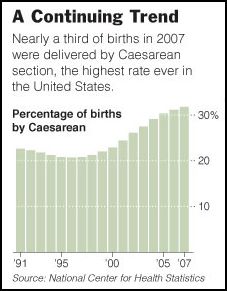
Caesarean sections — or C-sections, a surgery that involves making incisions through a woman’s abdomen and uterus to deliver her baby — have been on the rise since the mid-1990s.  Last month a New York Times story reported that 2007 saw the highest rate of Caesarean sections ever, 32 percent:

It is primarily non-medical issues that are driving the increase.  Many C-sections are performed because physicians fear lawsuits.  In a survey of obstetricians, 29 percent admitted to performing C-sections for this reason.

In other cases, mothers request that their labor be induced.  She may have a grandmother in town or a military husband about to be deployed and she wants to have the child while her family can be present.  Induced labor often fails and, so, C-sections are required.  More insidiously (and not mentioned in the story), epidurals also tend to slow down labor and require induction.  So the high rate of epidural use may also be contributing to the rise in C-sections.

And, C-sections beget C-sections.  Fewer and fewer women who have had a previous C-section are being allowed to attempt a vaginal birth.  “Fewer than 10 percent of women who had Caesareans now have vaginal births, compared with 28.3 percent in 1996.”

Rates of C-section in the U.S. are higher than in most industrialized countries but lower than in some developing countries.  “…rates have soared to 40 percent in some developing countries in Latin America, and the rates in Puerto Rico and China are approaching 50 percent.”

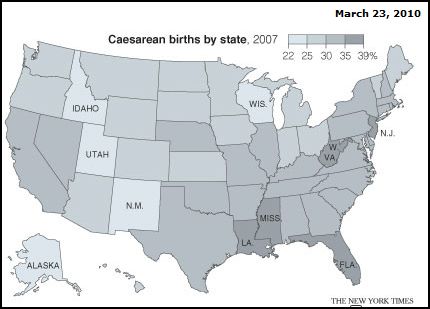
And rates in the U.S. states vary by 16 percentage points.  “The highest rates of Caesarean births were in New Jersey (38.3 percent) and Florida (37.2 percent), and the lowest were in Utah (22.2 percent) and Alaska (22.6 percent).”

There was no discussion about why the rates among states in the U.S. would be so variable.  Thoughts?

Lisa Wade, PhD is an Associate Professor at Tulane University. She is the author of American Hookup, a book about college sexual culture; a textbook about gender; and a forthcoming introductory text: Terrible Magnificent Sociology. You can follow her on Twitter and Instagram.
Orion submitted this gorgeous music video for the song, Tightrope, by Janelle Monae, featuring Big Boi. It’s a great example of how dancing doesn’t have to be sexualized or gendered by movement or attire. It’s just creative and interesting and mesmerizing!

On a completely different note: Any dance historians out there? To me this looks to be inspired by the adaptations of Charleston in Black America (Trankey Doo, Shim Sham, etc), like in this clip featuring Al Minns and Leon James (it’s filmed in 1961, but these dances emerged in the ’30s and ’40s):

I’d love to hear more about the evolution of this kind of movement.

UPDATE!  Thank you so much to our Reader, Anna, who is also a dance scholar and was able to give us some history in the comments thread:

Dance scholar here! I really enjoyed the dancing in the Janelle video. It should be read as an homage to rhythm dancing of African-descent from the 1920s through new Jack Swing (kidding, not sure there is a cut off date). The historical footage is in fact cited in Janelle’s video and as one poster pointed out, the dancing in her video is stylized as if it were being done on a tight rope… In my opinion (cause other scholars might see different things based on their training) her dance has some Camel Walkin’ mixed in with some dancehall hip articulation and a big dose of James brown, to be sure.

As for the claim that you cannot get from Al Minns and Leon James to 2010, that is shortsighted, very short! We get James and poppin and lockin and jazz itself from a peculiar mix of Bambara ethnic dances (modern-day Senegal, The Gambia, & Mali) and dance cultures of the people of the Kongo region (Angola, DRC, Congo among others) that intersected in New Orleans during the slaving period. You can also add in there “shipping music,” hybridized forms of music that emerged on slave ships with their transnational crews drawn from Europe, Africa, and the Mediterranean.

The hips and 6/8 syncopated shenanigans come to us from Kongo culture (but the Irish had some there, too). The Charleston, jitterbug and other high kicking dances come from the Senegal region and still reflected patterns from mandjiani in particular. Origins are always tricky, I try to avoid staking big claims based on them, but this conversation string was peculiar in that discussions of ethnic origin were not possible because race and gender were eliding the historical work done in Jenelle’s video. Yes I know the question was about gendered movement. And like a lot of the other folks, I am wondering while a male normative is held as neutral.

That said, from a dance perspective, the moves in Janelle’s video are without gender assignment, but there is an expectation that one’s gendered identity will be, must be expressed through the execution of the moves. That is the evolution of these forms which still have strong gender-based repertoire in Senegal. The Congo, people tend to do the same moves. The men MOVE their hips. It is de rigeur in pop as well as “traditional” dance music.

The last bit of the two guys dancing together was a comedy routine, a send up of a very famous dance riff from a couple in Harlem. I think that original “duet” appears in “Stormy Weather,” but I am not sure.

Thank you for putting up the two videos!

Thank YOU for your insight Anna!

Lisa Wade, PhD is an Associate Professor at Tulane University. She is the author of American Hookup, a book about college sexual culture; a textbook about gender; and a forthcoming introductory text: Terrible Magnificent Sociology. You can follow her on Twitter and Instagram.
It’s all over the web: Fox and ABC have resisted airing Lane Bryant’s new lingerie ad featuring plus-sized women (e.g., Adweek).  But I don’t think it’s, straightforwardly, because of a bias against fat women.  I think it’s a little more complicated than that.  I think it’s because the ads are scandalous… that they seem more overtly sexual than they would if they featured very thin models.

Think about it. In the media, the thin, young, beautiful, able-bodied white woman is the idealized woman. And the idealized woman is sexy, indeed, but not sexual. Sexy women attract attention; they inspire desire, but they don’t have desires of their own.  A sexy woman hopes that a man will like the look of her and take action.  But she’s not sexual.  She doesn’t take the action herself.  Doing so immediately marks her as suspiciously unfeminine.

Sexual women — women who have desires and express and act on them — are almost always presented as deviant in some other way. They’re working class, they’re Black or Latina, they’re mentally ill, or… they’re fat. Fat women are often characterized as sexual threats.  How many comedies have relied on the scary fat woman (of color) trying to get some?  It’s so funny, right?  Because she’s gross and aggressive!  She wants you and she doesn’t care what you want and so the fact that she’s fat doesn’t stop her.  Scary!

So, there is something innocent and asexual about very thin women.  As the feminine ideal, they are sexy, not sexual.  They incite desire, but they do not have it.

In contrast, fat marks a woman as overtly sexual.  She is a woman with appetites and, you better watch out, she might just eat you up.

This, I contend, is what is so scandalous about plus-sized women in lingerie. They are just too damn hot for TV.

Here’s the commercial:

What do you think?

UPDATE: Maura Kelly, a PhD Candidate in the Department of Sociology at the University of Connecticut, let us know that Fox did air the commercial on April 28th. Thanks for the update!

Lisa Wade, PhD is an Associate Professor at Tulane University. She is the author of American Hookup, a book about college sexual culture; a textbook about gender; and a forthcoming introductory text: Terrible Magnificent Sociology. You can follow her on Twitter and Instagram.

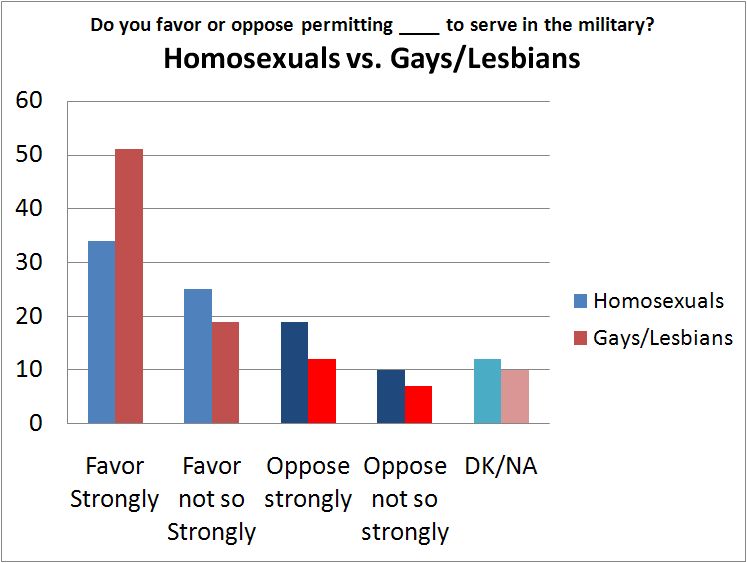
A recent CBS/New York Times poll reveals how words matter. They asked 500 respondents how they felt about permitting “homosexuals” to serve in the military; then they asked a different 500 how they felt about “gays/lesbians” serving in the military.  It turns out, people like gays and lesbians more than they like homosexuals:

Also in words: frankenfoods, atomic, soda vs. pop, tradition, hispanic, feminism, woman, averagenurse, George Lakoff on metaphor, professional, Jon Steward on re-branding, development, organic, the third world, man vs. girl, natural, honorifics, Africa, dithering, terrorism, the rape and other violent metaphors, and flesh-colored.

And also see our post on the war against “gay.”  (Poll discovered via Montclair SocioBlog.)

Lisa Wade, PhD is an Associate Professor at Tulane University. She is the author of American Hookup, a book about college sexual culture; a textbook about gender; and a forthcoming introductory text: Terrible Magnificent Sociology. You can follow her on Twitter and Instagram.

In “Women and Their Hair: Seeking Power through Resistance and Accommodation,” Rose Weitz* discusses how women use their hair — its color, how they style it — to send messages about themselves. For instance, some women with professional careers (lawyers, etc.) talked about cutting their hair shorter because they felt they’d be taken more seriously if they downplayed their femininity. African American professionals said they often straightened their hair to counter the stereotype of the “angry Black woman.” Hair styles may also send signals about our political views or religious affiliations.

I thought of that article when I saw a video sent in by Tom Megginson (author of the blog Change Marketing). The video was produced by HairLoss.com; they describe it as a public service announcement. From a story at PRWeb:

HairLoss.com, the Internet’s most comprehensive resource for unbiased consumer information and education concerning hair loss solutions and conditions, has released the second of a series of animated, one-minute-long public service announcements titled “Hair is Important”.

According to Michael Garcia, spokesman for HairLoss.com, this second video release “aims to illustrate to the public that men and women who are trying to restore their hair are really trying to restore much more than just their hair.”

Here’s the video:

The video illustrates Weitz’s point: hair is presented here as a way to “project who we are, what we believe in…and how we view the world.” The right hairstyle — which clearly means having hair — gives you the confidence to do something extraordinary. A lack of hair keeps us from “looking like ourselves and feeling like ourselves again.” If you go bald, you’ll lead a sad, lonely life and won’t get married.

HairLoss.com sponsors a video contest. Part of the description:

Create a 60-second “Public Service-Style Announcement” that captures one or more of the following ideas and concepts:

  • Hair Loss is no Laughing Matter.
  • Restoring Hair is about Restoring Life
  • Hair is important.
  • Accept Your Hair Loss (I am More than my Hair)
  • You may also create a video designed around your own compassionate and positive message.

The fourth option in that list — Accept Your Hair Loss (I am More than my Hair) — is an interesting contrast to the others. Clearly hair loss is presented as problematic by the organization; it’s “no laughing matter,” getting it back “restor[es] your life,” and hair loss may require compassion…something you generally feel toward people facing a serious difficulty. Throwing in the option of accepting hair loss feels like women’s magazines that have a one-page article on accepting your body, surrounded by pages of articles on dieting and using fashion to camouflage your “problem areas.”

A HairLoss.com rep also warns that you may not realize how miserable you are if you’re experiencing hair loss until you find a cure to your sad condition:

“Restoring hair is about restoring self-confidence and self-esteem,” said Garcia. “There’s an emptiness that follows losing one’s hair. Oftentimes, the hair loss sufferer doesn’t even realize just how much they have lost, besides hair, until they find a solution to their hair loss and get it all back.”

In his post about this “PSA,” Tom points out individuals with bald heads (voluntarily or otherwise) who still managed to inspire, entertain, lead, express a political viewpoint, and so on.

This emphasis on the need for men to have a full head of (not-too-grey, of course, definitely not grey) hair is interesting given that men are increasingly told they need to eliminate hair on other parts of their bodies (when not being ridiculed for doing so).

It also illustrates how we think about aging. The “real” you is a youthful you, before any signs of hair loss appeared. Hair loss robs you of your essential personhood, turning you into another person; getting your hair back makes you look and feel like yourself again. The message here is that aging isn’t a natural process that you go through. An aging you isn’t really you at all. Signs of aging steal your true self, turning you into a different, inferior, person. The way you looked in, say, your 20s and 30s, is the essence of you, and you must maintain/regain that look to remain truly you.

* In The Politics of Women’s Bodies: Sexuality, Appearance, and Behavior, 3rd edition (2010), p. 214-231.