Search results for The

The photo below was submitted to Fail Blog as a failure of communication:

In English adjectives come after before the noun that they modify such that, the way this is written, it reads as if there is a “big black reward” for the finder of the “lost dog” instead of a “reward” for the finder of the “big black dog.”

So this is funny, right?

It’s not simply funny because of the grammar mix up, it’s funny because “big” and “black,” when put together, have a particular connotation. We live in a society in which those words often go together because we stereotype black men as having large penises and being, generally, large.

The fact that the grammar mistake is humorous, then, relies specifically on this stereotype… so it’s nice evidence that the stereotype is real. The sign simply would not have the same impact if it read “Lost Dog Big White Reward” or “Lost Dog Big Yellow Reward.”

Fail Blog, via Dr. Grumpy.

Lisa Wade, PhD is an Associate Professor at Tulane University. She is the author of American Hookup, a book about college sexual culture; a textbook about gender; and a forthcoming introductory text: Terrible Magnificent Sociology. You can follow her on Twitter and Instagram.

Ms. Marx snapped a picture of an ad for Montessori school in Ontario.  Montessori schools are private schools (grades K-12) with an alternative pedagogy, or educational philosophy.

The slogan for this advertising campaign is: “Every child, every chance, every day.” In Ontario, Ms. Marx reports reports that tuition is $7,000 per year; in Toronto, tuition can be 10,300 for kindergartners and $19,895 for juniors and seniors in high school. So, the ad manages to completely erase the possibility that, while every child might benefit from a fantastic private school education from kindergarten on, not every parent can afford it.

Or, as Ms. Marx puts it:

Maybe it should say “Every child whose parents can afford the tuition, every chance offered to children of the elite, every day in capitalist societies.”

Lisa Wade, PhD is an Associate Professor at Tulane University. She is the author of American Hookup, a book about college sexual culture; a textbook about gender; and a forthcoming introductory text: Terrible Magnificent Sociology. You can follow her on Twitter and Instagram.


With tax season upon us, it is almost obligatory for Americans to complain about what they’re shelling out to Uncle Sam. According to Gallup polls, 46 percent of Americans think their taxes are too high.

The good news is that figure is near rock-bottom for the past 50 years; the bad news is that tax-related violence has been on the rise for the same period. The most recent example of this trend occurred last month, when software engineer Joe Stack, enraged by disputes with the Internal Revenue Service going back to the 1980s, flew a small plane into an IRS building in Texas.

In a lengthy essay/suicide note posted on his website, Stack styled himself after the early American patriots of “no taxation without representation” fame, reminding us all of the unique prestige of tax revolt in American history. As Stack points out, some of the first lessons American children receive about their nation’s history equates taxes to oppression, and revolt against those taxes to the struggle for liberty and justice for all. This probably contributes to Americans’ widespread distrust of taxation, and the acceptance of that distrust as normal and natural.

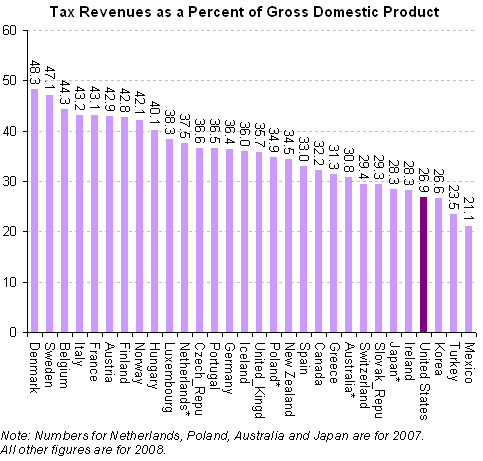
But that view of taxation is not shared worldwide. In fact, citizens of some countries are actually happy about paying taxes. If you’re an American reading these words, that statement probably sounds pretty far-fetched. But consider this: the citizens of Denmark pay the highest income taxes in the world (an average of 48.3 percent), and are also the happiest people in the world.

It’s not just that Danes pay those high income taxes: they also pay a Value Added Tax of 25 percent on every cup of coffee or pair of sneakers they buy, making the outcry in my hometown of Chicago over having the highest sales tax of any major city in the US (a whopping 10.25 percent) look picayune by comparison. And then there’s Denmark’s tax on new cars: a heart-stopping 180 percent. So if you buy a car with an MSRP of € 20,000 , you’ll pay an additional € 36,000 to get the car registered and licensed.

The Danish car tax, in and of itself, would probably be enough to provoke armed rebellion in the United States. So why do the citizens of Denmark not only tolerate the array of taxes they pay, but appear downright happy about them?

And just to be clear, Danes aren’t just generally happy, or happy despite the taxes they pay. Rather, they are specifically happy about paying taxes! Take this exchange, for example, from a recent series of “person in the street” interviews from Copenhagen by United States National Public Radio:

KESTENBAUM [Ed—NPR reporter]: You think paying taxes is terrific?

Ms. BAUOLASON [Ed—resident of Copenhagen]: I do actually think it is terrific.

From an American perspective, Denmark “seems to violate the laws of the economic universe.”

The key to this attitude seems to lie in Danes’ trust in government and each other—something I noted in an earlier post. As this video interview with a pair of Danish sociologists suggests, this trust stems from several factors. Among the most important is the widely-shared belief that their society is just, and that socio-economic goods are equitably distributed. As a result, many Danes seem satisfied that they are getting their money’s worth–that is, they enjoy tangible benefits of the taxes they pay in terms of universal health care, tuition-free education through the university level, and employment benefits and security far beyond anything available in the United States.

Meanwhile, things could not be more different in the United States, which ranks 23rd in the world happiness rankings, and where distrust of government has been virtually axiomatic since the Reagan era—if not before. This helps account for a paradox: while the United States has among the lowest income tax rates in the world, and we have nothing like the VAT and auto registration taxes that Danes pay, Americans rarely challenge each others’ complaints about “high taxes.”

In fact, one of the remarkable things about Joe Stack’s anti-tax rant/suicide note is how much it resembles what now constitutes “mainstream” rhetoric on taxation in America—particularly in the aftermath of the government bailout of financial firms following the 2008 economic crisis.

Stack wrote:

Why is it that a handful of thugs and plunderers can commit unthinkable atrocities (and in the case of the GM executives, for scores of years) and when it’s time for their gravy train to crash under the weight of their gluttony and overwhelming stupidity, the force of the full federal government has no difficulty coming to their aid within days if not hours?

Compare this to CNBC newsman Rick Santelli’s now legendary on-air rant of February 2009, in which he sounds many of the same notes as Stack, using virtually identical arguments and references to American history:

So while Stack’s violent actions took this rhetoric to the extreme, the evidence suggests that he was no outlier in his  perspective on taxation in America: his basic views are apparently shared by a wide swath of his fellow citizens, from television news reporters to the Tea Party movement to think tanks like the conservative Cato Institute.

What accounts for this extreme disparity between American and Danish attitudes toward taxes? And what does this have to do with the differences between the two countries in terms of happiness?

The evidence suggests that both phenomena stem from perceptions of fairness. While—as the two video interviews from Denmark suggest—many Danes believe that they benefit personally from their tax contributions, the rhetoric of people like Stack, Santelli and others suggest that many Americans believe they get little to nothing in return for their tax contributions. Instead, they believe their taxes benefit the “free riders” in US society—whether conceived as “welfare queens” at the bottom of the socio-economic ladder, or as corporations and executives at the top.

Thus, Stack signed off with this bitter epigram: “The capitalist creed: From each according to his gullibility, to each according to his greed.” For him, it was a bitterness unto death; for like-minded Americans, these beliefs contribute to a sense of pervasive injustice that frustrates their “pursuit of happiness” and makes April 15 a day of national resentment rather than a simple administrative deadline.

——————————

Brooke Harrington is Associate Professor of Economic Sociology at the Copenhagen Business School. She is the author of two books: “Pop Finance: Investment Clubs and the New Investor Populism” (Princeton University Press, 2008) and “Deception: From Ancient Empires to Internet Dating” (Stanford University Press, 2009). She is currently doing research on offshore banking.  Harrington blogs at our fellow Contexts blog, Economic Sociology.

If you would like to write a post for Sociological Images, please see our Guidelines for Guest Bloggers.

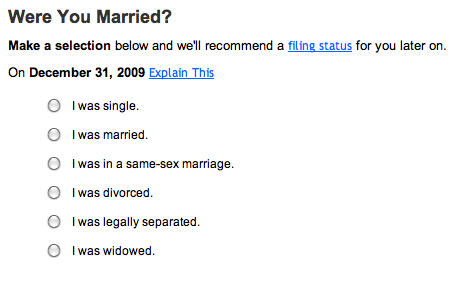
Amanda S. took a screen shot while doing her taxes online at Turbo Tax.  The program asks if the filer is married or gay married:

What a fascinating moment in U.S. history.  In some states a person can marry someone of the same sex, in others they cannot.  Tax programs trying to help people file their federal and state taxes need to record both kinds of marriages because they collect information for both tax returns simultaneously in order to reduce the time burden on the client.

But why not just ask people if they were married?  Perhaps the people who designed these questions thought that the term “marriage” is so deeply associated with heterosexuality that it wouldn’t occur to people who were married to someone of the same sex to check it.  Then again, I would think that those gay couples who are legally married would be especially cognizant of their right to check the “marriage” box whether same-sex marriage was specified or not.

Or are there different tax rules applied to gay and straight marriage?

In any case, if we’re going to separate homo- and hetero-marriage, why not label “marriage” as “opposite-sex marriage” or “other-sex marriage”?  Why normalize heterosexual marriage (real marriage, you know, the original marriage, marriage marriage!) and mark homosexual marriage (the gay kind, duh, so gay)?

I don’t know what they were thinking… but it’s fascinating.

Happy tax day U.S. Americans!

Lisa Wade, PhD is an Associate Professor at Tulane University. She is the author of American Hookup, a book about college sexual culture; a textbook about gender; and a forthcoming introductory text: Terrible Magnificent Sociology. You can follow her on Twitter and Instagram.
At Racialicious, Arturo R. García lodges a complaint against the modern makeover of Speedy Gonzales which is, apparently, underway.  Actor and Comedian George Lopez is scheduled to voice the character in a feature cartoon.

Starting in 1955, Speedy was a recurring character in Warner Brothers cartoons.  Dubbed “The Fastest Mouse in all of Mexico,” Speedy wore a sombrero and spoke in broken English.  In the cartoon below, he helps other Mexican mice steal cheese from across the Mexico/U.S. border guarded by a “Gringo cat” (Sylvester):

Lopez’s wife is on record saying that the new Speedy will not be the same racist caricature, but instead a Mexican boy who “…comes from a family that works in a very meticulous setting, and he’s a little too fast for what they do.”  But García isn’t convinced.  He writes:

The thing is, it’s not just about Speedy, but about the universe he inhabited. If this new film strays from the original Andale! Andale! schtick, critics will decry that the character was neutered by “the PC Patrol.” If it doesn’t, the couple has resurrected a very problematic cartoon character (two, if Slowpoke Rodriguez is also brought back.) What would be the next step – the return of Heckle & Jeckle? Is bringing back an “established brand” like this really a better option than creating an original character and building something positive from the ground up?

He also points out that Lopez’s success has rested largely on his own reproduction of racist stereotypes (of the whites-and-Latinos-are-so-different-hahaha! and Latinos-are-so-Latino-hahaha! varieties). For example:

Yeah… so I can’t imagine that that guy would ever participate in a project stereotyping Latinos.

I guess we’ll have to wait and see but, like García, I’m skeptical.

Lisa Wade, PhD is an Associate Professor at Tulane University. She is the author of American Hookup, a book about college sexual culture; a textbook about gender; and a forthcoming introductory text: Terrible Magnificent Sociology. You can follow her on Twitter and Instagram.
Tom Schaller at FiveThirtyEight posted this graph showing different types of federal taxes as a percent of total U.S. GDP (estimated through 2014 based on the current tax code):

Photobucket

Despite widespread beliefs that we’re all taxed to death, and that taxes are strangling the business sector, we can see that the only taxed that have clearly trended upward since 1935 are payroll taxes (SSI/Retirement). And corporate and excise taxes have actually decreased over time.

Total federal taxes make up less than 20% of our total GDP. Interestingly, a (non-random convenience) sample of Tea Partiers at a recent protest found that half of the attendees thought that federal taxes make up over 40% of GDP, and the mean answer was 42% (the highest answer being 99%).

This reminds me of watching The Price Is Right with some of my relatives as a kid. We’d watch, and inevitably someone would win a car or at the end get the Showcase Showdown package, and being kids my sisters and I would be agog over their riches. But one of the adults in the room would then give us a lecture about taxes, saying you’d have to pay a tax of 50% of the value of the winnings, so you’d really just end up owing money. The implication was that this was really unfair and robbed people like us of our birthright to go on TV and try to win stuff because we wouldn’t be able to come up with the money to pay the taxes on our winnings (though they did wonder if you could convince Bob Barker to just give you the cash value of the items rather than the things themselves so you’d have the cash to pay the taxes).

So basically, they would get riled up and resentful over the amount of taxes they thought they would have to pay if they flew to L.A., got on The Price Is Right, and won something of value. They were complaining about something that didn’t exist, a theoretical tax in a situation they were not going to face, ever.

The point is, a lot of the opposition to and anger about taxes strikes me as completely theoretical: it’s not derived from specific knowledge of tax codes or tax rates or how many services you got in return for the taxes you paid. It’s a more diffuse anger based on assumptions that the government is always out to over-tax you and that your life would be a lot better off if you could just reduce the tax burden and take the ski boat and bedroom set you just won on CBS home in peace, unmolested by the IRS.

Crossposted at Jezebel.

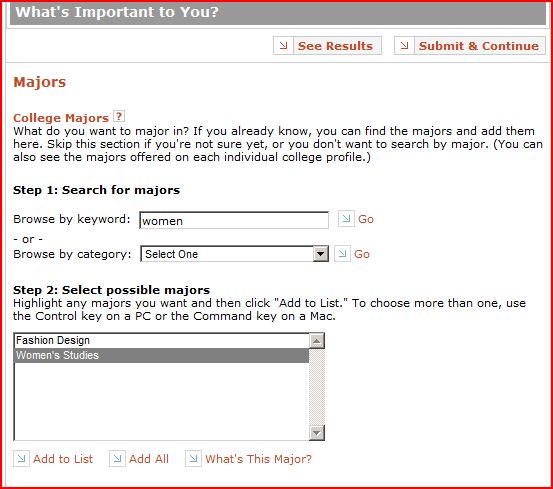
Ajax was searching for majors on College Board, a website aimed at helping people get into and through college.  She wanted to search for colleges with women’s studies majors and when she typed “women” into the keyword field, the search function returned two majors: women’s studies and fashion design.

This would make perfect sense if the search function returned only women’s studies since it has “women” in the name and all.  But fashion design?  It suggests that somehow fashion design has been marked as a major-for- or about-women, but no other major has.

What about, say, history?  Nope, no women in that.
Psychology?  Well, there is a Psych of Women class.  But, otherwise no.
Economics?  Don’t make me laugh!
Queer Studies? Afro-Am? Wait? Women are gay!? And black!?
Politics?  Oh honey, don’t worry your pretty little head about it!
Literature?  Oh yeah!  We forgot literature!   Let’s slap a “women” tag on that one and call it a day.

UPDATE: Brenden L. went to the website and typed in men. Guess what he got?

Lisa Wade, PhD is an Associate Professor at Tulane University. She is the author of American Hookup, a book about college sexual culture; a textbook about gender; and a forthcoming introductory text: Terrible Magnificent Sociology. You can follow her on Twitter and Instagram.

rachel56 sent in a fascinating story. Charley’s Grilled Subs is a super-successful franchise with locations in 16 countries. The restaurant specializes in Philly-style cheese steaks. If you go to their website and watch the video telling Charley’s story (here), this guy plays Charley:

But, in fact, that’s not Charley.  This is:

So here we have a Korean-American owner of a business that is Philadelphia themed.  I’m going to assume, and feel free to call me out on this, that he decided to portray “Charley” as white because he (or his marketers) imagined that Americans (whoever they are) think like this: Philly = America = white.  The idea that Charley is Korean might cause cognitive dissonance.  Cognitive dissonance is the state of holding two contradictory thoughts at the same time, such as Charley = Philly = America and Charley = Korean, when American does not = Korean.

When I lived in Madison, Wisconsin, I used to frequent a fast food noodle place called “Chin’s Asia Fresh.”  I always wondered if there was really a Chin or if it was a made-up character.  According to the website there is a Leeann Chin who, growing up in Canton, China, “learned cooking traditions from her mother and an eye for the best ingredients from her father.”  Of course, as is clear from Charley’s story, the “history” sections of restaurants can be fiction so… I guess I still wonder.   Of course, it would be advantageous for the Chin’s chain to market itself as authentically Asian, just as it is apparently advantageous for the Charley’s chain to market itself as “authentically” “American” (i.e., white).

All of this is a great example of how image is constrained and enabled by racial and ethnic stereotypes.

Lisa Wade, PhD is an Associate Professor at Tulane University. She is the author of American Hookup, a book about college sexual culture; a textbook about gender; and a forthcoming introductory text: Terrible Magnificent Sociology. You can follow her on Twitter and Instagram.