Search results for The

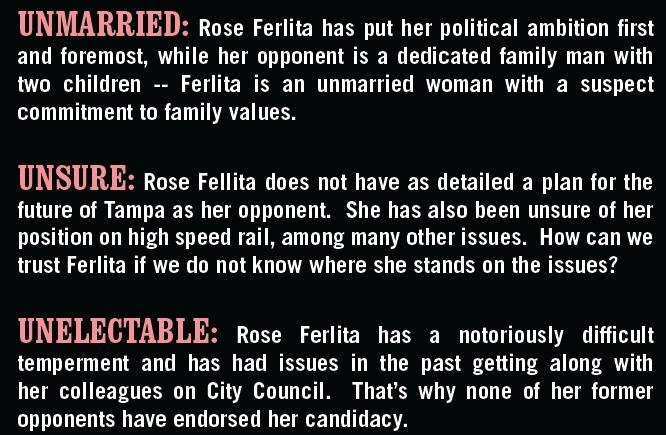
Clayton W. sent us a political mailer that recently went out against Rose Ferlita, a candidate for mayor of Tampa, Florida. What makes her unfit for office? Among other things, she’s single:

Text from the other side:
(Via Think Progress.)

So, awful, right? She’s single, she has a “suspect commitment to family values,” which I think it isn’t a stretch to say means “she might be a lesbian,” she’s a bitch. Given our current political alignments, we might legitimately assume this mailer was created by a very far right, possibly religious-based group, presumably on the conservative side of the spectrum.

But the story turns out to be weirder than that. Ferlita is a Republican, though Tampa’s mayoral races are non-partisan. The mailer, as you can see in the return address, is from Less Government Now, a 527 political action group (that is, one that can take unlimited donations as long as they do not directly advocate voting for a specific candidate). And it’s tied to a man named Scott Maddox, a Democrat who ran (unsuccessfully) for office last year. In that race, he had a friend enter the campaign as a fake Tea Party candidate in hopes of splitting the Republican vote.

It appears that Less Government Now is pursuing a similar strategy here, sending out materials that attack candidates from the right by coming up with the types of arguments they imagine will resonate with very conservative voters and thus split their vote. It doesn’t seem clear whether the other candidate for mayor of Tampa, Bob Buckhorn, had any knowledge of the mailer, or if Less Government Now acted on its own (Buckhorn has denounced the mailer).

I gotta say, I thought this was repugnant when I first saw it and assumed the group who put it out might actually believe this kind of crap. But to encourage people to vote based on sexist, homophobic values that you presumably don’t even agree with, simply as a political ploy? That is some nasty, nasty business.

UPDATE: Suzie emailed us about her post on March 20th at Echidne of the Snakes (there’s no way to link directly to the post, sorry) questioning the origin of the mailer. The St. Petersburg Times Tampa Bay site reports that according to the post office, the permit number listed on the mailer is fake, and there’s no evidence it was actually mailed. Less Government Now denies all knowledge of it. It’s possible that this is a fake mailer created to discredit the Democratic candidate by making it look a Democrat-affiliated group sent out something sexist. The person who first made it public, claiming to have received it anonymously, has been involved in political consulting and has a history of criminal charges. This is all making my head spin.


Authors are increasingly arguing that mainstream culture has been “pornified” (see, for example, the books Pornified and The Porning of America).  In other words, what used to be considered pornographic is now disseminated widely as simply advertising or entertainment and both verbal and visual references to pornography in popular culture are increasingly common.   In this vein, we have a collection of posts featuring ejaculation imagery (visual references to the “cum shot”), and I thought an ad recently submitted by one of my students, Breiana Caldwell, as well as readers Scatx and Xander, was a good opportunity to remind readers of this pervasive trope:

(source)

Lisa Wade, PhD is an Associate Professor at Tulane University. She is the author of American Hookup, a book about college sexual culture; a textbook about gender; and a forthcoming introductory text: Terrible Magnificent Sociology. You can follow her on Twitter and Instagram.

Leslee Beldotti sent in this 7-minute video from The Escapist that discusses female characters in video games and how game developers could incorporate women as complex characters rather than stereotypes. Leslee points out that the video somewhat conflates sex with gender in the discussion of biological vs. social behaviors, but it highlights the outcomes of making video games through a gendered lens (sorry about the 30-second intro ad):

On this topic, also see Lisa’s recent post on boob inflation in video games.


Dr. Bethany Pope, Pris S., and Christine each sent in the trailer for the Disney film, opening today, called Mars Needs Moms.  It is impossible not to be sarcastic about this trailer.

What can I say.  The premise of the film is that only women can parent (and by “parent,” I mean feed and vacuum).  I’m sure all of the human women out there with children really appreciate this sentiment.  Dads, HUH!  …what are they good for!  Absolutely nothing! Or, at least, that is what nearly every corner of Western society is trying to tell us.  How convenient, given that raising kids is rewarded with, basically, absolutely nothing concrete. Thanks, thanks for nothing Disney.

Also, as far as the trailer goes, it appears that this movie focuses almost entirely on boys and men. I wonder if it even passes the Bechdel test.  Twist the knife, why don’t you.

Lisa Wade, PhD is an Associate Professor at Tulane University. She is the author of American Hookup, a book about college sexual culture; a textbook about gender; and a forthcoming introductory text: Terrible Magnificent Sociology. You can follow her on Twitter and Instagram.

There is something so damn ironic about this pair of greeting cards photographed by Julie Becker from Lansing, Mich.   The cards, designed to congratulate new parents on the birth of their child, reveal a (perceived) desire to gender our infants from Day One. It is important to identify this child’s gender; it must be noted and color-coded that it is a “he” or a “she.” But the card company finds no irony in using exactly the same baby on each card:


In fact, gendering infants is a rather new phenomenon in Western history and not cross-culturally consistent. Some cultures, and in Western culture previously, the sex of children was considered rather irrelevant until puberty.

Lisa Wade, PhD is an Associate Professor at Tulane University. She is the author of American Hookup, a book about college sexual culture; a textbook about gender; and a forthcoming introductory text: Terrible Magnificent Sociology. You can follow her on Twitter and Instagram.

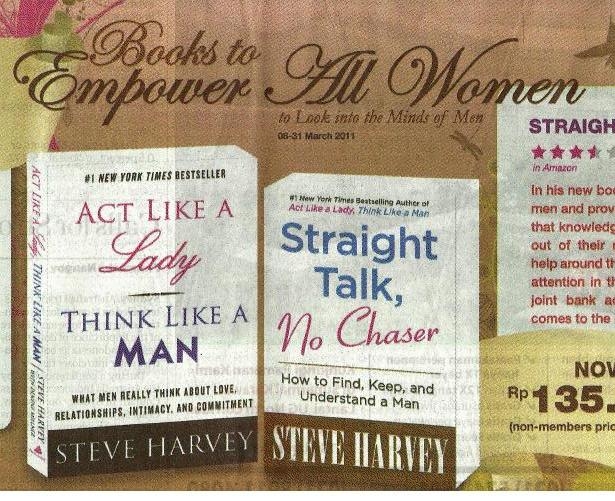
As a number of readers emailed us to point out, yesterday was International Women’s Day, designed to highlight both women’s accomplishments and the persistence of gender inequality worldwide. Ben Buursma noticed an ad in an Indonesian newspaper celebrating International Women’s Day and marketing “Books to empower all women,” though it turns out what they empower women to do is “look into the minds of men” and “find, keep, and understand a man”:

Emma M. H. sent in a link to the the White House Council on Women and Girls report on the status and well-being of U.S. women on a variety of social indicators. Interestingly, while both men and women are waiting longer to get married, the gender gap in age at first marriage has remained relatively constant for decades:

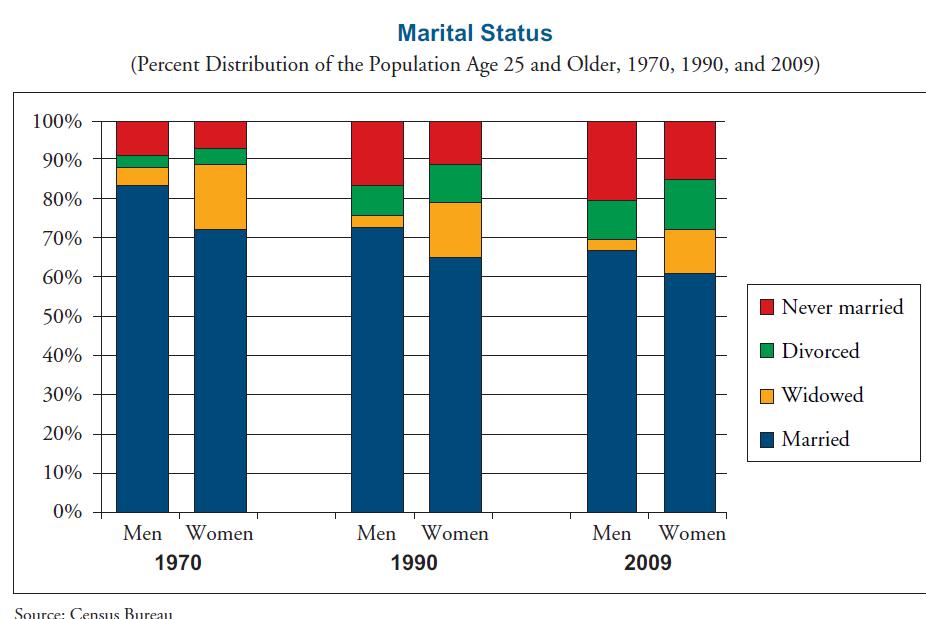
Men are more likely to be either married and never-married, while women currently more likely than men to be divorced or widowed:

Over time, the percent of women who have never given birth has gone up, particularly for the 25-29 age group, though in the last decade there has been a slight downward trend for women aged 30-44:

One note about that graph: the report uses the phrase “had a child” and “childbearing,” so I think this data would include women who have adopted children but never given birth.

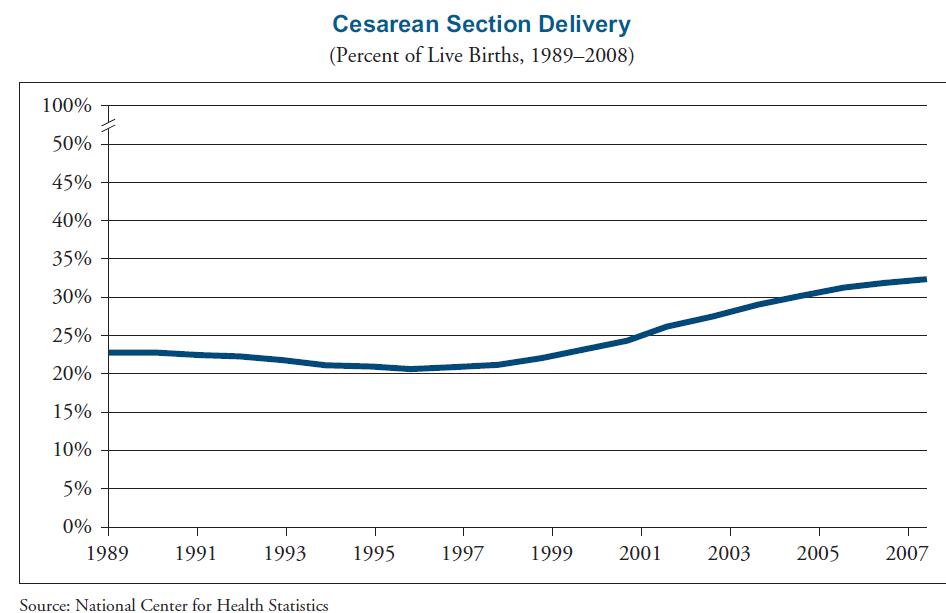
I was surprised to see that rates of Cesarean sections have gone up in the past decade:

Women are now outperforming men in terms of educational attainment, earning the majority of bachelor’s degrees, though notice the number of degrees in engineering/computer science earned by women hasn’t increased since 1998:

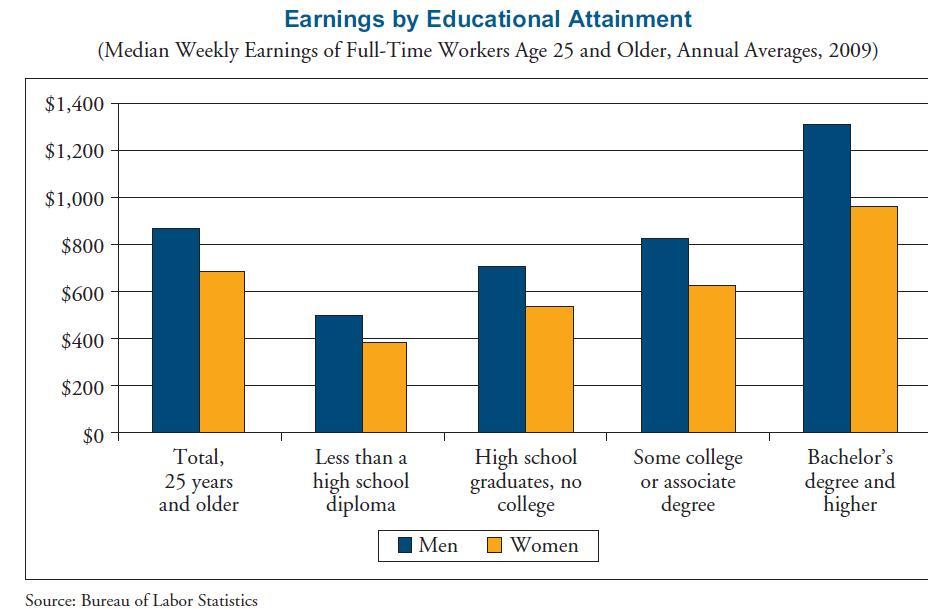
However, women still make less than men at each level of educational attainment:

The report has lots more data on family life, work, education, health, crime, and so on. I’ll post on other topics in the future.

Finally, Ben N., Kay C., Gregory S., and Dave Z. all sent in this video starring Daniel Craig that highlights global gender inequality (though unfortunately I can’t find any reference that provides sources for the statistics in the video, so take it for what it’s worth):

Happy Fat Tuesday to all our friends in New Orleans! The rest of us should have a bourbon and enjoy these posts from previous years:

Lisa Wade, PhD is an Associate Professor at Tulane University. She is the author of American Hookup, a book about college sexual culture; a textbook about gender; and a forthcoming introductory text: Terrible Magnificent Sociology. You can follow her on Twitter and Instagram.

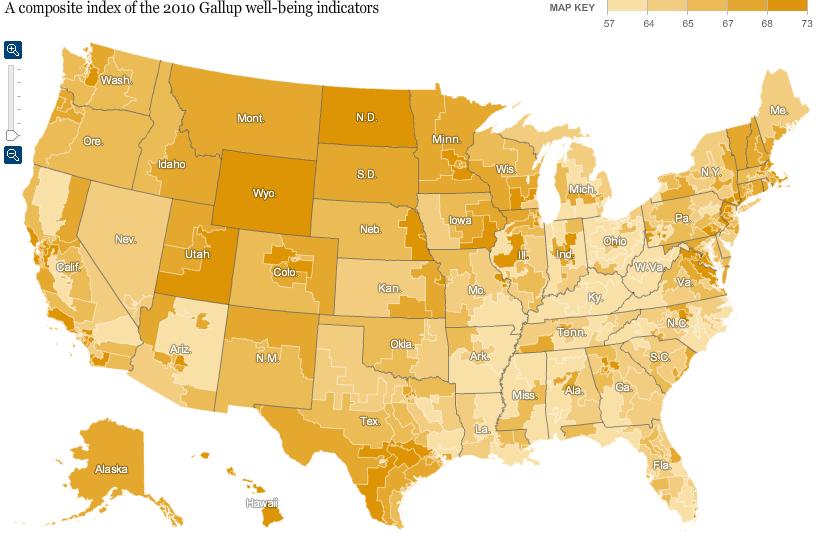
Kristina K. sent in a link to an interactive map at the New York Times that shows the results of Gallup’s 2010 polls of well-being. [UPDATE: Reader Danielle pointed out I forgot to provide a link to the map. Sorry! You can find it here.] Gallup surveys 1,000 people per day about a variety of indicators of well-being, including questions about physical, mental, and emotional health, various health-related behaviors, ability to access health care, access to adequate food and housing, and perceptions of their communities. Here are the overall composite scores, by congressional district (a higher score is better):


The general geographic pattern indicates a swath of relatively low well-being curving from Louisiana up through Michigan, while those in the upper Great Plains and the inter-mountain West are doing better than average.

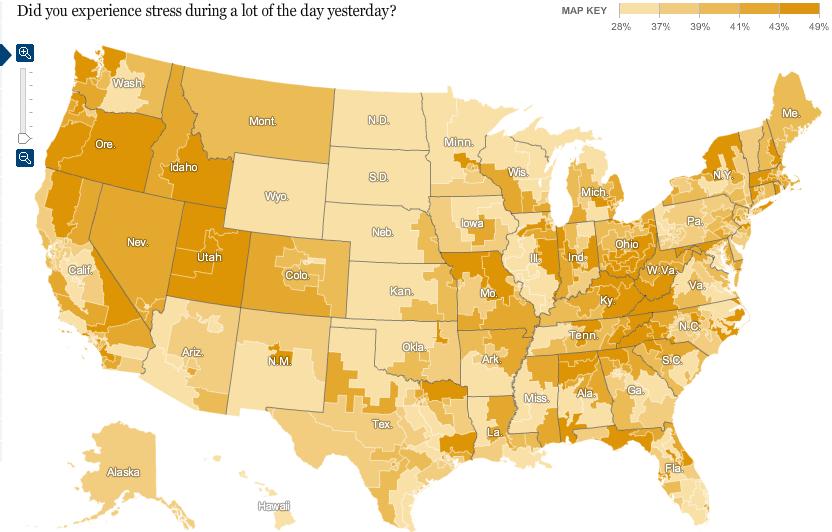
Percent reporting experiencing a lot of stress:

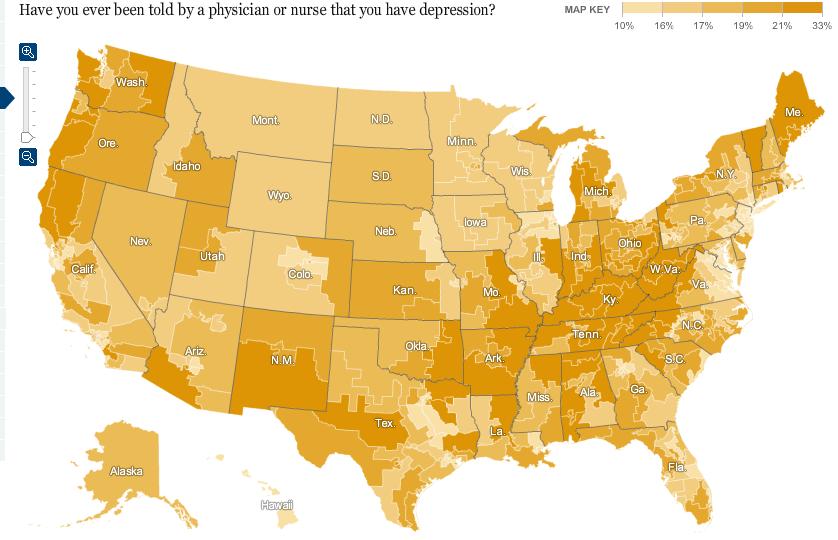
Percent who have ever been told they have depression:

Of course, this may reflect differences in rates of depression, but it could also reflect differences in medical professionals’ likelihood of identifying a set of symptoms as depression and bringing it up with a patient. For example, we see significant differences by state in the frequency of Caesarean sections among pregnant women.

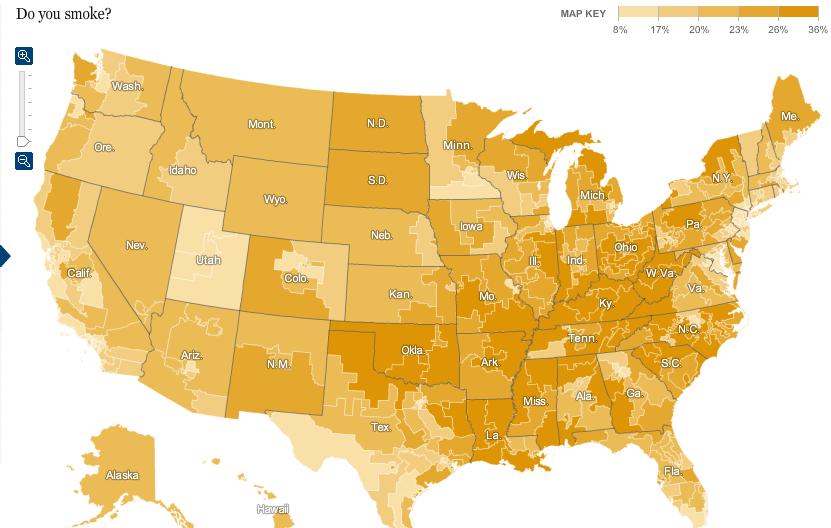
Percent of people who smoke:

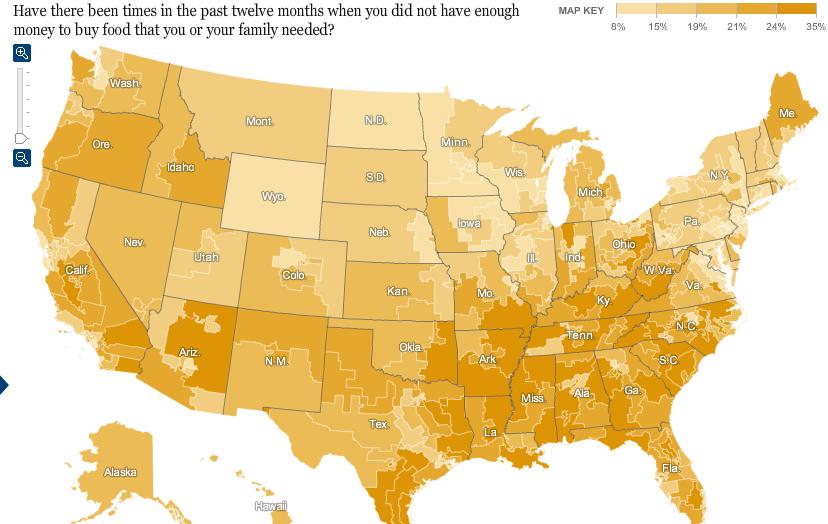
Percent reporting an inability to buy sufficient food:

The Gallup page on well-being presents more data. Here is a map of 2009 overall well-being that is a bit easier to read since it’s presented by state rather than congressional district:

Hawaii had the highest overall score, at 70.2; West Virginia had the lowest, 60.5. If you go to their site and click on a state, you can get a breakdown of scores in each area (emotional well-being, physical health, healthy behaviors, and so on).

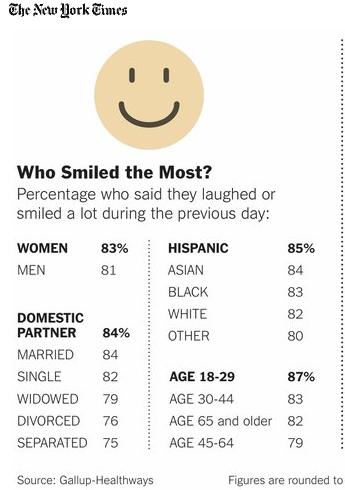
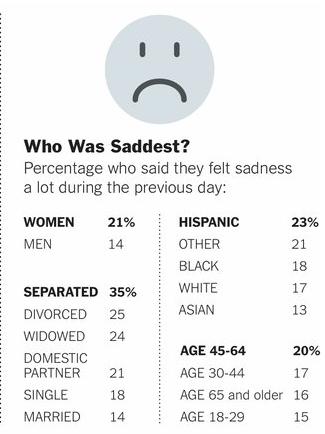
Finally, the NYT provides some demographic information on who was most likely to have said they spent a lot of the previous day laughing or smiling vs. being sad: