Search results for The

Lindsey V., who recently sent in the excellent film clip in which “scientists” “tested” gendered battle gear, also sent us a link to images showing that the breast size of two video game characters — “Ivy” from “Soul Caliber” and, to a lesser extent, Lara Croft from “Tomb Raider” — have increased over time (source).

Ivy:

Lara Croft:

What might drive their ever-inflating breasts?

Speaking in terms of advertising, Sut Jhally wrote that advertisers must:

…now worry about clutter and noise. That is, how do you make your ads stand out from the [5,000] commercial impressions that people are exposed to [every day].  So if you’re Pepsi, you’re not just competing with Coke anymore. You’re competing with every other advertiser who wants our attention. As advertising takes over more and more space in the culture, the job of the individual advertiser gets harder and harder.

Martin Barron and Michael Kimmel make a similar argument about the rise of “extreme” and violent sexual acts in pornography.  The increase in the sheer amount of porn that emerged with the Internet has created a competitive market in which “sexual victimization of women is a currency” (p. 350).  You have to get noticed somehow.

So, insofar as this boob inflation is a trend, we may be able to explain it, at least in part, with the greater number of cultural products.  Proliferation creates conditions in which each one has to up the ante to “stand out” against the “clutter and noise.”

Sources:

  • Barron, M., & Kimmel, M.S. (2010).  Sexual violence in three pornographic media. Journal of Sex Research, 37, 161-169.
  • Jhally, S. (2000). Advertising at the edge of the apocalypse. In Anderson, R., & Strate, L., Eds. Critical studies in media commercialism. New York: Oxford University Press, 27-39.

Thanks also to Caroline Heldman; I borrowed some of the text in this post from a forthcoming co-authored essay.

Lisa Wade, PhD is an Associate Professor at Tulane University. She is the author of American Hookup, a book about college sexual culture; a textbook about gender; and a forthcoming introductory text: Terrible Magnificent Sociology. You can follow her on Twitter and Instagram.


Some of you may have heard about the anti-Muslim protest outside a charity event in Orange County on February 13th. A local chapter of the Islamic Circle of North America (ICNA) Relief, a Muslim charity organization that raises money for women’s shelters, food pantries, disaster relief, and other humanitarian work, sponsored a fundraiser at the Yorba Linda Community Center.

Chrissy Y. sent in a video of the protest. It includes chants of “Go back home!”, “USA!”, and “terrorist!” amid loud boos as individuals walked into the center. At around 3:10 a woman accuses a man of beating his wife and being a child molester. Between the conflation of Muslim with being inherently un-American, the conflation of all Muslims with terrorists, and the reliance on the stereotype of Muslim men as brutal oppressors of victimized women, it is an ugly, ugly example of anti-Muslim sentiment:

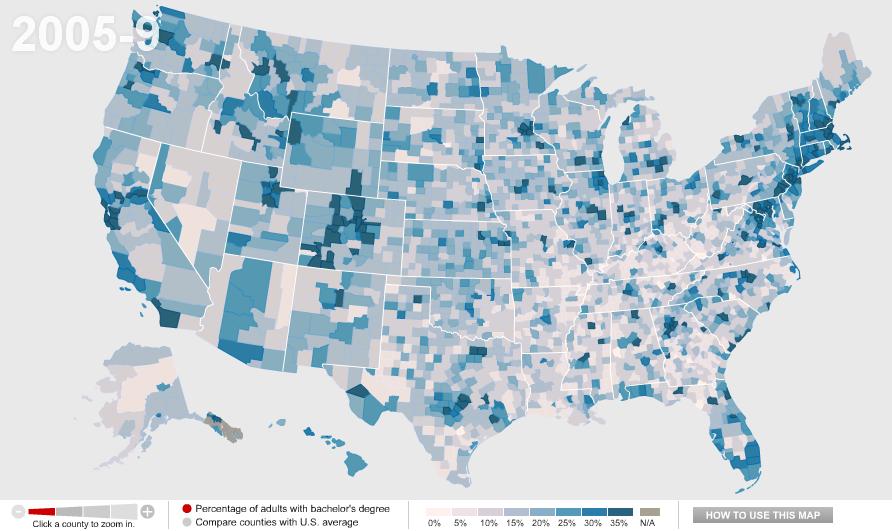
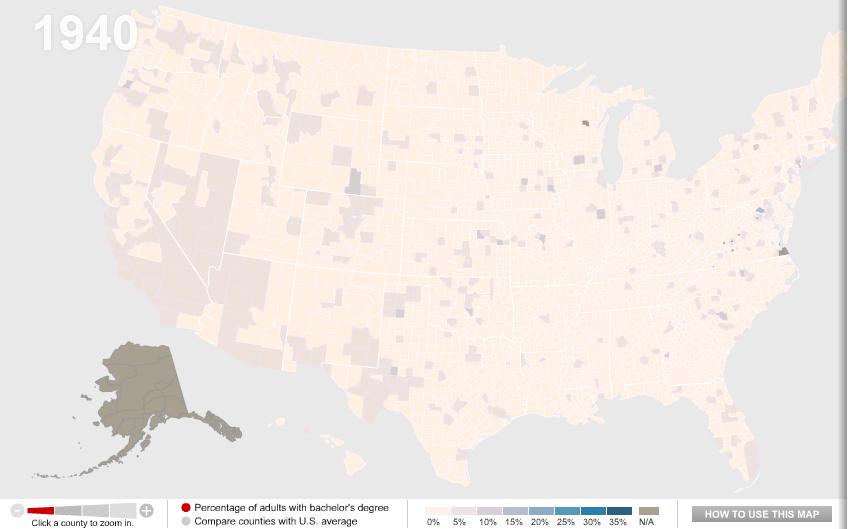
One of my colleagues, Kate Hahn, sent me a link to an interactive map at The Chronicle of Higher Education website that presents data on the proportion of U.S. adults with a bachelor’s degree over time. In 1940, in the vast majority of counties no more than 10% of the population had graduated from college (the national average was 4.6%):

Now the national average is 27.5%:

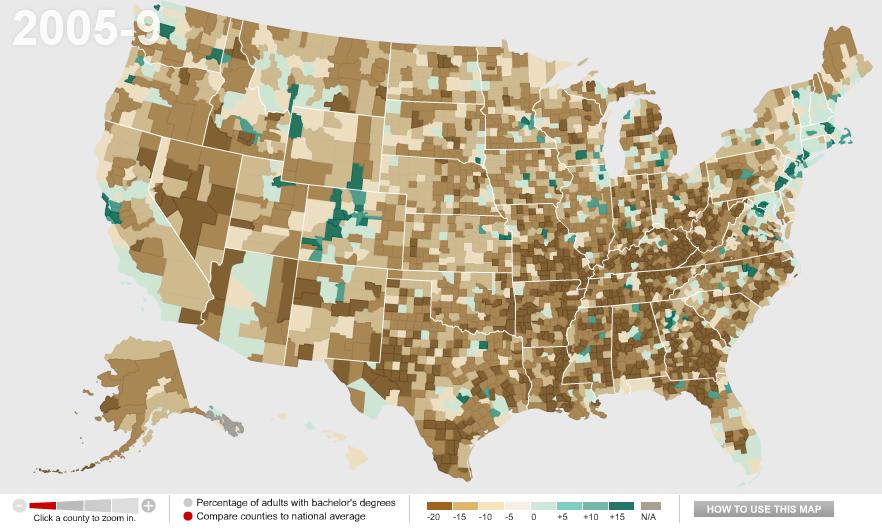
You can also compare counties to the national average. Green counties are above the national average, brown ones are below and, not surprisingly, we see clear regional variations in rates of college education, with Colorado and the Northeast doing particularly well and the South and Appalachian regions lagging:

Wealthy counties (those with a median income of $60,000+) in general have higher than average rates of bachelor’s degrees, with the exception of a few counties in the Mountain West, Alaska, and a few scattered areas:

We see the opposite with poor counties (median income under $30,000):

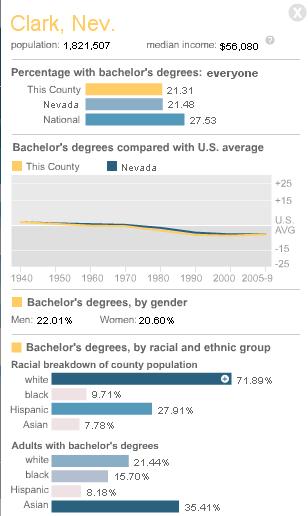
You can break down any of the comparisons by sex or race/ethnicity, and/or look only at  counties with 20% or more Hispanic or Black residents.  You can also select a particular county for more detailed information. For instance, here’s the info on Clark County, Nevada, where I live:

By comparing the maps over time, you can easily track a number of changes: the increase in college degrees overall, of course, but also changes in education such as the dramatic gains women have made in earning college degrees in the past few decades — the gender gap in college degrees was over 7 percentage points in 1980 but only about 1.5 points today.

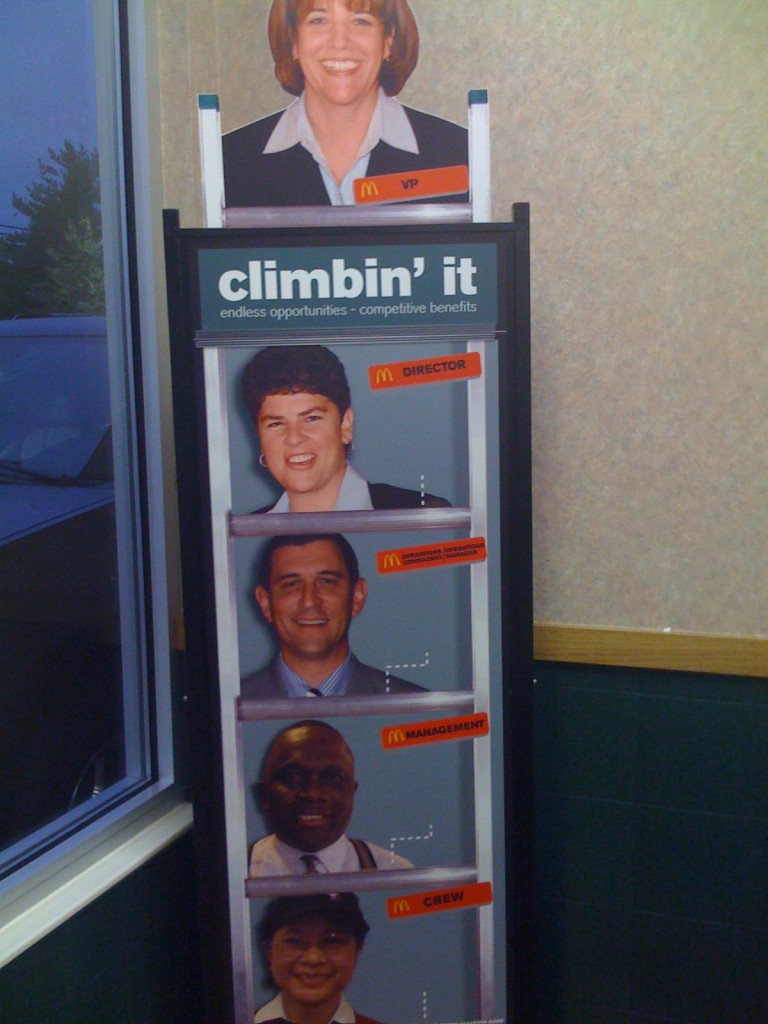
You know how sometimes you see something and you just cringe and wonder how, how, something made it into the public sphere? Paul Fidalgo, of Near Earth Object, took a photo of this display illustrating the career ladder at McDonald’s. The display provides a rather unintended commentary on race and corporate hierarchies in general:

I suppose I should be happy, as the sky appears to be the limit for White women like me on the Ladder of Whiteness.

I was doing some googling, looking for data on the racial diversity of McDonald’s employees, since the company has touted itself as a leader in providing career opportunities to women and underrepresented minorities. I’m always surprised how corporations that carefully guard their brand in other ways, and talk about diversity issues, often seem to drop the ball when it comes to thinking about the cultural politics of representations of race and ethnicity in their materials.

[UPDATE: A number of commenters argue that McDonald’s has a better record on promoting women and minorities than most corporations. I’m not trying to argue there that they don’t — I was trying to find some data on their employees because I’ve also heard they stand out, as far as corporate America goes. That’s why I found the display surprising, as opposed to perhaps predictable.]

So anyway, my online search led me to 365Black, the website McDonald’s set up to appeal to African Americans:

Ok…uh, sure. Just exactly like the baobab tree.

I’d seen 365Black before — readers have sent it in, and we just couldn’t think of much to say so we’ve never posted about it. But then my googling took me to MeEncanta, the McDonald’s page for the Latino community. They offer this sticker (i.e., instruct you to download the image and print it on sticky-backed paper) to show off your Latin pride:

Alrighty…

And finally I arrived at Myinspirasian, which targets Asian Americans. On the page about Asian Pacific American Heritage Month they include information about contributions by Asian Pacific Americans, such as this:

Multimedia creations inspired by Asian Pacific Americans are the latest rage among kids, teens and young adults of all ages. The multimedia creations offer a variety of the trendiest ways to receive news, information, entertainment and services using the worldwide web.

No specifics are given, so you’ll have to figure out what these mysterious “multimedia creations” are. Also, “they have become household names in a host of sporting activities,” though apparently not the type of household names where McDonald’s could actually name one. The entire section is similarly vapid, completely lacking in anything other than non-specific statements that Asian Pacific Americans have, like, done stuff, and things. It reminded me of some of the very superficial celebrations of Black History Month we’ve seen.

But if you want, you can take the Asian Phrases Challenge, where you can hear various phrases spoken in either Mandarin or Cantonese, Filipino/Taglish, Indian/Hinglish, or Korean:

I’m not sure what the “challenge” aspect is, since it doesn’t do anything but play the phrases.

I just…I don’t know. You decide to make webpages entirely devoted to a particular demographic and this is the best you can do? And do these types of marketing projects actually work?

———————–

For more, see our previous post showing how people of color are subordinated visually in advertising materials.

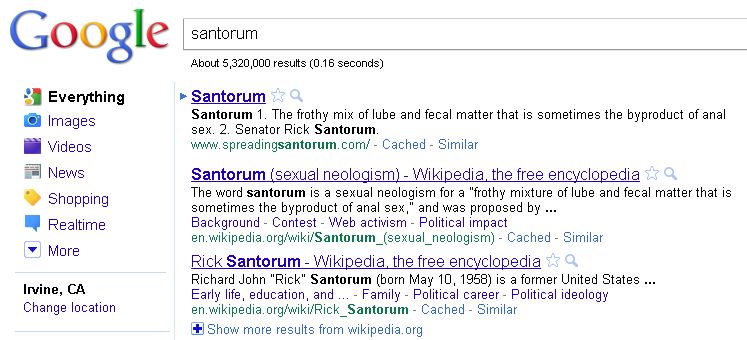
On the February 21, 2011 edition of The Colbert Report, there was a humorous but still telling segment (watch) about former Congressional Senator and Representative Rick Santorum (R-PA). The segment detailed the effects of Dan Savage’s appeal to readers and followers to “Google bomb” then U.S. Senator Santorum in 2003 as a response to some of Santorum’s comments about homosexuality. In April of 2003, the Senator made several controversial statements that essentially compared homosexual acts to bestiality and incest, and stated he believed such acts to be a threat to society and the institution of the family (read excerpts from the interview). Savage, author of the sex advice column “Savage Love,” appealed to his readers to come up with a definition of “Santorum” to memorialize the Senator’s comments as an act of protest.

After settling on a definition, Savage created the website Santorum to promote the newly coined sexual neologism that meant a “frothy mixture of lube and fecal matter that is sometimes the byproduct of anal sex.” Over time, and many searches later, Savage’s website is to this day at the top of the results list when you Google “Santorum.” [In a nutshell, in order to Google bomb, or to inflate the ranking of a site under a particular query, you rely on people clicking on a specific link in the search results list and you rely upon other websites linking to a particular page using a specific anchor text. In this case, other websites linked to Savage’s site using the anchor text “Santorum” and many people clicked on his site when Googling the term.]


As funny as the story is, it raises important questions about the power over discourse given the new possibilities presented by the web. Much is to be said for a crowd-sourced means of discourse. In a very general way, it can be likened to subvertising (see AdBusters) where popular advertisements are parodied or spoofed to illustratively and critically question the meaning of the original advertisements and the discourses they are selling to the consumer. In a more specific way to Santorum’s case, using a Google bomb can be likened to muckraking. Not only did Savage make a successful attempt at a large-scale practical joke, he successfully drew attention to Santorum’s comments about homosexuality. Further, the result of the Google bomb would make it difficult for Santorum to promote his own website and the discourse he would wish to produce about himself on the web, especially should he consider running for the U.S. Presidency in 2012.

Yet, each of these strategies that combat dominant narratives are traditionally produced by the few and the privileged, and the same was true of the dominant narratives. Ultimately, what I wish to highlight with this post is that the web is fostering challenges to existing power relations over the production of discourse. The Google bomb presents an interesting case for the democratization of discourse production, and it provides evidence for possible strategies of altering what discourses become visible in the mainstream.

William Yagatich is a sociology graduate student at the University of Maryland.  His post originally appeared at Cyborgology.

NEWS:

The newest Sociological Images essay to be published in Contexts magazine, The Social Control of Mothers, is now available.  The essay, drawing heavily on Elizabeth Armstrong’s book Conceiving Risk, Bearing Responsibility, explores the imperfect relationship between pregnant women’s consumption of alcohol and fetal alcohol spectrum disorders and asks whether controlling women’s behavior is really the best way to reduce the rate of these disorders. You can check out our earlier post on the topic, download the (more carefully composed) essay from Contexts, or send us a note at socimages@thesocietypages.org to ask for a copy.

Don’t forget that Sociological Images welcomes guest posts from academics and graduate students.  Please read our Guest Post Guidelines for more.

Finally, this is your monthly reminder that we’re on Twitter and Facebook.  If we’re lucky, we may just reach 10,000 friends sometime this March.  Who will be the 10,000th!?


On this last day of Black History Month, let us return to posts past.

We have been urged to celebrate Black History Month…

<sarcasm> Good times. </sarcasm>

Lisa Wade, PhD is an Associate Professor at Tulane University. She is the author of American Hookup, a book about college sexual culture; a textbook about gender; and a forthcoming introductory text: Terrible Magnificent Sociology. You can follow her on Twitter and Instagram.
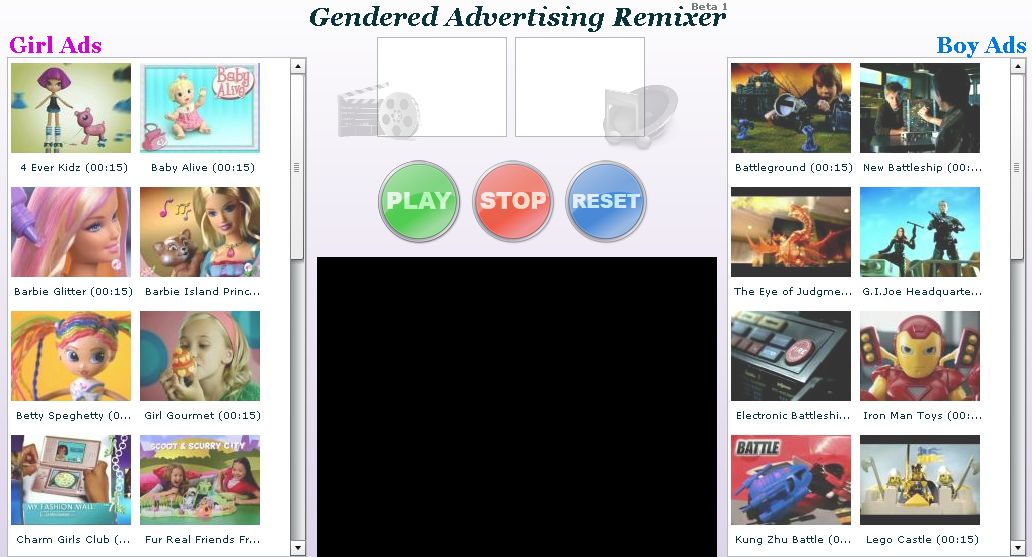
Joanna S. sent us a link to an application designed by Jonathan McIntosh where one can “re-mix” toy commercials aimed at boys versus girls.  You choose the visuals of one and the sounds of another, and have fun watching the wackiness.  We can’t embed the fun results, but you might enjoy visiting and playing a few for fun.

Lisa Wade, PhD is an Associate Professor at Tulane University. She is the author of American Hookup, a book about college sexual culture; a textbook about gender; and a forthcoming introductory text: Terrible Magnificent Sociology. You can follow her on Twitter and Instagram.