Search results for The

In an earlier post, I discussed growing trends of body modification as illustrative of the new cyborg body. Although it is debatable whether these trends are in fact “new,” (after all, various indigenous cultures have been practicing body modification long before European colonists began taking note of it in their travel diaries), I would like to continue this conversation by looking at one subculture of body modification: tattooing.

As an avid “tattoo collector” myself, I have spent the past few years attending tattoo conventions, hanging out with tattooers, and getting heavily tattooed, all while working on my research regarding the popularization of tattooing. What I notice are changing norms regarding appropriate use of the body as canvas. I would like to draw your attention to one particular trend that is growing in the tattoo subculture: facial tattoos.

What was once the purview only of convicted felons has become an increasingly normative way of expressing one’s commitment to the subculture. (For a case in point, simply Google “facial tattoos” and see what pops up.) What I notice from my interviews and discussions with tattooers and clients alike is a sharp disparity between those who see the face as a legitimate space for artistic display and those who see the face as “off limits.” Traditionally, tattooers were wary of getting tattooed on “public skin” (e.g., face, hands, and neck), as employment in the industry was unpredictable and one never knew if she would need to find another job amongst the masses. Having tattoos on public skin was almost certain to prevent employment. But things may be changing.

As the tattoo industry has become somewhat of a pop culture phenomenon, and many consumers have become visibly tattooed (full sleeves, bodysuits, and the like), tattooers have begun to see the face as a legitimate space for getting tattooed. Many of the artists I have spoken with now have prominent facial tattoos, and the ones that don’t often plan on getting them (usually something small beside one or both eyes). For many, it is now the only way to differentiate themselves from tattoo collectors or other body modification enthusiasts who now sport full body suits, stretched earlobes, and other prominent modifications. Where having full sleeves once denoted one’s status as a tattoo artist – a professional in a tightly-knit and guarded community of craftsmen – now facial tattoos serve to display one’s commitment to the profession, lifestyle, and artform.  As such, facial tattoos have become a new form of (sub-)cultural capital, where those who were on the “inside” of the subculture now find themselves defending their turf from a onslaught of newcomers wanting to jump on the bandwagon.
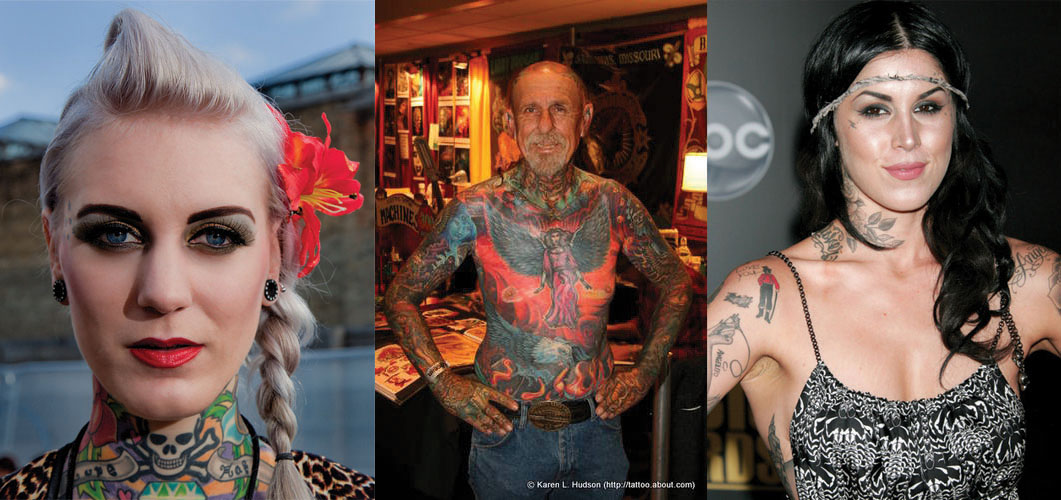
However, even among tattooers, there is a resistance to this growing trend. Many of the traditional tattooers (those who were trained long ago or received a formal apprenticeship) that I have spent time with spoke strongly against facial tattoos. In fact, most traditional tattooers refuse to tattoo clients on public skin entirely. It is simply not a part of their habitus (to borrow Bourdeiu’s terminology). This was certainly the case for the likes of Bert GrimmCharlie Barrs, or Amund Dietzel, traditional tattooers from the 40s, 50s, and 60s, as well as many other artists who were trained prior to the Tattoo Renaissance of the 70s. For the young man who walks into the tattoo shop and asks for his lover’s name emblazoned across his neck, he now has to find a “friend” in the industry who is willing to do it. Either that or he must risk receiving a poorly-rendered tattoo from a “scratcher” (someone untrained and unaffiliated with a tattoo shop, who purchased their equipment online) who will agree to do the piece at a dramatically reduced rate at a tattoo party or out of somebody’s basement.

In conclusion, as tattooing has become more popular, tattooers and those whose lives revolve around the art of tattooing must create new forms of distinction to differentiate themselves from the masses. This goes back to Bourdieu’s notion of the social field, and how forms of distinction change after the entrance of new social actors with much different forms of capital and very different habituses. Although many a Nu-Skool tattooer (those who recently joined the tattooing profession, often with art school training) sees no problem tattooing their face, hands and neck, many traditional tattooers still see it as a questionable practice and refuse to do it themselves. However, with pressure resulting from the increasing popularity of tattooing and the increasing numbers of individuals with their faces prominently tattooed, we may see an increase in traditional tattooers who choose to tattoo their face.

David Paul Strohecker is getting his PhD in Sociology at the University of Maryland. He studies cultural sociology, theory, and intersectionality. He is currently working on a larger project about the cultural history of the zombie in film.  This post originally appeared at Cyberology.

For more on Bourdieu, see our posts on The Evangelical Habitus, Dumb vs. Smart Books, and The Hipster and the Authenticity of Taste.


Squee sent in some rather odd commercials put together by the Norwegian Association of the Blind. The commercials encourage companies to hire blind individuals…by arguing that you can get away with doing things in front of, or to, blind workers because, you know, they won’t be able to tell anyway:

The message is a little strange, I think — trying to provide more employment opportunities for a group that may suffer from job discrimination by reinforcing the idea that if if someone is blind, they are completely clueless about what’s going on around them and, thus, their non-blind coworkers can act in ways that would be totally inappropriate if done to/around any other colleague.

Does that seem like an effective strategy to you?

Most of the men and women who were brought from Africa by slave traders to the U.S. lost track of what part of Africa they came from.  Africa, don’t forget, is a giant continent, comprising about 25% of the entire global dry land and including six different climate zones.  Pre-colonial Africa consisted of over 10,000 meaningful social tribes and polities.  So while we talk about “Africa” as if it’s a meaningful word, we’re describing a land mass at best and, at worst, erasing the complexity of 15% of the world’s people.  For more, see our post featuring Chimamanda Adichie on the “single story of Africa.”

Meanwhile, American Blacks — slaves and descendants of slaves — had the children of everyone from their white friends and lovers (beginning with indentured servants in early America) to the very men and women who enslaved them.  Many American blacks, then, are often perceived as essentially white when they visit Africa because their skin color is much less black those of “African” groups who never left Africa.

Enter Beyoncé.

Carly M. sent along a story about a fashion shoot for a French fashion magazine, L’Officiel Paris, in which she has her face blackened and wears a dress inspired by her “African roots.”

Beyoncé is born to an African-American father and a Creole mother; though this is not something I can confirm, her specific connection to Africa was likely cut by slave traders.  So, to refer to her African roots is to fetishize this thing-called-Africa that Americans recognize, but is a fiction in our imaginations.  And indeed, while some sort of African roots are no fiction for Beyoncé, her light skin and mixed history (Creole refers to someone of mixed African, Native American, and French ancestry) is far more American than African.

Which makes the blackening of her skin all the more interesting.  In the U.S., blackface has an ugly racist history featuring white men mocking black people, but it’s recently enjoyed a supposedly “edgy” resurgence in the fashion industry.  Yet, Beyoncé is famous in part because U.S. audiences are more tolerant of light-skinned Blacks than dark-skinned Blacks.  So what does it mean that she is appearing in blackface?

Dodai Stewart, at Jezebel, notes:

…Beyoncé’s skin looked a lot lighter in L’Oréal ads, and women like Aishwarya Rai Bachchan and Gabourey Sidibe had their faces lightened for magazine covers, and black models are so rarely seen on designers’ runways, the message we’re getting from the fashionistas is that it’s bad to actually have dark skin, but totally cool to pretend you have it.

So we have a situation in which slave traders ripped African people from their homes, landed them in the U.S., and erased their personal origins.  Then these individuals were mixed (voluntarily and not) with non-Africans, struggling to build a culture unique to American Blacks (one that the rest of us have happily appropriated again and again).  And then, in the year 2011, they appear in “African” garb and painted faces, because they’re just black enough/not black enough?*  I don’t even know.

Coverage of the photoshoot:

* Language changed from “they are dressed in”, in response to commenters, so as to not erase Beyonce’s agency here.

Lisa Wade, PhD is an Associate Professor at Tulane University. She is the author of American Hookup, a book about college sexual culture; a textbook about gender; and a forthcoming introductory text: Terrible Magnificent Sociology. You can follow her on Twitter and Instagram.

Via Shamus Khan, I found the Economic Policy Institute’s interactive graph that lets you see which Americans have earned most of the growth (or, more recently, suffered the losses) in U.S. incomes over time, based on IRS data (and reported in constant 2008 dollars):

You can select beginning and ending points and find out how incomes changed during that period and how the growth was distributed. For instance, the increase in average incomes between 1950 and 1960 were widely distributed:

If we look at the 10-year span between 1995 and 2005, the increase was much more concentrated among the very wealthy:

The data come from a study on historical income in equality in the U.S. by economists Thomas Piketty and Emmanuel Saez. They compare the share of income earned by the richest 0.1% of earners in the U.S., France, and the U.K.:

See our previous posts on Saez’s work here and here.


Duff McDuffee forwarded this clip by Hennessey Youngman. In it, he explains how to be a successful artist. The recipe is simple. Enjoy (language is NSFW):

But what if you can’t help but be black? Youngman has some advice for you too:

Youngman is pointing to the fact that, whereas white men can make unmarked art — art that is just art, not art of a particular kind — the art of people of color and women is always interpreted in light of their race or gender. Accordingly, if members of these groups want to be successful artists, they must make marked art, art that audiences recognize as the kind of art black people or women make. Further, they must perform “black artist” or “female artist” by adopting the identities that art critics expect and desire to see.

For an example of this phenomena, see our post titled What Counts as Indian Art? or our related, more extensive Contexts article by a similar name.

Lisa Wade, PhD is an Associate Professor at Tulane University. She is the author of American Hookup, a book about college sexual culture; a textbook about gender; and a forthcoming introductory text: Terrible Magnificent Sociology. You can follow her on Twitter and Instagram.

David F. sent in a fun example of public resistance to a gendered advertising message. ITA Software put up an ad on public transportation in Boston that plays on the idea of moms as particularly inept about technology. Universal Hub posted a photo taken of the ad on the Red Line, with a Post-It someone added:

Also see our earlier post on public resistance to a Pretzel Thins ad in New York.

Gwen Sharp is an associate professor of sociology at Nevada State College. You can follow her on Twitter at @gwensharpnv.

Jordan G. sent in a link to work by photographer Mark Laita.   Laita, after long working in advertising, decided that he was tired of producing images that were “nice”:

I felt the need to produce something that was raw and real, as life truly is, not just what we aspire to. The more shocking to our sense of what’s “right,” the better.

He decided to do so through contrast.   In his new photo series, he tries to get us to think by provocatively pairing portraits. They tell us stories about social class, consumption, social sacrifice, and standards of beauty.

Via BoingBoing and Turnstyle.

Lisa Wade, PhD is an Associate Professor at Tulane University. She is the author of American Hookup, a book about college sexual culture; a textbook about gender; and a forthcoming introductory text: Terrible Magnificent Sociology. You can follow her on Twitter and Instagram.

Cross-posted at Jezebel.

Carey Faulkner, a visiting Assistant Professor at Franklin & Marshall, asked us to post about a blog that has recently gotten quite a bit of attention: Born this Way.  The site posts photographs of gay-identified adults as children.  Submitters argue that the photographs are proof that they were born gay.

Perusing the photographs tells an interesting story: being gay — that is, being sexually sexually or romantically attracted to members of the same sex — is conflated with being gender non-conformist — adopting the mannerisms and interests of the other sex.  This is the argument made in the vast majority of posts: it’s obvious I was gay because I broke rules of masculinity/femininity by doing things like sniffing flowers, posing jauntily, liking Snow White, and playing with Barbie.

It is a specifically American belief that gay men act feminine and lesbians act masculine.  But, in fact, gay men and lesbians have a wide range of gender performances, as do straight and bisexual people.  In fact, most of us could probably find a picture or two in our histories showing gender non-conformity.  Meanwhile, most gay men and lesbians could probably find pictures of themselves conforming.  That gender performance is associated with sexual orientation in our society is a belief in U.S. culture, but it’s not somehow inevitable or biological.

Nevertheless, the site perpetuates this conflation in an effort to support the notion that being gay is biological.  In contrast to this assertion, however, excellent research has shown that there is no trans-cultural, trans-historical gay identity and interpretations of same-sex sexual behavior vary wildly (see, for example, Herdt’s Same Sex, Different Cultures, DeEmilio’s Capitalism and Gay Identity, and Katz’s The Invention of Heterosexuality).  And genetic, hormonal, and neurological research has thus far failed to show conclusively that being gay is biological, let alone that it is biologically determined or that it manifests in gender non-conformity.

Still, many gay men, lesbians, and their allies desperately want to prove that being gay is biological on the assumption that showing so will mean that intolerant people will be forced to accept them.  But this simply isn’t true.  People who are against homosexuality will likely just re-define their opposition.  Instead of saying that being gay is a sinful choice, they could simply argue that it is a disease, like cancer, or a deformity, like a cleft palate.  They say so already:

When an individual is not drawn to a member of the opposite sex, in biology that’s called an error.
– Dr. Laura Schlessinger

Homosexuality is a disability and if people wish to have it eliminated before they have children—because they wish to have grandchildren or for other reasons—I do not see any moral objection for using genetic engineering to limit this particular trend. It would be like correcting many other conditions such as infertility or multiple sclerosis.

– Former Chief Rabbi of the United Kingdom, Lord Jakobovits

I appreciate what Born This Way is trying to accomplish, but I don’t think that convincing people that homosexuality is biological will have the effect many hope for.  In the meantime, they’re doing everyone a disservice by perpetuating the stereotype of sissy gay men and butchy lesbians.

Lisa Wade, PhD is an Associate Professor at Tulane University. She is the author of American Hookup, a book about college sexual culture; a textbook about gender; and a forthcoming introductory text: Terrible Magnificent Sociology. You can follow her on Twitter and Instagram.