Search results for The

(source)

Many of you have probably seen the recent anti-Asian rant released by UCLA student Alexandra Wallace. In it, she says that “hordes” of Asians who are admitted to UCLA inappropriately bring their parents along and obnoxiously speak foreign languages in the library (“Oooooooh! Ching chong, ling long, ting tong!? Ooooooh!”). And she compares them to herself, the “polite, nice, American girl that my momma raised me to be.”

Okay so yes, this is what racism looks like. It’s also what sexism looks like. People who objected to Wallace’s video (as they should), often did so with sexist language, including these examples collected by Caroline Heldman for Ms. magazine:

  • “I bet her grades match her cup size.”
  • “i have big tits and gave the dean a blowjob to get into UCLA is all I hear.”
  • “EXCUSE ME WHILE I WHIP MY DICK OUT AND JERK IT TO THOSE TITS.”

But the most interesting thing I’ve heard about Wallace’s video and the response came from What Tami Said.  Tami suggested that all the shock and outrage regarding Wallace’s racism was naive, at best, and delusional, at worst.  Expressing shock, she said, may be a way to spice up a headline.  Or, it might be reflective of a belief among some that this sort of racism doesn’t exist anymore.  Or, she speculates, expressing shock may be a way for people to distance themselves from people like Wallace, a way for them to advertise the notion that they aren’t racist.

Tami’s insight is that the language of shock deserves analysis in itself.  What does it mean that we’re expressing shock when events like this on college campuses are rather routine (e.g., see “Conquistabros and Navajos,” “Compton Cookouts,” and other race-mocking parties).

In any case, she doesn’t think it’s helpful:

I get that few understand “isms” like marginalized people… But, for God’s sake pay attention! You needn’t be victim to oppression to know it exists. I submit that if you are truly shocked in the face of racism and sexism and homophobia and transphobia and other injustices, then you are as big a problem as the perpetrators of same. Because people who persist in being unaware of “isms” create an environment where ridiculous people like Amanda Wallace and, more importantly, people with far greater power and influence can conduct their bigotry unchallenged.


Lisa Wade, PhD is an Associate Professor at Tulane University. She is the author of American Hookup, a book about college sexual culture; a textbook about gender; and a forthcoming introductory text: Terrible Magnificent Sociology. You can follow her on Twitter and Instagram.

Dolores R. sent along an illustration of the nature of spurious relationships. A spurious relationship is one in which two variables appear to be related, but are in fact both caused by a third, “confounding” variable. Drawing on Andrew Sullivan’s map of passport ownership and data on Type 2 diabetes posted at the US News and World Report, Mark Frauenfelder at BoingBoing suggested, with tongue-in-cheek, that owning a passport prevents Type 2 diabetes.  In fact, both are probably related to a third variable, class: having the money to travel also usually means having access to healthy foods and sufficient health insurance.

Lisa Wade, PhD is an Associate Professor at Tulane University. She is the author of American Hookup, a book about college sexual culture; a textbook about gender; and a forthcoming introductory text: Terrible Magnificent Sociology. You can follow her on Twitter and Instagram.


A Guinness commercial borrows from the rules of masculinity to advertise its dark beer for St. Patrick’s Day:

It’s okay, but VideoJug does the man hug better.

Lisa Wade, PhD is an Associate Professor at Tulane University. She is the author of American Hookup, a book about college sexual culture; a textbook about gender; and a forthcoming introductory text: Terrible Magnificent Sociology. You can follow her on Twitter and Instagram.
Given the events in Japan and the ongoing concerns about the damaged Fukushima Daiichi nuclear reactors, I just wanted to point out that the New York Times has several very helpful images that explain the design of that type of nuclear reactor and what has happened over the last several days. The Union of Concerned Scientists has also posted several updates on their All Things Nuclear page.

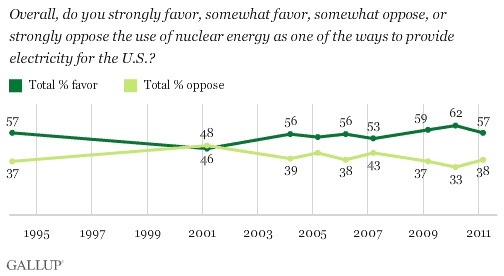
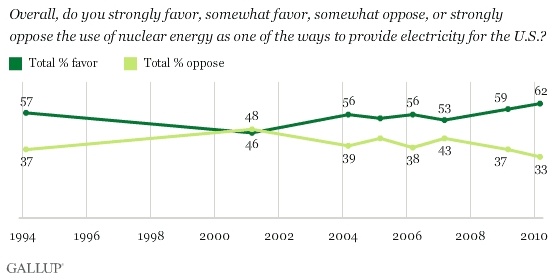
The last decade or so had shown gradually increasing public support for nuclear energy. Just a year ago a Gallup poll of 1,014 U.S. adults showed the highest level of support since they first asked about nuclear power in 1994, with 28% saying they “strongly” and 34% saying they “somewhat” favor nuclear energy:

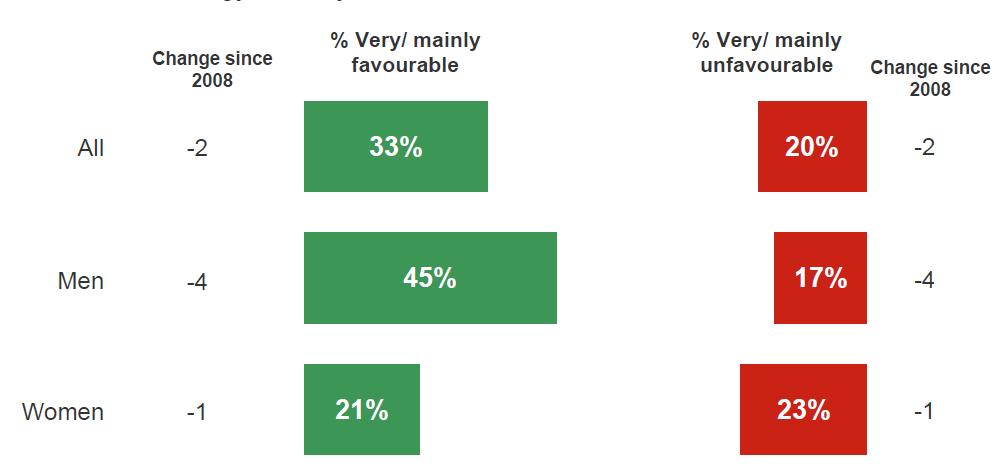
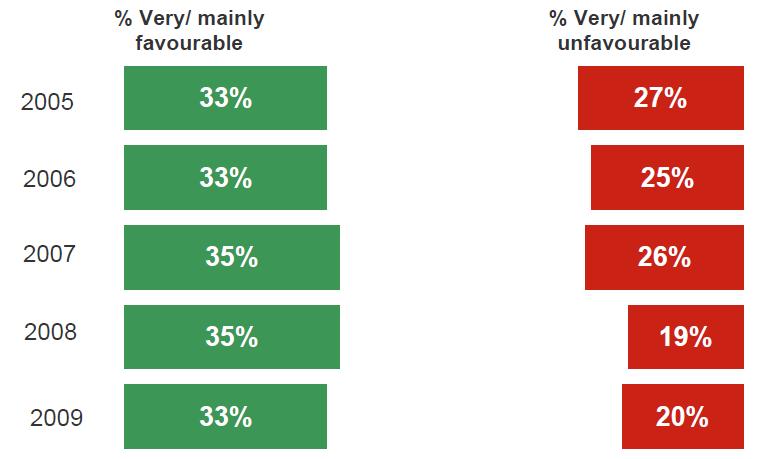
In November 2009, Ipsos MORI, a market research firm in the U.K., interviewed a representative sample of 2,050 people in Great Britain about their perceptions of the nuclear energy industry (at the request of the Nuclear Industry Association). Results of the question “How favorable or unfavorable is your opinion or impression of the nuclear energy industry?”:

Men viewed the nuclear industry more positively than women did:

Not surprisingly, the crisis in Japan has led to concerns about nuclear power in other countries; Germany, for instance, is at least temporarily shutting down all facilities built before 1980. There is likely to be increased scrutiny of older nuclear power facilities, in particular.

Sangyoub Park, an Assistant Professor of Sociology at Washburn University, sent in this map showing the location and age of reactors in the U.S. (via the U.S. Nuclear Regulatory Commission):

Though the current events in Japan would seem likely to decrease public support for nuclear energy, if the crisis at the Japanese nuclear facilities are contained with relatively little perceived harm, it’s possible we could see little long-term impact on public opinion. People might think that if a nuclear plant can be hit by an earthquake and a tsunami, suffer multiple explosions and fires, and not have a core meltdown, then they must be pretty safe. I’ll keep my eye out for polls on the subject over the next few weeks/months.

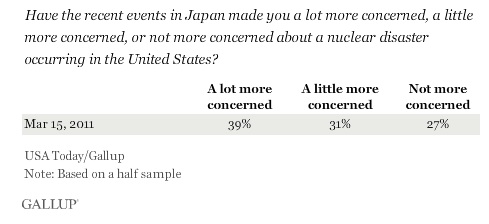
UPDATE: Sangyoub found a Gallup poll released this afternoon showing that the ongoing problems controlling the damage to nuclear reactors in Japan have increased public concerns about the possibility of a nuclear disaster in the U.S.:

This led to a dip in support for nuclear energy; the percent “somewhat” or “strongly” opposing nuclear power rose from 33% in 2010 to 38% now:

Related posts: the power of images in the environmental movement and Chernobyl, then and now.

Today, most Americans grow up in racially (and economically) segregated communities. When these same students come to college, however, many will live, work, and take courses with individuals who do not share their ethnic and class background. For many of these students, it will be the first time in their life to have any meaningful contact across difference.

Unfortunately, the racial harmony presented in recruitment materials is usually greatly exaggerated. Students of color experience daily racial microaggressions. Campus Safety officers often mistake them for non-students (at best) and trespassing criminals (at worst). Professors butcher their names and ignore them during most of the term (excluding the few days when the discussion shifts to hip-hop or colonization). White students dress up as People of Color for Halloween and numerous “themed” social gatherings (e.g., “Conquistabros and Navajos,” “Compton Cookouts,” and other race-mocking parties). Residence halls and bathroom stalls are consistently vandalized with racial epithets.

Unlike their homogeneous neighborhoods, then, college students are confronted with the reality of race every day.  Suddenly the myths of racial harmony and colorblindness are whisked away by institutional inequity, intergroup conflict, and hostile campus climates.

And on those campuses in which university leaders fail to think proactively about race, the inevitable dynamics of racism are left to be tackled by 18-24 year olds; the same 18-24 year olds who are encountering racial difference for the first time in their lives.  As the great drama of race plays out in campus newspapers, dorm rooms, classrooms, and off-campus parties. Racial identity, values, and beliefs take center stage in the minds of most students, often for the first time.

(confession borrowed from PostSecret)

Kenjus Watson is the Assistant Director of the Intergroup Dialogue Program and teaches courses in the Psychology Department at Occidental College.  He received a Masters of Education from Penn State University with an emphasis in diversity and social justice-oriented Student Affairs.  He writes about issues of race, gender, and sexuality in higher education.

The blog-o-sphere is abuzz with praise for Vivian Maier’s mid-century photographs of public New York and Chicago life.   The photos were taken by a live-in nanny working for wealthy families in Chicago’s north shore.  Her photos, over 100,000 of them, were discovered after her death two years ago.  To my untrained eye, they are gorgeous, interesting, and well-composed.  A fascinating look at another time.  More sociologically, they gracefully depict differences in socioeconomic class. I wonder if Maier, working-class herself, had a special sensitivity to these divides. In any case, I appreciate the texture that the photographs add to an understanding of how people of different classes lived.

Visit the website devoted to Maier here.  Photos borrowed from there and Chicago Magazine.  Via Crooked Timber.

Lisa Wade, PhD is an Associate Professor at Tulane University. She is the author of American Hookup, a book about college sexual culture; a textbook about gender; and a forthcoming introductory text: Terrible Magnificent Sociology. You can follow her on Twitter and Instagram.

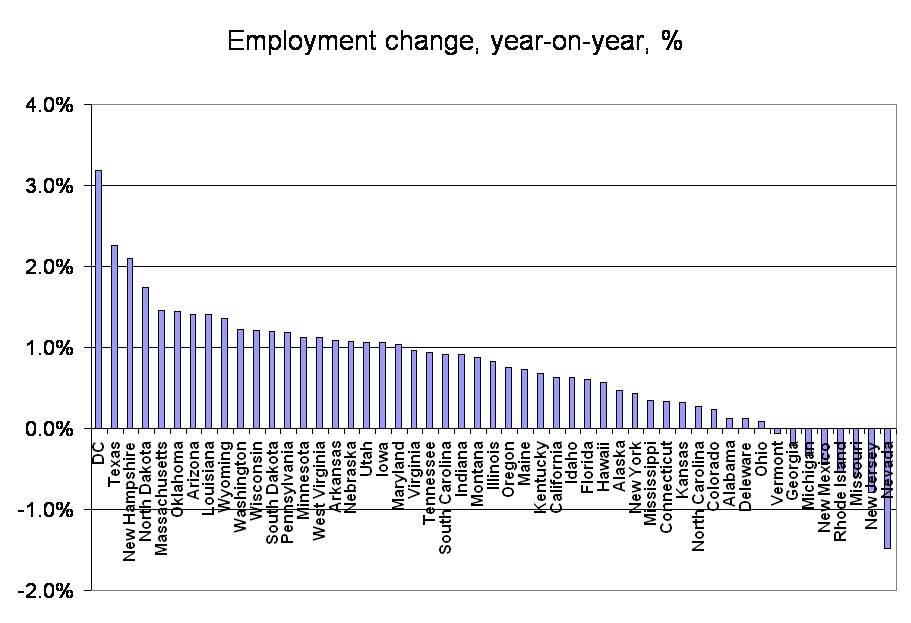
For those keeping track of unemployment in the U.S., The Economist posted this graph showing job gains and losses by state, based on Bureau of Labor Statistics data:

According to the BLS, as of January 2011, the U.S. unemployment rate had dropped to 9.0%. The lowest unemployment rate is in North Dakota, at 3.8%, while the highest is still in Nevada, at 14.2%.

The BLS has detailed state-level employment data here.


In the six-and-a-half minute video below, Feminist Frequency‘s Anita Sarkeesian makes the controversial argument that True Grit‘s Mattie Ross is not a feminist character.  Her argument revolves around an important distinction: the difference between admiring women for doing masculinity and admiring them.

Our instinct to see Ross as a feminist character comes from her performance of masculinity: she is aggressive, tough, and vengeful.  But is the valuing of masculinity feminist?  Some say no.  Instead, such detractors might argue, a true feminist perspective involves not just valorizing women who do masculinity, but coming to value femininity.  In fact, valuing masculinity over femininity might be part of the problem.  On this blog, we call this “androcentrism.”

Here’s how Sarkeesian makes the argument:

Lisa Wade, PhD is an Associate Professor at Tulane University. She is the author of American Hookup, a book about college sexual culture; a textbook about gender; and a forthcoming introductory text: Terrible Magnificent Sociology. You can follow her on Twitter and Instagram.