Search results for The

Mindy Jovanovic sent in a vintage advertisement for “Stuffed Girl’s Heads”: fake heads meant to mimic the taxidermied trophies of hunted game oh-so-popular among some types.  Mindy said, “Now I think I’ve seen it all.”
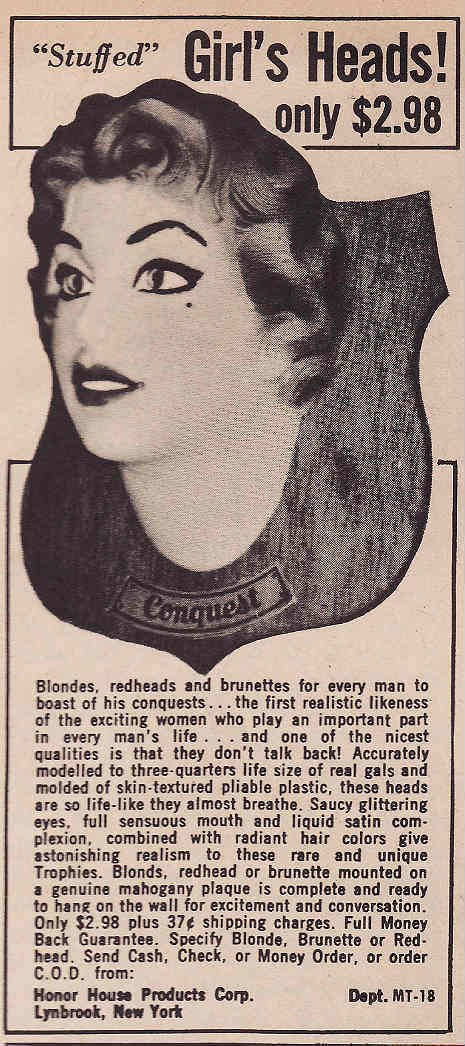
Well Mindy, I hate to disappoint you, but I think I have something even more offensive to show you: Jingle Jugs.  At least the girls have heads in this “conquest,” Jingle Jugs are just fake dancing boobs mounted on a board (hard nipples included).  And they’re not vintage.  Oh no, they’re for breast cancer awareness.

Image borrowed from Dangerous Minds.

Lisa Wade, PhD is an Associate Professor at Tulane University. She is the author of American Hookup, a book about college sexual culture; a textbook about gender; and a forthcoming introductory text: Terrible Magnificent Sociology. You can follow her on Twitter and Instagram.
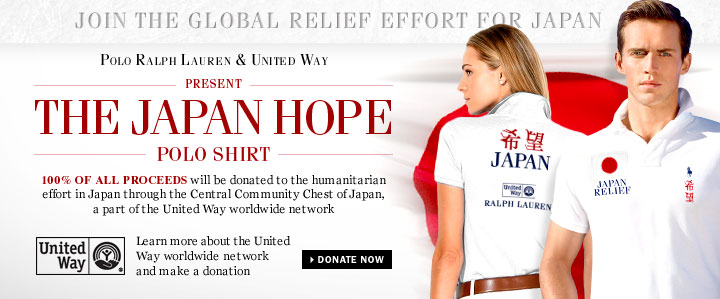
From the blog Japan Probe I discovered that Ralph Lauren has partnered with the United Way to create a line of polo shirts they’re calling Japan Hope:

The shirts range from $98-110, and the website says “100% of all proceeds” will be donated to humanitarian efforts in Japan. The site does have a link to a United Way site that lets you make donations directly, without buying a shirt. However, looking over the information about the Japan Hope shirt, I have the same concerns I often do when I see humanitarianism-through-consumption efforts. Though we’re assured that “100% of all proceeds” will be donated, nowhere could I find out what that actually adds up to. Perhaps the donation from each shirt is sizable, but it may just as well be tiny. There’s no way to know what your actual contribution to Japanese relief efforts is. If you wanted to donate $50 and you buy this shirt, have you met your donation goal?

I honestly don’t really understand the point of these types of products. If you want to help out, why not just donate directly to a group involved in relief efforts? Why the need to get something for yourself in return? Maybe I’m underestimating the draw; perhaps such gimmicks actually bring in donations (of whatever size) from individuals who otherwise wouldn’t have contributed anything at all. (If any of our readers have any direct evidence one way or the other, I would love to hear about it.)

But I would feel more comfortable with this type of consumption-based giving if the companies engaged in it clearly provided a baseline idea of what the “proceeds” would be so consumers could have some sense of the size of their contribution. Without such information, I can’t help but wonder how many people greatly overestimate the positive effects of their purchase.

For more on potential problems with buying-as-activism, see my earlier post on the ethical fix.

Oliver Noble edited a fun look at the history of product placement in American film, featured at Political Remix Video.   Among other tidbits, in this 6-and-a-half minute video, he reveals that:

  • the first known product placement was in 1919;
  • Hershey’s paid a million dollars to make Reeses Pieces a plot point in E.T. (image source);
  • movies sometimes switch up the product placed for different audiences;
  • and the record for the most product placements in a single film goes to Michael Bay’s Transformers with 47.

Fun stuff:

Lisa Wade, PhD is an Associate Professor at Tulane University. She is the author of American Hookup, a book about college sexual culture; a textbook about gender; and a forthcoming introductory text: Terrible Magnificent Sociology. You can follow her on Twitter and Instagram.

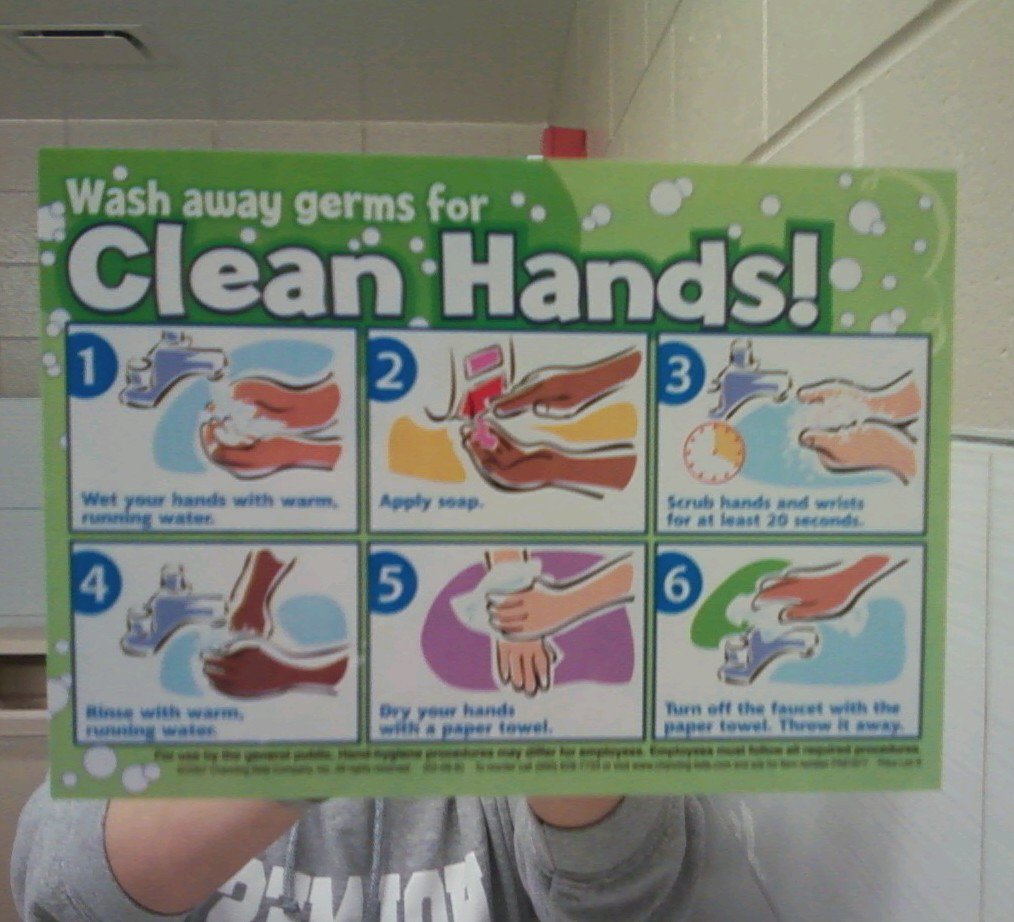
Sarah Glassman, a graduate student at Michigan State University spotted this sign in a campus dining hall restroom.  It’s a neat example of how a sign can avoid centering whiteness and instead be inclusive of people with different skin tones.

Thanks Sarah!

Lisa Wade, PhD is an Associate Professor at Tulane University. She is the author of American Hookup, a book about college sexual culture; a textbook about gender; and a forthcoming introductory text: Terrible Magnificent Sociology. You can follow her on Twitter and Instagram.
Cross-posted at Jezebel.

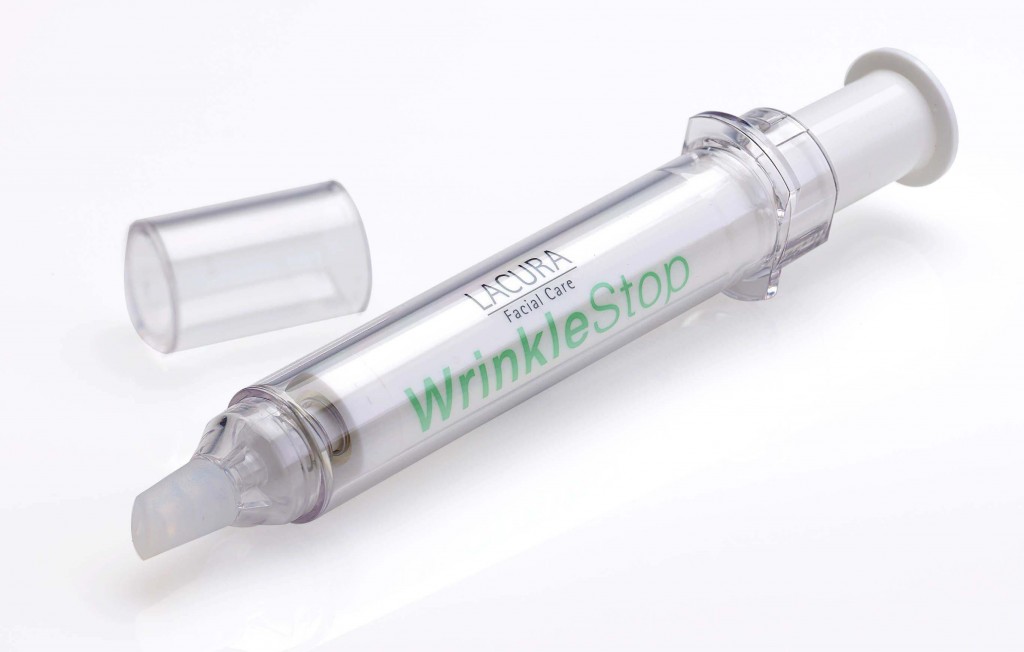
There was a time when the idea of sticking needles into one’s face was something that was to be avoided at all costs.  Then there was botox.  And it didn’t take long before certain segments of society were flocking to the needlers, begging to be stuck.  Face needling has become so commonplace — so desirable, even — that non-needly products have been disguising themselves as needles, so as to attract consumer dollars.

Of what am I speaking?  A product sent in by Ella Dilkes-Frayne.  Ella saw posters in a mall in Melbourne, Australia for non-injectable beauty products sold in containers that mimicked syringes.   The product, hoping to capitalize on the new acceptance of and desire for botox, is a great example of how socially and personally acceptable bodily intervention is always changing.

Lisa Wade, PhD is an Associate Professor at Tulane University. She is the author of American Hookup, a book about college sexual culture; a textbook about gender; and a forthcoming introductory text: Terrible Magnificent Sociology. You can follow her on Twitter and Instagram.

Way back in November David M. sent in another example of the tendency to conflate curves with women of color. This ad for a bodyshaper that appeared in the magazine i-on Glasgow (via wishiwerebaking on Flickr) says that wearing their product will give you “Latino curves,” and the code for the discount is “Latino” (which perhaps should be “Latina,” but we have much bigger issues than that to deal with).

I’m putting it after a jump because one reader said it was slightly NSFW or, more specifically, some public libraries; it’s an image of a woman in a strapless bra and body shaper, so you don’t see any nudity.

more...

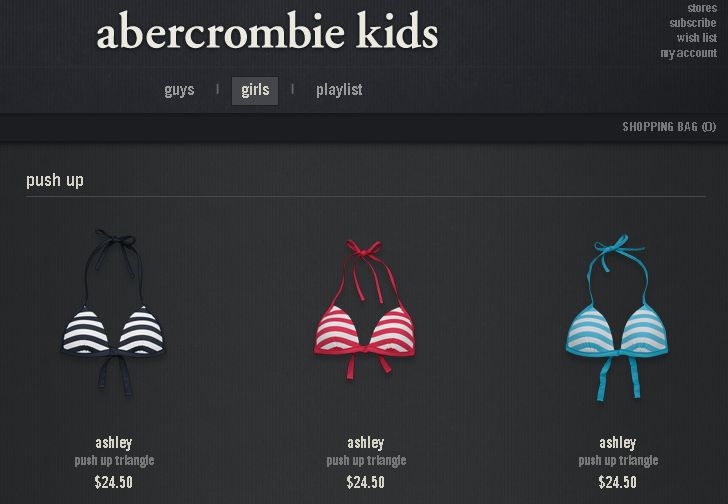
Allison K. sent in another example of the sexualization of young girls.  Abercrombie Kids is selling bikinis with “push-up” tops.  According to Wikipedia, the company markets its products at kids age 7-14. The average age of puberty is 12.   So, at what age should girls start trying to enhance their cleavage?  How old is too young?

UPDATE: In the last week this post was shared and tweeted by many of you.  News outlets took up the issue and, in response to the public pressure, Abercrombie first changed the language (taking out the phrase “push up” and just leaving “triangle”), then took the product off the site altogether.  On their Facebook page, they wrote that “We agree with those who say it is best ‘suited’ for girls age 12 and older.”

For more on the sexualization of young girls, see our posts on sexually suggestive teen brandsadultifying children of color, “trucker girl” baby booties“future trophy wife” kids’ tee, House of Dereón’s girls’ collection, 6-year-olds in French Vogue, “is modesty making a comeback?“, more sexualized clothes and toyssexist kids’ tees, a trifecta of sexualizing girls, a zebra-striped string bikini for infants, a nipple tassle t-shirt for girls, even more icky kids’ t-shirts, “are you tighter than a 5th grader?” t-shirt, the totally gross “I’m tight like spandex” girls’ t-shirt, a Halloween costume post, Toddlers and Tiaras, and girls in the World of Dance tour.

Lisa Wade, PhD is an Associate Professor at Tulane University. She is the author of American Hookup, a book about college sexual culture; a textbook about gender; and a forthcoming introductory text: Terrible Magnificent Sociology. You can follow her on Twitter and Instagram.
Cross-posted at Jezebel.

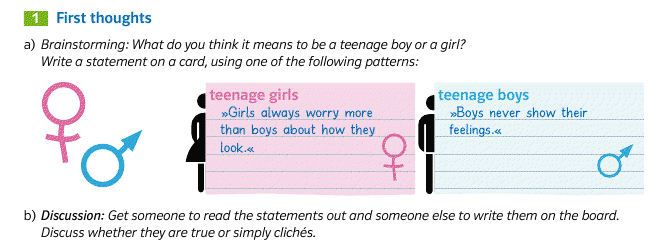
Andi S.-R. noticed an interesting segment in a German textbook used to teach English. In the last few years, 12th-grade English classes have started including a section about gender, so textbooks have added chapters on the topic. Andi found a supplement from Klett, one of the major German publishers of educational materials, provided a supplement for covering gender that included a brainstorming exercises. While the idea was to foster discussion about gender stereotypes, Andi questions whether the sample comments provided as examples would help with that goal or would prime students to focus on stereotypical behavior by providing it as a model:

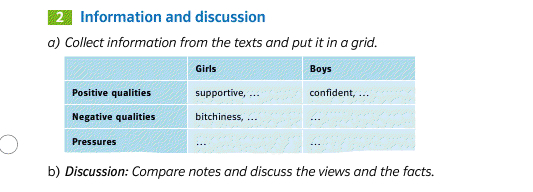
A second section helpfully suggests “bitchiness” as a quality students might associate with girls:

Again, the idea is to promote discussion, an excellent goal. But Andi succinctly points out the potential pitfalls of such a superficial approach:

…it’s unclear how students are supposed to know if these are “views” or “facts”, and having a discussion based on gut-feeling alone seems only likely to reinforce and teach as “facts” those stereotypes the students are familiar with, anyway.