Search results for The

“First, let me say that I’m tired of all of this talk about ‘snubs,'” said an anonymous member of the Academy of Motion Picture Arts and Sciences. And continued:

And as far as the accusations about the Academy being racist? Yes, most members are white males, but they are not the cast of Deliverance — they had to get into the Academy to begin with, so they’re not cretinous, snaggletoothed hillbillies.

In the video below, Jay Smooth takes on the idea that only “hillbillies” are racist and asks about the idea of the “good person” and what it actually takes to be one.

Lisa Wade, PhD is an Associate Professor at Tulane University. She is the author of American Hookup, a book about college sexual culture; a textbook about gender; and a forthcoming introductory text: Terrible Magnificent Sociology. You can follow her on Twitter and Instagram.

The United States imprisons more people than any other country. This is true whether you measure by percentage of the population or by sheer, raw numbers. If the phrase mass incarceration applies anywhere, it applies in the good ol’ U. S. of A.

It wasn’t always this way. Rates of incarceration began rising as a result of President Reagan’s “war on drugs” in the ’80s (marijuana, for example), whereby the number of people imprisoned for non-violent crimes began climbing at an alarming rate. Today, about one-in-31 adults are in prison. his is a human rights crisis for the people that are incarcerated, but its impact also echoes through the job sector, communities, families, and the hearts of children. One-in-28 school-age children — 2.7 million — have a parent in prison.

2 (1)

In a new book, Children of the Prison Boom, sociologists Christopher Wildeman and Sara Wakefield describe the impact of parental imprisonment on children: an increase in poverty, homelessness, depression, anxiety, learning disorders, behavioral problems, and interpersonal aggression. Some argue that taking parents who have committed a crime out of the family might be good for children, but the data is in. It’s not.

Parental incarceration is now included in research on Adverse Childhood Experiences and it’s particular contours include shame and stigma alongside the trauma. It has become such a large problem that Sesame Street is incorporating in their Little Children, Big Challenges series and has a webpage devoted to the issue. Try not to cry as a cast member sings “you’re not alone” and children talk about what it feels like to have a parent in prison:

Wildeman and Wakefield, alongside another sociologist who researches the issue, Kristin Turney, are interviewed for a story about the problem at The Nation. They argue that even if we start to remedy mass incarceration — something we’re not doing — we will still have to deal with the consequences. They are, Wildeman and Wakefield say, “a lost generation now coming of age.”

The subtitle of their book, Mass Incarceration and the Future of Inequality, points to how that lost generation might exacerbate the already deep race and class differences in America. At The Nation, Katy Reckdahl writes:

One in four black children born in 1990 saw their father head off to prison before they turned 14… For white children of the same age, the risk is one in thirty. For black children whose fathers didn’t finish high school, the odds are even greater: more than 50 percent have dads who were locked up by the time they turned 14…

Even well-educated black families are disproportionately affected by the incarceration boom. Wakefield and Wildeman found that black children with college-educated fathers are twice as likely to see them incarcerated as the children of white high-school dropouts.

After the Emancipation Proclamation, Jim Crow hung like a weight around the shoulders of the parents of black and brown children. After Jim Crow, the GI Bill and residential redlining strangled their chances to build wealth that they could pass down. The mass incarceration boom is just another in a long history of state policies that target black and brown people — and their children — severely inhibiting their life chances.

Hat tip Citings and Sightings. Cross-posted at Pacific Standard.

Lisa Wade, PhD is an Associate Professor at Tulane University. She is the author of American Hookup, a book about college sexual culture; a textbook about gender; and a forthcoming introductory text: Terrible Magnificent Sociology. You can follow her on Twitter and Instagram.

California’s Central Valley is a bread basket of America. It is the source of much of the country’s grapes, tree fruit, nuts, and vegetables. Many of the farms are massive, requiring large amounts of capital, land, and labor.

In the nearby small towns are the homes of the state’s farm laborers. They are primarily Latino. About half are undocumented. Most are poor and few have health care. Politically and economically weak, they are the primary human victims of pesticide drift.

Pesticide drift occurs when chemicals leave the fields for which they’re intended and travel to where humans can be exposed. According to data summarized by geographer Jill Harrison for her article on the topic, California is a pesticide-intensive state. It accounts for 2-3% of all cropland in the U.S., but uses 25% of the pesticides. One in ten of registered pesticides are prone to drift and a third include chemicals that are “highly acutely toxic” or cause cancer, reproductive or developmental disorders, or brain damage. Officially, there are an average of 370 cases of pesticide poisoning due to drift every year, but farmworker advocates say that this captures 10% of the victims at best.

Teresa DeAnda, an environmental justice advocate, stands on the dirt road between an agricultural field and her neighborhood in an image posted at Voices from the Valley.

State officials and representatives of agriculture business minimize pesticide drift; Harrison calls this “down-scaling.” They claim it’s accidental, rare, and not an integral part of the system when it operates well. “Unfortunately from time to time we have tragic accidents,” says one Health Department official. “I think the number of incidents that have occurred given the, are really not that significant…” says another. “The system works,” says an Agricultural Commissioner, “Unfortunately, we have people who don’t follow the law.” All of these tactics serve to make the problem seem small and localized.

It’s not easy to get politicians to pay attention to some of the weakest of their constituents, but activists have made some headway by what Harrison calls “pushing it up the scale.” Contesting its framing it as small problem by virtue of its frequency or impact, they argue that pesticide drift is routine, regular, and systemic. “These things happen every day,” says one resident. “You can smell [the pesticide use],” says another. “You can see it. When you drive, it gets on your windshield.” An activist argues: “The art of pesticide application is not precision delivery. It’s sloppy, and it often spills.” They further contest the downscaling by arguing that pesticide drift is harming the overall air quality. By describing it as air pollution, they make it a state of California problem, one that affects everyone. This makes it more difficult for big agriculture to say it’s no big deal.

Upscaling and downscaling are both part of the politics of scale, a tactic that involves making a problem seem big or little. Harrison notes that many environmentalists advocate a local approach. “The local,’” she writes, “is commonly touted as the space in which people can most directly voice their concerns and effect political change, due to local officials’ proximity to constituents and familiarity with local issues.” This case, though, suggests that justice isn’t one size fits all.

If you’d like to know more the struggle for environmental justice in the San Joaquin Valley, sociologist Tracy Perkins has started a website, called Voices from the Valley. You can also check out Remembering Teresa for more on pesticide drift. Cross-posted at Pacific Standard.

Lisa Wade, PhD is an Associate Professor at Tulane University. She is the author of American Hookup, a book about college sexual culture; a textbook about gender; and a forthcoming introductory text: Terrible Magnificent Sociology. You can follow her on Twitter and Instagram.

Strawberry shortcake, chocolate covered strawberries, strawberry daiquiris, strawberry ice cream, and strawberries in your cereal. Just delicious combinations of strawberries and things? Of course not.

According to an investigative report at The Guardian, in the first half of the 1900s, Americans didn’t eat nearly as many strawberries as they do now. There weren’t actually as many strawberries to eat. They’re a fragile crop, more prone than others to insects and unpredictable weather.

In the mid-1950s, though, scientists at the University of California began experimenting with a poison called chloropicrin. Originally used as a toxic gas in World War I, scientists had learned that it was quite toxic to fungus, weeds, parasites, bacteria, and insects. By the 1960s, they were soaking the soil underneath strawberries with the stuff. Nearly every strawberry field in California — a state that produces 80% of our strawberries — was being treated with chloropicrin or a related chemical, methyl bromide.

In the meantime, a major grower had collaborated with the University, creating heartier varieties of strawberries and ones that could be grown throughout the year. These developments doubled the strawberry crop. This was more strawberries than California — and the country — had ever seen. The supply now outpaced the demand.

Enter: Strawberry Shortcake.

Photo by Ghislaine flickr creative commons.

Strawberry Shortcake was invented by American Greetings, the greeting card company. She was created in cahoots with the strawberry growers association. They made a deal, just one part of a massive marketing campaign to raise the profile of the strawberry.

The head of the association at the time, Dave Riggs, aggressively marketed tie-ins with other products, too: Bisquick, Jello, Corn Flakes, and Cheerios. Cool Whip still has a strawberry on its container and its website is absolutely dotted with the fruit.

Photo by Mike Mozart flickr creative commons.

Riggs went to the most popular women’s magazines, too — Ladies’ Home Journal, Redbook, and Good Housekeeping — and provided them with recipe ideas. It was an all out strawberry assault on America.

It worked. “Today,” according to The Guardian, “Americans eat four times as many fresh strawberries as they did in the 1970s.” We think it’s because we like them, but is it?

Lisa Wade, PhD is an Associate Professor at Tulane University. She is the author of American Hookup, a book about college sexual culture; a textbook about gender; and a forthcoming introductory text: Terrible Magnificent Sociology. You can follow her on Twitter and Instagram.
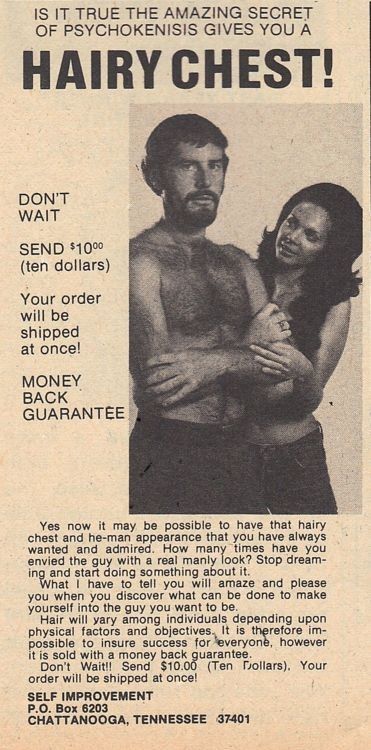
Back in the heyday of Burt Reynolds, having a hairy chest was oh-so-sexy. What a departure from the hairless chests of today’s masculine icons. At least it makes some sense to associate chest hair with masculinity, since men on average have more of it than women. It just goes to show that everything’s a social construction. But you knew that. ;)

2

Found at Cult of the Weird.

Lisa Wade, PhD is an Associate Professor at Tulane University. She is the author of American Hookup, a book about college sexual culture; a textbook about gender; and a forthcoming introductory text: Terrible Magnificent Sociology. You can follow her on Twitter and Instagram.

Pharmaceutical companies say that they need long patents that keep the price of their drugs high so that they can invest in research. But that’s not actually what they’re spending most of their money on. Instead, they’re spending more — sometimes twice as much — on advertising directly to doctors and consumers.

Data from the BBC, visualized by León Markovitz:

2“When do you cross the line from essential profits to profiteering?,” asked Dr Brian Druker, one of a group of physicians asking for price reductions.

Lisa Wade, PhD is an Associate Professor at Tulane University. She is the author of American Hookup, a book about college sexual culture; a textbook about gender; and a forthcoming introductory text: Terrible Magnificent Sociology. You can follow her on Twitter and Instagram.
The first Mardi Gras parade New Orleans was held in 1856, over 150 years ago. Today there are, by my count, sixty-eight official Mardi Gras parades in New Orleans and the vicinity. No doubt there are many more informal groups. Each is a private organization, typically still called krewes, wholly funded by its members.

In this sense, Mardi Gras in New Orleans is truly a product of locals who choose to play a role in creating its magic every year. That is, unlike other spectacles — like the city of Las Vegas or the Macy’s Thanksgiving Day Parade — Mardi Gras in New Orleans is a non-corporate holiday facilitated, but not put on by, the city or state government. Even in light of it’s oppressive past and present, it is truly one of the most purely generous, creative, and authentic things I have ever had the pleasure to observe.

Understanding why there are so many parades is part of the story.

First, krewes have traditionally been segregated by race and gender. New krewes have formed to enable the participation of excluded groups (Zulu 1909, Iris 1917) or integrate the tradition (e.g., Orpheus 1993).

Krewes have also emerged as commentary on this sort of exclusion. The Krewe of Tucks was started by two white male Loyola students in 1969. They wanted to parade as flambeaux carriers — a nod to the original form of parades in which slaves or free men of color carried flames through the streets to illuminate the floats — but were denied. No white person had ever carried the flambeaux.

Annoyed, they started their own parade aimed at mocking the whole parade tradition. Their king sits on a toilet throne and to this day they TP the city in toilet paper as they parade through the streets.

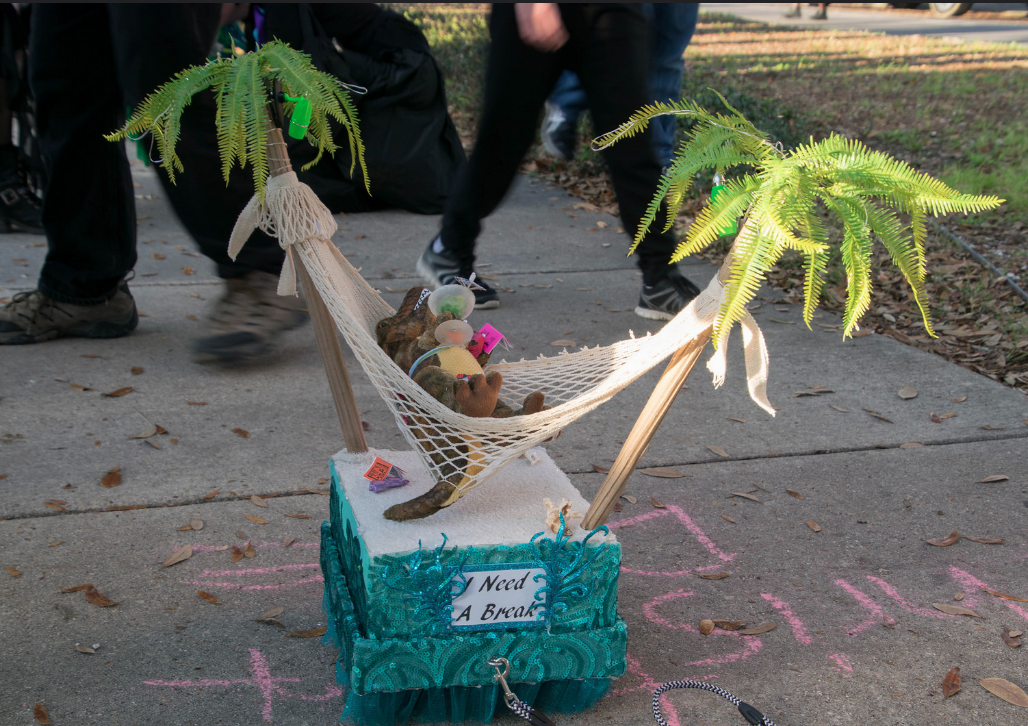
Other parades simply reflect the unending creativity and ingenuity of the people of New Orleans. Responding to the increasing grandeur of Mardi Gras floats over time, ‘tit Rex (as in “petite”) decided to go miniature. Every year, members build tiny floats on a theme and parade them through the Marigny neighborhood. The theme in 2013? “Wee the people.”

‘tit Rex:

Flickr Creative Commons, Chuck Robinson

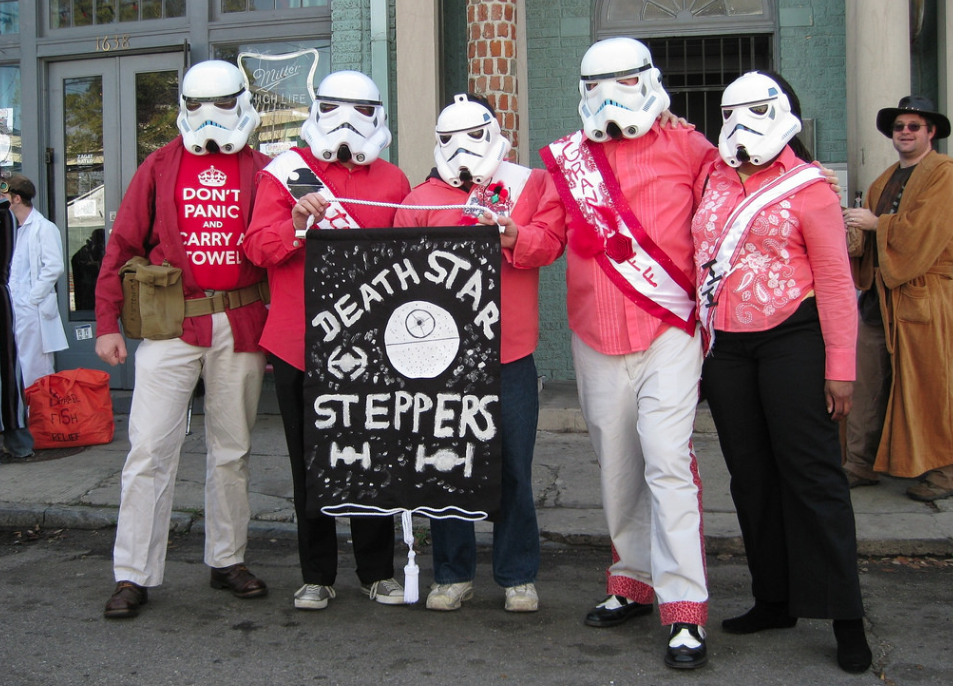
Not enough sci-fi in the super krewes? There is the Krewe of Chewbacchus — riffing off the famous Krewe of Bacchus. These BacchanAliens offer an intergalactic parade, tripping down the streets of New Orleans with a Bar-2-D2 and other creations.

Chewbacchus:


Flickr Creative Commons, C. Paul Counts

Other parades came about to serve neighborhoods or individuals who were isolated geographically or by mobility. The Krewe of Thoth (1948) was founded in order to offer a parade to the residents of 14 institutions, off the typical parade route, that served people with illnesses or disabilities, bringing Mardi Gras to those who couldn’t come to it. Other krewes emerged simply to serve neighborhoods that tourists rarely visit.

Thoth:

Images: Flickr Creative Commons, James Cage

So there are the stories of a few Mardi Gras krewes, helping to explain the bounty of parades available to enjoy in New Orleans. If you have any favorites, please add them in the comments!

Lisa Wade, PhD is an Associate Professor at Tulane University. She is the author of American Hookup, a book about college sexual culture; a textbook about gender; and a forthcoming introductory text: Terrible Magnificent Sociology. You can follow her on Twitter and Instagram.
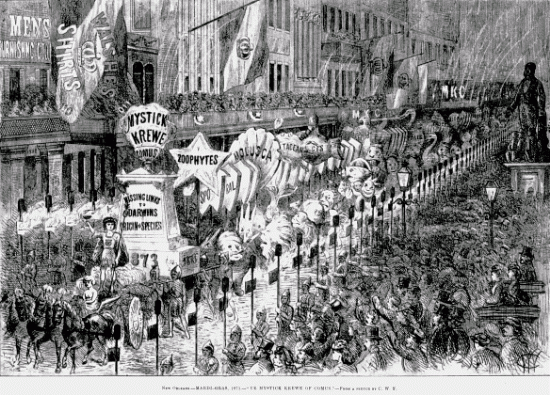
New Orleans has been celebrating Mardi Gras since the 1730s, but it took a hundred years before we began to see street processions. The first processions included carriages and maskers on horseback. The first floats appeared in 1856 with the formation of the first Mardi Gras krewe: the Mistick Krewe of Comus.

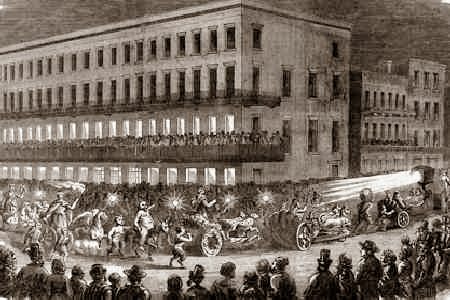
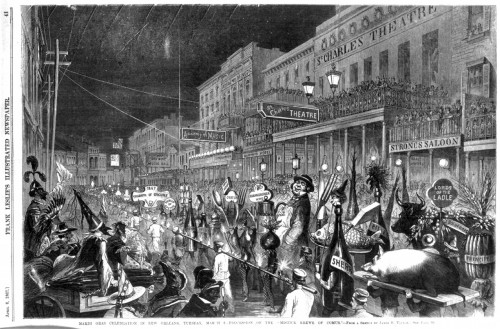
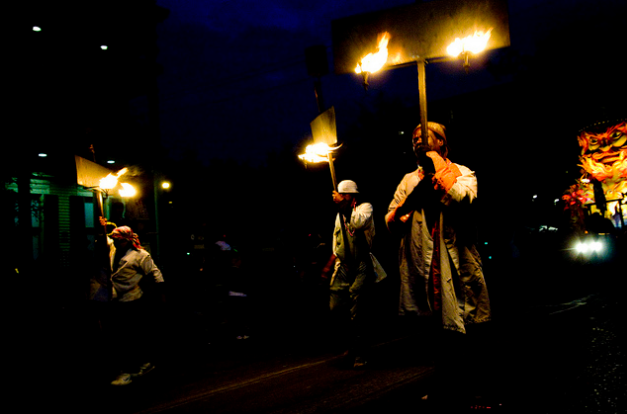
Enslaved and free men of color lit the spectacles with torches. They were called the flambeaux. Eventually, they became a spectacle in themselves, dancing for tips. In the historical engravings below from the 1850s, you can see men carrying torches among the festivities (Wikimedia Commons and the Library of Congress).
1a1b2
Today, there are still flambeaux carriers and they are still mostly black men. The tradition has been passed down through generations. In a video at nola.com, a flambeaux carrier named Herbert Long explains that he’s been carrying flame for 18 years, following “generations of [his] family.” Today they carry kerosene torches.

Photo by Derek Bridges flickr creative commons.

Unbelievably, the first white men to carry the flambeaux appeared in a parade in 1969, something I’ll talk about tomorrow. Meanwhile, the first ever all-female flambeaux troupe, the glambeaux, debuted in 2014.

Photos by Aaron Fellmeth Photography flickr creative commons.

Today, the flambeaux are a beloved part of the Mardi Gras tradition, good and bad.

Lisa Wade, PhD is an Associate Professor at Tulane University. She is the author of American Hookup, a book about college sexual culture; a textbook about gender; and a forthcoming introductory text: Terrible Magnificent Sociology. You can follow her on Twitter and Instagram.