Search results for The

Flashback Friday.

An article at Scientific American draws attention to the environmental cost of the commodification of flowers as a symbol of love.  Carolyn Wheelan writes:

[Roses] are… fragile and almost always flown to the U.S. from warmer climes in South America, where roughly 80 percent of our roses take root; to warm the hearts of European sweethearts, they are most often imported from Africa. They are then hauled in temperature-controlled trucks across the U.S. or the Continent and locked up overnight in cold boxes before their onward journey to the florists of the world… sending the roughly 100 million roses of a typical Valentine’s Day produces some 9,000 metric tons of carbon dioxide (CO2) emissions from field to U.S. florist.

When flowers aren’t shipped in to cooler climates, they must be grown in greenhouses, like the Yuzhny Greenhouse Farm in Russia pictured above.  Some flower farms take the form of vast arrays of greenhouses that use energy to maintain a microclimate out of synch with the climate in which they are situated.

The SciAm article does a good job of pointing out that not all flower farms are equal and there are lots of more and less environmentally- and socially-conscious choices.Fair trade, worker-conscious, organic, and otherwise environmentally-friendly flower companies claim to offer an alternative.  Florverde, for example, advertises its flowers as “for the earth, for the workers, for you”:

Originally posted in 2009. h/t Jezebel.

Lisa Wade, PhD is an Associate Professor at Tulane University. She is the author of American Hookup, a book about college sexual culture; a textbook about gender; and a forthcoming introductory text: Terrible Magnificent Sociology. You can follow her on Twitter and Instagram.
The day I defended my dissertation I watched Chaotic, the Britney Spears/Kevin Federline reality show, from beginning to end. True story. The next day I pulled all of the paperback classic novels from my bookshelves and donated them to Goodwill. They were mostly tattered Penguin copies of things like The Sun Also Rises and The Stranger. I was done with them.

I was the first person in my family to get a traditional college degree and those books meant a lot to me for a long time. I was an insecure student; a sufferer of the famous imposter syndrome.  The books were a signal to myself — and perhaps others, too — that I was a Smart, Educated Person with Intelligent Tastes. They were what sociologist Pierre Bourdieu would call cultural capital, objects that indicate my membership in a particular class. Both Chaotic and the purging of the books were part of the same cathartic expression: relief, incredible relief, at having not-failed. I had a new form of cultural capital now, a more powerful version of that message. I had a PhD. I could afford to toss the paperbacks.

Today, as someone who has officially “made it” in academia, I need those books even less than I did on that transitional day. And, as I’ve made the journey from nervous graduate student to tenured professor, I’ve slowly come to understand what an incredible privilege it is to carry the institutional capital that I do.

Every time I have the opportunity to admit I was wrong or confess a lack of knowledge, for example, I can do so without fear that anyone will think that I’m generally stupid or ignorant. Others assume I’m smart and knowledgeable because of the pedigree, whether I am or not. People who aren’t as lucky as I — who have the wrong accent, the wrong teeth, or the wrong clothes, and who don’t have the right degrees, jobs, and colleagues — they are at risk of being labeled as generally stupid or ignorant whenever they make an intellectual misstep, whether they are or not.

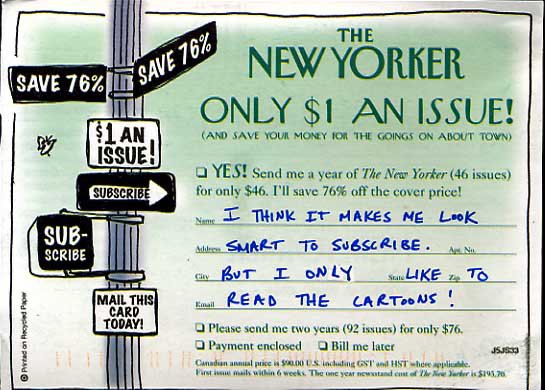
To them, that used Penguin copy of The Stranger may be more valuable than the $0.03 it costs on Amazon. In another part of the social strata, it might be worth it to pay $46 for that subscription to The New Yorker. The subscriber may only read the cartoons, but they don’t mind because, after all, that’s not really what they’re paying for.

1aImage via PostSecret. Cross-posted at Pacific Standard.

Lisa Wade, PhD is an Associate Professor at Tulane University. She is the author of American Hookup, a book about college sexual culture; a textbook about gender; and a forthcoming introductory text: Terrible Magnificent Sociology. You can follow her on Twitter and Instagram.

If it were to happen that the decision as to whether the tomato was a fruit or vegetable made it to the highest court of the land — if such a strange thing were to happen — certainly the botanist’s opinion would weigh heaviest. Right?

Nope.

In fact, this decision did make it all the way to the Supreme Court. It happened in 1893. The case was brought by a tomato importing family by the last name of Nix. At the time, the law required that taxes be collected on vegetables that were imported, but not fruit.

The lawyers for the Nix family argued that the tomato is a fruit and, therefore, exempt from taxation. They were, of course, correct. Botanists define fruit according to whether it plays a reproductive role. So, any plant product with one or more seeds is a fruit, whereas vegetables don’t have seeds. Fruits are ovaries, for lack of a better term. All other plant products — stems, roots, leaves, and some seeds — are vegetables.

But the Supreme Court said, essentially, “We don’t care” and gave their gavel a good pound. Here’s some of the text of their unanimous opinion:

Botanically speaking, tomatoes are the fruit of a vine… But in the common language of the people, whether sellers or consumers of provisions, all these are vegetables which are grown in kitchen gardens, and which, whether eaten cooked or raw, are… usually served at dinner in, with, or after the soup, fish, or meats which constitute the principal part of the repast, and not, like fruits generally, as dessert.

The judges were referring to the common understanding, which has more to do with how we use the plant products than how plants use them. Your typical chef roughly divides plant products according to whether they’re sweet or savory. Fruits are sweet. Vegetables are savory and used for main courses and sides. It’s all about whether you eat them for dinner or dessert. And that’s what the Supreme Court upheld.

Culinary vs. botanical categorization (source):

2

Since the culinary scheme dominates our colloquial understanding, we mis-classify lots of other things, too. Zucchini, bell peppers, eggplants, string beans, cucumbers, avocado, and okra — all fruit. Rhubarb is a vegetable. No seeds. Pineapples are fruits. “Ah ha!” you say, “I’ve never noticed a pineapple having seeds!” That’s because commercial growers sell us seedless pineapples. Who knew. Berries are fruit, but strawberries, blackberries, and raspberries are not actually berries. Isn’t this fun?

Bruno Latour and Steve Woolgar, in Laboratory Life: The Social Construction of Scientific Facts, wrote:

If reality means anything, it is that which “resists” the pressure of a force. … That which cannot be changed at will is what counts as real.

We often think of cultural facts as somehow less real than biological ones. For the Nix family, though, biology mattered naught. They still had to pay the damn tax on their tomatoes. Culture is real, folks. Social construction is not just something we do to reality; for all intents and purposes, it is reality.

Cross-posted at Pacific Standard.

Lisa Wade, PhD is an Associate Professor at Tulane University. She is the author of American Hookup, a book about college sexual culture; a textbook about gender; and a forthcoming introductory text: Terrible Magnificent Sociology. You can follow her on Twitter and Instagram.
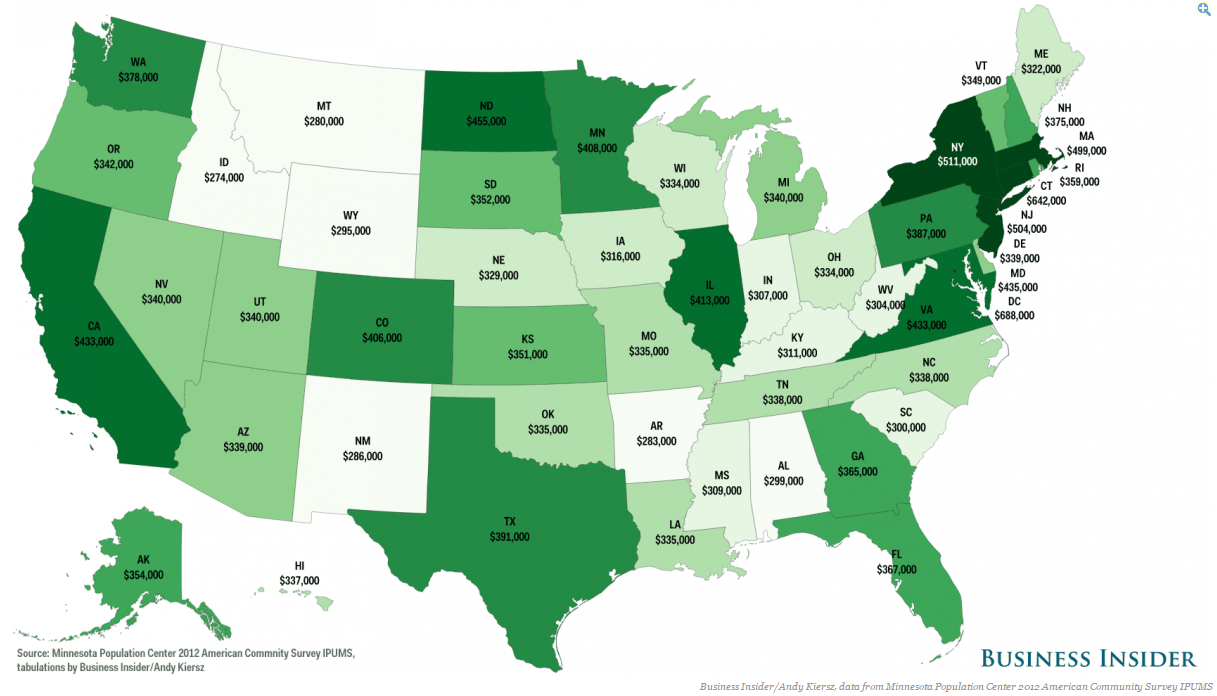
Click to enlarge:2
From Business Insider; h/t Gin and Tacos.

Lisa Wade, PhD is an Associate Professor at Tulane University. She is the author of American Hookup, a book about college sexual culture; a textbook about gender; and a forthcoming introductory text: Terrible Magnificent Sociology. You can follow her on Twitter and Instagram.

Americans have become increasingly critical of public policy as a means of addressing social problems.  Many believe that these policies don’t work; the reality is that public policies are often subverted in ways that make them ineffective or even counterproductive.

Take taxes and inequality.  As Danny Vinik, writing in the New Republic explains:

The vast majority of Americans—both liberals and conservatives—believe that state and local taxes should also be progressive. That’s the finding of a new report released by WalletHub Monday. The researchers surveyed 1,050 Americans on what they thought the combined rate of state and local taxes should be at various income levels. Not surprisingly, liberals want the rate structure to be a bit more progressive than conservatives do, but their responses [as the following chart shows] were relatively similar:

1 (3)

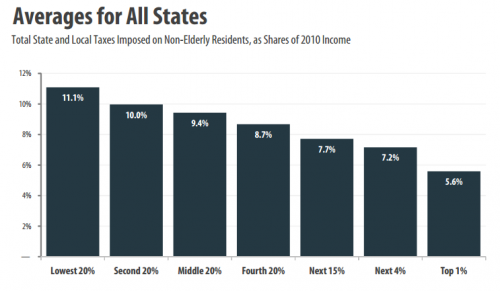
However the reality is quite different.  State and local taxes are actually quite regressive.  The Institute for Taxation and Economic Policy studied the “fairness of state and local tax systems by measuring the state and local taxes that will be paid in 2015 by different [non-elderly] income groups as a share of their incomes.”  They did this state by state and, as presented below, on an overall basis.  As we can see, the lower the income, the greater the state and local tax burden.

1 (4)

Here are some of the report’s key findings:

  • Virtually every state tax system is fundamentally unfair, taking a much greater share of income from low- and middle-income families than from wealthy families. The absence of a graduated personal income tax and overreliance on consumption taxes exacerbate this problem.
  • In the 10 states with the most regressive tax structures (the Terrible 10) the bottom 20 percent pay up to seven times as much of their income in taxes as their wealthy counterparts. Washington State is the most regressive, followed by Florida, Texas, South Dakota, Illinois, Pennsylvania, Tennessee, Arizona, Kansas, and Indiana.
  • Heavy reliance on sales and excise taxes are characteristics of the most regressive state tax systems. Six of the 10 most regressive states derive roughly half to two-thirds of their tax revenue from sales and excise taxes, compared to a national average of roughly one-third . Five of these states do not levy a broad-based personal income tax (four do not have any taxes on personal income and one state only applies its personal income tax to interest and dividends) while four have a personal income tax rate structure that is flat or virtually flat.
  • States commended as “low tax” are often high tax states for low-and middle-income families. The 10 states with the highest taxes on the poor are Arizona, Arkansas, Florida, Hawaii, Illinois, Indiana, Pennsylvania, Rhode Island, Texas, and Washington. Seven of these are also among the “terrible ten” because they are not only high tax for the poorest, but low tax for the wealthiest.

In short, we know how to construct tax policies that can lessen inequality, but we’re not using state and local taxes to do it.

Cross-posted at Reports from the Economic Front and Pacific Standard.

Martin Hart-Landsberg is a professor of economics at Lewis and Clark College. You can follow him at Reports from the Economic Front.

Flashback Friday.

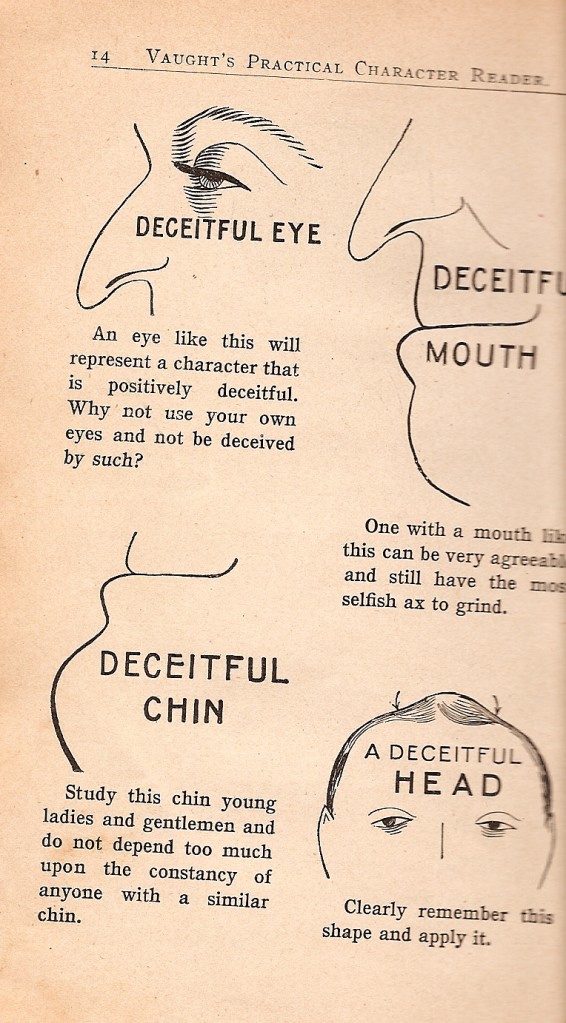
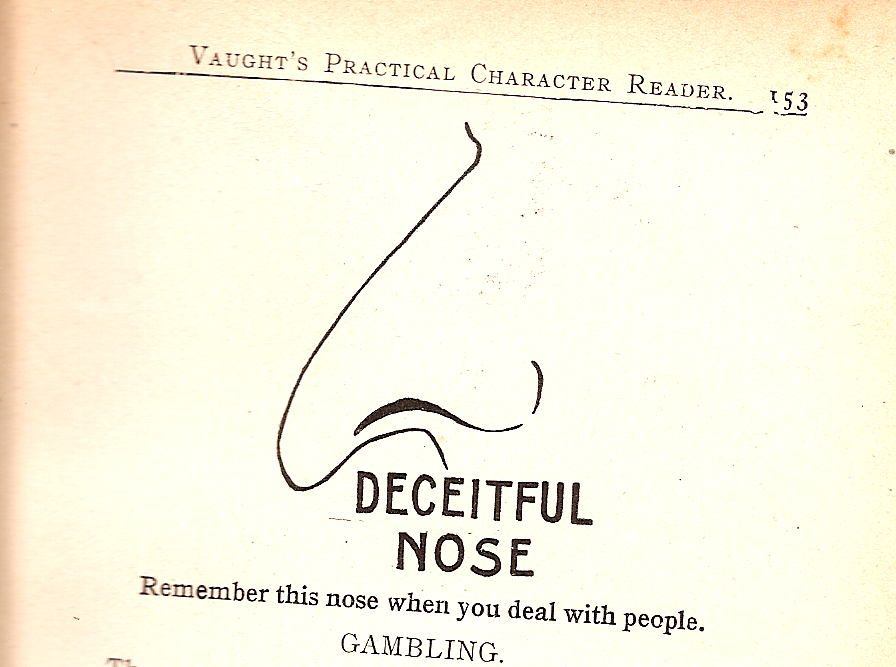
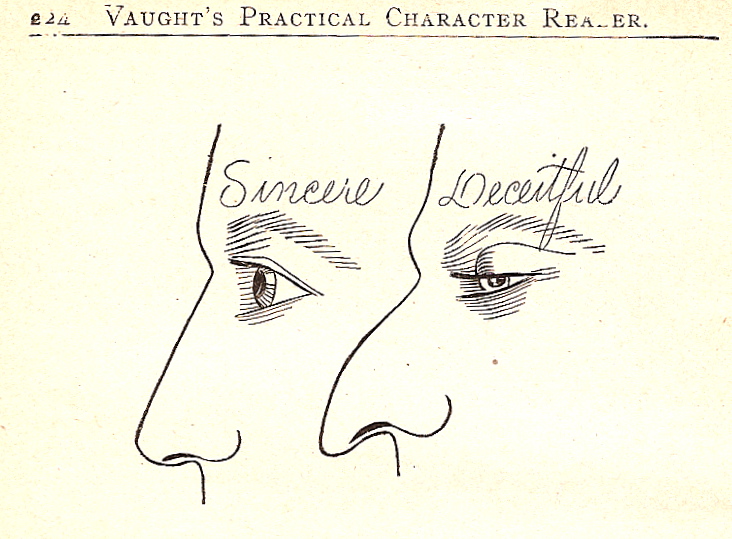
Reader Lindsey H. sent me a copy of a book called Vaught’s Practical Character Reader, apparently published in 1902 and revised in 1907 by Emily H. Vaught. Also available on Amazon. The book can best be described as an application of the theory of physiognomy, which is the idea that you can tell all kinds of things about a “person’s character or personality from their outer appearance” (wikipedia). Some images from Vaught’s book:

sc007ae911

sc007b3eec

sc007b4f96

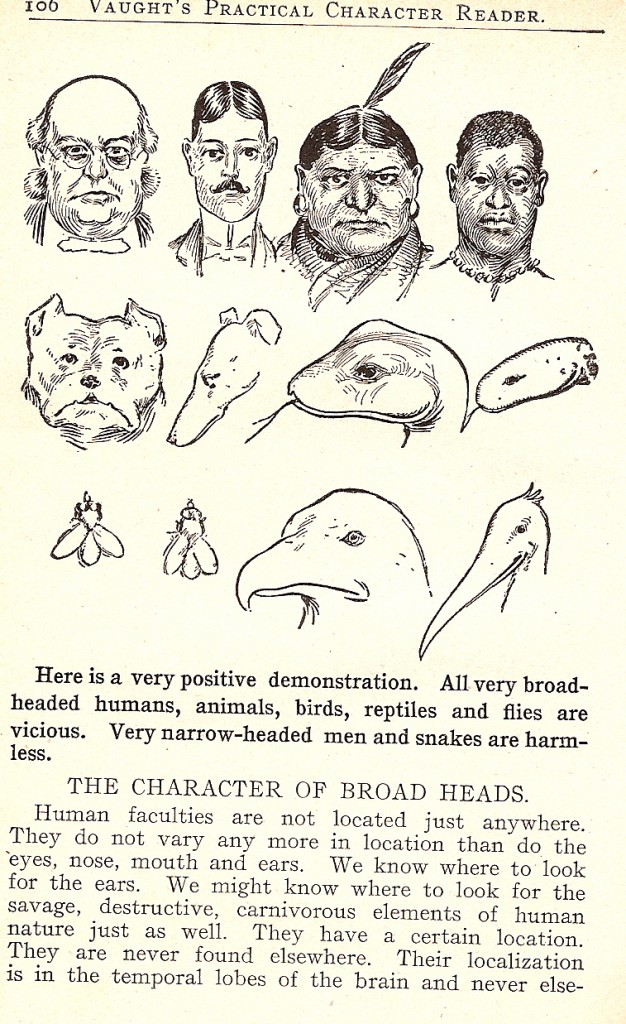
The book is full of images in which the features stereotypically associated with Northern and Western Europeans, or the mythical Aryan race, are associated with sincerity, honestly, a work ethic, and every other positive character trait, whereas large and especially hooked noses and small, hooded, or almond-shaped eyes were indications of negative traits.

Here we learn that the broadness of a person’s face tells you whether they are vicious or harmless:

sc007b25a4

The text does not explain whether the implication is that all Native Americans are vicious and all Blacks are harmless, or if these are just examples and those races would have just as much variety as we see among Whites.

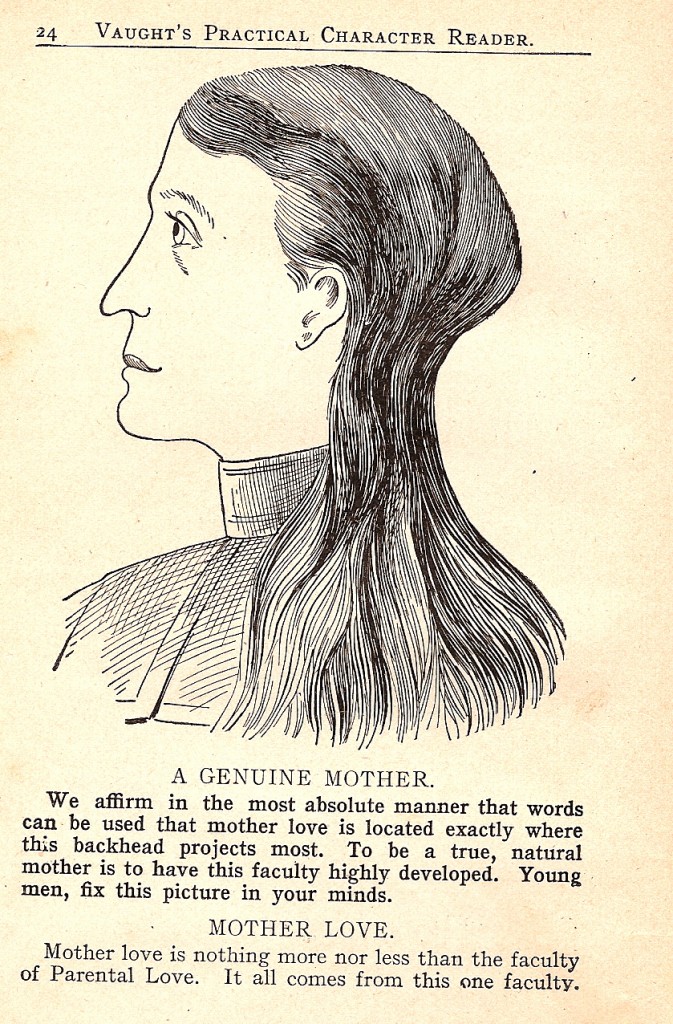
For those of you who are considering procuring yourself a wife, Vaught provides some tips on picking out a woman who will be a good mother (the same general head shape indicates a good father as well):

sc007b01f0

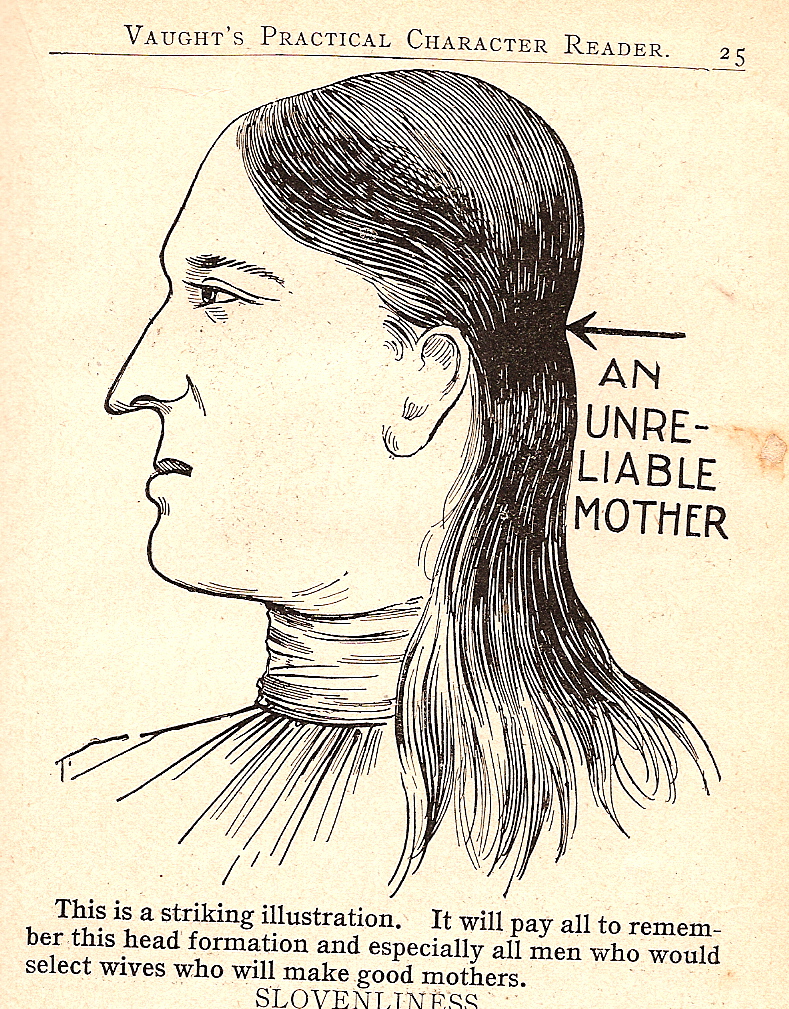
Avoid at all costs a man or woman with this head shape (notice the pointed nose, larger ears, and smaller eyes compared to the image above, in addition to the apparently super-important head protuberance):

sc007b1256

Also, based on the illustrations, apparently men who wear bowties are good fathers but those who wear neckties should arouse your suspicion. There is also a section titled “How to Pick Out a Good Child,” which I intend to take with me next time I am child shopping.

The back page advertises other books available from Vaught’s press, including Human Nature Year Book from the Human Science School and the new Text Book on Phrenology, which addresses “Heads Faces Types Races.”

I have seen examples of physignomy and phrenology before, and images of their practitioners measuring people’s heads and facial features, but I have never before seen an entire book devoted to it. These pseudosciences were taken quite seriously at the time, with “experts” showing that Africans and African Americans, for instance, had facial features that proved them to be less civilized and intelligent than those of European descent and that Jews were inherently deceitful.

Thanks a ton for sending it in, Lindsey!

Originally posted in 2009.

Gwen Sharp is an associate professor of sociology at Nevada State College. You can follow her on Twitter at @gwensharpnv.

I’m not saying that the Patriots are out-and-out liars. But they are outliers.

The advantage of an underinflated ball, like the eleven of the twelve footballs the Patriots used last Sunday, is that it’s easier to grip. Ball carriers will be less likely fumble if they’re gripping a ball they can sink their fingers into.

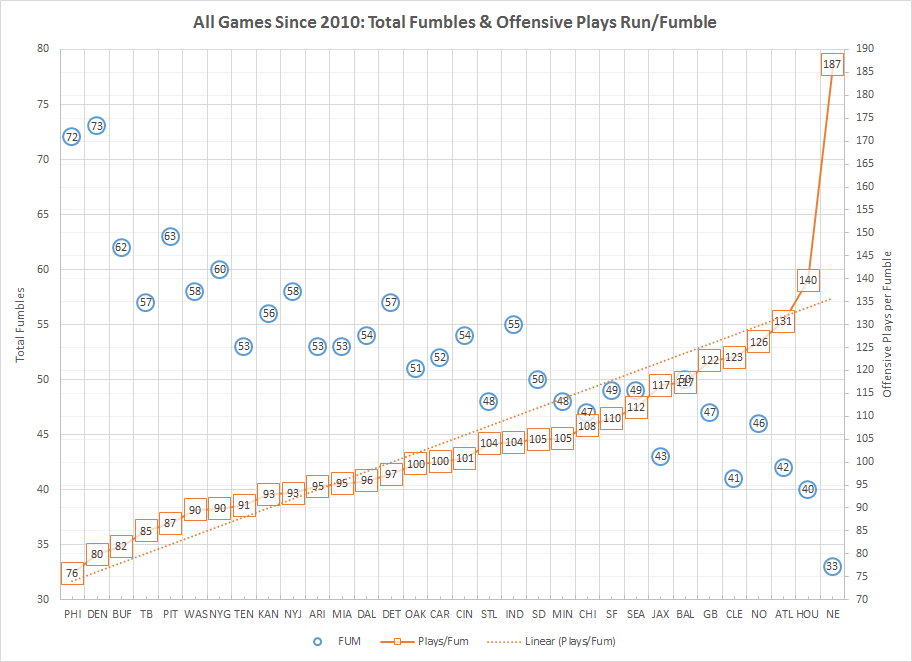
We can’t go back and measure the pressure of balls the Patriots were using before the Colts game, but Warren Sharp (here) went back and dug up the data on fumbles for all NFL games since 2010.  Since a team that controls the ball and runs more plays has more chances to fumble, Sharp graphed the ratio of plays to fumbles (values in red squares in the chart below) along with the absolute number of fumbles (values in blue circles). The higher the ratio, the less fumble-prone the team was.

1

One of these things is not like the others.  That’s what an outlier is. It’s off the charts. It’s nowhere near the trend line. Something about it is very different. The variables that might explain the differences among the other data points – better players, better weather or a domed stadium, a pass-centered offense – don’t apply. Something else is going on.

As the graph shows, when the teams are rank ordered on the plays/fumbles ratio, the difference between one team and the next higher is usually 0-2, there are only two gaps of 5 until the 9-point gap between #3 Atlanta and #2 Houston. From the second-best Texans and to the Patriots there’s a 47-point jump.

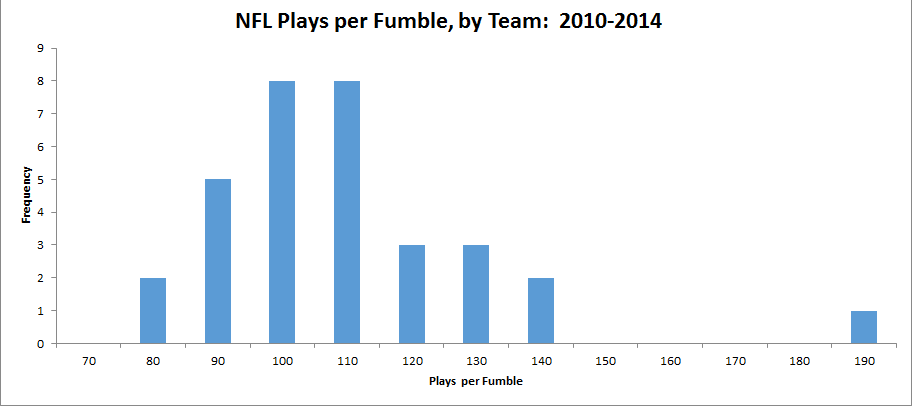
Sharp also graphed the data as a histogram.

1 (4)

It’s pretty much a bell curve centered around the mean of 105 plays-per-fumble. Except for that outlier. And the chart shows just how far out it lies.

The Patriots play in a cold-weather climate in a stadium exposed to the elements.  Yet their plays/fumble ratio is 50% higher than that of the Packers, 80% higher than the Bears. They have good players, but those players fumble less often for the Patriots than they did when they played for other NFL teams.

Usually, the statistical anomaly comes first – someone notices that US healthcare costs are double those of other nations – and then people try to come up with explanations.  In this case, it wasn’t until we had a possible explanatory variable that researchers went back and found the outlier. As Peter Sagal of “Wait, Wait, Don’t Tell Me” said, “The League became suspicious when a Patriots player scored a touchdown and instead of spiking the ball he just folded it and put it in his pocket.”

UPDATE, Jan. 28: Since I posted this, there has been some discussion of Sharp’s data (“discussion” is a euphemism – this is sports and the Internet after all). If you’re really interested in pursuing this, try Advanced Football Analytics  or this piece  at Deadspin “Why Those Statistics About The Patriots’ Fumbles Are Mostly Junk,” (to repeat, “discussion” is a euphemism, and if you more strongly voiced views, read the comments). One of the difficulties I suspect is that a fumble is a rare event. The difference between the teams with the surest grip and the most butterfingered is about one fumble every couple of games.

Cross-posted at Montclair SocioBlog.

Jay Livingston is the chair of the Sociology Department at Montclair State University. You can follow him at Montclair SocioBlog or on Twitter.

I wrote this for The Conversation. Read the original here.

Observers may be quick to declare social trends “good” or “bad” for families, but such conclusions are rarely justified. What’s good for one family – or group of families – may be bad for another. And within families, interests do not always align. Divorce is “bad” for a family in the sense of breaking it apart, but it may be beneficial, or even essential, for one or both partners or their children.

This kind of ambiguity makes it difficult to assess what kind of impact the recent recession and its aftermath had on families. But for researchers, at least, it offers a lot of job security – so many questions, so much going on. In any case, here’s where we stand so far.

The effect of the Great Recession on family trends in the United States has been dramatic with regard to birth rates and divorce, and has been strongly suggestive of family violence, but less clear for marriage and cohabitation.

Marriage rates declined, and cohabitation rates increased, but these trends were already underway, and the recession didn’t alter them much. When trends don’t change direction it’s difficult to identify an effect of a shock this broad. However, with both birth rates and divorce, clear patterns emerged.

Birth rates: a sharp drop

The most dramatic impact was on birth rates, which dropped precipitously, especially for young women, as a result of the economic crisis. How do we know? First, the timing of the fertility decline is very suggestive. After increasing steadily from the beginning of 2002 until late 2007, birth rates dropped sharply. (The decline has since slowed for some groups after 2010, but the U.S. still saw record-low birth rates for teenagers and women ages 20-24 as late as 2012.)

Second, the decline in fertility was steeper in states with greater increases in unemployment. Although we don’t have the data to determine which couple did or did not have a child in response to economic changes, this pattern supports the idea that financial concerns convinced some people to not have a child.

That interpretation is supported by the third trend: the fertility drop was more pronounced among younger women – and there was no drop at all among women over 40. That may mean the fertility decline represents births postponed by families that intend to have children later – an option older women may not have – which fits previous research on economic shocks.

It seems likely that people who are on the fence about having a baby can be swayed by perceived financial hardship or uncertainty. From research on 27 European countries, we know that people with troubled family financial situations are more likely to say they are unsure whether they will meet their stated childbearing goals – that is, economic uncertainty doesn’t change their familial aims but may increase uncertainty in whether they will be met.

However, some births delayed inevitably become births foregone. Based on the effect of unemployment on birth rates in earlier periods, it appears a substantial number of young women who postponed births will end up never having children. By one estimate, women who were in their early 20s during the Great Recession are projected to have some 400,000 fewer lifetime births and an additional 1.5% of them will never have a birth.

Divorce rates: a counter-intuitive reaction

In the case of divorce, the pattern is counter-intuitive. Although economic hardship and insecurity adds stress to relationships and increases the risk of divorce, the overall divorce rate usually drops when unemployment rates rise.

Researchers believe that, like births, people postpone divorces during economic crises because of the costs of divorcing – not just legal fees, but also housing transitions (which were especially difficult in the Great Recession) and employment disruptions.

My own research found that there was a sharp drop in the divorce rate in 2009 that can reasonably be attributed to the recession. But, as we suspect will be the case with births, there appears to have been a divorce-rate rebound in the years that followed.

Domestic violence: a spike along with joblessness

Family violence has become much less common since the 1990s. The reasons are not entirely clear, but they certainly include the overall drop in violent crime, improved response from social service and non-governmental organizations, and improvements in women’s relative economic status. However, when the recession hit there was a spike in intimate-partner violence, coinciding with the sharp rise in men’s unemployment rates (I show the trends here).

As with the other trends, it’s hard to make a case based on timing alone, but the evidence is fairly strong that the economic shock increased family stress and violence. For example, one study showed that mothers were more likely to report spanking their children in the months when consumer confidence fell. Another study found a jump in abusive head trauma cases during the recession in several regions. And there have been many anecdotal and journalist accounts of increases in family violence, emerging as early as 2009. Are these direct results of the economic stress or mere correlation? It’s hard to say for sure.

The ultimate impact of these trends on American families will likely take years to emerge. The recession may have affected the pattern of marriage in ways we don’t yet understand – how couples selected each other, who got married and who didn’t – and may create measurable group of marriages that are marked for future effects as yet unforeseen. Like the young adults who entered the labor market during the period of high unemployment and whose career trajectories will be forever altered unfavorably, how these families bear the scars cannot be predicted. Time will tell.

Philip N. Cohen is a professor of sociology at the University of Maryland, College Park. He writes the blog Family Inequality and is the author of The Family: Diversity, Inequality, and Social Change. You can follow him on Twitter or Facebook.